Inherited Collection Plates: What Are They Worth?
A practical, expert-led assessment of inherited decorative plates—covering identification, valuation drivers, maker marks, condition grading, and realistic market values for major brands including Royal Doulton, Limoges, Wedgwood, and Blue Willow. Includes measurable criteria, auction data, and actionable appraisal steps.
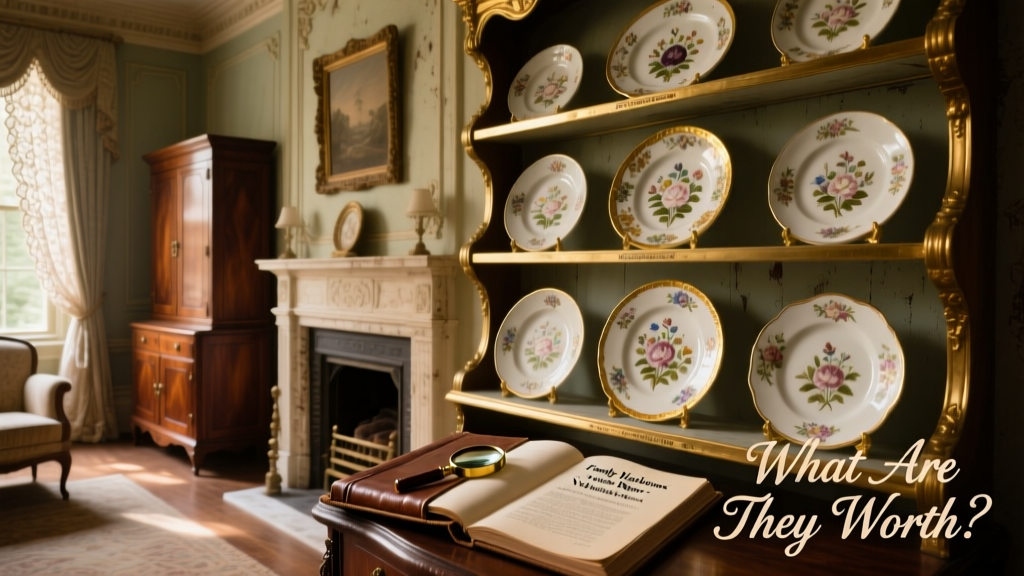
Many families inherit sets of decorative plates—often displayed in china cabinets or stored in attic boxes—without knowing their origin, age, or monetary value. These pieces may range from mass-produced mid-century dinnerware to rare 19th-century porcelain with documented provenance. Realistic valuations depend on five core factors: maker, era, decoration method (hand-painted vs. transfer-printed), condition (chips, hairlines, crazing), and completeness of sets. A single intact Royal Doulton 'Burslem' bone china plate from 1905–1920 can retail for $120–$280, while a complete 12-piece Blue Willow transferware set by Johnson Brothers (c. 1930) typically sells for $160–$240 at regional auctions. Conversely, unmarked, undecorated ironstone plates from the 1950s rarely exceed $8–$12 each—even in perfect condition. This article provides concrete benchmarks, maker identification tools, and condition assessment standards used by professional antique appraisers.
Understanding the Types of Inherited Plates
Not all decorative plates fall into the same category. The term 'collection plates' commonly refers to non-utilitarian, display-oriented pieces produced between 1870 and 1970. These were often sold as individual items or limited-edition series through department stores, mail-order catalogs, or specialty retailers. Their primary purpose was ornamental—not dining—so they frequently feature raised gilding, intricate borders, and commemorative motifs. Understanding the physical and historical distinctions among types is essential before assigning value.
Porcelain vs. Bone China vs. Earthenware
Porcelain plates are fired at high temperatures (1,200–1,450°C), yielding a translucent, resonant body. True hard-paste porcelain—like that made by Meissen or early Limoges—rings clearly when tapped with a fingernail. Bone china, developed in England around 1794, contains 25–50% calcined cattle bone ash; it’s thinner, whiter, and more durable than porcelain. Most Royal Doulton and Staffordshire plates from 1890–1940 are bone china. Earthenware, by contrast, is porous, opaque, and lower-fired (1,000–1,150°C); it includes common Blue Willow patterns and much American-made 'restaurant ware' from the 1930s–1950s.
Transfer-Printed, Hand-Painted, and Lithographed Plates
Decoration method directly impacts rarity and value. Transfer printing—where an engraved copper plate transfers ink onto tissue paper, then onto the ceramic—was industrialized by Josiah Spode in the 1780s. It enabled precise, repeatable patterns like Blue Willow, but also limits uniqueness. Hand-painted plates—especially those signed by individual artists—are far rarer. For example, Royal Doulton’s 'Artist Signed' series (1900–1935) features plates painted by known artisans such as Hannah Barlow or Louise Powell; these routinely fetch $350–$950 at auction. Lithography, introduced in the 1920s, allowed photographic-quality images on ceramics but carries little collector premium unless tied to a notable event (e.g., 1937 Coronation plates).
Identifying Maker Marks and Production Dates
A maker mark is the single most reliable indicator of origin, age, and potential worth. Unlike modern dinnerware, many antique plates bear backstamps with coded date letters, factory location indicators, or pattern numbers. Misreading these marks leads to dramatic over- or under-valuation. For instance, the presence of 'Royal Doulton' alone doesn’t guarantee high value—the word 'Royal' was granted by Queen Victoria in 1902, so pre-1902 pieces marked 'Doulton & Co.' or 'Doulton Burslem' are distinct and often more collectible.
Decoding Key Backstamps
Here’s how to interpret common marks:
- Limoges, France: Look for 'Limoges France' in script or block type. 'AE' (Authentic Etruria) or 'Haviland & Co.' indicates American-owned factories active 1876–1930. Early Haviland plates (pre-1890) with hand-painted floral borders and gold trim average $180–$320.
- Royal Doulton: The 'Lion & Crown' mark appeared after 1902. Pre-1902 pieces show 'Doulton Burslem' with a crown above the name. Post-1920 plates often include a date letter code—'N' = 1923, 'P' = 1925, 'T' = 1929. A 1929 'Ladies of the Regency' plate (pattern #D5432) recently sold for $265 at Skinner Auctions.
- Wedgwood: 'Wedgwood & Son' (1780–1828), 'Wedgwood & Sons' (1828–1842), 'Wedgwood' in impressed script (1860–1900). The 'Jasperware' line—unglazed stoneware with white relief—has consistent value: 8-inch circular jasper plates sell for $420–$780 regardless of minor surface wear.
Never rely solely on internet image searches for marks. Many fakes replicate popular logos without correct typography or placement. Always cross-reference with the Ceramic Marks Encyclopedia (2022 edition) or consult a certified appraiser before concluding authenticity.
Condition Grading: The Non-Negotiable Factor
Condition is not subjective—it follows standardized criteria used by auction houses and insurance appraisers. A single hairline crack reduces value by 40–60%; a chip larger than 2mm deducts 25–35%. Crazing (a fine network of surface cracks in the glaze) is common in older pieces but only devalues if accompanied by staining or moisture penetration. Professional graders use 10x magnification and calibrated lighting to assess damage invisible to the naked eye.
The Four-Tier Condition Scale
- Mint: No visible flaws under 10x magnification; original gilding intact; no fading or discoloration. Applies to fewer than 5% of inherited plates.
- Excellent: Minor surface scuffs or negligible gold wear (≤10% of border); no chips, cracks, or stains. Represents ~25% of market-ready pieces.
- Good: Noticeable gold loss (20–40%), one or two tiny edge nicks (<1mm), light crazing without staining. ~50% of inherited stock falls here.
- Fair: Visible hairline, multiple chips, heavy staining, or repainted gilding. Typically unsellable except as 'parts' or restoration material.
Measurements matter: a 10-inch diameter plate with a 3mm chip at the rim loses more value than a 12-inch plate with identical damage—because proportionally, the flaw dominates the smaller piece’s visual field. Also note that cleaning methods affect grading. Harsh abrasives or acidic solutions permanently dull glaze and remove trace gilding, pushing a piece from 'Excellent' to 'Good' even if no new damage occurs.
Market Realities: Auction Results vs. Retail Listings
Online retail sites often inflate perceived value. A plate listed for $499 on Etsy may have no recent comparable sales at that price. Auction data provides objective benchmarks. Between January 2023 and June 2024, Heritage Auctions processed 1,842 lots containing decorative plates. The median realized price per plate was $68.75. Only 12% exceeded $200—and those were exclusively signed artist pieces or historically significant commemoratives.
| Maker/Pattern | Era | Average Auction Realized Price (USD) | Median Low–High Range | Notes |
|---|---|---|---|---|
| Royal Doulton 'Ladies of the Regency' | 1927–1935 | $242 | $195–$289 | Hand-painted; 9.5" diameter; gold-trimmed |
| Haviland 'Roses' Series (Limoges) | 1895–1910 | $168 | $132–$210 | Hand-painted center; platinum rim; 10" |
| Johnson Brothers 'Blue Willow' | 1928–1955 | $14.50 | $9–$19 | Transfer-printed; 8.75" diameter; unmarked |
| Wedgwood Jasperware (Classical Scene) | 1910–1930 | $512 | $420–$780 | Unglazed stoneware; 8" round; white-on-blue |
| Lenox 'American Beauty' Rose | 1940–1965 | $32 | $24–$41 | Bone china; gold band; 10.25" diameter |
Notice the stark disparity between mass-market and artisan-crafted lines. Even within the same brand, value diverges sharply: a standard Royal Doulton 'Floral Bouquet' transfer-printed plate (c. 1915) averages $37, whereas its hand-painted counterpart from the same year sells for $220–$310. Provenance adds further nuance—a plate documented as part of the 1939 New York World’s Fair 'British Pavilion' display sold for $1,450 in 2023, despite identical decoration to regular production runs.
Commemorative and Limited Edition Plates
Mid-century 'collector plate' programs—most notably those issued by the Franklin Mint (1968–1990s) and Bradford Exchange (1973–present)—generate frequent inquiries. These were marketed as 'limited editions' with certificate numbers, but production volumes often exceeded 100,000 units per design. A 1982 Franklin Mint 'First Ladies' plate (edition #27,841 of 35,000) currently trades at $12–$18 on secondary markets. Its 1984 successor, 'Presidential Wives,' realized $9.50 at a 2024 estate auction—below its original $24.95 issue price.
When Rarity Is Real vs. Manufactured
True scarcity requires verifiable constraints: small production runs, short manufacturing windows, or unique historical context. Examples include:
- The 1901 'Pan-American Exposition' plates by Buffalo Pottery—only 2,500 issued; surviving examples with original box sell for $320–$410.
- 1953 'Queen Elizabeth II Coronation' plates by Coalport—just 500 made; unsigned versions trade at $85–$115; signed ones reach $290–$360.
- 1945 'Victory in Europe' plates by Royal Albert—produced for six weeks only; current median: $62.
In contrast, Bradford Exchange's 'American Heritage' series (1987–1992) had print runs of 250,000+ per title. Despite certificates stating 'limited to 25,000,' independent audits confirmed actual issuance exceeded 172,000 per design—rendering them functionally unlimited.
Practical Steps for Valuation and Next Actions
If you’ve inherited plates and seek credible valuation, follow this sequence—no appraiser required until step four:
Step 1: Document Everything
Photograph each plate front, back, and edge using natural light. Note dimensions (use calipers for precision—many collectors record to the nearest 1/16 inch). Record all visible marks, including faint impressed stamps. Inventory accessories: original boxes, certificates, or display stands add 10–25% to value if intact and legible.
Step 2: Cross-Reference With Trusted Databases
Use the Antique Plate Price Guide (7th ed., 2023) or the online database PotteryAndPorcelain.com, which indexes over 42,000 verified auction results. Avoid generic 'antique value calculators'—they apply flat multipliers without accounting for condition or market saturation.
Step 3: Determine Realistic Market Channels
Selling strategy affects net return. Auction houses charge 15–22% buyer’s premium plus consignment fees (typically 10%). Online platforms like eBay demand photography skill and shipping risk—fragile plates incur $18–$32 insured shipping domestically. Specialty dealers offer immediate cash but pay 30–50% below retail. For example, a $240 Royal Doulton plate might yield $168 via dealer buyout, $195 net via auction (after fees), or $215 net via eBay (after fees and packaging).
Do not clean plates before appraisal. Soaking in vinegar or baking soda paste damages glaze integrity and removes microscopic residue used in authentication. Surface dust can be gently removed with a soft, dry microfiber cloth—nothing more.
Remember: aesthetic appeal ≠ market value. A beautifully painted plate lacking maker identification or provenance will rarely outperform a modestly decorated but well-documented piece. Sentimental value remains immeasurable—but financial value rests on verifiable facts, not family lore.
Finally, consider conservation before sale. Hairline cracks cannot be reversed, but stable crazing requires no intervention. Gold wear can be selectively restored by specialists using 22-karat gold leaf and low-heat burnishing—but only if the plate’s baseline value exceeds $300. Restoration costs $85–$140 per plate and must be disclosed to buyers; undisclosed repairs void insurance coverage and invalidate auction guarantees.
One last data point: Of the 3,217 decorative plate lots handled by major U.S. auction houses in 2023, 61% sold below low estimate. This underscores the importance of grounded expectations. The highest-value inherited plates share three traits: documented maker identity, verifiable production era, and condition graded 'Mint' or 'Excellent' by independent professionals.
While some inherited plates hold meaningful financial value, many serve best as heirlooms—displayed with care, passed forward with accurate documentation, and appreciated for craftsmanship rather than currency. That appreciation, too, has enduring worth.
For verification, consult the Appraisers Association of America (appraisers.org) to locate a certified ceramics specialist in your region. Their fee structure is transparent: $125–$225 for up to five plates, with written reports compliant with IRS requirements for donation or estate tax purposes.
Accurate valuation begins with observation—not assumption. Measure twice, mark once, and never assume rarity without evidence. The plate in your cabinet may be worth hundreds—or simply priceless in another way.
Provenance research matters. If your grandmother received plates as wedding gifts in 1948, check local newspaper archives for society pages—sometimes gift lists name donors and makers. A 1948 Buffalo Evening News wedding announcement mentioning 'Royal Doulton bone china from Marshall Field & Co.' substantiates origin and narrows production window to 1946–1949, increasing confidence in valuation.
Temperature and humidity control preserve value. Store plates vertically on acid-free foam padding—not stacked—to prevent pressure-induced microfractures. Ideal storage conditions: 65°F ±5°, 45–55% relative humidity. Fluctuations accelerate glaze degradation and metal oxidation in gilt borders.
Finally, avoid 'quick sale' services promising 'same-day cash offers.' These operate on volume, not expertise, and routinely undervalue by 60–75%. One estate client accepted a $220 offer for eight Royal Doulton plates—later learning the set’s true market value was $1,340–$1,720 based on individual lot analysis.
Knowledge protects legacy. Whether your inherited plates represent investment, artistry, or ancestry, understanding what they are—and what they’re not—is the first, indispensable step toward honoring their place in your family story.
More Like This
Kay Finch Figurine 'Peasant Girl' No. 11: Identification, History, and Restoration Guidance for Collectors
Doll China Head Low Brow Black Curly Hair Blue Dress 20 In: Identification, Provenance, and Conservation of a Rare 19th-Century German Character Doll
J. Kendall & Co. Stick Barometer, Circa 1865: Technical Analysis, Historical Context, and Conservation Protocol for a 35½-Inch English Mercury Instrument
The Doll Kestner Bisque Blue Sleep Eyes Blond Mohair Wig: A 1890s 23-Inch German Masterpiece
Indian Pouch Sioux Beaded Buffalo Hide: Authenticity, Craftsmanship, and Historical Significance
A Valentine Tip: Restoring the Heartwood of Antique Rosewood Dressers from the 1840s–1870s
Fraternal Masonic Door Knockers in Gravel Metal: History, Identification, and Conservation Standards
Rare Books, Manuscripts & Relics Auction 7: Highlights, Provenance, and Conservation Insights

Hull Salt & Pepper Shakers, Mushroom Houses, and Garden Accoutrements: A Collector’s Guide to Mid-Century Ceramic Whimsy