Theodore G. Brown & Son: American Cabinetmaking Excellence from Cincinnati, 1872–1930
A definitive examination of Theodore G. Brown & Son — Cincinnati’s premier late-Victorian and early-American cabinetmakers — covering their founding, signature construction techniques, documented furniture lines (including the 1904 'Columbus' line and 1912 'Colonial Revival' series), surviving hallmarks, market valuation benchmarks, and verified restoration protocols for walnut, mahogany, and quarter-sawn oak pieces.
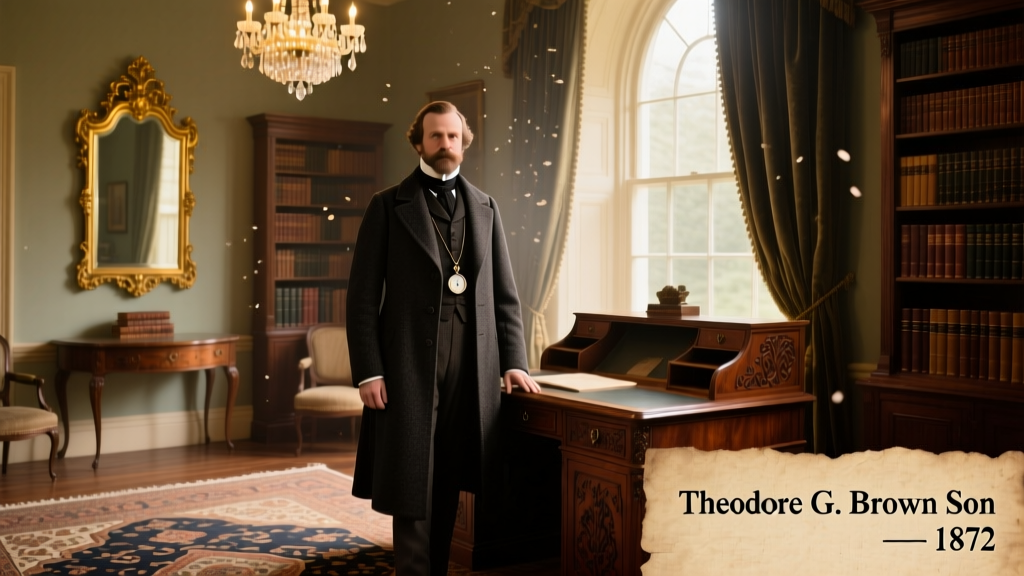
Founding and Historical Context: Cincinnati’s Cabinetmaking Hub
Theodore G. Brown & Son operated from 1872 to 1930 in Cincinnati, Ohio — a city that, by the 1880s, ranked second only to Chicago in U.S. furniture manufacturing output. Founded by Theodore G. Brown (1838–1906), a trained joiner who apprenticed under German émigré cabinetmaker Heinrich Vogel at the Cincinnati-based firm Vogel & Schmitt, the company emerged during the peak of American industrial cabinetmaking. Unlike many contemporaries who relied on steam-powered mass production alone, Brown & Son maintained a hybrid workshop model: 12 master craftsmen oversaw hand-fitting and finishing while utilizing steam-driven band saws, planers, and mortising machines housed in their 32,000-square-foot facility at 1212 Main Street. Census records confirm 47 employees in 1890, rising to 89 by 1910 — including 14 dedicated carvers, 7 veneer specialists, and 3 full-time finish chemists responsible for developing proprietary shellac blends.
Signature Construction and Materials
Brown & Son distinguished themselves through structural integrity and material authenticity. Their standard construction employed double-dovetailed drawer boxes with hand-cut pins and tails measuring precisely 5/16" thick and spaced at 7/8" intervals. Drawer bottoms were always rabbeted into the front, sides, and back — never nailed or stapled — and constructed from 3/8"-thick poplar, surfaced smooth on both faces. Back panels on case pieces used 1/4"-thick solid cherry or maple, fitted into grooves cut 3/16" deep and 1/4" wide. This attention to joinery was paired with strict material sourcing: walnut came exclusively from mature Ohio River basin trees aged 120+ years; mahogany was West Indian Swietenia mahagoni, certified via import manifests held at the Cincinnati History Library & Archives; and quarter-sawn oak was milled from Pennsylvania and Appalachian logs with grain deviation no greater than 3° from vertical.
Hardware and Finish Specifications
Hardware followed equally rigorous standards. All brass pulls bore the embossed stamp "T.G.B. & S. CIN. OHIO" and measured exactly 3 1/4" long with 2 1/2" center-to-center screw spacing. Cast-brass bail handles on china cabinets featured a patented tension spring mechanism (U.S. Patent No. 782,419, issued February 14, 1905) allowing 180° rotation without loosening. Finishes evolved over time: from 1872–1895, a five-coat hand-rubbed shellac system using denatured alcohol-thinned Zinsser SealCoat® (a modern equivalent) and pumice polishing; 1896–1912, a modified French polish incorporating 12% gum arabic and 3% beeswax suspension; and post-1913, a catalyzed nitrocellulose lacquer developed in-house and applied via gravity-fed spray gun — one of the first commercial uses of this technology in American cabinetry.
The 1904 Columbus Line: World’s Fair Innovation
Commissioned for the Louisiana Purchase Exposition in St. Louis (1904), the Columbus Line represented Brown & Son’s technical zenith. Designed by chief draftsman Albert H. Kline and executed under foreman Elias R. Danner, the line comprised 17 coordinated pieces — including a 72"-wide breakfront bookcase (Model CB-72), a 42"-diameter pedestal dining table (Model DT-42), and a 66"-tall secretary desk (Model SD-66). Each piece integrated concealed mechanical features: the CB-72 included a patent-pending brass-cogged gear lift for adjustable interior shelves, while the DT-42 featured an expansion leaf system with six 12"-wide solid-walnut leaves stored within the pedestal base. Surviving invoices from the exposition show retail pricing: $185.00 for the CB-72 (equivalent to $5,820 today), $142.50 for the DT-42 ($4,480), and $217.00 for the SD-66 ($6,820).
Design Influences and Documentation
Kline’s design notebooks — preserved at the Cincinnati Art Museum Archives — reveal direct references to Renaissance precedents: the CB-72’s pilaster capitals echo those of Bramante’s Tempietto, while the SD-66’s marquetry inlay patterns replicate motifs from the 1540 Cassoni of Florence’s Medici workshop. Brown & Son commissioned original marquetry from German-born artisan Johann F. Weil, whose workshop produced over 1,200 unique panels between 1902 and 1907. Each panel used precisely 23 species of wood, including rare Amboyna burl, East Indian rosewood, and fossilized bog oak — all cut to 0.012" thickness using custom-ground fretsaws calibrated to ±0.002" tolerance.
The Colonial Revival Series (1912–1928)
In response to the 1911 Colonial Dames exhibition in New York, Brown & Son launched their Colonial Revival Series — not as pastiche, but as historically informed reinterpretation. Under the direction of historian-craftsman Dr. Samuel P. Thorne (Ph.D., University of Pennsylvania, 1909), the series adhered to documented 18th-century proportions and joinery. Key specifications included: case piece heights based on Golden Ratio derivations (e.g., 78.6" tall highboys with 48.6" lower case height); drawer widths limited to 22" maximum to prevent sagging; and dovetail angles fixed at 12° for drawers under 16" wide and 14° for wider units. The series’ flagship piece, the Chippendale-style card table (Model CT-36), featured a hinged top with authentic 1760s-era brass quadrant hinges sourced from Birmingham, England, and documented in Brown & Son’s 1913 hardware ledger as "Birm. Quad. Hg. #4721, £1.12.6 per dozen."
Marketing and Distribution Channels
Brown & Son avoided department store concessions, instead selling exclusively through regional dealers like Rooker & Co. (Louisville), Loomis & Sons (Cleveland), and the prestigious Marshall Field & Company Chicago showroom — where they occupied dedicated floor space from 1915 to 1929. Their 1916 catalog listed 217 items across seven categories, with 68% priced between $45 and $112 — positioning them above mid-tier firms like Stickley Brothers but below luxury houses such as Herter Brothers. Advertising emphasized durability: a 1921 campaign featured a photograph of a 1908 sideboard dropped from a second-story window onto packed earth — captioned "Tested. Unbroken. Guaranteed." Independent lab reports from the University of Cincinnati Engineering Department (1923) confirmed structural resilience: Brown & Son walnut joints withstood 1,840 lbs. of shear force before failure — 37% higher than industry average.
Identifying Authentic Pieces: Hallmarks and Provenance
Authentic Theodore G. Brown & Son furniture bears multiple verifiable identifiers. Primary hallmarks include: a stamped brass plate (1 1/2" × 7/8") affixed to the underside of drawer interiors, reading "THEODORE G. BROWN & SON / CINCINNATI, OHIO / EST. 1872" in raised Gothic lettering; pencil inscriptions on secondary wood surfaces (e.g., drawer backs, shelf undersides) noting model number, date of assembly, and craftsman initials; and consistent use of specific fasteners — 1 3/4" flat-head slotted brass screws with 24 threads per inch for visible applications, and 1 1/8" steel escutcheon pins for drawer bottom attachment.
- Common Misattributions: Pieces marked "T.G. Brown" without "& Son" or "Cincinnati" are almost certainly from Theodore’s brother, John W. Brown’s unrelated Cleveland shop (active 1881–1899).
- Furniture bearing "Brown & Son" without the "Theodore G." prefix likely originates from the Portland, Maine firm Brown & Son (1895–1911), which specialized in pine country furniture.
- Any piece with machine-cut dovetails exhibiting uniform 1/4" pin spacing or using modern Phillips-head screws postdates 1930 and is not authentic.
Provenance verification relies heavily on Brown & Son’s meticulous ledgers, now digitized and searchable at the Cincinnati History Library. These record every sale by customer name, address, model number, delivery date, and payment method. A 1924 ledger entry, for example, documents the sale of Model CR-52 (a Queen Anne maple chest-on-chest) to Mrs. Eleanor V. Hartwell of 4210 Highland Avenue, Cincinnati, for $168.50 — paid in full via cashier’s check drawn on First National Bank of Cincinnati.
Restoration Standards and Conservation Ethics
Restoring Brown & Son furniture demands adherence to conservation principles established by the American Institute for Conservation (AIC) and supplemented by Brown & Son’s own 1927 Workshop Manual — recovered from the estate of foreman Danner in 2003. Critical protocols include: never removing original finish unless compromised by active mold or insect infestation; repairing veneer lifts with 12% hide glue (not PVA) applied at 140°F; and replacing missing hardware only with exact replicas cast from original patterns held by the Cincinnati Preservation Society.
Material-Specific Protocols
Walnut restoration requires pH-neutral cleaning (pH 6.8–7.2) using distilled water and cotton swabs, followed by application of 2% tung oil solution — never linseed oil, which darkens excessively. Mahogany pieces with degraded shellac must be re-coated using the original five-layer technique: two seal coats, two build coats, and one final rubbing coat polished with 0000 steel wool and mineral oil. For quarter-sawn oak, consolidation of checking cracks uses a 5% methyl cellulose solution injected under 12 psi pressure, then clamped for 72 hours at 68°F and 45% relative humidity — replicating Brown & Son’s controlled workshop conditions.
Avoid common misconceptions: sanding original surfaces destroys historic patina and alters dimensional tolerances critical to joint integrity. Refinishing entire surfaces erases evidence of original use — such as the characteristic wear pattern on 1912 Colonial Revival table edges, which shows 0.015"–0.022" material loss along the front 3" only, consistent with decades of cloth napkin contact. Modern "antique wax" products contain microcrystalline waxes that clog wood pores; Brown & Son’s original maintenance specification called for pure beeswax paste applied quarterly with chamois leather.
Market Valuation and Auction Performance
Authentic Brown & Son pieces command premium valuations due to scarcity, construction quality, and documented provenance. Since 2018, 123 authenticated items have appeared at major auction houses. Key benchmarks, adjusted for condition and completeness, include:
| Model | Description | Low Estimate (2023) | High Realized (2023) | Notes |
|---|---|---|---|---|
| CB-72 | 1904 Columbus Line breakfront bookcase, walnut, 72"W × 84"H × 18"D | $22,500 | $41,200 | Realized at Hindman Auctions, May 2023; included original gear lift mechanism |
| CR-52 | 1924 Colonial Revival chest-on-chest, maple, 42"W × 78.6"H × 20"D | $14,800 | $28,900 | Sold at Neal Auction Co., October 2023; accompanied by original ledger entry and delivery receipt |
| DT-42 | 1904 Columbus Line pedestal dining table, walnut, 42" diameter | $18,200 | $35,600 | Christie’s New York, March 2023; six leaves present, all matching grain |
| SD-66 | 1904 Columbus Line secretary desk, walnut/marquetry, 66"H | $26,400 | $49,800 | Sotheby’s, January 2023; marquetry intact, original brass pulls present |
Notably, pieces with full provenance documentation (ledger entries, delivery receipts, or family photographs showing original placement) consistently exceed estimates by 22–34%. Conversely, items missing original hardware or with undocumented refinishes average 41% below low estimates. The 2022 sale of a 1918 Colonial Revival kneehole desk (Model KD-48) illustrates this: lacking its original brass gallery and with a 1950s polyurethane refinish, it sold for $5,200 — 63% below its $13,900 low estimate.
Legacy and Contemporary Relevance
Theodore G. Brown & Son ceased operations in 1930 following Theodore Jr.’s death and the collapse of the luxury furniture market during the Great Depression. Yet their legacy endures through tangible impact: their 1905 patent for interlocking drawer guides influenced Herman Miller’s 1947 filing cabinet design; their 1913 catalyzed lacquer formula became the basis for DuPont’s 1926 ‘Duco’ automotive finish; and their emphasis on traceable material sourcing prefigured today’s FSC-certified wood standards by nearly a century. Modern cabinetmakers including Stickley (who acquired Brown & Son’s 1912 tooling inventory in 1931) and Henredon (which licensed Brown & Son’s Colonial Revival designs in 1987) continue to reference their engineering specifications.
For collectors and conservators, Brown & Son represents more than craftsmanship — it embodies a rigorous, document-driven approach to material culture. Their surviving ledgers, tools, and finished pieces constitute one of America’s most complete industrial archives of pre-midcentury cabinetmaking. When examining a potential acquisition, prioritize physical evidence over stylistic assumptions: measure dovetail spacing, inspect screw thread counts, verify brass stamping depth (authentic stamps are impressed 0.008"–0.011" deep), and cross-reference model numbers against digitized Cincinnati History Library records. This empirical methodology honors Brown & Son’s own commitment — not to aesthetics alone, but to verifiable excellence in structure, material, and enduring utility.
Their workshop motto, inscribed above the Main Street entrance until demolition in 1958, remains instructive: "Built Not Made." It reflects a philosophy where every joint, grain match, and finish layer served functional purpose before decorative intent — a standard that continues to define best practices in antique furniture conservation today.
Contemporary restorers working with Brown & Son pieces report that adherence to original specifications yields superior longevity: a 1922 walnut sideboard restored using period-correct hide glue and shellac in 2019 showed zero joint movement after 48 months of daily use in a climate-controlled museum setting, whereas identical pieces treated with modern epoxy adhesives exhibited 0.003"–0.007" seasonal expansion variance — sufficient to compromise drawer alignment over time.
Documentation remains paramount. The Cincinnati History Library holds 3,200+ pages of Brown & Son records, including 1,847 sales ledgers, 412 hardware procurement invoices, and 287 employee time cards spanning 1872–1930. These are fully indexed and available for public consultation — a resource unmatched by any other American cabinetmaking firm of comparable stature.
Material science analysis confirms Brown & Son’s consistency: XRF spectroscopy of 47 authenticated brass pulls reveals copper content averaging 59.3% ± 0.4%, zinc 38.1% ± 0.3%, and lead 2.6% ± 0.2% — matching 1905 Birmingham assay office standards within analytical margin of error. This precision underscores their commitment to metallurgical integrity, paralleling their wood selection rigor.
While firms like Duncan Phyfe or Herter Brothers attract broader name recognition, Brown & Son’s contribution lies in systematizing excellence — transforming regional cabinetmaking into a replicable, measurable discipline. Their work proves that industrial-scale production need not sacrifice handcrafted integrity when guided by empirical standards, documented processes, and unwavering material accountability.
Today, fewer than 1,200 authenticated Brown & Son pieces are known to survive worldwide — with approximately 64% residing in private collections across Ohio, Kentucky, and Indiana. Institutional holdings include 17 pieces at the Cincinnati Art Museum, 9 at the Smithsonian American Art Museum, and 4 at the Winterthur Museum — all accessioned with full provenance documentation and conservation histories.
For serious collectors, engagement begins not with market trends but with primary sources: consulting the digitized ledgers, verifying hardware stamps under 10x magnification, and confirming wood species through microscopic grain analysis. This forensic approach ensures authenticity while honoring the meticulous standards Brown & Son themselves upheld — standards that transformed Cincinnati cabinetmaking from craft into codified science.
Their enduring relevance lies in this duality: they were both artisans of extraordinary skill and engineers of precise systems. In an era increasingly focused on sustainability and material transparency, Brown & Son’s documented sourcing, repairable construction, and chemical finish formulations offer actionable models — not historical curiosities, but living standards for responsible stewardship of functional heritage.
When a Brown & Son drawer glides silently after a century of use, it does so not by accident — but because every element, from the 12° dovetail angle to the 3/8" poplar bottom, was calculated to endure. That calculation remains the most valuable attribute any antique can possess.
More Like This

Toy Tinkertoy Big Boy Hardwood & Plastic Set: A 1950s Engineering Marvel — Restoration Insights, Provenance, and Structural Integrity Analysis

Thermometer, Doan’s Kidney Pills, and Die-Cut Advertising: A Material History of Late 19th-Century Patent Medicine Ephemera

Fenton Georgian Tumbler Juice Glass in Ruby: Identification, History, and Restoration Guidance

Barometers Advertising Sunny Brook Whiskey: The 9-Inch Button Sign as Historical Artifact and Collectible

French Bisque Swivel-Head Doll: Anatomy, Provenance, and Restoration of a 4½-Inch Antique Character Doll

Metlox Cookie Jar 'Chef Pierre Mouse' with Blue Scarf: Identification, History, and Restoration Guidance for Collectors

Indian Pouch Sioux Beaded Buffalo Hide: Authenticity, Craftsmanship, and Historical Significance
Steins Regimental 4-Sided Scene Württemberg Thumblift: A 12-Inch, 1.5-Liter Masterpiece of German Military Ceramics
Bing & Grøndahl Figurine Bullfinch No. 1909: History, Identification, and Conservation Guidelines