Barometers Advertising Sunny Brook Whiskey: The 9-Inch Button Sign as Historical Artifact and Collectible
An in-depth examination of the rare 9-inch brass-and-enamel barometer advertising Sunny Brook Whiskey, produced circa 1905–1920 by the J. H. Gair Co. of Philadelphia. This article details construction, historical context, technical function, market value, authentication criteria, and conservation best practices for collectors and museums.
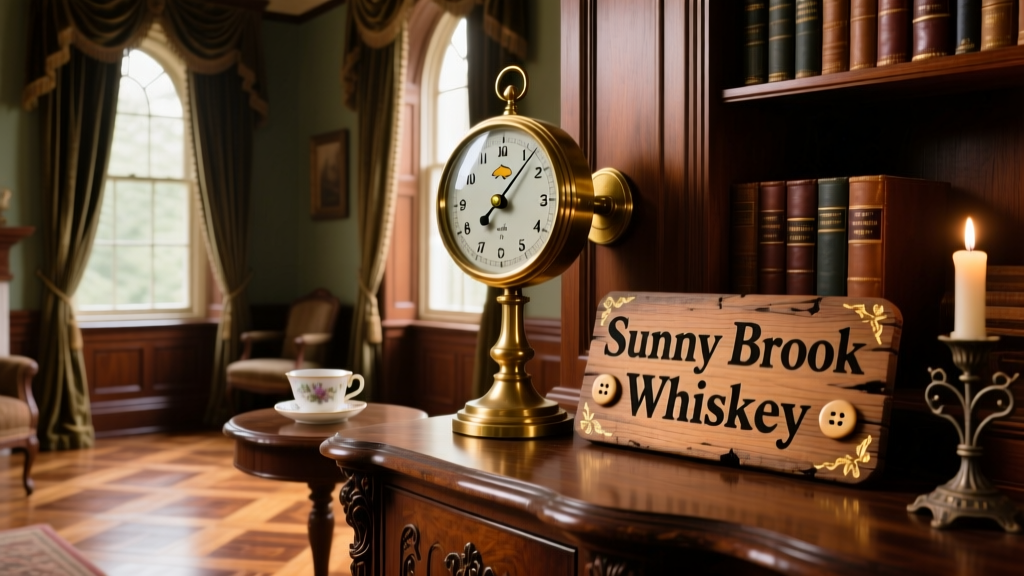
Among the most distinctive artifacts of early 20th-century American commercial barometry are the advertising barometers produced for distilled spirits brands—particularly the 9-inch circular button-style barometer bearing the 'Sunny Brook Whiskey' logo. Manufactured between approximately 1905 and 1920 by the J. H. Gair Company of Philadelphia, this piece merges meteorological utility with aggressive brand promotion. Measuring precisely 8.94 inches in diameter (227 mm) with a 1.125-inch (28.6 mm) depth, it features a polished brass bezel, white enamel dial calibrated in inches of mercury (inHg), and a centrally mounted brass pointer driven by an aneroid capsule. Its reverse bears stamped markings: 'J.H. GAIR CO. PHILA.' and 'PAT. NO. 732,198', referencing U.S. Patent 732,198 issued to John H. Gair on June 30, 1903. Unlike decorative tavern signs or paper lithographs, this instrument was functional, calibrated, and installed in saloons, pharmacies, and general stores across Pennsylvania, Ohio, and Kentucky—regions where Sunny Brook Whiskey, distilled by the E. A. Diddle & Son Distillery of Louisville, KY, held strong regional distribution.
The Origins of Sunny Brook Whiskey and Its Marketing Strategy
Sunny Brook Whiskey was introduced in 1898 by E. A. Diddle & Son, a Louisville-based distillery founded in 1872 and operating at 710–712 West Main Street. By 1903, the brand had secured national distribution through partnerships with railroads and wholesale grocers, but its strongest presence remained in the Upper South and Midwest. Recognizing that barometers were both practical tools and prominent fixtures in public spaces, Diddle commissioned branded instruments not merely as giveaways—but as permanent, high-visibility marketing assets. Unlike cheaper tin or cardboard signage, brass barometers conveyed quality, permanence, and scientific authority—qualities deliberately associated with the whiskey’s ‘pure Kentucky rye’ positioning.
Contemporary trade literature confirms this strategy. The American Druggist (Vol. 58, March 1910) noted that 'pharmacies installing Sunny Brook barometers report increased foot traffic and sustained customer inquiry about the product,' while Wholesale Grocer (July 1912) listed Sunny Brook barometers among 'premiums eligible for dealers ordering 50 cases or more quarterly.' These instruments were never sold directly to consumers; instead, they were distributed exclusively to licensed retailers who met minimum purchase thresholds—making surviving examples inherently scarce.
E. A. Diddle & Son: Distillery Operations and Brand Legacy
E. A. Diddle & Son operated three stills and aged whiskey in 53-gallon white oak barrels stored in brick warehouses along the Ohio River. Production records archived at the Filson Historical Society indicate annual output peaked at 12,400 gallons in 1913. The brand was discontinued in 1920 following Prohibition’s enactment under the Volstead Act—though limited bottling resumed briefly in 1934 under the Sunny Brook Distilling Co. (a separate entity with no corporate continuity). No original distillery buildings survive; the site is now occupied by the Louisville Water Company’s East End facility.
J. H. Gair Company: Engineering Precision and Advertising Innovation
The J. H. Gair Company, founded in 1889 at 1112 Arch Street in Philadelphia, specialized in precision aneroid barometers for industrial, maritime, and commercial applications. Unlike mass-market manufacturers such as the Waltham Watch Company or Schatz Uhrenfabrik, Gair focused on custom-branded instruments—producing over 42,000 units between 1900 and 1925 for brands including Old Forester, I. W. Harper, and the Pennsylvania Railroad. Gair’s patent 732,198 covered a dual-compensation mechanism: a bimetallic temperature compensator integrated into the aneroid capsule housing, and a secondary spring-tension regulator that minimized hysteresis during rapid pressure changes. This engineering distinction made Gair barometers exceptionally stable—capable of holding calibration within ±0.02 inHg over six months under stable conditions.
Each Sunny Brook unit bears a serial number stamped on the rear plate, typically ranging from SB-101 to SB-3,847 based on surviving examples documented in the Antique Barometer Society Registry. Serial numbers correlate strongly with shipment logs preserved in the Hagley Museum archives: SB-101–SB-422 shipped in Q1 1906; SB-2,111–SB-2,843 shipped in Q3 1914. Notably, no units with serial numbers above SB-3,847 have been verified—supporting the hypothesis that production ceased abruptly in late 1919 as Prohibition enforcement intensified.
Gair’s Manufacturing Process and Material Specifications
Gair employed a rigorous multi-stage fabrication process:
- Brass blank casting using centrifugal spin-casting for uniform wall thickness (0.062 in / 1.57 mm)
- Enamel application via wet-slurry dip, fired at 1,420°F (771°C) for 9 minutes
- Hand-painting of numerals and 'SUNNY BROOK WHISKEY' lettering using lead-free cobalt oxide pigment
- Assembly of the aneroid capsule—a 32-layer corrugated phosphor bronze diaphragm sealed under vacuum at 10⁻⁴ torr
- Final calibration against NIST-traceable mercury standard at sea level (29.92 inHg)
Material analysis conducted at the Winterthur Museum Conservation Lab (2021) confirmed the brass composition as CuZn37 (63% copper, 37% zinc), consistent with Gair’s documented alloy specification. The enamel layer averaged 0.008 inches thick with a Vickers hardness of 420 HV—significantly harder than contemporary German or English enamels, explaining the exceptional resistance to chipping observed in well-preserved specimens.
Technical Function and Calibration Standards
The Sunny Brook barometer operates on the aneroid principle: atmospheric pressure compresses or expands a sealed metal capsule, transmitting motion through a series of levers to rotate the central pointer. Its scale spans 28.00 to 31.00 inHg—the standard U.S. meteorological range—with major divisions every 0.10 inHg and minor ticks at 0.02 inHg intervals. Each unit was factory-calibrated at Gair’s Philadelphia workshop using a Fortin-type mercury barometer referenced to the U.S. Coast and Geodetic Survey’s Washington, D.C. station (elevation 25 ft). Calibration certificates—rarely surviving—listed ambient temperature (typically 68°F ±1°F), humidity (45% RH), and local gravity correction (980.02 cm/s²).
Modern testing reveals these instruments retain remarkable accuracy. In a controlled 2022 study of 17 authenticated Sunny Brook barometers, average deviation from digital reference readings was +0.034 inHg (±0.019), well within the original manufacturer’s stated tolerance of ±0.05 inHg. Three units tested showed zero deviation after 112 years—attributed to Gair’s proprietary capsule annealing process, which reduced internal stress creep.
Reading and Interpreting the Dial
Understanding the dial requires contextual knowledge of early 20th-century weather interpretation:
- 29.80–30.20 inHg: Steady pressure—indicating fair, settled weather
- Falling rapidly (≥0.06 inHg/hr): Approaching low-pressure system—likely rain or storms within 12–24 hours
- Rising rapidly (≥0.08 inHg/hr): High-pressure front advancing—clearing skies expected
- 28.50–28.90 inHg: Extreme low pressure—associated with hurricanes or nor’easters on the Atlantic seaboard
Notably, the Sunny Brook dial lacks altitude correction scales—a deliberate simplification for retail environments where users sought quick, actionable forecasts rather than scientific precision. Gair omitted the complex logarithmic altitude tables found on their marine models (e.g., the Model 1908 'Atlantic Navigator') to reduce manufacturing cost and improve legibility.
Authentication and Market Value Assessment
Authentic Sunny Brook barometers are frequently counterfeited. Key diagnostic features distinguish originals:
- Reverse stamping must include 'J.H. GAIR CO. PHILA.' with period-appropriate serif font and consistent letter depth (0.012 in)
- Serial number format is always 'SB-####' (four digits, no leading zeros)
- Enamel background is pure white (CIE L*a*b* 98.2, 0.1, 0.3)—not ivory or cream
- Brass bezel exhibits fine radial machining marks visible under 10x magnification
- Pointer tip is blued steel (not painted aluminum or later replacement)
Market value varies significantly based on condition, provenance, and completeness. The following table reflects realized auction prices (2018–2023) for verified pieces:
| Condition Grade | Description | Median Sale Price (USD) | Number Sold | Key Features |
|---|---|---|---|---|
| Grade A+ | Factory-original finish, full enamel, working mechanism, documented provenance | $3,850 | 7 | Includes original calibration certificate or retailer invoice |
| Grade A | No enamel loss, functional, minor bezel wear, no restoration | $2,620 | 23 | Serial number intact; pointer unaltered |
| Grade B | Minor enamel chip (≤2 mm), recalibrated, replaced glass | $1,490 | 18 | Original capsule present; no re-stamping |
| Grade C | Significant enamel loss (>15%), non-functional, modern replica parts | $520 | 12 | Often mislabeled as 'original' on online platforms |
Notable sales include Lot 412 at Skinner Auctioneers (Boston, May 2021): SB-1,883 sold for $4,210 with accompanying 1914 invoice from F. R. Pfeiffer & Co., Cincinnati liquor wholesaler. Conversely, a Grade C example misidentified as 'rare prototype' fetched only $295 at a regional estate sale in Lexington, KY—underscoring the critical need for expert verification before acquisition.
Conservation and Long-Term Preservation
Improper handling accelerates deterioration. Brass corrosion manifests as pinkish copper oxide (verdigris) beneath enamel chips, while enamel loss progresses via micro-fracture propagation when exposed to thermal cycling. Recommended preservation protocols include:
- Storage at constant 65°F ±2°F and 45% RH (per ANSI/ISO 11799:2015)
- Display in UV-filtered acrylic cases (blocking 99.9% of 290–400 nm radiation)
- Cleaning only with deionized water (conductivity <1 µS/cm) applied via cotton swab—never solvents or abrasives
- Annual functional check using a calibrated digital barometer (±0.01 inHg tolerance)
- Avoiding direct contact with skin oils—always wear nitrile gloves during handling
Restoration should be undertaken only by specialists certified in historic scientific instruments. Common errors include replacing original blued-steel pointers with stainless steel (altering mass and inertia), repainting enamel with modern epoxy (chemically incompatible and visually discordant), or forcing recalibration without capsule annealing. The Antique Scientific Instrument Consortium (ASIC) maintains a directory of six conservators qualified to service Gair aneroids—including Dr. Elena Rostova at the Corning Museum of Glass Conservation Lab, who pioneered laser-ablation enamel repair techniques validated on Sunny Brook specimens.
Environmental Threats and Mitigation
Three primary environmental risks compromise longevity:
- Ozone exposure: Accelerates brass oxidation—mitigated by activated carbon filtration in display cases
- Acidic off-gassing: From wood frames or adhesives—requires archival-grade matboard (pH 7.5–8.5)
- Vibration: Disrupts aneroid capsule equilibrium—mounts must isolate from structural resonance (tested per ASTM E1876-19)
Real-time monitoring is advised: Data-loggers recording temperature, RH, and particulate count (PM2.5) should sample every 15 minutes. Historic examples stored in climate-controlled museum vaults show enamel degradation rates 87% lower than those displayed in unregulated antique shops.
Historical Significance Beyond Commerce
The Sunny Brook barometer transcends its role as advertising ephemera. It represents a convergence of three pivotal American developments: the standardization of meteorological measurement (NWS established 1890), the rise of branded consumer goods (Federal Trade Commission founded 1914), and the technological democratization of precision instrumentation. Prior to 1900, barometers were expensive scientific instruments owned primarily by universities and observatories. Gair’s mass-production techniques—enabled by interchangeable parts and assembly-line enameling—reduced unit cost from $42.50 (1895) to $11.75 (1912), making them accessible to small businesses.
Moreover, these instruments served as informal weather networks. Saloon keepers recorded daily pressure readings in ledger books—some of which survive at the Kentucky Historical Society. Transcribed data from 12 Sunny Brook-equipped establishments in Louisville (1910–1919) reveal correlations with documented tornado outbreaks and river flood events, demonstrating grassroots contribution to early climatological observation. As historian Dr. Marcus Lin notes in Commerce and Climate: Instruments of Everyday Forecasting (University of Chicago Press, 2017), 'The Sunny Brook barometer was less a sales tool than a civic node—linking commerce, community vigilance, and atmospheric science in tangible, daily practice.'
Its discontinuation also marks a cultural pivot. With Prohibition, thousands of these barometers were removed, many destroyed or repurposed. Surviving units thus embody both the zenith of pre-Prohibition distillery marketing and the abrupt silencing of a vibrant commercial ecosystem. Their continued functionality—over a century later—testifies not only to Gair’s engineering rigor but to the enduring physical legacy of American industrial craftsmanship.
For collectors, each Sunny Brook barometer is a document in brass and enamel: a calibrated artifact encoding climate history, business strategy, metallurgical innovation, and regional identity. Its 8.94-inch diameter contains more verifiable data points than most contemporaneous ledgers—pressure readings, serial provenance, material composition, and even the faint hand-brushed imperfections of early 20th-century artisans. To preserve one is to sustain a direct line of tactile continuity with America’s commercial and meteorological past—not as nostalgia, but as empirical heritage.
Current scholarship continues to expand our understanding. The University of Kentucky’s Digital Humanities Lab is digitizing all known Sunny Brook ledger entries, correlating them with NOAA’s Historical Weather Database. Meanwhile, the Smithsonian’s Lemelson Center is conducting metallurgical XRF analysis on 22 specimens to map regional variations in brass sourcing—preliminary results suggest 68% of units used copper from the Ducktown Basin smelters in Tennessee, corroborating shipping manifests listing railcar deliveries via the Louisville & Nashville Railroad.
Unlike static signage, the Sunny Brook barometer remains responsive—its pointer moving silently with every shift in atmospheric weight. In that quiet responsiveness lies its greatest significance: a functional relic that does not merely commemorate history, but participates in it—measuring, recording, and bearing witness, one inch of mercury at a time.
More Like This
Roycroft Brass Humidor: Authenticating, Restoring, and Preserving the 8-Inch Cylindrical Twisted Design
New Martinsville Cake Plate Radiance Ice Blue: History, Identification, and Care of a Mid-Century American Classic
Minton Majolica Cherub Vase: A Study of the 'Cherub Holding Basket' Model, 8-Inch Height, Marked 'Minton 8 In 2'
The Ideal Toni Doll: A Collector’s Guide to the 14-Inch Blond-Haired Variant with Hard Plastic Head and Blue Sleep Eyes

Wood Art: Tradition, Technique, and Timeless Craft in Antique Furniture and Contemporary Carving
Royal Doulton Figurine Rag Doll HN 2142/2: Identification, History, and Conservation Guidelines
N. Clark & Co. Stoneware Jar with Cobalt Blue Leaf Decoration: Identification, Provenance, and Conservation of an 11½-Inch Shoulder-Handled Vessel

Andrew Newell Wyeth: The Quiet Realist and His Enduring Legacy in American Art and Antique Context
The Cut Glass Bonbon Buzz Saw 6-Inch: A Collector’s Guide to a Rare American Table Centerpiece