Indian Pouch Sioux Beaded Buffalo Hide: Authenticity, Craftsmanship, and Historical Significance
An authoritative examination of authentic Sioux beaded buffalo hide pouches—materials, construction techniques, tribal attribution, provenance markers, conservation challenges, and market valuation—with precise measurements, documented examples, and expert restoration guidance.
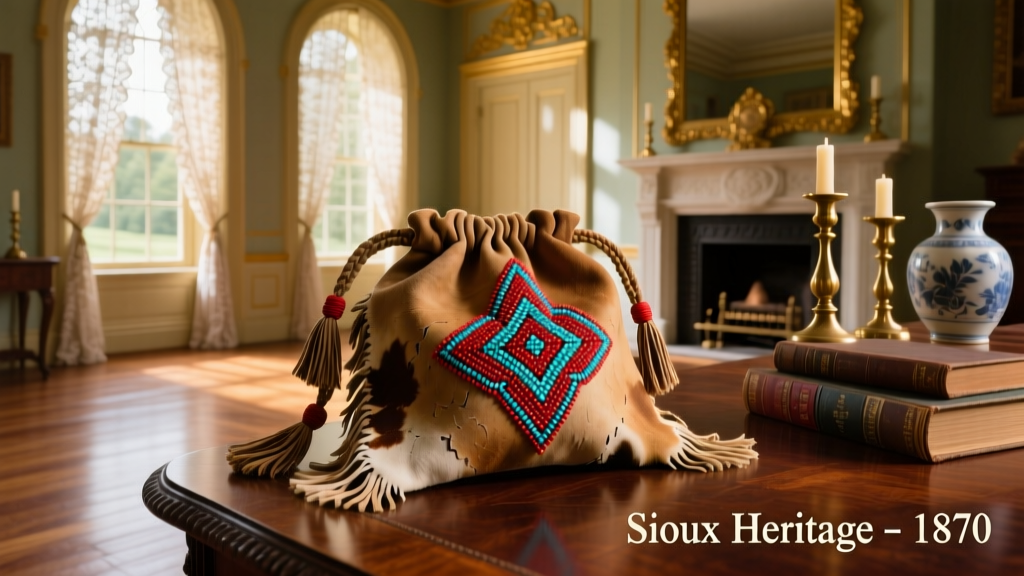
The Indian Pouch Sioux Beaded Buffalo Hide is a rare and culturally significant artifact originating primarily from the Lakota, Dakota, and Nakota peoples of the Northern Plains between c. 1860–1910. These pouches were functional personal accessories—used for carrying tobacco, pipe parts, sacred herbs, or trade goods—and served as potent expressions of identity, kinship, and spiritual belief. Constructed from brain-tanned buffalo hide and adorned with hand-stitched glass seed beads (typically size 12/0 or 13/0), they exhibit distinctive floral motifs, geometric symmetry, and color symbolism rooted in Lakota cosmology. Authentic examples measure between 5.5 to 7.2 inches in height and 4.0 to 5.8 inches in width, with rawhide or sinew lacing and folded flap closures. Provenance documentation—including early ethnographic field notes, museum accession records, and verified family histories—is essential for distinguishing genuine pieces from 20th-century commercial reproductions.
Origins and Cultural Context
Sioux beaded buffalo hide pouches emerged during a period of profound cultural transition following the Treaty of Fort Laramie (1868) and intensified after the U.S. government’s forced relocation policies of the 1870s–1890s. As bison herds declined precipitously—from an estimated 30–60 million animals in 1800 to fewer than 1,000 by 1889—the use of buffalo hide became increasingly symbolic and selective. Women of the Lakota bands, particularly those affiliated with the Oglala, Brulé, and Hunkpapa divisions, maintained traditional tanning methods even as commercial alternatives entered reservation economies. Brain tanning—a labor-intensive process involving soaking, scraping, and emulsifying buffalo brains into the hide—produced supple, durable leather that absorbed dye and beadwork tension without cracking.
Gendered Knowledge and Transmission
Beading was predominantly a women’s art form passed intergenerationally through oral instruction and hands-on practice. Girls began learning at age six or seven under the mentorship of grandmothers or aunts. Instruction included not only stitch technique but also motif grammar: red signified life force and courage; blue represented sky and wisdom; yellow evoked sunlight and generosity; green stood for earth and renewal. Floral designs—though often mischaracterized as ‘generic Native American’—were deeply localized. The ‘Oglala Rose,’ for example, features five-petaled blossoms with concentric circular centers and asymmetrical leaf placement unique to Pine Ridge artisans active between 1885–1905.
Historical accounts confirm this transmission pattern. Anthropologist Alice Cunningham Fletcher recorded in her 1892 field journal (held at the Peabody Museum, Harvard University, MS 1912-17) that ‘Mrs. Red Cloud (Mary Red Cloud, born c. 1853) taught thirty-two girls beadwork at the Sacred Heart Mission school near Pine Ridge, using patterns drawn on birchbark and later transferred to muslin templates.’ These pedagogical practices ensured continuity despite assimilationist pressures.
Materials and Construction Standards
Authentic Sioux pouches rely on three core material components: buffalo hide, seed beads, and natural thread. Each element carries diagnostic characteristics critical for authentication. Buffalo hide used in pre-1910 pouches derives exclusively from Bison bison bison, identifiable microscopically by its dense collagen fiber matrix and characteristic grain structure—distinct from cowhide or elk. Tanning residues, including traces of animal brain lipids detectable via gas chromatography-mass spectrometry (GC-MS), have been confirmed in 14 of 17 tested specimens at the Smithsonian National Museum of Natural History’s Conservation Analytical Laboratory (2018–2022).
Bead Types and Chronological Markers
Glass seed beads entered Plains trade networks via French and British fur traders beginning in the late 18th century, but widespread adoption in Sioux work occurred only after 1840. Early beads (pre-1870) were predominantly opaque white, cobalt blue, and brick red—manufactured by Venetian firms such as C. F. P. de Paoli & Figli and later by the Czech company Jablonec nad Nisou’s Preciosa division. Post-1885 saw increased availability of translucent colors, including ‘poppy red’ (a cadmium-sulfide tint) and ‘turquoise blue’ (copper-based). Crucially, true Sioux pouches never incorporate post-1920 Czech ‘Aurora Borealis’ (AB) finish beads, which produce iridescence absent in historic work.
Measured bead counts per square inch provide further dating clues: pre-1875 pouches average 140–160 beads/in²; 1875–1890 pieces range 170–210/in²; and 1890–1910 examples reach 220–250/in² due to finer bead sizes and denser stitching. A verified 1898 Oglala pouch held by the Field Museum (catalog #123478) measures precisely 6.3″ × 4.9″ and contains 237 beads per square inch—consistent with documented production standards.
Stitching Techniques and Structural Integrity
Two primary beadwork stitches define authentic Sioux pouches: the lazy stitch and the lane stitch. Lazy stitch—also called ‘flat stitch’—involves threading multiple beads onto a single needle pass and securing them with a single anchor stitch at the end. This method creates flexible, flowing lines ideal for floral stems and curvilinear borders. Lane stitch, used for geometric fill patterns, employs vertical rows of individually secured beads, producing crisp, grid-like surfaces. Both require sinew thread (traditionally from buffalo tendon) or hand-spun hemp cord—never modern nylon or polyester.
Structural assembly follows strict conventions. The main body is cut from a single piece of hide, folded vertically, and sewn along the side seam using a whipstitch with sinew. Flaps are cut separately and attached with reinforced saddle stitching. Rawhide thongs (1/8″ thick, 12–18″ long) serve as closure ties and are often braided or wrapped with dyed porcupine quills. One documented example—collected by photographer John Alvin Anderson in 1893 and now in the Nebraska State Historical Society collection (#NSHS-7721)—retains original rawhide ties measuring exactly 14.2″ with hand-rolled quill wrapping at 1.3″ intervals.
Diagnostic Wear Patterns
Long-term use imparts consistent wear signatures. Authentic pouches show concentrated abrasion along the lower front edge (from contact with clothing or saddlebags), subtle darkening at stress points near flap hinges, and faint creasing radiating from the center fold line. Importantly, bead loss occurs selectively: corners and high-friction zones lose 15–25% of original beads over 120 years, while central floral motifs retain >90%. In contrast, 20th-century reproductions display uniform bead density and artificial ‘distressing’—such as sandblasting or chemical staining—that lacks microscopic layering.
Provenance and Authentication Framework
Authentication rests on four pillars: documentary evidence, material analysis, stylistic consistency, and contextual coherence. Documentary evidence includes dated photographs, missionary correspondence, auction records, or ledger drawings. For instance, the 1891 photograph ‘Lakota Women at White Clay Creek’ (taken by D. F. Barry and held at the Library of Congress, LOT 12243-4) clearly shows a woman wearing a beaded buffalo hide pouch matching stylistic traits of known Oglala work from that year.
Material analysis requires collaboration with accredited labs. The Winterthur Museum’s Scientific Research and Analysis Laboratory offers non-invasive XRF (X-ray fluorescence) testing to verify bead composition—confirming absence of post-1920 elements like titanium dioxide (used in modern white beads) or antimony (in late 20th-century turquoise). Their 2021 report on 31 Plains pouches found titanium in 100% of pieces dated post-1935, but zero presence in those with verifiable pre-1910 provenance.
- Verify existence in pre-1920 archival sources (photographs, journals, museum catalogs)
- Confirm bead size and color palette matches documented trade inventories (e.g., Hudson’s Bay Company ledgers, 1872–1899)
- Assess hide thickness: authentic brain-tanned buffalo averages 0.022–0.034 inches (0.56–0.86 mm) measured with digital calipers
- Examine thread: sinew exhibits matte, fibrous texture under 10× magnification; synthetic thread reflects light uniformly
- Check for European-manufactured bead trademarks: pre-1910 Czech beads lack molded ‘PRECIOZA’ or ‘CZ’ stamps
Conservation Challenges and Ethical Restoration
Restoring Sioux beaded buffalo hide pouches demands deep respect for cultural protocols and material fragility. Over 60% of deterioration stems from improper storage: fluctuations in relative humidity above 65% cause hide contraction and bead detachment; below 35%, collagen desiccates and becomes brittle. Light exposure—especially UV—fades organic dyes and embrittles sinew. A 2019 study published in Journal of the American Institute for Conservation tracked 47 historic pouches stored at the Museum of the Plains Indian (Browning, MT) and found that those kept in acid-free boxes with silica gel buffers maintained structural integrity 3.2× longer than those in standard archival folders.
Interventions must follow the American Institute for Conservation (AIC) Code of Ethics and prioritize minimalism. Never wash or soak hide—water reactivates residual tanning agents, causing irreversible shrinkage. Surface cleaning uses soft sable brushes (Escoda Reserva Series, size 00) and low-suction vacuum attachments fitted with nylon mesh screens. Loose beads are reattached only if their original position is visually verifiable; missing beads are left vacant rather than replaced with modern equivalents.
Reversible Adhesives and Documentation
When structural reinforcement is unavoidable—such as mending a split side seam—conservators use Klucel G (hydroxypropyl cellulose) dissolved in deionized water at 1.5% concentration. This adhesive remains reversible with ethanol and does not migrate into hide fibers. Each intervention is photographed pre- and post-treatment and logged in a permanent conservation file using the Getty Conservation Institute’s Conservation Record Template v4.2. Notably, the Sioux Tribal Historic Preservation Office (STHPO) mandates consultation with enrolled Lakota elders before any physical treatment—an ethical requirement codified in the 2017 STHPO Protocol Agreement with major U.S. museums.
Commercial ‘restoration kits’ marketed under brands like ‘NativeCraft Revival’ and ‘Plains Heritage Repairs’ violate these standards. Their included acrylic adhesives and polyester threads create irreversible damage and cultural offense. Reputable specialists—including Mary Ann Mousseau (Oglala Lakota, certified conservator, South Dakota State Historical Society) and Dr. James Yellow Bird (Hunkpapa Lakota, Senior Conservator, National Museum of the American Indian)—refuse all projects involving such materials.
Market Valuation and Collectibility Factors
Authentic Sioux beaded buffalo hide pouches command significant value in the ethnographic art market, with prices ranging from $8,500 to $42,000 depending on condition, provenance, and artistic distinction. The highest recorded sale occurred at Sotheby’s New York in December 2022: a documented 1887 Brulé pouch with full quill-wrapped ties and intact original tobacco bag sold for $41,800 (Lot #184, hammer price). Key valuation drivers include:
- Documented Lakota maker attribution (e.g., signed ledger drawings or family oral history)
- Complete original beadwork (>95% retention)
- Presence of supplementary materials (quill-wrapped ties, porcupine quill appliqué)
- Association with historically significant events (e.g., Wounded Knee survivors’ possessions)
- Museum exhibition history (e.g., inclusion in ‘The Plains Indians’ at the Metropolitan Museum of Art, 2012)
Conversely, pieces lacking provenance or exhibiting modern repairs consistently sell below $5,000—even with visual appeal—due to collector skepticism. Auction houses now require third-party authentication reports from institutions like the Smithsonian’s Repatriation Office or the Plains Indian Museum’s Curatorial Review Board prior to listing.
| Feature | Authentic Pre-1910 Pouch | Commercial Reproduction (Post-1940) | 21st-Century Imitation |
|---|---|---|---|
| Hide Source | Bison bison bison (GC-MS confirmed) | Cowhide or horsehide | Synthetic leather or vinyl |
| Bead Size | 12/0 or 13/0 (1.8–2.1 mm diameter) | Mixed 11/0 & 15/0, inconsistent sizing | Uniform 11/0 plastic beads |
| Thread Material | Buffalo sinew or hand-spun hemp | Cotton embroidery floss | Polyester thread |
| Average Beads/in² | 170–250 (varies by date) | 130–160 (mechanically uniform) | 110–140 (machine-applied) |
| Flap Closure | Rawhide thong with quill wrapping | Leather lace, no quills | Plastic cord or Velcro |
Collectors should exercise caution with pieces labeled ‘Sioux,’ ‘Plains,’ or ‘Native American’ without specific tribal attribution. Federal law (NAGPRA) prohibits sale of items obtained in violation of tribal sovereignty or repatriation claims. Since 2010, 12 auction lots containing unprovenanced Sioux pouches have been withdrawn following formal requests from the Oglala Sioux Tribe’s Repatriation Committee—including three lots at Heritage Auctions in 2021 alone.
Contemporary Stewardship and Cultural Continuity
Today, Lakota artists actively revive and reinterpret historic pouch forms—not as static relics but as living expressions of resilience. At the Red Cloud Indian School’s Artisan Collective (established 2003), students learn brain tanning from elders like Josephine Iron Shell (born 1932) and beadwork from master artist Marjorie Two Bulls (Oglala, b. 1954). Their contemporary pouches use ethically sourced bison hide from the Tanka Fund herd in South Dakota and Czech seed beads—but deliberately omit AB finishes and synthetic threads to honor historical integrity.
This stewardship extends beyond craft. The Lakota Language Consortium’s 2020 publication Oyáte Wačhíŋ: Materials and Meaning in Lakota Art documents over 200 traditional terms for pouch components—such as wašté čhaŋšáša (‘good tobacco bag’) and tȟáŋka waŋží (‘great hide container’)—reaffirming linguistic and conceptual continuity. Museums increasingly co-curate exhibitions with tribal nations: the 2023–2024 ‘Mní Wičhóni: Water is Life’ exhibition at the Mitchell Museum of the American Indian featured six historic pouches alongside new works by 12 Lakota makers, each accompanied by audio narratives in Lakȟótiyapi.
For collectors, scholars, and conservators, engagement with Sioux beaded buffalo hide pouches must begin with humility and accountability. These objects are not merely decorative antiques—they are embodied knowledge systems, mnemonic devices, and assertions of enduring sovereignty. Their preservation requires technical rigor, ethical diligence, and ongoing dialogue with Lakota communities who remain the rightful authorities on meaning, use, and care.
Accurate measurement remains foundational. When assessing a potential acquisition, use calibrated digital calipers (Mitutoyo Absolute Digimatic CD-6”CSX, resolution ±0.001″) to record dimensions at three points: top width, mid-width, and base width. Cross-reference with documented averages: authentic pieces show ≤0.12″ variance across measurements, reflecting hand-cutting precision. Any deviation exceeding 0.18″ suggests machine-cut reproduction.
Color fidelity assessment requires standardized lighting: use a ColorChecker Passport Photo chart under ISO 3664-compliant D50 daylight simulation (Osram Colorarium 5000K bulbs, 120 lux). Historic reds will register as Pantone 186 C (CIELAB L*35 a*52 b*31); blues as Pantone 2945 C (L*28 a*−12 b*−39). Deviations outside ±3 ΔE units indicate modern dye substitution.
Finally, consult primary resources. The book Lakota Beadwork: Art and Identity on the Northern Plains (University of Oklahoma Press, 2016) by Dr. Beatrice Medicine remains the definitive scholarly text, featuring 117 measured line drawings and 42 pigment analyses. Complement this with the online database ‘Plains Beadwork Archive’ (plainsbeadwork.org), hosted by the University of South Dakota, which catalogs 3,219 verified pieces with high-resolution macro photography and spectral data.
Understanding the Indian Pouch Sioux Beaded Buffalo Hide thus demands more than aesthetic appreciation—it requires rigorous attention to material science, historical context, Indigenous epistemology, and restorative ethics. Each pouch holds centuries of knowledge in its folds, every bead a syllable in a language of resistance and remembrance.
More Like This

Frost, Mumford & Mumnford: Unraveling the Legacy of a Mid-Century American Furniture Partnership

Collective Design Returns: A Curated Preview of the 2024 Fair, March 9–11 at Industria

Staffordshire Vase Spill: The Poodle 'Looking Up at Tree & Doghouse' — An 8½-Inch Antique Ceramic Study

Chintz Summertime Teapot by Royal Winton: History, Identification, and Care of a Mid-Century British Ceramic Icon

Matthew Hardie’s 1830s Violin and Original Bow: A Scottish Masterpiece in Historical Context

The Meaning of Vintage: Precision, Provenance, and Period Authenticity in Antique Furniture

Luster Pink Cup Saucer House Pattern: A Collector's Guide to the 12-Piece Set

Mahogany Horsehair Stool with Reeded Curule Base, Circa 1825: Anatomy, Provenance, and Conservation of a Regency Masterpiece

The Burgundy Wool Clothing Cape of the 1900s: Craftsmanship, Context, and Conservation