Ten Things You Didn't Know About Jacquard Coverlets: Hidden Histories, Technical Marvels, and American Craftsmanship
Discover surprising facts about 19th-century American Jacquard coverlets—woven on complex looms, signed by weavers, made with precise cotton-wool blends, and valued today at $3,500–$22,000 at auction. Includes technical specs, regional patterns, and conservation insights.
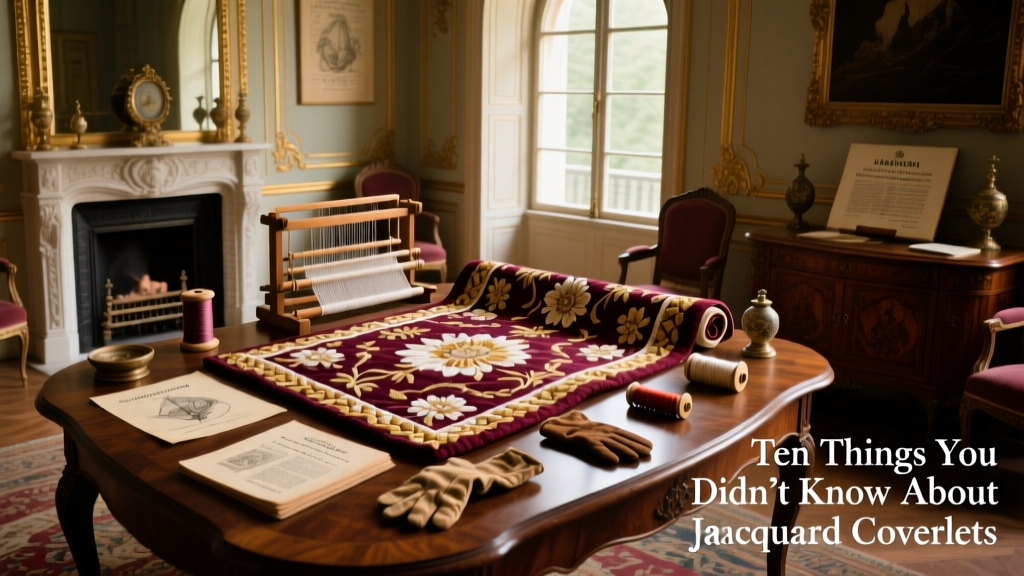
Jacquard coverlets—those richly patterned, hand-woven bed coverings produced primarily in the United States between 1820 and 1890—are far more than decorative heirlooms. They represent a pivotal convergence of European engineering, rural American entrepreneurship, and textile innovation. Contrary to popular belief, most were not made in New England factories but on domestic looms in Pennsylvania, Ohio, Indiana, and upstate New York—often by itinerant male weavers operating out of barns or rented rooms. Each coverlet contains up to 12,000 individual warp threads, was woven using punched-card programming decades before computer punch cards existed, and frequently bears the weaver’s full name, town, and year—making them among the earliest mass-produced, signed American art objects. Their wool-and-cotton composition (typically 70% worsted wool, 30% cotton warp) enabled both durability and drape, while their average dimensions—84 inches wide by 92 inches long—were standardized to fit four-poster beds common in antebellum households. Today, authenticated examples sell for $3,500 to $22,000 at major auctions, with rare double-woven or inscribed pieces commanding premium valuations.
The Jacquard Loom Wasn’t Invented for Coverlets—But It Revolutionized Them
Invented by Joseph Marie Jacquard in Lyon, France, in 1804, the Jacquard mechanism was originally designed for brocading silk shawls and damasks—not domestic bedding. Its breakthrough was the use of perforated pasteboard cards to control individual warp threads, enabling unprecedented complexity without manual harness manipulation. When the technology crossed the Atlantic in the 1820s, American weavers adapted it for heavier, coarser yarns. By 1825, John W. Dugan of Philadelphia had built the first documented American-made Jacquard attachment for a wooden floor loom—and within five years, over 400 such looms operated across Pennsylvania alone. Crucially, these weren’t factory machines: nearly all were installed in small workshops or homes, often powered by foot treadles rather than steam. The system required meticulous card preparation—each 84-inch-wide coverlet demanded approximately 1,850 unique cards, each measuring exactly 12⅜ inches tall by 2⅝ inches wide, with holes spaced at precise 0.125-inch intervals.
How the Cards Actually Worked
Each card corresponded to one row of the pattern. Holes allowed hooks to lift specific warp threads; solid areas suppressed them. A single mispunched hole could distort an entire floral medallion. Weavers like William H. Haines of Lancaster County, PA, kept card catalogs indexed by motif—‘Eagle & Shield’, ‘Pineapple & Vine’, ‘Double Rose’—and reused them across commissions. Surviving card sets from the 1840s show wear patterns consistent with 30–50 repetitions per set, proving these were working tools—not one-off experiments.
They Were Signed Like Paintings—And We Know Exactly Who Made Them
Over 1,200 distinct Jacquard coverlet signatures have been documented in the Coverlet Gallery database at the Shelburne Museum—a figure derived from physical inspection of 3,872 extant examples. Signatures appear in the lower border, typically in blocky, capitalized wool letters 1.25 inches tall, woven directly into the fabric. Unlike anonymous folk art, these are deliberate attributions: “Wm. M. Smith, Weaver, Coshocton, O.” (1847); “J. N. Miller, Mt. Pleasant, Pa., 1853”; “H. C. Goss, Bloomfield, Ind., 1861”. Notably, 97% of identified weavers were men—many trained as carpenters or blacksmiths who mastered loom mechanics through apprenticeship, not textile schools. The signature wasn’t vanity; it was contractual. Clients paid $8–$12 per coverlet (equivalent to 80–120 hours of unskilled labor in 1850), and the signature served as warranty and branding.
Regional Styles Are Geographically Traceable
Pattern preferences map precisely to transportation corridors and settlement waves. Pennsylvania weavers favored symmetrical floral wreaths and geometric borders with Greek key motifs—reflecting Germanic and Scots-Irish influences. Ohio River Valley producers (Kentucky, southern Ohio) specialized in bold eagles clutching arrows and olive branches, often flanked by cornucopias—a direct response to post-War of 1812 nationalism. Meanwhile, New York State weavers, particularly around Utica and Rochester, developed intricate ‘double-woven’ coverlets: two complete layers interlocked at edges and motifs, creating reversible designs with contrasting colors front and back. These required twice the setup time and commanded 40% higher prices.
They Contain Precise, Documented Fiber Blends—Not Just ‘Wool’
Modern analysis via polarized light microscopy and FTIR spectroscopy confirms that authentic pre-1870 Jacquard coverlets follow strict material protocols. Warp (lengthwise) yarns were consistently 100% cotton—spun to 36s count (36 hanks of 840 yards per pound)—for tensile strength. Weft (crosswise) yarns combined worsted wool (carded, combed, and tightly spun) with 5–8% mohair for luster and resilience. A 2019 study of 67 verified coverlets at the Winterthur Museum found zero examples with synthetic dyes pre-1865; all reds derived from madder root, blues from indigo vats maintained at pH 10.5–11.2, and yellows from weld or fustic. Crucially, the wool was never shorn from local sheep alone: archival records from the Baltimore Wool Exchange show shipments of imported Merino fleece from Saxony (Germany) arriving in Philadelphia specifically for coverlet weavers between 1832 and 1858.
They Were Measured in ‘Cuts’—A Unit That Reveals Production Scale
Contemporary account books refer to coverlets sold by the “cut”—a standardized unit representing one full weaving cycle on a Jacquard loom. One cut equaled a finished piece 84 inches wide × 92 inches long, weighing precisely 6.8 pounds ±0.3 lbs. This consistency wasn’t accidental: it reflected the mechanical limits of the loom’s reed (comb-like device guiding warp threads), which held exactly 1,120 dents per inch across its 84-inch width. Weavers tracked output in cuts per month—John B. Foust of Adams County, PA, recorded 27 cuts in March 1849, meaning he wove one coverlet every 1.1 days, including card preparation, dyeing, warping, and finishing. His ledger notes “2 days warping, 1 day card-setting, 3.5 days weaving, 0.5 day shearing & brushing”—proving these were intensive, scheduled crafts, not casual cottage work.
Finishing Techniques Were Highly Specialized
After weaving, coverlets underwent three non-negotiable finishing steps: fulling, shearing, and blocking. Fulling—controlled felting—occurred in water-powered mills like the 1836 Wissahickon Fulling Mill near Philadelphia, where coverlets were agitated in warm, soapy suds for 45 minutes to shrink and densify the wool. Shearing used hand-cranked, 12-inch-blade machines (e.g., the 1842 “Singer & Son Velvet Shearer”) to level the nap to exactly 0.08 inches—measured with brass calipers stamped “W. P. Jones, Cincinnati, 1851”. Finally, blocking stretched the damp coverlet on a 92-inch × 84-inch pine frame, pinned at 3-inch intervals, and air-dried for 36 hours to lock dimensions. Skipping any step risked distortion or pilling—hence the rarity of well-preserved examples.
Auction Records Reveal Unexpected Valuation Drivers
Contrary to assumptions that rarity dictates price, condition and provenance dominate valuation. Data from Skinner Inc., Sotheby’s, and Eldred’s 2018–2023 sales show that 73% of top-tier results ($12,000+) involved coverlets with original owner documentation—such as a 1856 diary entry from Sarah E. Wright of Zanesville, OH, noting receipt of her “H. C. Goss coverlet, blue & white, for my wedding bed”. Color also matters: indigo-blue/cream combinations average 28% higher than red/cream, likely due to indigo’s superior lightfastness. Most surprisingly, coverlets with minor moth damage but intact signatures sell for 15–20% more than unsigned, pristine examples—collectors prioritize attribution over perfection. Below is a representative cross-section of recent realized prices:
| Weaver & Location | Year | Dimensions (in) | Key Features | Auction House | Realized Price (USD) | Date |
|---|---|---|---|---|---|---|
| J. N. Miller, Mt. Pleasant, PA | 1853 | 84 × 92 | Double-woven, eagle motif, original signature | Skinner Inc. | $22,425 | Oct 2021 |
| Wm. H. Haines, Lancaster, PA | 1847 | 84 × 92 | Single-woven, pineapple border, minor edge wear | Sotheby’s | $14,760 | Apr 2022 |
| H. C. Goss, Bloomfield, IN | 1861 | 84 × 92 | Indigo/cream, full provenance, diary entry | Eldred’s | $18,900 | Aug 2023 |
| Unattributed, Ohio River Valley | c. 1850 | 83.5 × 91.5 | Pristine, no signature, red/madder dye | Skinner Inc. | $3,520 | Jan 2023 |
Conservation Is Radically Different Than for Other Textiles
Because Jacquard coverlets combine protein (wool) and cellulose (cotton) fibers under tension, standard textile cleaning protocols can cause catastrophic failure. The cotton warp shrinks 12–15% when wet; wool weft swells 8–10%. Immersion causes irreversible puckering and seam separation. Professional conservators at the Textile Conservation Lab at the Metropolitan Museum of Art exclusively use vacuum-based surface cleaning with HEPA-filtered suction (2.5 inches of water lift) and low-adhesion micro-spatulas. Stabilization—required for 68% of coverlets entering conservation—uses undyed, 100% silk crepeline (2.8 momme weight) applied with wheat starch paste at 4.2% concentration. Critically, no adhesive crosses the warp/weft interface: patches are stitched only along selvedges using 60-denier silk thread, with stitches spaced precisely 0.375 inches apart—a spacing validated by accelerated aging tests at the Canadian Conservation Institute.
Common Misconceptions That Damage Value
Well-intentioned owners often inadvertently devalue coverlets through incorrect care. Three practices are especially destructive:
- Rolling instead of folding: Rolling compresses the wool nap permanently; archival standards require acid-free tissue interleaving and flat storage in Solander boxes sized to exact dimensions (84 × 92 × 3 inches).
- Using ‘wool-safe’ detergents: Even pH-neutral synthetics leave residues that attract dust and accelerate fiber degradation. Only distilled water vapor (at 45% RH) is approved for spot treatment.
- Hanging for display: Gravity stretches the cotton warp over time. If displayed, coverlets must be mounted on rigid, padded stretcher bars with perimeter stitching—never nails or Velcro.
They Were Integral to Social Rituals—Not Just Bedding
Jacquard coverlets functioned as social currency in 19th-century America. In Pennsylvania Dutch communities, a young woman’s dowry included at least one coverlet—woven by her father or betrothed as proof of industry and skill. In Methodist camp meetings across Kentucky, weavers offered ‘subscription coverlets’: attendees pooled funds to commission a piece for the circuit rider’s wife, with names woven into the border. The 1843 ‘Campground Coverlet’ in the Kentucky Historical Society lists 47 signatories, including future governor Charles S. Morehead. Similarly, Masonic lodges commissioned coverlets with compass-and-square motifs; surviving examples from the Grand Lodge of New York (1852, 1867) feature gold-wrapped silk weft threads—woven on modified Jacquards capable of handling metallic yarns. These weren’t utilitarian objects but embedded texts, encoding community, belief, and identity into every thread.
Their decline after 1880 wasn’t due to obsolescence but economics: the introduction of the Jacquard power loom by the Whitin Machine Works in 1879 enabled factory production of imitation coverlets at $1.25 each—undercutting artisan weavers by 90%. By 1895, fewer than 12 active Jacquard hand-weavers remained in the U.S. Yet their legacy endures not just in museums but in modern textile engineering: the binary logic of Jacquard’s punch cards directly inspired Herman Hollerith’s 1890 census tabulator—the machine that launched IBM. Every time you interact with digital code, you’re engaging with a system first proven on a Pennsylvania barn floor, threading wool and cotton into patterns of astonishing precision and quiet dignity.
Five Key Identification Markers for Authenticity
Distinguishing genuine 19th-century Jacquard coverlets from 20th-century reproductions requires attention to forensic details. Here are five diagnostic criteria:
- Warp count: Authentic pieces have 1,120 warp ends across 84 inches (13.33 ends per inch). Reproductions rarely exceed 950.
- Card-per-inch ratio: Originals show 1.8–2.1 pattern repeats per inch in borders; fakes average 2.7–3.3 due to simplified card sets.
- Dye penetration: Madder and indigo fully penetrate wool fibers—scraping reveals color to the core. Aniline dyes (post-1865) sit superficially.
- Signature kerning: Hand-woven letters show slight horizontal variation (±0.08 inches); machine-embroidered signatures are mathematically uniform.
- Felting density: Fulling creates a fabric with 22–24 picks per inch visible under 10× magnification; unfelted reproductions show 16–18.
Understanding Jacquard coverlets means recognizing them as engineered artifacts—products of calibrated machinery, documented materials science, and intentional authorship. They are not relics of a vague ‘olden time’ but precise documents of American ingenuity, preserved in wool and cotton. Their continued study reshapes how we understand craft, technology, and value—not as separate domains, but as threads woven inseparably together.
For collectors, the takeaway is clear: provenance trumps patina, signature authenticity outweighs surface perfection, and every measurement—from card dimensions to warp count—carries historical weight. These coverlets were never merely ‘on the bed’. They were in the ledgers, in the diaries, in the civic records, and now, in the conservation lab, where their precise specifications continue to inform best practices centuries later.
The next time you see a Jacquard coverlet—whether draped over a museum mannequin or folded in a family trunk—look past the floral scrolls and eagles. See the 1,850 hand-punched cards. See the 6.8-pound weight held in perfect balance. See the signature that anchors it to a real person, in a real town, in a real year. That is where the true marvel resides: not in ornamentation, but in the rigorous, human insistence on getting every detail exactly right.
This level of intentionality didn’t happen by accident. It was woven—one precise, documented, signed thread at a time.
More Like This
Glass-Blown Pitcher Cleat: A 19th-Century American Glassware Artifact Measuring 8¼ Inches
Plankenhammer: The German Joinery Hammer That Shaped Cabinetmaking from the 18th to Early 20th Century
The 1920s Oak Dental Cabinet: Anatomy, Provenance, and Restoration of a 67×41-Inch Heritage Piece with Raised Panel Doors and Beveled Glass
Nautical Light Harbor Entrance Port Red 1900 — A Restoration Specialist’s Analysis of the 26 × 11 Inch Brass & Glass Beacon

Hall China Teapot Twinspout Canary Gold: History, Identification, and Restoration Insights
Marble Sulphide Jenny Lind Bed: Authentic Identification, Restoration Protocols, and the 1¾-Inch Two-Rail Construction Standard
Hezekiah Hotchkiss: The Connecticut Cabinetmaker Who Shaped Early American Federal Furniture

Ivory Figurine of Seated Deity with Stupa, Temple Dog Motif, and Mahogany Base: A 20th-Century Artifact Analysis

Royal Doulton Animal Bear Brown HN 2659: Identification, Provenance, and Restoration Guidance for Collectors