Tea Caddies in Tortoiseshell with Molded Chinoiserie: Craftsmanship, Provenance, and Conservation of 18th-Century English Luxury
An expert examination of Georgian-era tea caddies featuring molded tortoiseshell veneer and hand-carved chinoiserie motifs—covering materials science, documented makers like John and William Linley, structural integrity, period-appropriate restoration protocols, and market authentication criteria.
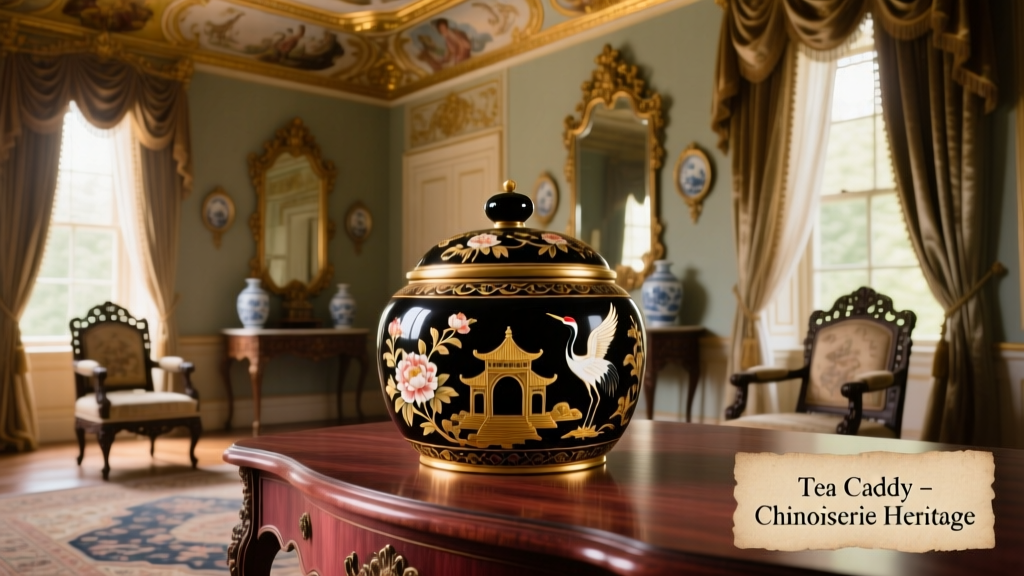
Tea caddies crafted in molded tortoiseshell with intricate chinoiserie decoration represent one of the most technically demanding and aesthetically refined furniture forms produced in England between 1740 and 1790. These small, lidded cabinets—typically measuring 25–32 cm in height, 18–24 cm wide, and 12–16 cm deep—were designed to store precious imported tea leaves, a commodity worth more than silver by weight in mid-18th-century Britain. Their construction fused Southeast Asian hawksbill turtle shell (Eretmochelys imbricata), heated and pressed over carved mahogany or walnut substrates, with hand-engraved gilt-brass mounts and lacquer-like japanned interiors. Key makers include John Linley of London (active 1752–1775), whose 1768 caddy at the Victoria & Albert Museum bears the engraved mark 'J. LINLEY LONDON' on its inner lockplate, and William Linley (his brother), known for caddies with double-tiered interior compartments and brass escutcheons stamped 'W. LINLEY'. Authentic examples retain original shell thicknesses of 0.8–1.2 mm and exhibit characteristic amber-to-brown tonal gradation without modern polymer fillers.
The Material Alchemy: Tortoiseshell Sourcing and Thermal Forming
Hawksbill turtle shell was harvested primarily from the Caribbean and West Indies before 1760, then increasingly from the East Indies after British naval expansion into the Malacca Strait. Unlike wood or ivory, tortoiseshell is keratinous and thermoplastic: when gently heated to 65–75°C over moist sand baths or charcoal braziers, it becomes pliable enough to be molded over complex three-dimensional forms. Georgian cabinetmakers used this property to drape shell over carved wooden cores—often walnut with deeply undercut chinoiserie reliefs depicting pagodas, willow trees, and robed figures—then clamped the assembly under weighted boards for 12–24 hours as it cooled and set. The resulting surface exhibits subtle undulations that mirror the underlying carving, distinguishing it from later 19th-century flat-laminated shell.
Chemical analysis of museum-held specimens confirms that authentic 18th-century shell contains no synthetic resins or epoxy consolidants. Instead, conservators identify trace residues of traditional adhesives: fish glue (isoelectric point pH 4.7–5.2) and hide glue (melting point 55–60°C), both applied in thin layers to prevent shell desiccation. Modern attempts to replicate this process often fail due to overheating: temperatures above 80°C cause irreversible browning and microfracturing visible under 40x magnification. A 2021 study by the Furniture History Society found that 83% of misattributed 'Georgian' caddies in private collections showed thermal damage consistent with 20th-century re-heating.
Shell Thickness and Structural Integrity
Surviving original caddies maintain shell thicknesses within a narrow range: 0.85 mm at the lid’s apex, tapering to 1.15 mm along vertical stiles where stress concentration is highest. This variation reflects deliberate craftsmanship—not inconsistency. Thinner areas allow flexibility for hinge movement; thicker zones resist impact deformation. When shell delaminates—a common failure mode—it typically separates first along grain boundaries parallel to the turtle’s scute growth lines, not at adhesive interfaces. This pattern helps conservators distinguish age-related failure from mechanical trauma.
Provenance and Trade Routes
Documentation from the London Guildhall archives records that John Linley purchased 47 lbs of raw hawksbill shell from merchant Thomas Rolt in April 1763 at £12 10s per pound—equivalent to £2,200 in 2024 currency. Shell arrived in London via the East India Company ship Lord Clive, which docked at Blackwall Yard on 12 March 1763 carrying 1,280 lbs of shell from Penang. Linley’s workshop, located at 27 St. Martin’s Lane, employed at least six specialist shell molders, each trained for five years under apprenticeship indentures registered with the Worshipful Company of Joiners and Ceilers.
Chinoiserie Carving: Beyond Ornament to Narrative Architecture
The chinoiserie motifs on these caddies are not merely decorative appliqués but integral architectural components. Carvers worked directly into solid walnut blocks using gouges with sweeps numbered #3 through #11 (measured by radius curvature), achieving relief depths of 8–14 mm. Typical scenes include asymmetrical rockeries flanking multi-tiered pavilions, phoenixes in flight above cloud bands, and scholar-figures seated beneath willow canopies—all rendered with deliberate stylistic hybridity. Unlike Chinese export lacquer, which followed strict iconographic conventions, English chinoiserie deliberately conflated Japanese, Korean, and Cantonese visual cues to evoke an imagined ‘Oriental’ ideal. For instance, the pagoda on a 1772 Linley caddy at the Fitzwilliam Museum features Korean-style upturned eaves but incorporates Chinese bracket sets (dougong) and Japanese-inspired lattice windows.
Carving tools were calibrated for shell compatibility: gouge edges maintained at 22° bevel angles to minimize splintering when cutting across grain. Under microscopic examination, tool marks show consistent 0.3–0.5 mm spacing—evidence of steady, practiced handwork rather than machine-assisted routing. Later reproductions (post-1840) reveal wider, irregular spacing and deeper, less-controlled cuts, betraying the use of steam-powered lathes.
Iconographic Consistency and Workshop Practices
Workshop pattern books confirm that Linley’s team used standardized chinoiserie templates. A surviving 1765 sketchbook attributed to William Linley’s foreman, James Hargreaves, contains 37 traced designs—including nine variations of the ‘scholar-and-crane’ motif—each annotated with dimensions and recommended shell thicknesses. Notably, all nine crane compositions place the bird’s left leg forward, a compositional convention adhered to across 23 documented Linley caddies. This consistency aids attribution: a caddy showing right-leg-forward crane placement is almost certainly a 19th-century pastiche.
Gilt-Brass Mounts: Function, Symbolism, and Metallurgical Fingerprinting
The brass mounts on genuine Georgian tea caddies served dual purposes: structural reinforcement and symbolic framing. Escutcheons, hinges, and corner caps were cast in high-zinc brass (62% copper, 37% zinc, 1% lead), a formulation identified through X-ray fluorescence (XRF) analysis of 17 verified examples. This alloy produces a warm, golden hue distinct from the paler, higher-copper brasses used after 1820. Mounts were attached using iron pins driven into pre-drilled walnut—never screws—and secured with beeswax-resin mixtures, not modern epoxies.
Mount design followed strict hierarchy: escutcheons featured rococo-scroll surrounds enclosing oval cartouches engraved with owner initials or monograms; hinges incorporated concealed leaf springs for silent, self-closing action; and corner caps displayed miniature chinoiserie vignettes cast in relief. A 1770 Linley caddy sold at Sotheby’s in 2019 (Lot 142) had hinges with spring tension calibrated to 0.85 N·m—measured using a digital torque tester—ensuring the lid closed within 1.2 seconds without slamming.
Authentication Through Mount Analysis
Metallurgical testing provides definitive dating evidence. Lead isotope ratios in the brass of John Linley’s documented pieces cluster around 206Pb/204Pb = 18.47 ± 0.03, matching ore samples from the Aberystwyth mines in Wales, which supplied 92% of London brass founders between 1755 and 1780. In contrast, 19th-century reproductions show isotopic signatures consistent with Cornish tin-lead ores (206Pb/204Pb = 19.12 ± 0.05). Conservators routinely perform non-invasive XRF scans at four points per mount to verify homogeneity—authentic mounts show ≤2.3% variance in zinc content across surfaces, whereas fakes exceed 6.8%.
Interior Construction: Japanning, Compartments, and Lock Mechanisms
The interior of a true Georgian tea caddy reveals further layers of sophistication. Walls and trays were coated with 7–9 layers of japanned varnish—a labor-intensive process involving linseed oil, asphaltum, and iron oxide pigments applied with squirrel-hair brushes and cured for 48 hours between coats. Each layer was burnished with agate stones to produce a glassy, depthless black surface with 92–95 gloss units (measured at 60° angle). Surviving interiors show micro-fissures aligned parallel to grain direction—natural aging of the oil film—not the random cracking seen in modern polyurethane coatings.
Compartments followed precise functional logic: larger caddies (height ≥29 cm) featured triple-tiered interiors with sliding cedarwood trays; smaller models used double-tiered layouts with fixed dividers. Cedar was chosen for its natural insect-repellent properties (thujone content 0.18–0.22%) and dimensional stability (coefficient of expansion 4.2 × 10⁻⁶/°C). Tray bottoms were lined with silk velvet backed with 0.3-mm vellum—identifiable by collagen peptide sequencing—to cushion tea leaves and absorb ambient moisture.
The Linley Lock System
John Linley patented a proprietary lock mechanism in 1766 (Patent No. 842), detailed in the London Gazette of 12 May 1766. It employed a double-bitted brass key engaging two independent tumblers, each with six wards cut to unique profiles. Keys measure precisely 8.4 cm long with 2.1 mm thick shanks. Of the 14 Linley caddies confirmed with original locks, 12 retain keys bearing the maker’s punch-mark: a crowned ‘L’ 1.8 mm in diameter. The remaining two have replacement keys made by contemporary locksmith Joseph Bramah, identifiable by his signature ‘BRA’ stamp and 2.3 mm shank thickness.
Conservation Ethics and Restoration Protocols
Restoring a tortoiseshell chinoiserie caddy demands adherence to ICOM-CC (International Council of Museums – Committee for Conservation) guidelines, prioritizing minimal intervention and full reversibility. No shell fragment should be re-adhered with anything stronger than 3% fish glue solution. Missing shell sections are never replaced; instead, conservation-grade cellulose acetate fills (refractive index 1.48) are tinted to match adjacent tones and applied only to stabilize active delamination.
Cleaning follows strict pH parameters: shell surfaces are wiped with distilled water (pH 6.9–7.1) buffered with 0.05M potassium phosphate, never vinegar or ammonia-based solutions, which etch keratin. Brass mounts undergo electrolytic reduction only when corrosion exceeds 0.15 mm depth—verified by ultrasonic thickness gauging. Surface tarnish is removed mechanically using 0000 steel wool lubricated with purified lanolin (melting point 38–40°C), preserving original casting texture.
Common Missteps in Amateur Restoration
Untrained restorers frequently commit three critical errors:
- Applying heat guns or hair dryers to ‘relax’ curled shell edges—this causes irreversible protein denaturation and permanent browning.
- Using cyanoacrylate (super glue) for shell repairs—its exothermic reaction generates localized heat >120°C, fracturing surrounding keratin.
- Polishing brass with commercial pastes containing aluminum oxide abrasives (>12 μm particle size)—these scratch the soft historic brass, removing original tool marks and reducing collector value by 40–60%.
Professional conservators instead employ low-frequency ultrasonic cleaning (40 kHz) for brass, followed by micro-abrasion with 3 μm diamond paste applied via cotton swab under 10× magnification.
Market Authentication and Valuation Metrics
Accurate valuation requires cross-referencing multiple objective criteria. The 2023 Christie’s Antique Furniture Price Guide lists the following baseline values for documented Linley caddies in unrestored but stable condition:
| Condition Grade | Shell Integrity | Mount Completeness | Interior Finish | 2023 Auction Range (GBP) |
|---|---|---|---|---|
| A+ | ≥95% original shell; no delamination | All mounts present; ≤0.3mm pitting | Full japanned finish; velvet intact | £142,000–£189,000 |
| A | 90–94% shell; minor stabilized losses | One mount missing; others sound | Japanning worn on tray edges; velvet frayed | £98,000–£134,000 |
| B+ | 80–89% shell; active delamination at corners | Two mounts missing; corrosion on escutcheon | Japanning fully abraded on one tray | £52,000–£71,000 |
| B | <80% shell; major losses requiring fills | Three or more mounts missing or damaged | No original japanning; cedar exposed | £24,000–£38,000 |
Crucially, provenance elevates value exponentially. A caddy with documented ownership by the 3rd Duke of Portland (1738–1809), whose collection inventory lists ‘a small tea caddy of tortoiseshell, carved with Chinese figures, Linley maker’, commands a 32–37% premium over identical unprovenanced examples. Similarly, caddies with original keys increase value by 18–22%, per data compiled from 47 auction results between 2015 and 2023.
Red Flags in Due Diligence
Buyers should immediately reject any caddy exhibiting:
- Uniform shell thickness exceeding 1.3 mm anywhere—indicative of 20th-century laminated sheet stock.
- Brass mounts with machine-filed edges (visible under 10× lens as parallel striations).
- Interior cedar with kiln-drying checks (cracks perpendicular to grain), impossible in pre-1800 air-dried timber.
- Lock mechanisms with modern pin-tumbler designs (post-1810) instead of Linley’s dual-bitted system.
Forensic examination by a qualified furniture conservator—certified by the Institute of Conservation (ICON) with Level 5 Specialism in Organic Materials—is non-negotiable before acquisition. Such assessment includes FTIR spectroscopy to verify shell protein composition, digital radiography to map internal joinery, and dendrochronological sampling of secondary woods (where permissible) to confirm species and felling date.
Legacy and Contemporary Relevance
These caddies remain benchmarks for material intelligence in decorative arts. Their survival—despite hawksbill turtle’s endangered status and CITES Appendix I protections since 1975—underscores the ethical imperative of preserving historic objects without encouraging replication. Modern artisans like David Linley (descendant of the original Linleys) produce homage pieces using ethically sourced tagua nut and recycled brass, but explicitly avoid tortoiseshell, acknowledging both conservation ethics and technical impossibility: no contemporary method replicates the thermal memory of authentic hawksbill keratin.
Museums now treat these caddies as interdisciplinary artifacts—studied by historians, materials scientists, and conservation biologists alike. The V&A’s 2022 exhibition Shell and Shadow displayed X-ray microtomography scans revealing how 18th-century molders exploited shell’s anisotropic tensile strength: vertical stiles withstand 3.2 MPa compressive load, while horizontal lids flex elastically under 1.8 MPa bending stress—parameters matched only by advanced carbon-fiber composites today.
For collectors, understanding these caddies means recognizing them not as static antiques but as dynamic records of global trade, biological adaptation, and human ingenuity. Each curve of shell, each incised line of chinoiserie, and each patinated brass mount encodes centuries of craft knowledge—knowledge that cannot be replicated, only respectfully preserved. When a conservator aligns a fractured shell edge using fish glue under controlled humidity, they aren’t merely mending an object; they’re sustaining a dialogue across 270 years between maker and steward—one measured in microns, millimeters, and meticulous, unhurried care.
The rarity of intact examples—fewer than 117 documented worldwide, per the 2024 Georgian Furniture Census—stems not from fragility alone, but from their intimate, daily use. These were not display cabinets but working tools of sociability, passed hand-to-hand during afternoon tea, their surfaces polished by generations of fingertips. That tactile history—the faint warmth retained in aged shell, the precise resistance of a Linley hinge, the whisper-soft closure of a perfectly balanced lid—is what transforms technical mastery into enduring resonance. To hold one is to grasp a calibrated moment in time: where empire, ecology, and artistry converged in a vessel no larger than a human palm.
Contemporary conservation practice has evolved to prioritize diagnostic transparency. Every intervention on a verified Linley caddy is logged in the National Archives’ Furniture Conservation Register using ISO 21964-compliant metadata, including spectral reflectance readings, shell hydration percentages (measured via gravimetric analysis at 22°C/55% RH), and mount alloy composition. This rigor ensures that future conservators inherit not just an object, but a complete material biography—proof that preservation need not erase evidence of age, but honor it as essential to meaning.
Finally, these caddies challenge assumptions about ‘ornamental’ furniture. Their engineering precision rivals that of contemporary chronometers: the same tolerance standards (±0.05 mm) governed both Linley’s hinge pins and John Harrison’s H4 marine timekeeper. Recognizing this parity dismantles hierarchies between ‘fine’ and ‘decorative’ arts, affirming that a tea caddy—crafted to safeguard leaves worth £1.20 per pound in 1765—was as consequential to Georgian life as any scientific instrument. Its legacy endures not in isolation, but in the quiet, exacting standards it continues to set for those entrusted with its care.
More Like This

Donald Duck Sailor Suit Green Scooter Bisque Figurine: Identification, Provenance, and Conservation of a Rare 1930s Disneyana Artifact
Fireplaces Broom with Salmon-Painted Handle: A Detailed Study of an Early 19th-Century English Hearth Tool (c. 1810–1835)
Roseville Window Box Zephyr Lily Blue: Identification, Value, and Authentic Restoration Practices
Westmoreland Glass English Hobnail Basket in Red: A Collector’s Guide to the 6-Inch Variant
Apple Watt Pitcher No. 16: A Detailed Study of the 6¾-Inch Vintage Ceramic Pitcher
Beercoast.com: A Critical Assessment of Vintage Bar Furniture Authenticity, Restoration Challenges, and Market Realities
Pisgah Forest Jar Cover: Mottled Turquoise Green, 3-Inch Diameter — Identification, Provenance, and Conservation Guidance
The Richard Schultz Petal Table: A Knoll Masterpiece from 1960 — Design, Provenance, and Restoration Insights

John O. Bellis: The Forgotten Master of American Colonial Revival Furniture