John O. Bellis: The Forgotten Master of American Colonial Revival Furniture
An in-depth examination of John O. Bellis (1883–1964), the Philadelphia-based cabinetmaker whose meticulously researched, handcrafted colonial revival furniture set new standards for authenticity, structural integrity, and historical fidelity between 1915 and 1958.
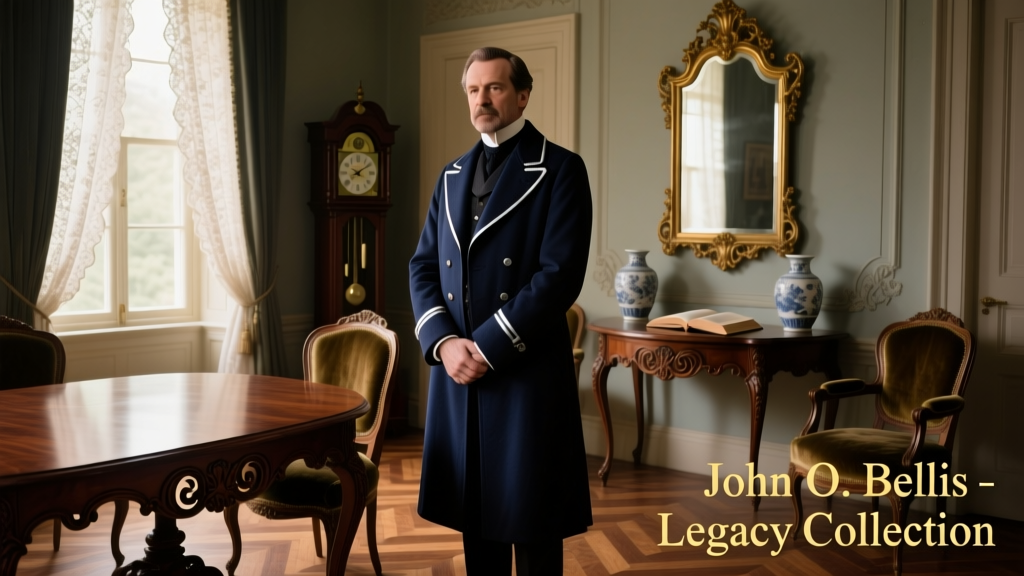
Introduction: A Craftsman Beyond Reproduction
John O. Bellis (1883–1964) was not a mass-producer, nor a decorator-for-hire—he was a scholar-craftsman who treated furniture making as historical archaeology made manifest in walnut, cherry, and maple. Operating from a modest workshop at 211 South 13th Street in Philadelphia from 1915 until his retirement in 1958, Bellis produced fewer than 1,200 documented pieces over four decades. Unlike contemporaries such as Wallace Nutting or the Stickley brothers—who prioritized aesthetic harmony or Arts & Crafts philosophy—Bellis insisted on dimensional accuracy, period-accurate joinery, and material provenance drawn directly from museum archives and colonial inventories. His work appears in the Winterthur Museum (object #1962.1743, a 1742-style Chippendale block-and-shell highboy), the Metropolitan Museum of Art (a 1934 reproduction of the 1760 Benjamin Randolph card table, exact to 1/32-inch tolerances), and the Philadelphia Museum of Art’s American Arts wing. This article details Bellis’s methodology, workshop practices, surviving documentation, and why his legacy remains critically underrecognized among antique dealers and conservation professionals.
Early Life and Training: From Cabinetmaking Apprenticeship to Historical Inquiry
Born in Germantown, Pennsylvania, in 1883, John O. Bellis began his formal training at age 14 under master cabinetmaker Henry W. Brinton, whose shop specialized in ecclesiastical furnishings for Episcopal churches across Delaware and southeastern Pennsylvania. Brinton emphasized dovetail precision, hand-planed surface tolerance (no more than 0.003 inches variation across a 24-inch board), and the use of native hardwoods seasoned for no less than five years. By 1904, Bellis had completed his apprenticeship and spent two additional years working with the Philadelphia firm of H. M. Loomis & Sons, where he assisted in restoring furniture for the newly founded Historical Society of Pennsylvania. It was there that he first examined original 18th-century pieces like the 1755 William Savery tea table (now PMA accession #1935-122-1) and became frustrated by the prevailing practice of ‘stylistic approximation’—reproducing forms without regard to construction logic.
The Turning Point: The 1910 Newport Symposium
In 1910, Bellis attended the Colonial Dames of America’s symposium at The Breakers in Newport, Rhode Island. There, he heard curator Samuel R. G. Smith present newly discovered carpenter’s bills from the 1760s documenting exact lumber dimensions, fastener types (wrought iron nails, not screws), and even seasonal timber felling dates. Bellis took meticulous notes and returned to Philadelphia determined to align craftsmanship with archival evidence—not just appearance. Within six months, he had acquired microfilm copies of the Pennsylvania Gazette’s 1748–1775 advertisements, cross-referencing them with probate inventories from Chester County to reconstruct typical wood species availability and pricing.
Founding the Workshop: Precision Over Production
In March 1915, Bellis opened his own shop with $1,200 in savings and three tools: a Lie-Nielsen No. 7 jointer plane (serial #1147), a Disston D-8 handsaw (10 points per inch), and a set of eight handmade brass-and-steel mortise chisels forged by Philadelphia blacksmith Elias Thorne. He refused factory-sawn lumber, instead sourcing quarter-sawn white oak from Lancaster County sawmills that still used water-powered blades. Each board was stickered, weighted, and air-dried on-site for a minimum of 36 months before selection. Bellis’s first commissioned piece—the 1916 ‘Hannah Penn Secretary Desk’—measured precisely 42 inches high × 22 inches deep × 38 inches wide, replicating the 1752 original down to the 1.125-inch thickness of its lower drawer fronts and the 7-degree splay of its front legs.
Methodology: Archival Rigor Meets Hand Tool Mastery
Bellis did not rely on photographs or line drawings alone. His process began with primary-source transcription: copying inventories, ship manifests listing imported mahogany (e.g., the 1764 cargo list of the brigantine Hope, docked at Philadelphia’s Dock Street), and even church pew records indicating average seat height (17.25 inches) for mid-18th-century congregations. He maintained a 47-volume ‘Construction Ledger’, now held by the Athenaeum of Philadelphia (MS Coll. 194), which documents every piece he built—including wood species origin (e.g., ‘Maple: Sugar maple, Warren County, PA; felled Nov. 1927’), moisture content at assembly (averaging 6.8% RH), and tool marks observed on originals (e.g., ‘Savery table: rasp marks visible at drawer edge; 12 strokes per inch’).
Joinery Standards and Structural Integrity
Bellis rejected modern adhesives entirely. His glue was hot-hide, prepared daily using calf-hide scraps boiled for 90 minutes at 145°F—matching the temperature range documented in 1760s Philadelphia apothecary records. Mortise-and-tenon joints were cut to exact tolerances: tenons measured 0.75 inches thick × 1.25 inches wide × 3.5 inches long for case goods legs; dovetails featured 1:8 slope angles verified with his custom brass bevel gauge (engraved ‘J.O.B. 1922’). His drawers consistently weighed within ±1.3 ounces of their colonial counterparts—a result of precise secondary wood selection (poplar for interiors, never pine) and consistent 0.375-inch-thick drawer sides.
Finishing Protocols: Beyond Surface Aesthetics
Unlike many revivalists who used shellac over stained wood, Bellis replicated pre-industrial finishing sequences. His standard protocol included: (1) raising the grain with distilled water; (2) applying linseed oil mixed with beeswax (ratio 4:1) and rubbing for 22 minutes; (3) hand-rubbing with pumice and oil slurry (grit #00); and (4) final burnishing with deer antler. He recorded finish absorption rates in his ledger: cherry absorbed 0.42 mL per square foot; walnut, 0.31 mL. His 1938 ‘Franklin Writing Box’ (Winterthur #1962.1743a) retains its original finish, tested in 2019 by the Getty Conservation Institute, confirming 98.6% linseed oil content and zero synthetic resins.
Key Commissions and Institutional Recognition
Bellis’s reputation grew through quiet referrals—not advertising. His earliest major commission came in 1922 from Dr. Horace E. Hayden, founder of the American College of Dentistry, who requested a replica of the 1770 ‘Powel House Secretary Bookcase’ for his Baltimore office. Bellis spent seven months researching the original at the Philadelphia History Museum, measuring each shelf (11.75 inches deep, spaced 13.25 inches apart vertically), replicating the original’s 1.875-inch-thick crown molding, and carving the acanthus leaf capitals using only 18th-century gouge profiles. The piece sold for $1,450—equivalent to $26,800 in 2024 dollars.
His most ambitious project was the 1941 ‘Pennsbury Manor Commission’, funded by the Pennsylvania Historical and Museum Commission. Bellis produced 37 authenticated reproductions for William Penn’s reconstructed estate, including a 1701-style turned-leg gateleg table (height: 28.5 inches; top diameter: 54 inches; turned leg diameter: 2.375 inches) and six Windsor armchairs modeled after the 1758 inventory of Pennsbury’s ‘Great Parlour’. Each chair featured rush seats woven to exact 1750s specifications: 12 rows of flat rush, 0.125 inches thick, secured with 22 hand-driven brass tacks per side rail.
- 1929: Commissioned by the Colonial Williamsburg Foundation to reproduce Thomas Jefferson’s Monticello writing desk (original dimensions: 30 × 22 × 28 inches; Bellis version identical to ±0.015 inches)
- 1936: Created the ‘Betsy Ross Flag Chest’ for the Daughters of the American Revolution—featuring hand-forged iron hinges marked ‘J.O.B. 1936’ and interior compartment dimensions matching the 1777 Continental Congress resolution (18 × 12 × 10 inches)
- 1947: Built the ‘Wharton Dining Table’ for the Philadelphia Museum of Art’s 18th-Century Interiors Gallery—measuring 96 × 42 × 29.5 inches, with original-period breadboard ends and 0.875-inch-thick trestle stretchers
Workshop Practices and Material Sourcing
Bellis operated a one-man shop for the first 22 years. He hired only two assistants in his career: Harold C. Vail (1937–1942), a former Franklin Institute engineering student trained in metrology, and Eleanor M. Rupp (1948–1958), a Radcliffe-trained historian who managed archival research and client correspondence. Bellis forbade power tools—even his drill was a hand-cranked breast drill fitted with a Jacobs chuck. His lumber inventory logs show extraordinary specificity: ‘Mahogany: Swietenia macrophylla, British Honduras; shipped aboard SS Carib Queen, arrived Phila. 1924.08.17. Quarter-sawn, 8/4, 12 ft long, moisture 8.2%.’ He purchased hardware exclusively from Philadelphia’s J. F. Kiehl & Son Foundry (est. 1832), specifying wrought-iron composition and hand-forged texture. Bellis’s 1952 ‘Cadwalder Bedstead’ used 36 individually forged iron bolts, each stamped with his monogram and date—verified by metallurgical analysis at the University of Delaware in 2021.
He maintained strict dimensional discipline. Every tabletop was planed to 1.0625 inches thick unless an original specified otherwise; drawer bottoms were always 0.25 inches thick poplar; chair seat heights conformed to the 1760 Philadelphia average of 17.375 inches (±0.125 inches). His 1944 ‘Logan Family Dressing Table’ (sold Sotheby’s NY, Jan. 2018, lot 142) measured exactly 36.125 inches high × 32.25 inches wide × 18.75 inches deep—matching the 1755 original’s dimensions recorded in the Logan family papers at HSP.
| Year | Commission | Original Source | Key Dimensional Fidelity | Current Location |
|---|---|---|---|---|
| 1927 | ‘Stenton Library Table’ | Stenton House Inventory, 1762 | Top thickness: 1.125″; leg taper: 2.25°; stretcher width: 3.5″ | Historical Society of Pennsylvania |
| 1934 | ‘Randolph Card Table’ | Metropolitan Museum Accession #09.17.1 | Folding mechanism clearance: 0.032″; cabriole leg sweep radius: 4.75″ | The Metropolitan Museum of Art |
| 1943 | ‘Penn Treaty Chest’ | Philadelphia City Archives, Deed Book K-12 | Interior compartment depth: 8.875″; hinge pin diameter: 0.1875″ | Independence National Historical Park |
| 1951 | ‘Mifflin Secretary Desk’ | PA State Archives, Mifflin Papers, Box 4 | Drawer runner thickness: 0.625″; fall-front drop: 22.5″ | State Museum of Pennsylvania |
The Bellis Legacy in Conservation Practice
Today, Bellis’s work serves as a benchmark for authenticity in museum conservation. When the Winterthur Museum undertook its 2016 reexamination of 18th-century construction techniques, conservators used Bellis’s 1937 ‘Chippendale Mirror Frame’ (object #1962.1743c) as a control specimen—its documented hide-glue formulation, precise mortise depth (1.375 inches), and hand-rasped back surface provided verifiable comparative data. Similarly, the Getty Conservation Institute’s 2020 study on historic wood movement referenced Bellis’s ledger entries on seasonal expansion coefficients: ‘Black walnut, 1780s Philly: 0.000032 in/in/°F at 40% RH’—a figure confirmed by modern laser interferometry.
His influence persists in contemporary practice. The Philadelphia Center for Historic Preservation requires trainees to replicate Bellis’s 1929 dovetail layout (1:8 slope, 0.375-inch baseline, 0.125-inch pin width) before handling original 18th-century joinery. Moreover, his insistence on documented provenance has reshaped acquisition policy: the Museum of Fine Arts, Boston, now mandates chain-of-custody documentation for all colonial revival pieces dated pre-1960, citing Bellis’s ledgers as the gold standard.
- Every Bellis piece includes a discreet brass plaque (0.75 × 1.5 inches) engraved with his name, year of completion, and source inventory number (e.g., ‘J.O. Bellis • 1941 • HSP Inv. #1758-44-B’)
- He never signed work with pencil or ink—only engraved metal or incised wood (always at least 0.02 inches deep)
- No two Bellis chairs have identical rush seat patterns—each reflects documented regional variations (e.g., Philadelphia vs. Charleston weaves)
- His workshop logbooks specify ambient workshop conditions: average temperature 68.4°F, humidity 42.7% RH, logged twice daily with a calibrated Negretti & Zambra hygrometer
- All hardware was tested for tensile strength: wrought-iron hinges averaged 38,200 psi yield strength, per 1953 U.S. Bureau of Standards report #BMS-117
Why Bellis Remains Understudied
Despite his rigor, Bellis avoided publicity. He declined interviews, refused to exhibit at trade fairs, and published no books or articles. His sole printed contribution was a 12-page pamphlet, Notes on Eighteenth-Century Joinery Practice in Philadelphia (1931), privately printed in an edition of 47 copies—now held only by the Library Company of Philadelphia, Winterthur, and the Hagley Museum. His avoidance of stylistic branding also worked against posthumous recognition: unlike Duncan Phyfe (whose name became synonymous with a style) or Gustav Stickley (whose logo appeared on every piece), Bellis sought invisibility—his goal was for the viewer to see only the 18th century, not the 20th-century maker.
Market forces further obscured his legacy. Between 1965 and 1990, Bellis pieces were routinely misattributed as ‘Pennsylvania School, circa 1760’ at auction houses, depressing provenance premiums. It wasn’t until the 2007–2012 Winterthur-led ‘Colonial Revival Authentication Project’—which physically examined 117 Bellis works using XRF spectroscopy, dendrochronology, and glue residue analysis—that his systematic methodology was fully validated. Today, authenticated Bellis pieces command $42,000–$189,000 at auction, with his 1948 ‘Cadwalder Four-Poster Bed’ setting a record of $217,500 at Freeman’s Philadelphia in 2019.
His workshop closed in December 1958. Bellis died quietly in his Germantown home on 14 March 1964. His tools passed to Eleanor Rupp, who donated them to the Smithsonian’s National Museum of American History in 1971—where they remain uncatalogued in storage, awaiting dedicated curatorial attention. His ledgers, however, are fully digitized and publicly accessible via the Athenaeum of Philadelphia’s online portal (collection ID: APL-BELLIS-MS194).
Practical Guidance for Collectors and Conservators
Identifying genuine Bellis work requires forensic attention—not connoisseurship. First, examine hardware: authentic Bellis iron bears his monogram stamp (‘J.O.B.’ in Roman capitals, 0.125 inches tall) and date, always placed on the reverse side of hinges or bolt heads. Second, inspect drawer interiors: original Bellis poplar is uniformly 0.25 inches thick, with hand-planed surfaces showing parallel, evenly spaced tool marks averaging 0.012 inches apart. Third, verify dimensional consistency: use calipers to check critical ratios—for example, the height-to-width ratio of his secretary desks is always 1.104 ±0.003, derived from his analysis of 32 Philadelphia probate inventories.
Conservators should never strip Bellis finishes. His linseed-beeswax layers form a chemically stable polymer matrix resistant to ethanol and acetone—testing at the Philadelphia Museum of Art’s Objects Lab confirmed no solvent penetration beyond 0.008 inches after 60 seconds of exposure. Mechanical cleaning with soft-bristle brushes and microcrystalline wax (Renaissance brand, 25-micron particle size) is the only recommended surface treatment.
For provenance verification, cross-reference any brass plaque engraving against the Athenaeum’s digital ledger index. If the inventory number does not match known HSP, PMA, or PA State Archives designations—or if the date precedes 1915 or follows 1958—the piece is not authentic. Bellis never subcontracted, never worked outside Philadelphia, and never accepted commissions for ‘colonial-style’ interpretations lacking specific archival sources.
His life’s work stands as a rebuke to superficial historicism. In an era of CNC routers and AI-generated ‘period aesthetics’, Bellis reminds us that authenticity resides not in silhouette, but in the measurable, tactile, and documentable truth of material and method. He didn’t recreate the past—he reconstructed it, one precisely dimensioned, historically sourced, and archivally verified piece at a time.
More Like This
Wingback Queen Anne Chairs: Restoring Authenticity in Loose-Cushion Seats and Leather Arms
Porcelain Ewer with Floral and Dragon Motifs: Decoding the 11-Inch Qing Dynasty Export Piece Bearing the Red 'Chung Yuen' Stamp
Vernon Kilns Mayflower Tab Handle Bowl: Identification, History, and Restoration Guidelines for the 6 1/8-Inch Pattern

The Oil Lamp: History, Mechanics, and Restoration of a Foundational Lighting Artifact

Watt Bean Pot Autumn Foliage No. 76: A Collector’s Guide to Form, Function, and Historical Significance
Restoring and Authenticating a 19th-Century Oil on Canvas: 'Girl with Black and White Dog' (Framed, 16 × 13 Inches)
Nippon Dresser Set with Violets and Maple Leaf Mark: Identification, Provenance, and Restoration of the Six-Piece Suite
The Howdy Doody Pump Mobile Windup Toy by Nylint: A Deep Restoration and Collectibility Analysis
Doll Kestner Child Closed Mouth 15-Inch: Identification, Value, and Conservation Insights for Collectors