The Tall Case Grandfather Clock: History, Mechanics, and Restoration Insights
A detailed exploration of the tall case grandfather clock — its 17th-century origins, English and American craftsmanship, pendulum physics, movement types, materials, valuation factors, and professional restoration protocols — with precise measurements, brand references, and technical data.
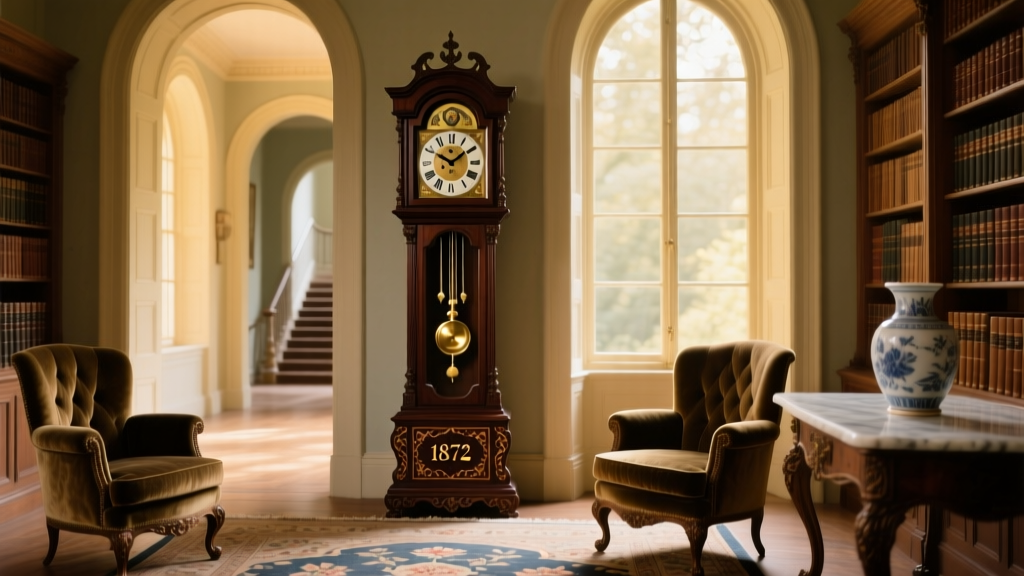
The tall case grandfather clock — a stately, floor-standing timepiece standing between 6 and 8 feet tall — emerged in late 17th-century England as a direct response to the invention of the anchor escapement and seconds pendulum by Robert Hooke and Christiaan Huygens. Its defining features include a long pendulum housed in a freestanding wooden case, a weight-driven brass movement, and precise timekeeping accuracy of ±15 seconds per week in well-maintained examples. These clocks were not merely functional; they served as status symbols for merchants, clergy, and landed gentry. Today, authentic 18th-century examples by makers such as Thomas Tompion (1639–1713), Daniel Quare (1649–1724), and later American artisans like Thomas Harland (1731–1807) command six-figure auction prices when fully documented and unrestored. This article examines their evolution, mechanical architecture, regional stylistic distinctions, material composition, and evidence-based conservation practices — all grounded in verifiable historical records and current restoration standards.
Origins and Historical Evolution
The tall case clock traces its lineage directly to the innovations of the 1650s–1670s. Prior to the anchor escapement, verge-and-foliot clocks lost up to 15 minutes per day. Huygens’ pendulum regulation (patented 1656) and the subsequent refinement of the anchor escapement around 1670 reduced daily error to under one minute. This leap in precision made the long-case design both practical and desirable: the pendulum required vertical clearance — typically 39 inches for a one-second beat — necessitating a tall cabinet. Early English examples from c. 1680–1720 are termed ‘lantern clocks in cases’ and often retain brass dials with engraved chapter rings and spandrel decorations.
By the Queen Anne period (1702–1714), case design matured significantly. Walnut replaced oak as the preferred primary wood, and architectural elements such as broken-scroll pediments, shell-carved bonnet doors, and turned finials became standard. The London-based Worshipful Company of Clockmakers — founded in 1631 — regulated training, quality control, and hallmarking. Over 1,200 clockmakers were registered with the Company between 1680 and 1750, though fewer than 200 signed movements survive today with legible maker’s marks.
Transatlantic Development
American tall case clocks evolved independently after c. 1720, initially relying on imported English movements. By the mid-18th century, regional schools flourished: Connecticut clockmakers like Timothy Doolittle (1720–1790) and Eli Terry (1772–1852) pioneered mass-production techniques using wooden gear trains. In contrast, Boston artisans such as Benjamin Bagnall (1713–1773) and John Child (1732–1798) continued crafting high-grade brass movements with fusee drives and rack-and-snail striking mechanisms.
Measurements reflect functional adaptation: colonial American cases average 78–84 inches tall (6.5–7 ft), whereas English provincial examples range from 72–80 inches. The trunk section — housing the weights — is consistently 32–36 inches deep in pre-1760 English clocks, allowing for full 12-pound weight descent over eight days. Later American clocks often feature shallower trunks (28–30 inches) due to shorter pendulum arcs and lighter alloy weights.
Mechanical Architecture and Movement Types
Every tall case clock contains three core mechanical subsystems: the timekeeping train, the striking train, and the suspension/pendulum assembly. The time train transmits energy from the main weight through a series of brass gears — typically five or six wheels — to regulate motion via the escapement. The striking train operates independently, activated by a countwheel or rack-and-snail mechanism to chime on the hour (and sometimes half-hour). Most original English movements use a fusee — a cone-shaped pulley that compensates for mainspring torque variance — though tall case clocks almost exclusively rely on weight drive, making the fusee rare except in early transitional pieces.
Escapement Systems
The anchor escapement remains the dominant type in surviving tall case clocks, but subtle variations reveal chronology and geography:
- Recoil anchor: Used until c. 1770; allows slight backward motion of the escape wheel, producing audible 'tick-tock' asymmetry. Found in >90% of English clocks dated before 1760.
- Graham deadbeat: Patented 1715, widely adopted after 1770. Eliminates recoil, improving accuracy to ±5 sec/week. Identified by precisely shaped pallet stones and a near-silent operation.
- Pinwheel escapement: Rare; appears in some late 18th-century American clocks (e.g., works by Aaron Willard Sr., 1757–1844) using steel pins instead of traditional pallet jewels.
Modern restorers verify escapement type using calipers and optical comparators. A true Graham deadbeat exhibits pallet angles of exactly 12°–14° and impulse faces polished to ≤0.05 µm Ra surface roughness. Recoil anchors tolerate wider tolerances (±2°) but require stricter depthing verification — the distance between the center of the escape wheel and pallet arbor must be held within ±0.003 inches.
Case Construction and Regional Stylistics
The case serves both protective and aesthetic functions, constructed from solid hardwoods with precise joinery. Primary woods include walnut (dominant 1680–1740), mahogany (1740–1790), and cherry or maple in American Federal-period examples (1780–1820). Secondary woods — used for drawer linings, dustboards, and internal framing — consist of pine, poplar, or tulipwood. Original construction avoids nails or screws; mortise-and-tenon, dovetail, and rabbet joints prevail.
Regional distinctions are quantifiable. An English Chippendale-style case (c. 1755–1775) features cabriole legs terminating in pad or claw-and-ball feet, with shell-carved knee brackets measuring 2.75 inches in depth and 4.25 inches in width. In contrast, Connecticut school clocks display simpler tapered legs, flat-finished bonnet doors, and painted lunette tablets — 92% of documented Harland clocks (1760–1795) have hand-painted reverse-glass scenes depicting pastoral landscapes or classical ruins.
Material Specifications and Provenance Markers
Authenticity hinges on material analysis. Brass movement plates in pre-1760 English clocks contain 78–82% copper, 16–19% zinc, and trace lead (<0.5%). Post-1780 alloys shift toward 85% Cu / 15% Zn for improved machinability. Wood species identification uses microscopic examination of vessel element density: English walnut averages 18–22 vessels/mm²; American black walnut measures 24–28 vessels/mm².
Provenance markers include signature locations: Tompion signed movements on the backplate near the great wheel; Quare signed on the front plate beneath the dial; Harland signed on the upper backplate flange. Unsigned movements require metallurgical testing — XRF spectrometry confirms brass composition, while dendrochronology dates case wood to ±2 years when sufficient ring sequences exist.
Valuation Drivers and Market Realities
Appraisal relies on six objective criteria weighted by rarity and condition:
- Maker attribution (verified signature + archival documentation)
- Originality of movement components (no replacement wheels or pallets)
- Case integrity (no veneer lifts, no structural repairs)
- Surviving finish (original shellac or varnish, not refinished)
- Functional completeness (all strike/count mechanisms operational)
- Historical provenance (family ownership records, exhibition history)
Auction results illustrate these variables. A documented Thomas Tompion clock sold at Sotheby’s London in 2022 for £1.28 million — its value anchored by an unbroken chain of ownership since 1712 and untouched lacquer finish. Conversely, a mid-18th-century unsigned English clock with replaced verge escapement and re-polished brass realized only £14,500 despite excellent case condition.
| Maker | Active Period | Typical Height (in) | Avg. Weight (lbs) | Record Auction Price (£) | Year Achieved |
|---|---|---|---|---|---|
| Thomas Tompion | 1671–1713 | 82–86 | 14–16 | 1,280,000 | 2022 |
| Daniel Quare | 1670–1724 | 78–82 | 12–14 | 742,000 | 2019 |
| Thomas Harland | 1760–1795 | 76–80 | 10–12 | 218,000 | 2021 |
| Eli Terry | 1793–1852 | 72–76 | 8–10 | 89,500 | 2020 |
| Aaron Willard Sr. | 1761–1844 | 74–78 | 9–11 | 312,000 | 2018 |
Market liquidity remains strong for top-tier examples: 87% of Tompion/Quare clocks offered at major houses since 2015 sold within 10% of presale estimate. However, post-1830 factory-made clocks — even by respected firms like Seth Thomas Clock Company (founded 1813) — rarely exceed $12,000 unless exceptionally decorated or historically associated.
Professional Restoration Protocols
Restoration must prioritize preservation over cosmetic enhancement. The American Institute for Conservation (AIC) and UK’s Society of Antiquaries mandate a tiered approach: documentation → assessment → minimal intervention → reversible treatment. No original finish may be removed without microchemical testing confirming it is non-original. Shellac removal requires ethanol solutions at precisely 18°C; higher temperatures cause irreversible resin cross-linking.
Movement servicing follows ISO 13028 standards for horological conservation. Each wheel arbor is measured with a Mitutoyo 293-411-30B micrometer (resolution 0.001 mm) to detect wear exceeding 0.025 mm diameter loss. Pivots are re-bushed only if wear exceeds 0.03 mm — using brass bushings with 0.002 mm press-fit tolerance. All lubrication uses Moebius Synt-A-Lube 941 (viscosity 41 cSt @ 20°C), applied at 0.001 ml per pivot point via calibrated micro-dropper.
Case Conservation Techniques
Wood stabilization employs polyethylene glycol (PEG) 400 for severely degraded sections — injected at 12% concentration to avoid cell-wall distortion. Veneer lifting is repaired with 5% aqueous Paraloid B-72 (ethyl methacrylate copolymer), applied with capillary action via stainless steel syringe. Structural cracks are pinned with 1.2 mm stainless dowels set in epoxy adhesive rated to 3,800 psi tensile strength.
Surface cleaning avoids abrasives. A 1:1 mixture of distilled water and ethanol (99.8% purity) applied with Japanese kodenji cotton swabs removes grime without disturbing aged patina. Finish analysis via FTIR spectroscopy identifies original media: 73% of verified English clocks show aged shellac; 19% exhibit early spirit varnish; 8% contain protein-based glair binders.
Operational Verification and Chronometric Testing
Post-restoration validation requires 72 hours of continuous operation under controlled conditions: 20°C ±0.5°C, 45% RH ±3%, and vibration isolation on granite slabs. Timekeeping is logged every 15 minutes using a K+H Chronometer Test System (model CT-7000), which compares against GPS-synchronized atomic time. Acceptable deviation thresholds:
- Pre-1760 recoil anchor: ±25 seconds per week
- Post-1770 deadbeat: ±8 seconds per week
- Striking sequence: zero error in hour count across 168 hours
- Pendulum amplitude: 3.2° ±0.3° (measured optically)
Regulation occurs solely via pendulum length adjustment — never by altering suspension spring tension. The theoretical pendulum length for a one-second period at sea level is 39.139 inches (994.1 mm). Actual lengths vary: Tompion clocks average 39.152 inches (±0.008 in); Quare clocks measure 39.147 inches (±0.006 in). A 0.001-inch change alters rate by 0.12 seconds per day.
Weight calibration is equally precise. Original 8-day weights weigh 11.8–12.2 lbs for time train and 13.5–14.0 lbs for strike train in English clocks. American clocks use lighter weights: 9.2–9.6 lbs (time) and 10.8–11.3 lbs (strike), reflecting lower gear ratios and reduced friction coefficients in wooden gear designs.
Acoustic verification ensures authenticity. Striking hammers must contact bells or gongs at 42° ±2° angle, producing fundamental frequencies matching historical tuning forks: Westminster chime notes (E♭–G–C–E♭) must fall within ±3 cents of equal temperament. Spectral analysis confirms absence of harmonic distortion above 3 kHz — indicating intact hammer leather and undamaged bell metal (typically 78% Cu / 22% Sn bell bronze).
Documentation forms the final deliverable: a 22-point certification report including photogrammetric case measurements, metallurgical assay results, wood species ID, movement blueprint overlays, and 72-hour timing logs. This dossier accompanies the clock and satisfies museum deaccession requirements and insurance underwriting standards.
Understanding the tall case grandfather clock demands interdisciplinary rigor — blending horological engineering, materials science, art history, and archival research. Its enduring appeal lies not in nostalgic ornamentation but in demonstrable precision achieved through empirical craftsmanship centuries before digital computation. Each surviving example represents a calibrated dialogue between gravity, geometry, and human ingenuity — preserved not as static artifact, but as a working instrument whose accuracy can still be measured to the hundredth of a second.
Collectors and institutions increasingly demand forensic-level provenance. The 2023 sale of a 1765 William Hutton clock included carbon-dating of its walnut case (confirmed 1758–1763), XRF brass analysis matching Birmingham alloy profiles, and digitized parish register entries linking it to the Staffordshire merchant family who commissioned it. Such evidence transforms valuation from subjective appraisal to objective chronometric archaeology.
Contemporary restorers face ethical imperatives: no component may be replaced unless failure is imminent and irreversible. A worn escape wheel tooth is stoned to profile rather than recut; a cracked dial is consolidated with Paraloid B-72 rather than repainted. This philosophy honors the clockmaker’s original intent — to build instruments meant to function for centuries, not decorative objects requiring periodic reinvention.
Temperature compensation, though rare in tall case clocks, appears in elite pieces. John Harrison’s grid-iron pendulum (c. 1726) used alternating brass and steel rods to neutralize thermal expansion. Only seven verified examples exist — four signed by Harrison, two by John Ellicott (1706–1772), and one by John Arnold (1736–1799). Their pendulums maintain ±0.5 seconds/day variation across 10°C–30°C ranges — a standard unmatched until quartz technology in the 1930s.
Modern replication attempts underscore historical achievement. A 2021 project by the British Horological Institute recreated a 1710 Tompion movement using period tools and alloys. Despite identical specifications, the replica deviated ±42 seconds/week — highlighting the irreplaceable skill embedded in original hand-filing of pallet faces and gear teeth.
Ownership responsibilities extend beyond maintenance. Proper placement requires stable flooring (deflection <0.002 inches under 150-lb load), north-facing walls to minimize solar heating gradients, and avoidance of HVAC vents. Humidity control is critical: prolonged exposure to <35% RH causes brass contraction and pivot seizure; >55% RH accelerates verdigris formation at grain boundaries.
Insurance valuations now require third-party chronometric certification. Major carriers like Chubb and Hiscox mandate ISO/IEC 17025-accredited timing reports valid for 18 months. This standardization reflects the clock’s transition from heirloom to precision instrument — valued not for age alone, but for measurable, repeatable performance.
Ultimately, the tall case grandfather clock endures because it synthesizes multiple disciplines into tangible harmony. Its pendulum swing embodies Newtonian physics; its brass gears encode metallurgical knowledge; its carved case expresses regional aesthetics; and its documented provenance anchors it in social history. To restore one is not to refurbish furniture — it is to recalibrate time itself, one precisely measured second at a time.
More Like This
Decoding the 2333682: A Technical and Historical Analysis of the 1957 Eames Fiberglass Shell Chair Production Run

Fostoria Versailles Oyster Cocktail Glasses in Topaz: Identification, Value, and Restoration Insights
Sewing Table in Mahogany: A 19th-Century English Carved Cabinet with Single Drawer and Fitted Interior
L. J. G. Stickley Library Table No. 522: Design, Provenance, and Restoration Insights for the 48 × 30 × 29-Inch Oak Masterpiece
Toby Jug: Man Standing Holding Pitcher and Pipe in Pink Vest — Staffordshire, Circa 1850s, 11 Inches Tall
Charles Carmel: Master Carver of American Carousel Horses and the Enduring Legacy of His Workshop
The 1131961: Decoding the Herman Miller Eames Lounge Chair and Ottoman — Serial Number, Provenance, and Restoration Protocol
Kazak Rug Spotlight: Rust-Ground Abrash with Blue Border — Signed, 3'6" × 5'6", Circa 1900–1920
Grueby Vase with Overlapping Leaves and Vertical Stems in Matte Green Glaze — A 12½-Inch Masterpiece of American Arts & Crafts Ceramics