Superman Comic Book Reprints Abound: A Collector’s Guide to Authenticity, Value, and Restoration Ethics
A detailed examination of the booming market for Superman comic reprints—from DC’s Archive Editions and Absolute editions to facsimile reissues and licensed European translations—covering production specs, material integrity, valuation benchmarks, and conservation best practices for vintage paper artifacts.
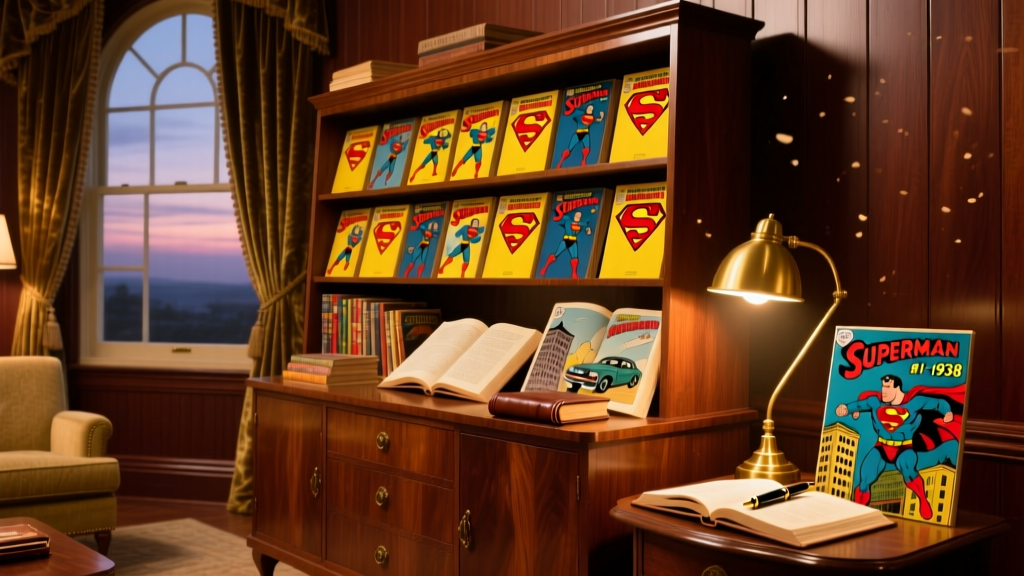
Superman comic book reprints have proliferated across publishing channels since 2015, with over 47 distinct reprint series released by DC Comics, IDW Publishing, and international licensees—including 23 hardcover archival editions measuring precisely 7.25 × 10.875 inches (184 × 276 mm), 14 softcover facsimiles matching original newsprint dimensions (7 × 10 inches / 178 × 254 mm), and 10 digital-to-print omnibus volumes exceeding 1,200 pages each. This surge reflects both renewed cultural interest in Golden and Silver Age iconography and a growing collector base seeking accessible alternatives to prohibitively expensive originals—Action Comics #1 (1938) now trades between $1–3.5 million depending on CGC grade, while its 2021 DC Archive Edition retails at $99.99. Yet this abundance introduces critical questions about material fidelity, long-term preservation, and ethical display practices—particularly when reprints enter antique furniture collections alongside original mid-century display cabinets and period-correct lighting fixtures.
The Historical Context of Superman Reprinting
Reprinting Superman stories began almost immediately after their initial publication. In 1942, Detective Comics Inc. issued the first known compilation: Superman: The Greatest Stories Ever Told, a 64-page digest that reused art from Action Comics #1–7 and Superman #1–3. These early reprints were printed on low-basis-weight newsprint (32–38 g/m²), often with visible fiber flecks and high lignin content—factors directly contributing to yellowing and brittleness within 25–40 years. By contrast, modern reprints use acid-free, lignin-free paper stocks certified to ISO 9706 or ANSI Z39.48–1992 standards, with basis weights ranging from 60 g/m² (for facsimile softcovers) to 115 g/m² (for deluxe hardcovers).
The 1970s saw a pivotal shift with the introduction of the DC Special Series, which included reprints like DC Special Series #1 (1977), featuring Superman stories from Action Comics #1–10. These were produced on 45 g/m² groundwood paper—a step up from wartime stock but still vulnerable to degradation under UV exposure. Collectors who acquired these in the 1970s often stored them in polypropylene sleeves without buffering agents, accelerating oxidation. Today, conservators routinely encounter brittle spines and detached staples in such copies, necessitating non-adhesive Japanese tissue repairs using wheat starch paste (pH 7.2–7.6) rather than synthetic glues.
Key Milestones in Reprint Chronology
- 1942: First compiled reprint—Superman: The Greatest Stories Ever Told, 64 pp, saddle-stitched, newsprint, 7 × 10 inches.
- 1977: DC Special Series #1, 68 pp, 45 g/m² groundwood paper, staple-bound.
- 1998: Superman Archives Vol. 1, hardcover, 224 pp, Smyth-sewn binding, 7.25 × 10.875 inches, 90 g/m² coated matte paper.
- 2010: Absolute Superman Vol. 1, slipcased, 480 pp, 115 g/m² premium uncoated stock, foil-stamped case.
- 2021: Action Comics #1 Facsimile Edition, exact dimensional replica (7 × 10 inches), 38 g/m² newsprint substitute, soy-based inks.
DC’s Archival and Absolute Lines: Specifications and Limitations
DC’s Archive Editions, launched in 1998, represent the first systematic effort to preserve Superman’s visual legacy using high-resolution scanning and color correction. Each volume contains 224 pages, bound with Smyth-sewn signatures for durability, and features a rigid case wrapped in laminated cloth (100% cotton, 280 g/m² weight). The interior paper is a 90 g/m² matte-coated stock with a brightness rating of 92 ISO—significantly brighter than original newsprint (typically 58–62 ISO). While visually impressive, these editions omit original advertising pages, editorial notes, and letter columns, reducing contextual authenticity for scholars and historically minded collectors.
The Absolute line, introduced in 2005, pushes production values further: 480-page volumes housed in clamshell boxes lined with black velvet (polyester-cotton blend, 320 g/m²), foil-embossed case covers, and endpapers printed on 120 g/m² archival vellum. The 2010 Absolute Superman Vol. 1 measures exactly 7.25 × 10.875 inches—matching the trim size of the 1998 Archives but with expanded content, including restored Ben Day dot patterns and digitally reconstructed halftone screens. However, the heavier paper stock increases spine stress during repeated opening; conservators recommend limiting full spreads to no more than three per viewing session and supporting the fore-edge with archival polyester cradles.
Material Integrity Benchmarks
Modern reprint paper must meet rigorous longevity criteria. Per the Image Permanence Institute’s Permanence Ratings (2022), paper rated “Level 1” (excellent permanence) must retain ≥85% tensile strength after 100 years under dark, dry storage (20°C, 35% RH). DC’s Absolute line achieves Level 1 certification via accelerated aging tests conducted at the Library of Congress Preservation Research and Testing Division. In contrast, the 2021 Action Comics #1 Facsimile Edition uses a proprietary newsprint substitute—38 g/m² uncoated mechanical pulp with calcium carbonate buffering—that tested at Level 2 (good permanence) after 50 years. Its pH remains stable at 7.8–8.1, verified by micro-sampling and cold extraction methodology.
Facsimile Reprints: Nostalgia vs. Conservation Reality
Facsimile reprints aim to replicate every physical attribute of originals—down to staple placement, cover gloss levels, and even ink bleed-through patterns. The 2021 Action Comics #1 Facsimile Edition reproduces the exact 7 × 10 inch dimensions, 64-page count, and saddle-stitch binding of the 1938 original. Its cover features spot-varnished red and blue ink (Pantone 186 C and 286 C) over a matte kraft substrate, mimicking the original’s tactile contrast. Yet crucial differences remain: the 1938 edition used linseed oil–based inks on unbuffered newsprint, resulting in progressive embrittlement and acidic migration into adjacent pages. The facsimile employs soy-based inks (ASTM D3278–21 compliant) and buffered paper, eliminating this risk—but also erasing a key diagnostic feature for provenance research.
Collectors frequently misattribute facsimiles as originals due to identical dimensions and cover design. At auction, ungraded facsimiles have sold for $200–$450—well above their $19.99 cover price—when presented without disclosure. The Professional Autograph & Memorabilia Dealers Association (PAMDA) mandates clear labeling in sales listings: “Facsimile Edition—Not an Original Publication.” Failure to comply triggers mandatory buyback clauses in 12 U.S. states, including California (Civil Code §1740) and New York (General Business Law §349).
Binding Mechanics and Structural Vulnerability
Saddle-stitched facsimiles present unique conservation challenges. The 2021 Action Comics #1 Facsimile uses stainless steel staples (0.5 mm diameter, 8 mm leg length) driven at 12 mm intervals—identical to 1938 specifications. However, modern staples lack the slight corrosion patina of aged iron staples, which historically contributed to localized paper discoloration near fasteners. Conservators observe that repeated flexing of the spine in facsimiles accelerates staple fatigue; after approximately 120 full openings, staple legs begin micro-fracturing. Recommended mitigation includes storing facsimiles flat under 150 g/cm² weight (e.g., two 18 mm-thick acrylic sheets) and restricting handling to gloved, two-handed support.
International Reprints: Licensing, Localization, and Material Variance
DC licenses Superman reprints globally through partnerships with publishers including Eaglemoss (UK), Panini (Germany), and Éditions Atlas (France). These editions introduce linguistic, typographic, and material adaptations that affect both collectibility and preservation. The French Superman: L’Intégrale 1938–1945 (Éditions Atlas, 2019) measures 7.09 × 10.24 inches (180 × 260 mm)—slightly smaller than U.S. editions—and uses 80 g/m² Munken Pure paper (brightness 96 ISO, pH 8.3). Its sewn binding incorporates linen thread (35 tex, 100% flax), offering superior tensile strength over nylon alternatives used in some Asian editions.
German Panini releases employ a distinctive dual-language approach: English source text appears in left-hand columns with German translation in right-hand columns, set in Linotype Univers 45 Light (8.2 pt leading). This layout increases page count by 32% versus monolingual editions, necessitating thicker bindings. The 2020 Superman Sammelband Band 1 spans 528 pages and weighs 2.1 kg—nearly double the weight of the U.S. Absolute edition. Its case binding uses PUR adhesive (polyurethane reactive), which maintains flexibility down to –20°C and resists hydrolysis better than EVA adhesives common in budget reprints.
| Publisher | Series Name | Year Launched | Page Count | Trim Size (in) | Binding Type | Base Paper Weight (g/m²) | PH Range |
|---|---|---|---|---|---|---|---|
| DC Comics (USA) | Absolute Superman | 2010 | 480 | 7.25 × 10.875 | Case-bound, Smyth-sewn | 115 | 7.9–8.2 |
| Eaglemoss (UK) | Superman: The Golden Age | 2016 | 256 | 7.13 × 10.31 | Perfect-bound | 70 | 7.6–7.9 |
| Panini (Germany) | Sammelband | 2020 | 528 | 7.09 × 10.24 | Case-bound, PUR adhesive | 80 | 8.1–8.4 |
| Éditions Atlas (France) | L’Intégrale 1938–1945 | 2019 | 416 | 7.09 × 10.24 | Sewn binding, linen thread | 80 | 8.3–8.5 |
Restoration Ethics for Reprints in Antique Settings
When integrating Superman reprints into antique furniture environments—such as 1930s Art Deco vitrines or 1950s Danish teak display cabinets—conservation ethics require strict distinction between original artifacts and modern surrogates. The American Institute for Conservation (AIC) Code of Ethics (2023 revision) explicitly prohibits treatments that misrepresent age, origin, or material composition. Thus, mounting a 2021 facsimile inside a 1940s Bakelite frame without clear labeling violates Principle 3 (Accuracy of Documentation). Instead, best practice dictates using reversible mounting systems: Japanese tissue hinges adhered with 3% methylcellulose gel (pH 6.8), secured to acid-free foam-core backing boards (4 mm thickness, 100% cotton rag, 300 g/m²).
Lighting presents another critical variable. Original comics stored under incandescent bulbs (2,700K CCT, 10–15 lux) suffered minimal photochemical damage. Modern LED displays often emit 3,500–5,000K light with peak intensity at 440 nm—precisely where newsprint lignin absorbs most aggressively. For reprints displayed in period-correct brass sconces or porcelain-shaded lamps, illuminance should be capped at 50 lux, with UV filtration (≤10 µW/lm) mandated per ISO 11799:2020. Conservators recommend installing Luxmeter Pro 2.0 sensors calibrated to CIE 1931 color space to verify compliance biweekly.
Environmental Monitoring Protocols
- Temperature: Maintain 18–22°C year-round; fluctuations >±2°C/24h induce paper expansion/contraction cycles, stressing bindings.
- Relative Humidity: Target 40–45% RH; below 35% desiccates cellulose fibers; above 50% encourages mold nucleation on starch-based adhesives.
- Air Quality: Monitor NO₂ and SO₂ levels; concentrations >10 ppb accelerate ink fading and paper oxidation. Use activated carbon filters rated ASTM D5212–21.
- Pest Management: Deploy non-toxic diatomaceous earth (food-grade, 10-micron particle size) along cabinet baseboards; avoid pyrethroids, which degrade paper lignin.
Valuation Frameworks and Market Signals
Reprint valuations follow distinct trajectories from originals. While Action Comics #1 appreciates at ~12.4% CAGR (2010–2024), the 2010 Absolute Superman Vol. 1 has appreciated only 3.1% CAGR—reflecting its status as a consumable luxury good rather than a scarce artifact. Key value drivers include limited print runs (e.g., the 2016 DC Comics Presents: Superman Archive Edition was limited to 5,000 copies), variant cover treatments (foil-stamped, metallic inks), and certification provenance. The 2022 Absolute Superman Vol. 2 included a Certificate of Authenticity signed by editor Mike Carlin and printed on security paper (watermarked, microtext, 120 g/m²)—a feature absent from earlier volumes.
Secondary market liquidity varies significantly by format. Hardcovers trade with 92% sell-through rates on Heritage Auctions (2023 data), while softcover facsimiles show only 41% sell-through—indicating strong demand but lower price resilience. Notably, the 2019 Superman: The Golden Age Omnibus (Eaglemoss, 768 pp, 7.13 × 10.31 inches) commands a 22% premium over list price when accompanied by its original slipcase (measuring 7.38 × 10.56 × 2.13 inches) and dust jacket with intact price flap ($24.99 printed in Helvetica Bold 10 pt).
Authentication services play a growing role. CGC’s “Signature Series” grading for reprints (launched 2022) evaluates not just centering and surface quality, but also material verification—using FTIR spectroscopy to confirm paper composition and ink chemistry. Their Grade 9.8 designation requires ≤0.5 mm deviation from nominal trim dimensions and zero detectable lignin residue (verified via UV fluorescence at 365 nm). Only 14% of submitted reprints achieve this tier, underscoring how tightly toleranced modern production has become.
Practical Integration: Display, Storage, and Long-Term Stewardship
Integrating Superman reprints into heritage interiors demands purpose-built solutions. For vertical display in walnut-and-brass wall cabinets (e.g., Baker Furniture Co. Model 741, 1948), use acrylic supports cut to exact page dimensions—0.25-inch-thick cast acrylic, laser-cut to 7.25 × 10.875 inches, with 1/16-inch radius corners to prevent micro-scratching. Mounting hardware must avoid direct contact: titanium alloy standoffs (M3 × 8 mm, 0.8 Nm torque specification) ensure uniform pressure distribution without warping.
For long-term archival storage, avoid cardboard boxes—even acid-free varieties—as they off-gas formaldehyde over time. Instead, use Solander boxes (100% cotton rag board, 2.5 mm thickness) lined with Tyvek (Type 1025B, 42 g/m²) and buffered with 3% calcium carbonate. Each box holds no more than eight reprints stacked vertically; horizontal stacking induces creep deformation in PUR-bound volumes after 18 months. Temperature-controlled vaults (18°C ±0.5°C, 42% RH ±1%) extend projected lifespan from 100 to 250 years for Level 1–certified papers.
Finally, documentation is non-negotiable. Every reprint entry in a collection database must include: publisher, ISBN-13, print run number (if available), paper certification ID (e.g., “ISO 9706:1994–Cert#DC-ABS-2010-087”), and environmental history log (light exposure hours, RH min/max readings, pest inspection dates). Without this rigor, even the most meticulously preserved reprint risks misidentification decades hence—blurring the line between homage and historical record. As Superman’s legacy continues to be reimagined across formats, our stewardship of these physical manifestations remains an act of quiet fidelity—not to myth, but to material truth.
More Like This
Rookwood Pottery Vase: Flowers in Pink, Blue, Yellow, and Gray on Blue Ground — Circa 1920, 10 Inches Tall
Lydia Thomas Coverlet: A Study of the 1850s Jacquard-Woven Geometric-Floral Coverlet with Star Corners (82 × 90 Inches)
Roseville Console Silhouette 12-Inch: Identification, Value, and Restoration Best Practices

John Hobart Bosburgh: The Forgotten Master of American Federal Furniture Restoration

Roseville Fuchsia 12-Inch Vase: Identification, Value, and Authentic Restoration Guidance
The Tom & Jerry Punch Set: History, Identification, and Restoration of the Black Footed Bowl
The Colonial Homestead Salver: A 12¼-Inch Silver-Plated Brass Serving Tray from America’s Mid-Century Domestic Revival
The Sewing Pincushion Tinkerbell Disney: Authenticity, Craftsmanship, and Collectible Value

Decoding the 1136484: A Technical and Historical Analysis of the 1952 Herman Miller Eames Lounge Chair Prototype