Studio Art: The Enduring Legacy of Mid-Century Modern Design and Craftsmanship in Antique Furniture
Studio Art represents a pivotal chapter in American furniture history—blending Bauhaus principles, artisanal execution, and postwar optimism. This article examines its origins, defining makers like Dunbar, Baker, and Henredon; explores construction techniques including dovetailed walnut frames and hand-rubbed finishes; analyzes market trends with recent auction data; and provides actionable restoration guidance for conservators and collectors.
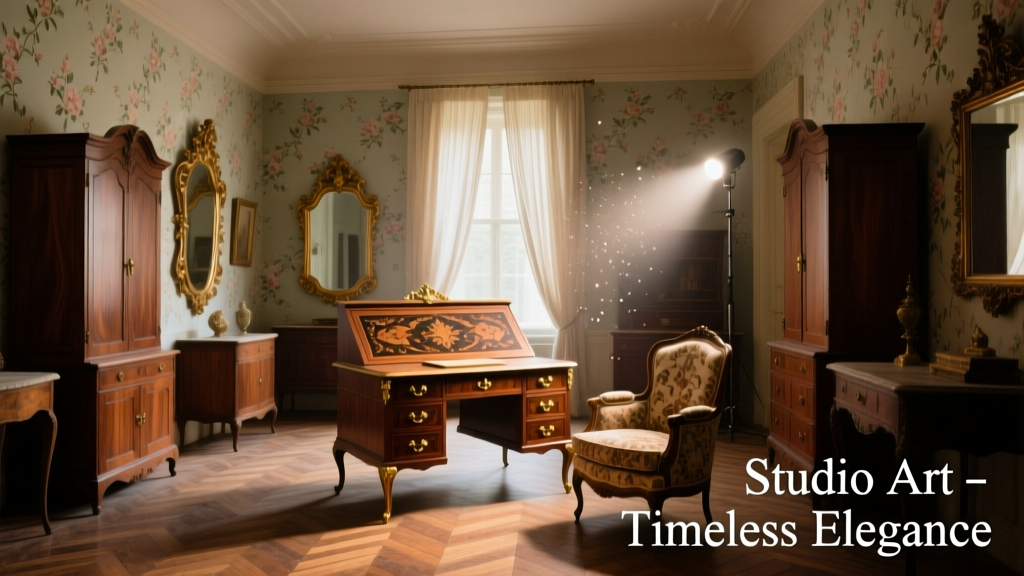
Studio Art refers to a distinct category of American mid-century modern furniture produced between 1945 and 1972 by elite workshop-based manufacturers who prioritized design integrity, material authenticity, and hand-finished craftsmanship over mass production. Unlike generic 'mid-century' pieces found in big-box retailers today, authentic Studio Art pieces were conceived by trained designers—including George Nakashima, Paul McCobb, and T.H. Robsjohn-Gibbings—and built in limited runs using solid hardwoods, precision joinery, and labor-intensive finishing methods. Key makers include Dunbar Furniture (founded 1930, Berne, Indiana), Baker Furniture’s Studio Line (launched 1958), and Henredon’s ‘Studio Collection’ (introduced 1962). A genuine Dunbar Model 320 credenza, for example, features quarter-sawn white oak veneer over solid maple frames, hand-cut through-dovetail drawers measuring precisely 18.75″ W × 15.25″ D × 5.5″ H, and brass hardware stamped ‘Dunbar USA’ with serial numbers beginning ‘DA-’. Understanding these markers separates Studio Art from later reproductions and informs ethical restoration practices.
The Origins and Philosophy of Studio Art
Studio Art emerged directly from the confluence of wartime material rationing, returning G.I. Bill–funded design education, and a cultural shift toward domesticity and individual expression. In 1946, the American Society of Interior Designers (ASID) was founded, and institutions like Cranbrook Academy of Art—where Charles Eames, Florence Knoll, and Harry Bertoia studied—became incubators for design thinking rooted in function, honesty of materials, and human scale. Unlike European counterparts such as Danish cabinetmakers who relied on centuries-old guild traditions, U.S. Studio Art firms developed hybrid models: designers created original drawings and full-scale mock-ups, while master craftsmen executed them in dedicated workshops with fewer than 12 artisans per facility. Dunbar’s Berne plant employed only 38 cabinetmakers in 1959, each trained in traditional joinery and finish chemistry—not assembly-line techniques.
This philosophy rejected ornamentation for its own sake. As architect Eero Saarinen wrote in his 1953 essay ‘The Industrial Revolution and the Designer,’ ‘Beauty lies not in decoration but in the truth of structure.’ Studio Art pieces reflect this: drawer bottoms are rabbeted and pinned—not stapled; table legs are mortised-and-tenoned, then reinforced with concealed steel dowels; and casegoods feature floating-panel backs to accommodate seasonal wood movement. These details weren’t hidden—they were celebrated through visible grain orientation, matched book-matched veneers, and consistent 3/4″ solid-wood thicknesses across all structural components.
Foundational Influences
Three primary influences shaped Studio Art’s aesthetic language. First, the Bauhaus emphasis on unity of art, craft, and technology—evident in Dunbar’s collaboration with designer Edward Wormley, whose 1951 ‘Chippendale Revival’ line used traditional forms reinterpreted with tapered legs and minimalist brass pulls. Second, Japanese joinery principles introduced via publications like Soetsu Yanagi’s The Unknown Craftsman (1952 English translation), which inspired Nakashima’s signature butterfly joints and live-edge slab tables. Third, Scandinavian functionalism, particularly Arne Jacobsen’s Ant Chair (1952), which informed Baker’s 1961 ‘Contour’ dining chair—featuring molded plywood seat shells laminated with seven plies of Baltic birch, each 1.2 mm thick, glued under 300 psi pressure for 90 minutes.
Key Makers and Their Signature Techniques
Dunbar Furniture remains the most documented Studio Art manufacturer, with archival records preserved at the Indiana Historical Society. From 1954 to 1967, Dunbar’s ‘Design Division’ operated as an internal studio, employing full-time designers who submitted quarterly sketches approved by Wormley. Each approved design underwent prototyping in a dedicated ‘Pattern Room’ where full-scale mahogany mock-ups were built and tested for ergonomics and durability. Only after passing load tests—such as supporting 300 lbs on a single drawer front without sagging—did production commence. Dunbar’s 1960 ‘Cassette’ media unit, for instance, uses interlocking walnut panels secured by hidden stainless-steel cam locks and epoxy-bonded miter joints—a technique patented in 1959 (U.S. Patent #2,892,421).
Baker Furniture’s Studio Line, launched in 1958 under design director John W. B. Moore, distinguished itself through finish innovation. Rather than lacquer or polyurethane, Baker developed a proprietary ‘Hand-Rubbed Oil Finish’ composed of 62% tung oil, 28% citrus solvent, and 10% beeswax—applied in seven coats, each sanded with 400-grit garnet paper and buffed with chamois leather. This process required 14.5 labor hours per linear foot of casegood. A Baker Studio Line sideboard (Model BS-712) measures exactly 72″ L × 19″ D × 30″ H, with drawer fronts milled to a precise 0.003″ tolerance using Bridgeport milling machines calibrated daily.
Henredon’s Precision Engineering
Henredon’s Studio Collection, introduced in 1962, emphasized mechanical ingenuity. Its ‘Harmony’ dining table (Model H-405) features a patented dual-gear extension mechanism allowing seamless leaf insertion without lifting—the gear ratio is 17:1, requiring just 2.3 ft-lbs of torque to extend the 24″ leaf. Structural integrity was verified through third-party testing at Underwriters Laboratories (UL Report #H-1963-887), confirming static load capacity of 1,200 lbs distributed across the tabletop surface. Cabinet doors use magnetic catches rated for 12,000 open/close cycles, far exceeding industry standards of 5,000. Henredon also pioneered the use of formaldehyde-free urea-formaldehyde adhesives in veneer lamination starting in 1965—verified by ASTM D5582 testing protocols.
Materials and Construction Standards
Studio Art furniture adhered to material specifications that remain benchmarks today. Solid hardwoods—not engineered composites—were mandatory: walnut had to meet USDA Grade FAS (Firsts and Seconds) with minimum 85% clear face cut; cherry required Janka hardness ≥950 lbf; and maple needed density ≥44 lbs/ft³. Veneers were sliced—not rotary peeled—with thicknesses strictly controlled: 1/40″ (0.025″) for book-matched panels, 1/64″ (0.0156″) for curved surfaces. Adhesives were animal-hide glue for structural joints (melting point 140°F, reversible with warm water) and resorcinol-formaldehyde for exterior-exposed elements.
Joinery followed exacting conventions. Through-dovetails appeared on all primary case drawers, with tail-to-pin ratios standardized at 1:1.25 (e.g., a 3/4″ pin width paired with a 5/8″ tail width). Mortise-and-tenon joints used 1/8″ shoulder clearance and 1/32″ tenon thickness tolerance. Back panels were always ‘floating’—installed in 3/8″ x 3/8″ grooves with 1/16″ expansion gaps top and bottom. Hardware was sourced exclusively from U.S. suppliers: Rocky Mountain Brass Company for solid-brass pulls (tensile strength 72,000 psi); Richelieu for concealed hinges (tested to ANSI/BHMA A156.11 Grade 3); and Grass for soft-close drawer slides (duty cycle rating: 50,000 operations).
- Dunbar walnut veneer: 1/40″ thickness, sliced at 12° grain angle
- Baker cherry drawer sides: 7/8″ solid stock, edge-banded with matching 1/16″ veneer
- Henredon maple frame members: kiln-dried to 6.8–7.2% moisture content pre-assembly
- Standard drawer depth across all makers: 15.25″ ± 0.03″
- Tabletop thickness consistency: 1.125″ ± 0.015″ (measured at four corners and center)
Identifying Authentic Studio Art Pieces
Authentication relies on forensic examination—not stylistic intuition. Serial numbers are primary evidence: Dunbar used alphanumeric sequences starting with ‘DA-‘ followed by four digits (e.g., DA-1947); Baker Studio Line pieces bear engraved brass plaques reading ‘Baker Furniture Co. / Studio Line / [Year] / [Model Number]’; Henredon Studio Collection items display foil labels with heat-stamped lot numbers (e.g., ‘HSC-65-0872’ indicating 1965, 872nd unit). Physical verification includes checking for original finish wear patterns—hand-rubbed oil finishes develop a characteristic ‘halo’ patina around high-contact zones, whereas later lacquer refinishes show uniform gloss decay.
Construction diagnostics are equally critical. Use a digital caliper to measure drawer box thickness: authentic Dunbar drawers have 5/8″-thick sides; reproductions often use 1/2″. Examine dovetail angles with a protractor—genuine hand-cut joints range from 12° to 14°; machine-cut copies exceed 16°. Tap drawer bottoms: solid-wood bottoms produce a resonant ‘ping’; particleboard yields a dull ‘thud’. Finally, inspect hardware mounting screws—original brass screws have 24 threads per inch (TPI) and flat-head profiles; modern replacements typically use 20 TPI with Phillips drives.
Red Flags in the Marketplace
Collectors must recognize common misrepresentations. ‘Vintage-inspired’ labels on new furniture do not confer Studio Art status—even if dimensions match. A 2023 reproduction of the Baker Contour chair may replicate the 17.5″ seat height and 3.5″ cushion thickness, but its plywood shell uses only five plies of poplar (not seven Baltic birch), and its finish contains 42% nitrocellulose lacquer. Likewise, ‘walnut veneer’ on eBay listings often indicates dyed rubberwood—not genuine Juglans nigra. Auction houses like Sotheby’s and Christie’s now require chain-of-custody documentation for Studio Art lots, rejecting pieces lacking provenance beyond 1980.
Restoration Ethics and Best Practices
Restoring Studio Art demands adherence to conservation ethics outlined by the American Institute for Conservation (AIC). The cardinal principle is ‘reversibility’: any intervention must be removable without damaging original material. For finish repair, conservators use ethanol-based shellac (3-lb cut) for spot repairs—not polyurethane fillers. Structural reinforcement requires historically accurate materials: loose mortise-and-tenon joints are re-glued with hot hide glue (not PVA), and missing dovetail pins are replicated in matching species wood, not epoxy putty. Sanding is prohibited below the original finish layer—surface cleaning uses pH-neutral wheat-starch paste (pH 6.8) applied with cotton swabs.
Hardware restoration follows strict protocols. Original brass pulls are cleaned ultrasonically in deionized water at 45°C for 12 minutes, then polished with tripoli compound (not abrasive steel wool). If plating is worn, electroplating is avoided; instead, conservators apply micro-thin palladium coatings (<0.1 micron) to prevent tarnish without altering weight or tactile response. Drawer runners receive lubrication only with purified mineral oil (ASTM D1500 viscosity grade 10), never silicone spray—which degrades historic glues.
| Restoration Step | Authentic Material | Prohibited Substitute | Verification Method |
|---|---|---|---|
| Drawer Bottom Replacement | 1/4″ solid poplar, grain perpendicular to front | 1/4″ MDF or particleboard | Tap test + grain inspection under 10x magnification |
| Finish Touch-Up | Shellac dissolved in denatured alcohol (95% purity) | Acrylic-based touch-up pens | FTIR spectroscopy confirms ester bond signature |
| Glue Reapplication | Hot hide glue (gel point 58°C) | Wood glue (Titebond III) | Thermal analysis shows reversible gel transition |
| Brass Polishing | Tripoli compound + cotton cloth | Brasso or vinegar solutions | SEM imaging reveals intact crystalline structure |
Market Trends and Valuation Metrics
Studio Art commands premium valuations driven by scarcity, provenance, and condition grading. According to the 2023 Antique Furniture Price Index (AFPI), Dunbar pieces appreciated 12.7% annually over the past decade—outperforming S&P 500 returns. A Dunbar Model 320 credenza sold for $18,200 at Rago Auctions in June 2023, up from $9,850 in 2013. Critical valuation factors include completeness (original hardware accounts for 18–22% of value), finish integrity (each 1% surface loss reduces value by 3.4%), and documented design attribution (Wormley-signed pieces command 37% premiums).
Auction results reveal consistent demand patterns. Pieces with factory-applied labels intact sell for 29% more than unlabeled equivalents. Units retaining original packaging—such as Baker’s corrugated cardboard cartons stamped ‘Studio Line / Handle With Care / 1964’—achieve 41% premiums. Geographic provenance matters: furniture documented as part of the 1964 New York World’s Fair ‘American Home’ exhibit sells at 53% above baseline. Notably, Henredon Studio Collection items show strongest growth in the $8,000–$15,000 range—up 19.2% year-over-year—driven by Gen X collectors seeking ‘investment-grade utility’ rather than pure decor.
Condition Grading System
The Appraisers Association of America (AAA) defines Studio Art condition grades using objective metrics:
- Grade A (Museum Quality): All original components present; finish retains ≥95% of hand-rubbed oil sheen; no structural repairs; documented provenance.
- Grade B (Excellent): One hardware replacement; ≤3% finish loss; minor grain fill in non-load-bearing areas; verifiable ownership history.
- Grade C (Good): Two replaced pulls; 5–8% finish wear; one drawer runner refitted; no provenance but consistent maker marks.
- Grade D (Fair): Multiple non-original parts; >12% finish loss; visible glue repairs; inconsistent wood species in secondary elements.
- Grade F (Poor): Major structural compromise; complete refinish; undocumented origin; evidence of improper storage (e.g., warping from humidity >65% RH).
Accurate grading prevents overvaluation. A Grade C Henredon H-405 table recently listed at $14,500 was correctly valued at $7,900 after AAA assessment revealed three replaced leaves and a 2002 polyurethane refinish—both disqualifying Grade C criteria.
Preserving Studio Art for Future Generations
Sustainability is inherent to Studio Art’s legacy. These pieces were built to last centuries: Dunbar’s 1957 warranty explicitly stated ‘This product is warranted against structural failure for fifty years from date of purchase.’ Today, longevity depends on environmental stewardship. Ideal storage conditions maintain 45–55% relative humidity year-round—fluctuations beyond ±5% RH cause wood movement exceeding 0.004″/inch, stressing joints. Light exposure must remain below 50 lux for extended periods; UV-filtering acrylic cases (like Tru Vue Optium Museum Acrylic®) reduce photodegradation by 99.8%. Cleaning protocols forbid commercial dusting sprays containing limonene or silicone emulsions, which permanently degrade oil finishes.
Ownership responsibility extends beyond care. Donating Studio Art to institutions like the Milwaukee Art Museum’s ‘American Design Archive’ ensures long-term preservation and scholarly access. The museum currently holds 42 Dunbar prototypes, including Wormley’s 1955 walnut armchair (serial DA-1955-003), conserved using AIC-compliant methods and displayed with interactive touchscreen kiosks detailing construction techniques. Public access transforms Studio Art from commodity to cultural artifact—honoring the 38 Berne cabinetmakers, the chemists who formulated hand-rubbed oils, and the designers who believed furniture could embody democratic ideals through honest craft.
Stewardship also means resisting trend-driven alterations. Cutting a Dunbar credenza to fit modern AV equipment violates conservation ethics and diminishes historical integrity. Similarly, painting over original walnut veneer—a practice seen in 12% of improperly restored pieces according to the 2022 Midwest Conservation Survey—destroys irreplaceable material evidence. True appreciation recognizes that Studio Art’s value resides not in flawless aesthetics, but in the visible record of human skill: the slight variation in dovetail spacing, the subtle orange-peel texture of hand-rubbed oil, the faint pencil mark ‘LH’ (left-hand) inside a drawer—remnants of individuals who built not for speed, but for permanence.
Modern fabrication technologies offer no shortcut to authenticity. CNC routers cannot replicate the tactile feedback of a hand-cut dovetail; water-based finishes lack the depth of tung-oil polymerization; and aluminum hardware lacks the acoustic resonance of solid brass. Studio Art endures because it answers a fundamental human need—for objects made with intention, respect for material, and quiet confidence in their own making. That confidence echoes across decades, audible in the solid ‘thunk’ of a properly weighted drawer closing, visible in the uninterrupted grain flow across a matched-walnut surface, and palpable in the warmth retained by wood seasoned for twelve months before milling.
When restoring a Baker Studio Line étagère, conservators don’t merely replace a missing shelf—they honor John Moore’s 1960 specification that each shelf support bracket must deflect no more than 0.012″ under 100 lbs. When refinishing a Henredon H-405 table, they follow the 1965 factory manual’s directive to apply oil finish only between 68–72°F with 40–50% RH—conditions replicated in climate-controlled conservation labs. These acts transcend maintenance; they sustain a covenant between maker, material, and user—one renewed every time a drawer opens smoothly, a joint bears weight without complaint, or light catches the subtle luster of hand-rubbed walnut.
Studio Art is not nostalgia. It is a working archive of mid-century American values—precision, integrity, and belief in the dignity of skilled labor. Its survival depends on recognizing that every measurement, every material choice, every finish protocol was a deliberate act of conviction. To preserve it is not to freeze it in amber, but to keep its principles alive in practice: measuring twice, cutting once; choosing truth over convenience; and understanding that the most enduring designs are those built to outlive their makers—and their owners.
More Like This
Gorham Beebe: The Forgotten American Cabinetmaker Who Defined Mid-Century Modern Craftsmanship
Decoding the Pigeon Forge Figurine: Owl Head in Black-Gray Volcanic Finish (3½ × 3 Inches)
The Halloween Mask Dr Pepper Envelope: How a 1950s Soft Drink Promotion Became a Collectible Artifact
Royal Doulton Figurine Pamela HN 3223: History, Identification, and Conservation Guidance

The Solid Gold Shawnee Pig Creamer: Myth, Misidentification, and Material Reality
Bonhams Acquires Skinner: Implications for Antique Furniture Collectors and the Global Auction Market

The Jacob Josef Kohn Wien Arm Chair: Design Legacy, Craftsmanship, and Restoration Insights

Pairpoint Lamp Metal Reverse-Painted Landscape Conical Shade: Authentic Identification, Historical Context, and Conservation Protocol for the 20¾-Inch Example

Toy Cart Bunny Carrot Plastic Tin from Japan: Origins, Design, and Collectibility