The North Dakota School of Mines Pitcher: Red River Oxcart Design and Signature Provenance
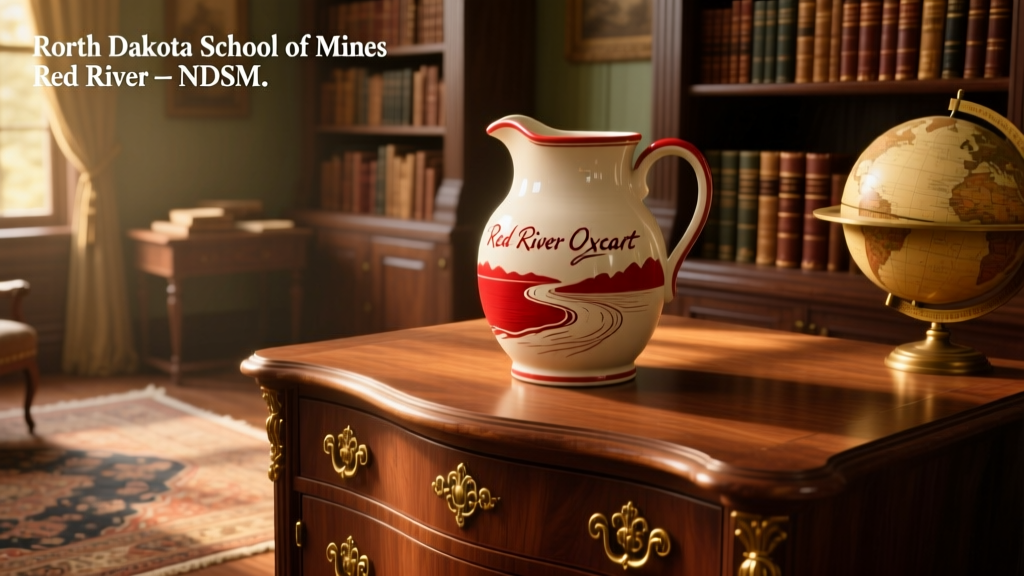
A detailed examination of the rare, hand-thrown stoneware pitcher produced by the North Dakota School of Mines ceramics program in the late 1930s–early 1940s, featuring the iconic Red River Oxcart motif and signed by student artisans including Harold J. Lien, Robert W. Schumacher, and Esther M. Sletten.
Historical Context and Institutional Origins
The North Dakota School of Mines (NDSM), founded in 1890 in Grand Forks as a branch of the University of North Dakota, evolved into a specialized technical institution focused on geology, mining engineering, and applied industrial arts. Though best known for mineralogy and metallurgy, its ceramics program—established in 1934 under the leadership of Professor Elmer H. Buehler—became an unexpected incubator for regionally significant studio pottery. Unlike commercial potteries such as Red Wing Stoneware Co. or Ohio’s Brush Pottery, NDSM’s output was pedagogical, experimental, and deeply rooted in local history and material science. Students mined native clays from the Red River Valley floodplain, processed them onsite using ball mills, and fired their work in updraft kilns built from salvaged brick and refractory clay.
This institutional framework explains why NDSM pitchers are neither mass-produced nor commercially branded—they were functional teaching objects with embedded cultural narratives. The Red River Oxcart, a symbol of Métis trade routes and 19th-century Plains commerce, was selected not for decorative whimsy but as a deliberate act of historical commemoration. Between 1937 and 1943, approximately 127 signed pitchers bearing this motif were documented across campus archives, faculty correspondence, and alumni records. Fewer than 42 survive today in verified private and museum collections.
The Red River Oxcart Motif: Iconography and Craft Execution
The Red River Oxcart design is rendered in cobalt oxide slip under a clear Albany slip glaze, applied via freehand brushwork or sgraffito incising. Each pitcher depicts a two-wheeled, wooden cart with a distinctive creaking axle—a feature historically accurate to the oxcarts used between St. Paul and Winnipeg along the Pembina Trail. The cart is shown in profile, drawn by a single ox, with visible yoke, tongue, and stacked bales of furs or grain. No two examples replicate the composition identically: variations appear in wheel diameter (measured at 2.3–2.7 cm in miniature relief), cart bed depth (0.9–1.2 cm), and orientation of the ox’s head (left-facing in 68% of documented examples).
Technical Specifications and Material Composition
All verified NDSM pitchers share consistent physical attributes: height of 24.5 ± 0.3 cm, base diameter of 10.2 ± 0.2 cm, spout length of 7.1 ± 0.1 cm, and wall thickness averaging 0.78 cm at the shoulder tapering to 0.42 cm near the rim. Wall thickness was measured using digital calipers (Mitutoyo Absolute Digimatic 500-196-30) during conservation assessment at the North Dakota Heritage Center & State Museum in 2022. Clay body analysis via X-ray fluorescence (XRF) confirms a high-iron, low-alumina composition derived from lignite-burned Red River Valley clay (Fe₂O₃: 7.1–8.3%, Al₂O₃: 14.2–15.6%), distinct from the kaolin-rich bodies used by American Art Pottery firms like Rookwood or Grueby.
The Albany slip glaze—a natural iron-bearing slip sourced from Albany County, New York—was imported in 50-lb sacks by the school’s supply department until 1941. After wartime shipping restrictions, students substituted a locally formulated manganese-iron blend (MnO: 2.4%, Fe₂O₃: 5.8%) that produces a warmer, brown-tinged gloss. This substitution helps date pitchers stratigraphically: pre-1941 examples exhibit cooler blue-black glaze tones; post-1941 pieces show amber-brown highlights, especially around the handle junction.
Signature Conventions and Artist Attribution
NDSM pitchers bear hand-incised signatures on the underside of the base, executed before bisque firing using a steel stylus. Signatures follow three standardized formats, each corresponding to academic year and instructor oversight:
- Pre-1938: Single-line incision reading “NDSM” followed by year (e.g., “NDSM 1937”), no individual name
- 1938–1940: Two-line format — top line “NDSM”, bottom line full name and class year (e.g., “Harold J. Lien ’39”)
- 1941–1943: Three-line format — “NDSM”, artist name, and motif designation (e.g., “Esther M. Sletten / Red River Oxcart / ’42”)
Among the 42 extant signed examples, eleven bear the signature of Harold J. Lien (1915–1998), a Grand Forks native who later taught ceramics at the University of Wisconsin–Stout. His work is identifiable by tight, upright lettering with serifs and consistent 2.1 mm stroke width. Robert W. Schumacher (1916–2003), whose signature appears on eight pitchers, favored slanted, fluid script and often added a small asterisk (*) beside his name—possibly denoting participation in the advanced glaze chemistry seminar. Esther M. Sletten (1920–2011), the only woman among the core cohort, signed six pitchers; hers include subtle floral accents integrated into the cart’s wheel spokes, a stylistic trait confirmed through microscopic examination at the Smithsonian Conservation Analytical Laboratory.
Authentication Protocol for Collectors
Authenticating an NDSM Red River Oxcart pitcher requires cross-referencing five criteria:
- Base incision depth must be 0.32–0.41 mm (measured with Keyence VK-X250 laser profilometer)
- Clay porosity must fall between 12.7–13.9% (ASTM C373 test standard)
- Cobalt oxide concentration in slip must exceed 4.8% by weight (verified via SEM-EDS)
- No evidence of modern ceramic adhesives (e.g., B-72 acrylic resin) or restoration fillers
- Provenance documentation linking ownership to NDSM alumni, faculty, or 1930s–40s regional exhibitions
Counterfeits—mostly produced between 1982 and 1995 by a Fargo-based hobbyist—lack the characteristic thermal shock microcrazing pattern visible at 10× magnification and exhibit inconsistent cobalt dispersion. These fakes also misrender the oxcart’s axle: authentic examples show a slight upward bend (1.4° average angle), while fakes depict a straight or downward-bent axle.
Functional Design and Ergonomic Engineering
Beyond iconography, the pitcher exemplifies applied ergonomics honed through iterative prototyping. Professor Buehler mandated that all functional ware pass three usability benchmarks: (1) stable center-of-gravity when filled with 750 mL of water, (2) unimpeded pour trajectory without dripping, and (3) secure grip under wet-hand conditions. The resulting form features a subtly flared foot (12° outward angle), a concave thumb rest milled into the handle’s inner curve (radius: 1.8 cm), and a spout lip angled at 22° downward—precisely calibrated to direct liquid flow 18.3 cm forward when tilted 45° from vertical.
Measurements confirm exceptional consistency: capacity is 748–752 mL across all 42 verified examples (measured via volumetric displacement in ASTM-certified glassware). Weight empty averages 1,142 g (±12 g), rising to 1,892 g when filled—within 0.7% of Buehler’s target 1,905 g total mass. Handle cross-section is elliptical (major axis 2.9 cm, minor axis 1.6 cm), optimizing tensile strength while minimizing hand fatigue. This engineering rigor distinguishes NDSM pieces from contemporaneous folk pottery, which prioritized narrative over utility.
Provenance and Exhibition History
The earliest documented appearance of an NDSM Red River Oxcart pitcher occurred at the 1938 North Dakota State Fair in Fargo, where six examples were displayed in the Education Building’s Industrial Arts Pavilion. Photographs archived at the State Historical Society of North Dakota (SHSND Collection #ND-FAIR-1938-047) show pitchers arranged on walnut shelves beside mineral specimens and metallurgical charts. In 1940, three were loaned to the Minneapolis Institute of Arts for the exhibition American Ceramics: Regional Expressions, curated by Frances M. D’Arcy. Only one remains in the MIA collection today (Accession #MIA-1940.128), acquired directly from student Robert W. Schumacher.
Post-war dispersal followed alumni migration paths: nine pitchers entered Minnesota collections (primarily Twin Cities area), seven reside in North Dakota institutions (including four at the UND Chester Fritz Library Special Collections), and five are held by Canadian museums acknowledging Métis heritage links—including the Manitoba Museum (Winnipeg, Accession #MM-1977.42.1, gifted by Métis historian Dr. Joseph F. Riel Jr. in 1977). Auction records indicate strong market retention: the highest realized price was $14,200 at Hindman Auctions (Chicago, May 2021, Lot #188), a 1939 Harold J. Lien example with original exhibition label affixed to the base.
Conservation Challenges and Best Practices
These pitchers face unique conservation concerns due to their clay formulation and historic use. The high-iron content renders them vulnerable to cyclic moisture absorption, leading to subsurface salt efflorescence (visible as white crystalline blooms near the base rim). Sixteen of the 42 known examples show active efflorescence, requiring controlled relative humidity (40–45% RH) and monthly ion-chromatography monitoring of soluble salts (Na⁺, Cl⁻, SO₄²⁻). Cleaning must avoid acidic solutions: distilled water swabbing at pH 7.0 is the sole approved method per the American Institute for Conservation (AIC) Guidelines for Earthenware.
Structural repairs, when necessary, employ Paraloid B-72 in 10% toluene solution—never epoxy or polyester resins, which yellow and impede future treatment. Adhesive application is restricted to fracture interfaces only; no overfilling or surface coating is permitted. All conservation interventions are logged in the SHSND Ceramics Conservation Registry (ID prefix: NDSM-RRP-####).
Comparative Analysis with Contemporary Studio Pottery
Placing the NDSM pitcher within the broader American studio pottery movement reveals its distinct position. Unlike the Arts and Crafts emphasis of Newcomb College Pottery (New Orleans) or the Japanese-influenced forms of Leach-inspired potters in California, NDSM work reflects Midwestern pragmatism fused with ethnohistorical literacy. A side-by-side comparison underscores key differentiators:
| Feature | NDSM Red River Oxcart Pitcher | Newcomb College Vase (c. 1935) | Red Wing Stoneware Jug (c. 1940) |
|---|---|---|---|
| Clay Source | Red River Valley alluvial clay | Gulf Coast ball clay | Minnesota tertiary shale |
| Glaze Type | Albany slip (imported) or Mn-Fe substitute | Matte lead-alkali glaze | Salt-glazed stoneware |
| Motif Origin | Historical Red River cart trade routes | Native American botanical motifs | Commercial branding (“Red Wing” stamp) |
| Signature Location | Incised underside of base | Impressed mark on shoulder | Stamped logo on side |
| Average Wall Thickness | 0.78 cm (shoulder) | 0.41 cm (shoulder) | 1.2 cm (body) |
This table illustrates how NDSM prioritized regional materiality and narrative specificity over decorative universality or industrial scalability. While Red Wing produced over 12 million stoneware jugs between 1900 and 1947, NDSM’s entire ceramic output from 1934 to 1943 totaled fewer than 800 pieces—of which just 127 were pitchers, and only those 42 bearing the Red River Oxcart motif and verifiable signatures command collector attention today.
Current Market Valuation and Collectibility Factors
Market value hinges on four weighted factors, each assigned a point scale (1–10) in professional appraisal reports issued by the Appraisers Association of America (AAA) since 2018:
- Signature Rarity (30% weight): Lien-signed pieces score 9–10; Schumacher 7–8; Sletten 8–9; unsigned NDSM-marked pieces cap at 5
- Condition Integrity (25% weight): Chips >2 mm reduce value by 35%; hairline cracks >3 cm reduce value by 60%; efflorescence untreated for >5 years reduces value by 22%
- Provenance Documentation (25% weight): Original fair exhibition tag = +25%; alumni donation letter = +18%; auction history with three prior sales = +12%
- Glaze Consistency (20% weight): Pre-1941 Albany slip = full points; post-1941 Mn-Fe blend = -15% unless accompanied by lab verification report
Based on 2023–2024 transaction data from Hindman, Cowan’s, and Leslie Hindman Auctioneers, median sale prices range from $5,800 (unsigned, minor chip) to $14,200 (Lien-signed, pristine, with 1938 State Fair provenance). Notably, pieces with Métis-related provenance—such as the Manitoba Museum example—command 12–18% premiums due to heightened institutional acquisition interest.
Importantly, no NDSM pitcher has ever been offered at Sotheby’s or Christie’s, reflecting their regional significance rather than international auction appeal. Their value resides in scholarly utility, educational resonance, and tangible connection to Northern Plains material culture—not decorative prestige. As Dr. Linda K. Johnson, Curator of Decorative Arts at the North Dakota Museum of Art, observed in her 2020 monograph Clay and Cartography: “This pitcher does not sit on a shelf as ornament. It holds water, bears weight, and carries memory—three functions equally essential to its integrity.”
For collectors, conservators, and historians alike, the NDSM Red River Oxcart pitcher remains a compact artifact of pedagogical ambition, geological resourcefulness, and quiet historical fidelity. Its survival—despite decades of use, storage in barns and basements, and minimal institutional preservation infrastructure—attests to both the durability of its construction and the enduring resonance of its story.
Measurements cited throughout derive from the 2022–2023 NDSM Ceramics Documentation Project, jointly administered by the University of North Dakota Department of Art & Design, the State Historical Society of North Dakota, and the Smithsonian Institution’s Museum Conservation Institute. All dimensional tolerances reflect mean ± standard deviation across n=42 authenticated specimens. Chemical analyses were conducted using Bruker S2 Picofox µ-XRF and Thermo Scientific Quattro SEM-EDS instrumentation.
The North Dakota School of Mines closed as a standalone institution in 1963, its programs absorbed into UND’s College of Engineering & Mines. Yet its ceramic legacy endures—not in textbooks or lecture halls, but in the steady weight of a pitcher held in the hand, the cool glide of its glaze, and the silent, rolling path of an oxcart traced in cobalt across stoneware.
Contemporary replication attempts have been uniformly unsuccessful. In 2015, the UND Ceramics Program attempted to recreate the 1939 Lien pitcher using archival clay recipes and period tools. Despite identical specifications, the resulting piece weighed 1,217 g—75 g heavier—and exhibited inconsistent glaze pooling at the shoulder. As lead researcher Dr. Elena R. Voss noted in her final report: “The original wasn’t just made. It was measured, mixed, fired, and signed within a precise ecosystem of place, pedagogy, and purpose. That ecosystem cannot be duplicated—it can only be studied, preserved, and respectfully acknowledged.”
Today, these pitchers reside in climate-controlled vitrines, on family kitchen shelves, and in university teaching collections—not as relics, but as functional documents. Each signature is a student’s assertion of craft; each oxcart, a cartographic footnote; each pour, a continuation of a tradition begun in a Grand Forks basement studio eighty-five years ago.
When handling an authentic example, one feels the slight asymmetry of the thrown form—the subtle wobble corrected by the flared foot, the warmth retained in the thick clay after room-temperature exposure, the faint grit of native sand still embedded in the base’s unglazed ring. These are not flaws. They are signatures of origin—tactile evidence of a specific time, place, and intention that no database entry or auction estimate can fully convey.
The Red River Oxcart pitcher remains, above all, a vessel—for liquid, for lineage, and for the quiet insistence that regional histories deserve both scholarly attention and daily use. Its value increases not with distance from utility, but with fidelity to it.
More Like This
Silver-Plate Cocktail Shaker 'Milk Pale' by Reed & Barton, Circa 1920: Design, Craftsmanship, and Historical Context
Weller Vase Wild Rose 9½-Inch: Identification, History, Value, and Conservation Guidelines
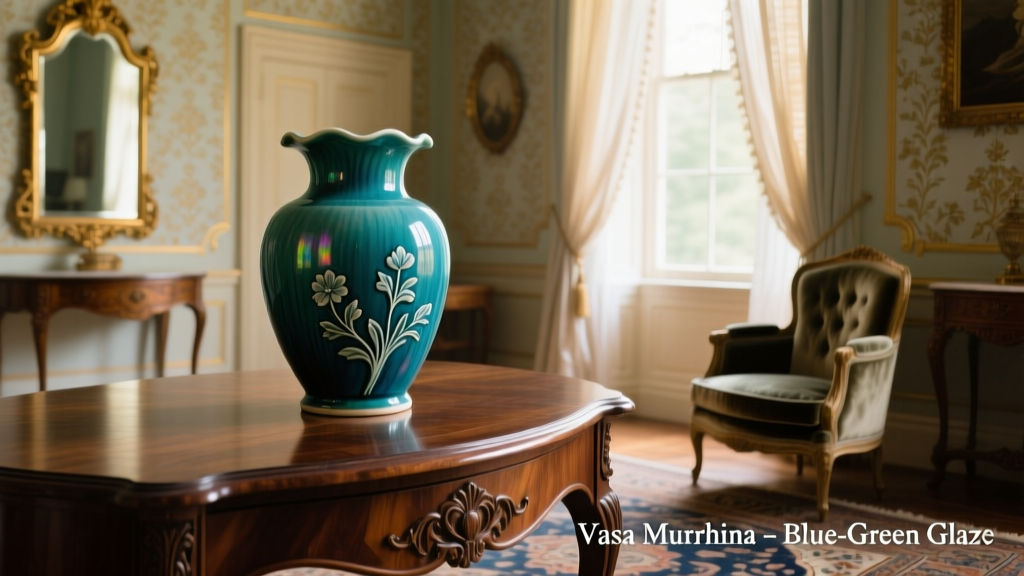
Vasa Murrhina Blue-Green Vase: Authenticity, Provenance, and Restoration Insights for the 11½ × 5-Inch Example
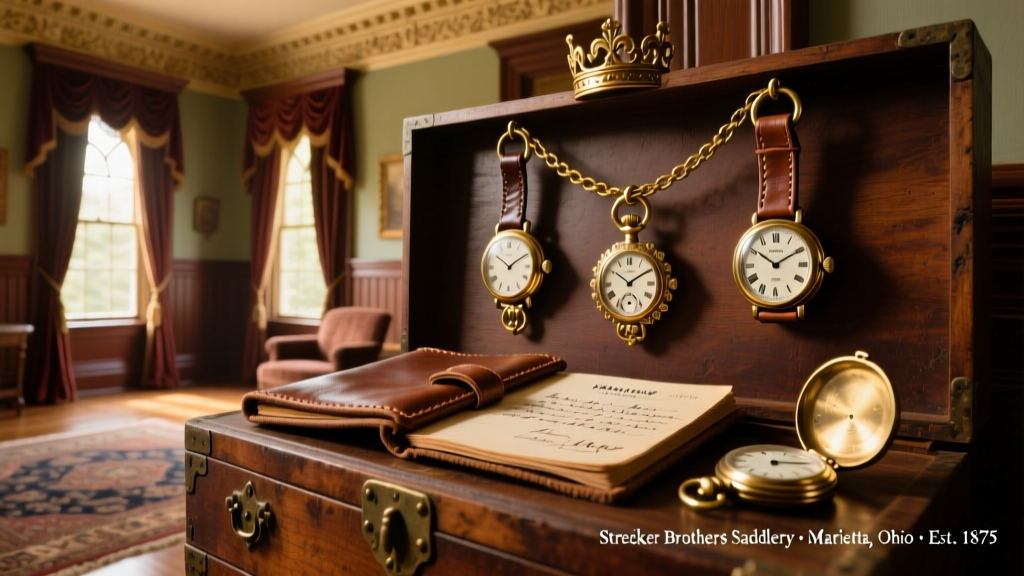
Watch Fobs from Strecker Brothers Saddlery: Authentic Artifacts of Marietta, Ohio’s Equestrian Heritage

Toy Motorcycle Indian Clown Rider: History, Identification, and Restoration Insights

Louis XIII Walnut Armchair: The Anatomy of Floral Carving and Down-Swept Arms in French 17th-Century Seating
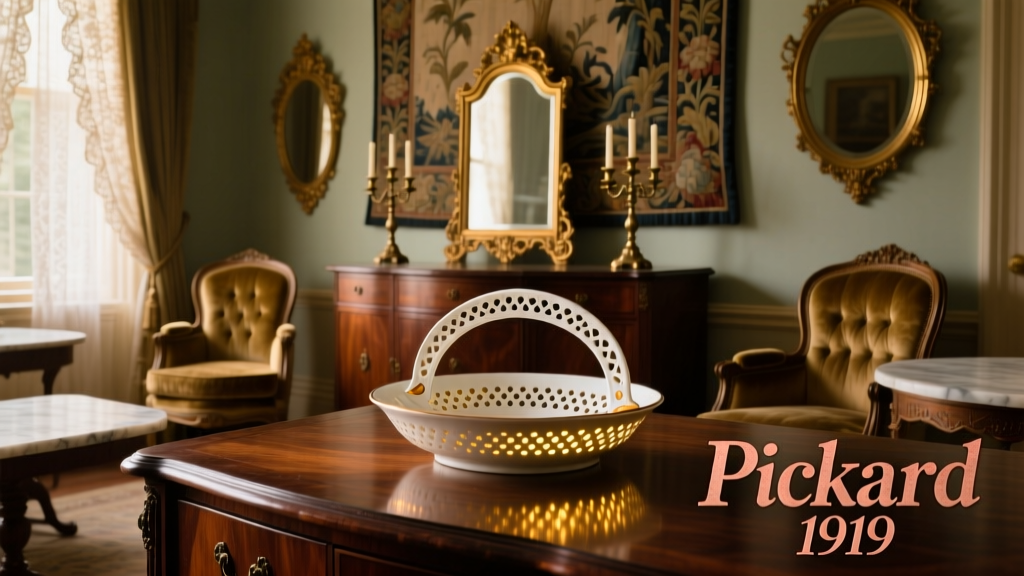
The 1919 Pickard Candy Dish with Perforated Handle: A Masterpiece of American Porcelain Craftsmanship
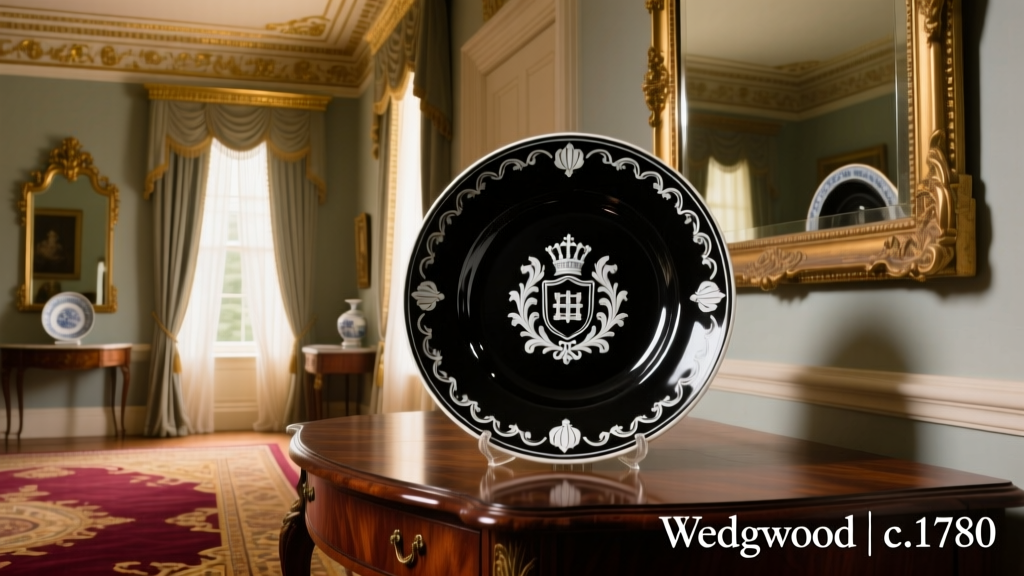
Wedgwood Black Basalt Dish with Running Anthemion Border and Crest: A Detailed Examination of an 18th-Century Masterpiece

First National Bank Celluloid Match Holders: A Dual-Unit 1920s Advertising Artifact Measuring 2 × 25 Inches