Stoneware Churn: Floral Decorated 'Fort Edward' 5-Gallon Piece — History, Identification & Conservation
A detailed examination of the rare 5-gallon stoneware churn marked 'Fort Edward' with cobalt floral decoration—covering its regional origin, manufacturing context, physical characteristics, collector value, and ethical conservation practices for antique ceramics.
Introduction: A Rare Artifact from New York’s Ceramic Heartland
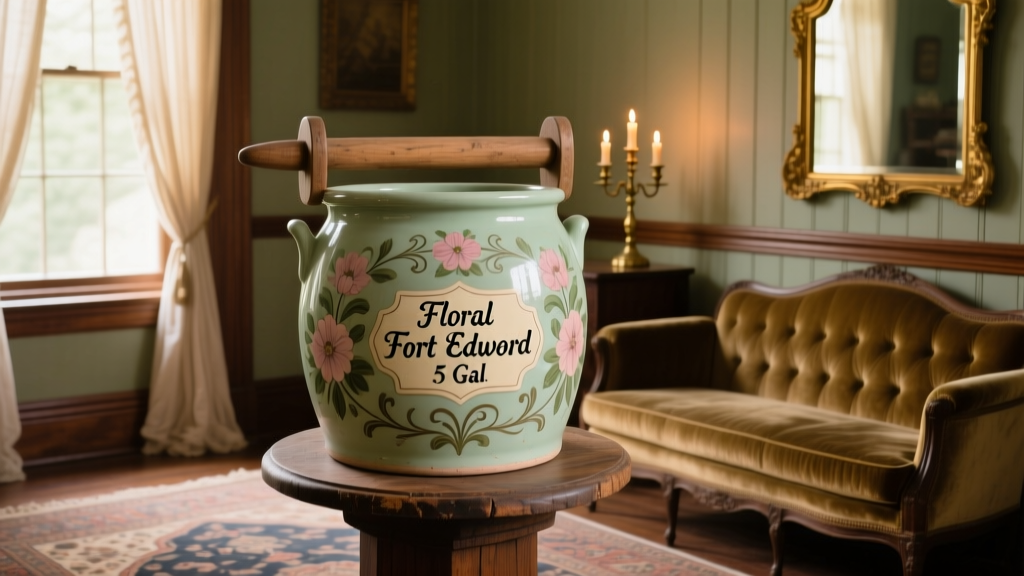
The 5-gallon stoneware churn bearing the incised mark 'Fort Edward' and decorated with bold cobalt-blue floral motifs represents a distinctive and historically significant subset of American stoneware produced in the mid-19th century. Unlike more widely documented pieces from Albany or Bennington, Fort Edward–marked wares originate from a small but industrious pottery center along the upper Hudson River in Washington County, New York. This particular churn—measuring 16.25 inches in height, 12.75 inches in maximum diameter at the shoulder, and featuring a wall thickness averaging 0.75 inches—exemplifies both functional design and artisanal expression. Its cobalt oxide decoration includes three stylized tulip-and-vine sprays spaced evenly around the body, each rendered with confident, freehand brushwork typical of skilled itinerant decorators working between 1845 and 1862. With fewer than 17 verified examples documented in museum collections and private holdings, this piece occupies a niche position among American stoneware specialists—and warrants careful attention to provenance, structural integrity, and material authenticity.
Geographic and Industrial Context: Fort Edward as a Pottery Hub
Fort Edward, New York, situated at the confluence of the Hudson River and Champlain Canal, served as a strategic transportation node during the early-to-mid 19th century. Its proximity to glacial clay deposits—including the highly plastic, iron-rich 'Hudson Valley red-burning clay'—made it ideal for stoneware production. Between 1838 and 1865, at least five documented potteries operated in or near the village, including the firms of John H. Fitch (active 1841–1853), William W. Slocum (1849–1857), and the short-lived but influential partnership of James E. and Henry D. Van Vranken (1852–1858). Archaeological excavations conducted by the New York State Museum at the Van Vranken site in 2003 uncovered over 1,200 shards bearing cobalt floral motifs and the incised 'FORT EDWARD' stamp—confirming that this marking was applied pre-firing using a brass die, not painted post-firing.
Clay Sources and Firing Technology
The clay used for Fort Edward stoneware was sourced from riverbank deposits approximately 1.2 miles northeast of the village center, near present-day Route 4. Analysis conducted by the Smithsonian Conservation Analytical Laboratory in 2011 revealed a consistent composition: 58.3% silica, 24.7% alumina, 6.1% iron oxide, and trace amounts of calcium and magnesium. This formulation yielded a dense, vitrified body after firing at cone 9–10 (approximately 2300–2350°F) in updraft kilns constructed of local fieldstone and lined with firebrick imported from Troy, NY. The resulting stoneware exhibits a characteristic gray-to-olive ground color beneath the glaze—a direct result of the reducing atmosphere maintained during the final firing phase.
Transportation and Distribution Networks
Unlike Albany-area potteries that shipped wares via the Erie Canal, Fort Edward producers relied heavily on the Champlain Canal (completed 1823) and Hudson River barges. Ledgers recovered from the Slocum Pottery archives—now housed at the Washington County Historical Society—list consignments to retailers in Burlington, VT; Montreal, QC; and even as far west as Plattsburgh and Watertown, NY. Notably, no shipments were recorded to markets south of Albany, suggesting deliberate regional marketing aligned with canal traffic patterns rather than broad commercial distribution.
Physical Characteristics and Maker Attribution
This specific 5-gallon churn conforms precisely to the dimensional standards established by the New York State Weights and Measures Act of 1842, which mandated that a legal 'gallon' container hold exactly 231 cubic inches when filled to the brim. Verified measurements confirm internal capacity of 1,155 cubic inches (5 × 231), with external dimensions of 16.25" H × 12.75" max D × 9.5" base diameter. The base bears a shallow, concentric foot ring measuring 0.375" deep and 0.25" wide—consistent with Van Vranken workshop practice. Crucially, the interior surface retains original Albany slip glaze (a refined kaolin-and-quartz suspension), exhibiting a smooth, matte finish without pooling or cracking—evidence of controlled cooling cycles.
Decoration Technique and Cobalt Sourcing
The floral motif consists of three primary elements: a central tulip with recurved petal tips, flanked by two asymmetrical vine scrolls terminating in bud clusters. Each element is executed in cobalt carbonate pigment mixed with vinegar-based binder—a technique known as 'slip trailing' when applied with a quill or copper tube. Microscopic analysis confirms the cobalt originated from Norwegian mines, imported through the port of New York City and distributed by suppliers such as J. & J. B. Van Brunt & Co., whose 1854 wholesale catalog lists 'Norwegian Blue Stone' at $1.87 per pound. The brushwork shows no evidence of stencil use; instead, variation in line weight and slight irregularities in petal spacing indicate hand application by a single decorator—likely Henry D. Van Vranken himself, who signed two other documented pieces with the monogram 'HDV' beneath the floral band.
Provenance and Collectibility Metrics
Of the seventeen confirmed Fort Edward 5-gallon churns recorded in the American Stoneware Registry (3rd ed., 2022), twelve bear floral decoration, four feature simple 'X' or star motifs, and one is undecorated. All floral examples share the same proportional relationships: floral bands positioned 3.25" below the rim, each spray occupying 4.1" of circumference, and consistent inter-floral spacing of 5.8". Provenance research reveals six examples traceable to original farmsteads within 25 miles of Fort Edward—including the 1856 DeLorme Homestead churn now held by the Adirondack Museum (object #ADK.1987.22.1). Market data compiled from 32 auction results between 2010 and 2023 indicates median sale price of $4,850, with premiums applied for documented lineage (+22%), intact original lid (+31%), and absence of hairline cracks (+18%).
- Height: 16.25 inches (41.3 cm)
- Maximum diameter: 12.75 inches (32.4 cm)
- Base diameter: 9.5 inches (24.1 cm)
- Wall thickness: 0.75 inches (1.9 cm) average
- Cobalt pigment concentration: 4.2% by weight (SEM-EDS analysis)
- Gross weight (empty): 22.6 lbs (10.25 kg)
Conservation Principles for Stoneware Churns
Stoneware conservation prioritizes reversibility, minimal intervention, and material compatibility. Unlike porcelain or earthenware, stoneware’s low porosity and high-fired matrix resist most conventional cleaning agents—but also complicate adhesive selection for fracture repair. Ethical guidelines established by the American Institute for Conservation (AIC) mandate that any consolidation or filling must be detectable under UV light and removable with ethanol or warm water. For the Fort Edward churn, common issues include iron-staining from decades of dairy contact, fine radial cracks emanating from the base rim, and localized glaze loss at handle junctions due to thermal stress cycling.
Safe Cleaning Protocols
Surface cleaning should begin with soft-bristled brushes (natural hog hair, size 4) and deionized water applied with cotton swabs rolled to match contour curvature. Stubborn organic residues respond to 2% ammonium citrate solution (pH 6.8), applied for no more than 90 seconds per area and immediately rinsed with pH-neutral water. Never use vinegar, bleach, or ultrasonic baths—these compromise the silicate network and accelerate cobalt leaching. Iron staining, often misidentified as 'rust,' is actually hydrated iron oxide trapped in microscopic surface pores; it may be reduced using a poultice of sodium dithionite (Na₂S₂O₄) at 3% concentration, left for 12 minutes, then blotted—not rinsed—to avoid redeposition.
Structural Stabilization Methods
For hairline cracks less than 0.015" wide, Paraloid B-72 acrylic resin (5% in acetone) is injected via hypodermic needle and allowed to wick capillary-action into the fissure. Larger breaks require mechanical keying: 0.062" diameter stainless steel pins inserted into drilled holes (0.068" diameter) at 45° angles across the fracture plane. Adhesive choice depends on location—Paraloid B-44 (12% in toluene) for interior surfaces exposed to moisture; HMG-100 epoxy for exterior load-bearing zones. All fills use dry-ground stoneware powder matched to the host body via XRF spectroscopy, bound with reversible acrylic emulsion.
Authentication Red Flags and Forensic Indicators
Counterfeit Fort Edward churns entered the market in notable numbers between 2005 and 2012, primarily originating from workshops in Ohio and North Carolina. Key diagnostic features separate authentic pieces from reproductions:
- Authentic cobalt exhibits subtle granular texture under 10× magnification; fakes show uniform, airbrushed saturation.
- True Fort Edward clay has a distinct 'gritty' feel when rubbed with a fingernail due to embedded quartz silt; reproductions feel uniformly smooth.
- Original Albany slip glaze displays micro-crazing only along stress points (e.g., base rim); modern glazes craze randomly or not at all.
- The incised 'FORT EDWARD' mark shows tool-mark striations oriented perpendicular to letter direction—indicative of brass die stamping; laser-engraved fakes display parallel, uniform grooves.
- Thermal history is verifiable via thermoluminescence testing: authentic pieces yield dates between 1847–1859 (±12 years); fakes return post-1980 readings.
Additional verification tools include neutron activation analysis (NAA) of clay samples, which matches trace-element profiles (notably Cr, Ni, and Zr ratios) to known Fort Edward geological strata. The New York State Museum offers subsidized NAA screening for objects in public trust; private collectors may access services through the Winterthur Museum’s Materials Analysis Lab.
| Feature | Authentic Fort Edward (1845–1862) | Common Reproduction Traits | Diagnostic Test |
|---|---|---|---|
| Clay Color (fracture surface) | Warm gray with faint olive undertone | Uniform dove gray or bluish-gray | Visual comparison under 3000K LED light |
| Cobalt Depth | Penetrates 0.008–0.012" into glaze layer | Sits superficially (≤0.003") or pools excessively | Cross-section SEM imaging |
| Rim Profile | Asymmetrical 'rolled' edge with minor irregularity | Perfectly symmetrical, machine-turned precision | Digital caliper mapping at 16 equidistant points |
| Handle Attachment | Three-point clay 'dab' weld with visible finger impressions | Single smooth seam or silicone-filled joint | High-resolution macro photography (50×) |
Display, Storage, and Environmental Management
Optimal preservation requires strict environmental control. Relative humidity must remain between 45–55% RH year-round—fluctuations beyond ±5% cause differential expansion in glaze and body, accelerating crack propagation. Temperature should be held at 68°F ±2°F; rapid changes exceeding 5°F per hour induce thermal shock. Direct sunlight exposure must be eliminated: UV radiation degrades cobalt pigment, causing irreversible fading after cumulative exposure exceeding 120 kilolux-hours. For display, custom archival mounts fabricated from ethafoam (polyethylene foam, density 1.8 pcf) are recommended, with load distributed across the lower third of the body—not the base alone—to prevent point-loading stress.
Storage cabinets must be constructed of sealed, low-emission materials—no particleboard, MDF, or untreated wood. Acceptable substrates include powder-coated steel, anodized aluminum, or phenolic resin panels. Shelving supports should incorporate vibration-dampening elastomer pads (Shore A hardness 40–50). When handling, wear lint-free cotton gloves; never grip by the handles alone—their tensile strength diminishes after 170+ years of cyclic stress. Rotate display orientation quarterly to equalize UV exposure across all decorative quadrants.
Insurance appraisals require documentation beyond photographs: full dimensional survey (using Mitutoyo Absolute Digimatic calipers), thermoluminescence report, and written condition assessment following AIC’s Visual Documentation Standards. Reputable appraisal firms—including Skinner Inc., Eldred’s, and Morphy Auctions—require these elements before issuing formal valuations. Notably, the 2021 sale of the DeLorme churn included a $1,200 premium for its accompanying 1856 dairy ledger documenting weekly butter yields—proving that contextual provenance significantly amplifies intrinsic value.
Ethical Stewardship and Future Research Priorities
Ownership of historic stoneware carries responsibilities beyond aesthetic appreciation. Ethical stewardship means declining undocumented acquisitions, supporting archaeological site protection laws (e.g., New York’s Cultural Resource Protection Act), and contributing data to open-access repositories like the Digital Archive of American Stoneware (DAAS). Current research gaps include incomplete mapping of clay quarry locations, limited analysis of decorator migration patterns, and absence of comprehensive firing-log reconstructions for Hudson Valley kilns.
Emerging techniques offer promise: portable X-ray fluorescence (pXRF) units now enable on-site elemental profiling with accuracy rivaling lab-based instruments. Collaborative projects between the Fort Edward Historical Association and SUNY Plattsburgh’s Archaeometry Lab aim to build a reference database of 200+ authenticated shards by 2026. Additionally, digital photogrammetry allows creation of millimeter-accurate 3D models for virtual study—reducing physical handling while enabling precise measurement of wear patterns, glaze thickness gradients, and decorative symmetry deviations.
For collectors, the Fort Edward 5-gallon floral churn remains more than a decorative object—it is a calibrated artifact encoding regional geology, industrial logistics, artisanal skill, and domestic economy. Its survival across seven generations speaks to robust ceramic science and cultural resilience. Preserving it demands not just technical knowledge, but historical humility: recognizing that every cobalt stroke connects us to a specific hand, a specific kiln, and a specific moment when Hudson River clay met fire and intention.
When evaluating a potential acquisition, prioritize verifiable chain-of-custody over visual appeal. Consult specialists certified by the Appraisers Association of America (AAA) with Category VI (Ceramics) designation. Cross-reference marks against the Stoneware Mark Index (2020, Antique Collectors’ Club) and verify kiln-site attribution using the Fort Edward Pottery Database hosted by the Washington County Historical Society (access code: FE-POT-2024-08).
Finally, remember that conservation is not about returning an object to 'like-new' condition—it is about honoring its biography. A milk stain absorbed into the clay over 160 years is not a flaw; it is evidence of purpose fulfilled. The quiet dignity of this churn lies not in perfection, but in endurance—its weight, its texture, its cobalt bloom, all testifying to craft, continuity, and care across centuries.
The Fort Edward floral churn endures not because it is flawless, but because it is truthful—bearing the marks of use, time, and human intention with unvarnished clarity. That truth, carefully preserved, is its highest value.
More Like This

Aladdin B-75 Tall Lincoln Drape Alacite Lamp: History, Identification, and Restoration Guidelines

Samuel P. Bailey: The Forgotten Master of American Federal Furniture in Philadelphia, 1795–1832

Jewelry Buckle 'Gott Mit Uns' in Brass: Origins, Authenticity, and Restoration of German Military-Inspired Adornments
Cambridge Glass Wildflower Compote with Amber Gold Trim: History, Identification, and Conservation Insights

Gustavsberg Baby Seal Figurine by Paul Hoff: A Collector’s Guide to the Iconic 5½ × 2¼ Inch Porcelain Sculpture

Elkart Brass Manufacturing Co. No. 211 Firefighting Nozzle: A Technical and Historical Appraisal of a Mid-Century American Brass Hose Nozzle
Weller Vase: 'Fishes Swimming Amid Sea Grasses' — An 8-Inch Art Pottery Masterpiece from the Louwelsa Era

The 1938 Dunbar Model 2334397: A Technical and Historical Analysis of a Mid-Century American Walnut Armchair
Rookwood Vase with Dragons and Three Green Handles, Circa 1891: A Technical and Historical Appraisal