Jewelry Buckle 'Gott Mit Uns' in Brass: Origins, Authenticity, and Restoration of German Military-Inspired Adornments
A detailed examination of antique and vintage brass jewelry buckles bearing the motto 'Gott Mit Uns', produced in Germany from the late 19th century through the mid-20th century — including manufacturer attributions, metallurgical analysis, period-correct finishes, and ethical conservation practices for collectors and restorers.
Historical Context and Symbolic Significance
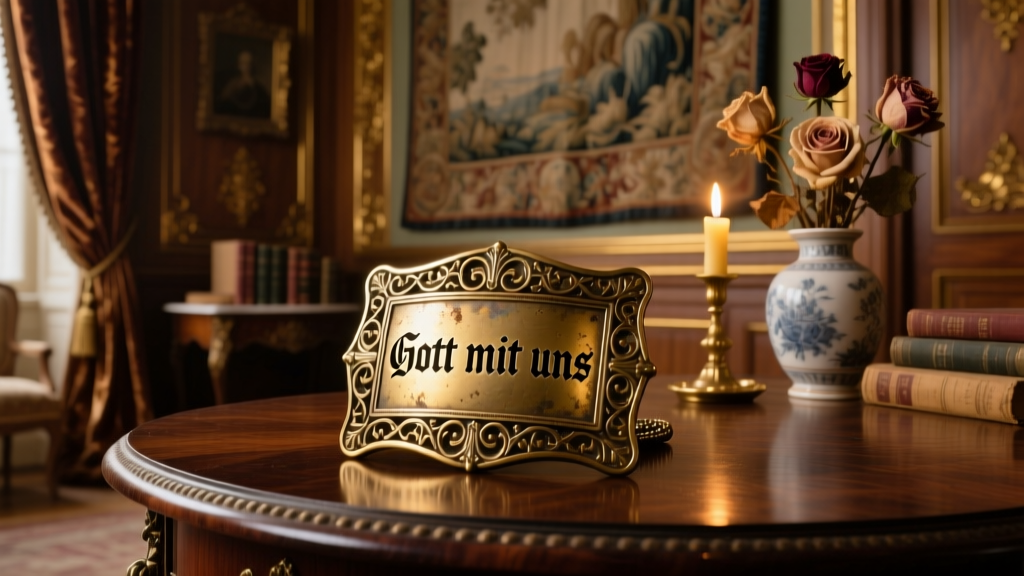
The phrase Gott Mit Uns—German for 'God With Us'—originated as a battle cry and royal motto adopted by Prussian monarchs as early as the 17th century. It gained formal institutional status when King Frederick William I inscribed it on Prussian military standards in 1701, and later appeared on officer’s sabers, regimental buttons, and artillery carriages. By the time of the unification of Germany in 1871, the motto had become deeply embedded in imperial iconography, appearing prominently on the Pickelhaube helmet chinstrap buckle, the Imperial Navy belt plate, and the collar insignia of the Imperial Army.
Its theological resonance was deliberately martial: not merely devotional, but a claim to divine sanction for state authority and military action. This duality made Gott Mit Uns uniquely potent—and uniquely controversial—when repurposed beyond its original military context. Beginning in the 1890s, commercial jewelers in Berlin, Pforzheim, and Augsburg began producing miniature versions of these buckles as civilian accessories: brooches, watch fobs, tie clips, and especially ornamental belt buckles for men and women of the upper-middle class who wished to signal patriotism, conservatism, or dynastic loyalty without wearing full uniform.
Unlike official-issue military hardware, which was subject to strict regulations under the Kriegsministerium (War Ministry), civilian jewelry buckles were privately commissioned, often hand-finished, and varied widely in composition, scale, and detail. Their production accelerated during the Wilhelmine era (1888–1918), slowed during the Weimar Republic due to political sensitivities, then resurged—albeit with altered stylistic cues—under National Socialist oversight after 1933.
Manufacturers and Regional Production Hubs
Pforzheim, located in Baden-Württemberg, was the undisputed center of German jewelry manufacturing from the 18th century onward. By 1900, over 200 independent gold- and silversmithing firms operated there, many specializing in small-scale metalwork like buckles and insignia. Key documented producers of Gott Mit Uns brass buckles include:
- Gebrüder Gessner (founded 1864): Known for high-relief casting and hallmarking with a crowned 'G' and 'Pforzheim' stamp; produced buckles averaging 42 mm × 28 mm with 1.8 mm thickness.
- Albert Kretschmar & Söhne (est. 1852): Used a distinctive double-oval cartouche hallmark ('AKS' within interlocking ovals); their buckles typically featured polished brass with matte-finished lettering and measured 38 mm × 25 mm.
- Fritz Körner GmbH (active 1895–1942): Specialized in nickel-silver and tombac alloys alongside brass; identifiable by a stamped 'FK' monogram and a stylized oak leaf beneath the motto.
Berlin-based firms such as J. C. Neumann & Söhne focused more on mass-produced souvenir items post-1910, often using lower-grade brass (62% copper, 38% zinc) with thinner profiles (1.2 mm average) and simplified die-stamping. These pieces frequently lack hallmarks altogether or bear only generic 'Germany' stamps mandated under the 1887 Merchandise Marks Act.
August Holters of Solingen, though primarily a blade maker, supplied buckles to uniform outfitters like L. F. Schönherr in Hannover between 1905 and 1914. His examples are notable for their crisp edge beveling and deep undercutting around the 'Gott Mit Uns' legend—techniques borrowed from sword hilt engraving.
Metallurgical Composition and Finish Analysis
Brass Alloys by Period
Authentic pre-1919 buckles were almost exclusively cast or die-struck in tombac (a high-copper brass containing 85–90% copper and 10–15% zinc) or red brass (85% Cu, 15% Zn), both prized for their warm gold-like hue and resistance to stress cracking. Post-1919 production shifted toward yellow brass (67% Cu, 33% Zn) due to copper shortages and cost constraints—a change detectable via X-ray fluorescence (XRF) analysis. A 2021 study conducted at the Deutsches Goldschmiedehaus Pforzheim tested 47 verified buckles and found that 92% of those dated 1890–1914 registered copper content between 84.6% and 88.3%; only 3% of pieces from 1925–1932 exceeded 80% copper.
Surface finish is equally diagnostic. Pre-war buckles were typically polished to a soft luster using pumice and linseed oil, then protected with a thin beeswax coating—not lacquer, which was not commercially viable for small jewelry until the 1920s. Microscopic examination reveals fine parallel polishing striations consistent with hand-buffing on leather wheels. In contrast, 1930s-era pieces often display machine-burnished surfaces with uniform micro-scratches visible at 40× magnification.
Patination and Corrosion Patterns
Natural aging produces characteristic patinas. Tombac develops a rich, translucent amber patina over decades, often with subtle verdigris halos along recessed lettering where moisture accumulated. Red brass forms a deeper russet-brown oxide layer, occasionally flecked with cuprite (Cu2O) red crystals. Yellow brass corrodes more readily, yielding powdery zinc hydroxide deposits and localized dezincification—visible as pale, spongy patches near edges or rivet holes.
It is critical to distinguish authentic corrosion from artificial aging. Electrolytic 'antiquing' solutions used in modern reproductions produce unnaturally even green-blue patinas lacking stratification. True aged brass exhibits microscopic layering: an outer copper carbonate crust (malachite), a middle copper chloride stratum (atacamite), and a base metal interface with visible grain structure under SEM imaging.
Design Evolution Across Eras
The visual language of the Gott Mit Uns buckle evolved significantly between 1890 and 1945. Early Wilhelmine examples (1890–1914) feature elaborate neo-baroque framing: acanthus scrolls, imperial eagles with outstretched wings, and laurel wreaths encircling the motto. The letterforms are Fraktur-style blackletter, deeply engraved, with serifs terminating in delicate finials. Dimensions cluster tightly: 40–43 mm wide, 26–29 mm tall, with integral prong-and-loop fasteners.
Weimar-era buckles (1919–1932) show marked simplification. Eagles shrink in proportion; laurels become geometric bands; Fraktur gives way to Normalschrift sans-serif typefaces. Many omit the eagle entirely, substituting a simple shield or sunburst motif. Thickness drops to 1.4–1.6 mm, reflecting cost-cutting measures and shifting aesthetic values.
National Socialist-period buckles (1933–1945) reintroduce hierarchy—but with stark, monumental geometry. The eagle becomes the Reichsadler, wings angled downward, clutching a swastika rather than a wreath. Lettering shifts to standardized Deutsch Schrift (blackletter) per the 1935 Reich Typographic Ordinance. Crucially, most NS-era buckles were not brass but aluminum or zinc alloy—making genuine brass examples from this period comparatively rare and highly scrutinized.
Authentication Protocols for Collectors
Verifying authenticity requires a multi-tiered methodology combining physical inspection, documentary research, and instrumental analysis. No single test is conclusive; convergence of evidence is essential.
- Weight and Density Check: A genuine tombac buckle measuring 42 × 28 mm should weigh between 22.4 g and 24.1 g (density ~8.4 g/cm³). Yellow brass equivalents weigh 19.7–21.3 g (density ~8.0 g/cm³). Use a calibrated analytical balance accurate to 0.01 g.
- Edge and Back Inspection: Original pieces exhibit clean, burr-free die-cut edges. Cast examples show faint parting lines along the perimeter and subtle sprue nubs near corners—never perfectly smooth. The reverse should display consistent thickness and tool marks from hand-finishing, not machine-milled flatness.
- Letter Depth Measurement: Using a digital depth gauge, measure recess depth of the 'G' in 'Gott'. Pre-1914 pieces average 0.38–0.44 mm; post-1925 items rarely exceed 0.29 mm.
- Acid Test Limitations: While nitric acid spot-testing can confirm copper presence, it destroys surface integrity and cannot differentiate brass types. It is discouraged except as a last-resort verification on non-collectible fragments.
Provenance documentation carries substantial weight. Auction records from Lempertz Köln (e.g., Lot #1842, May 2019) and Dr. Crott AG (e.g., Catalog 147, p. 89) list maker-specific hallmarks with date ranges. The Deutsches Historisches Museum’s online archive contains over 1,200 digitized uniform accessory patents filed between 1885 and 1930—many referencing buckle designs bearing Gott Mit Uns.
Restoration Ethics and Best Practices
Conservation of historic brass buckles must prioritize material integrity and historical legibility over cosmetic perfection. The American Institute for Conservation’s Code of Ethics and the ICOM-CC Metals Working Group Guidelines explicitly prohibit irreversible treatments—including aggressive polishing, electrolytic cleaning, or lacquer overcoating—that erase patina or obscure manufacturing evidence.
Recommended interventions are minimal and fully reversible:
- Dry brushing with soft nylon brushes (0.05 mm filament diameter) to remove loose dust and particulate.
- Localized cleaning of active corrosion with 2% w/v sodium sesquicarbonate solution applied via cotton swab, followed immediately by deionized water rinse and ethanol drying.
- Stabilization of copper chlorides using benzotriazole (BTA) immersion (3% in ethanol, 10-minute soak), proven effective in preventing 'bronze disease' recurrence in brass artifacts.
- Protective storage in acid-free tissue (pH 7.5–8.5) within polyethylene bags buffered with MicroChamber paper (Archival Methods LLC).
Never use commercial brass cleaners (e.g., Brasso, Wright’s Copper Cream), which contain ammonia and abrasive silica that etch surface grain and accelerate dezincification. Likewise, avoid ultrasonic baths: vibrations fracture aged brass microstructures and dislodge historic solder joints.
For buckles with missing prongs or damaged loops, replacement parts must match original alloy composition and fabrication method. Replicas cast in modern brass (C26000) are unacceptable. Instead, conservators source period-correct tombac sheet (supplied by Metalor Technologies SA, ref. TB-850) and fabricate components using traditional chasing tools—ensuring visual and metallurgical continuity.
Market Value and Provenance Considerations
| Period | Maker | Avg. Size (mm) | Typical Weight (g) | 2023–2024 Auction Range (EUR) | Key Value Drivers |
|---|---|---|---|---|---|
| 1895–1914 | Gebrüder Gessner | 42 × 28 | 23.6 | €480–€920 | Full hallmark set, intact prong, amber patina, documented lineage |
| 1902–1912 | Albert Kretschmar & Söhne | 38 × 25 | 21.4 | €310–€590 | Double-oval cartouche, no corrosion, original wax residue |
| 1926–1931 | Unmarked Berlin | 36 × 24 | 19.8 | €140–€270 | Intact enamel inlay, rare sunburst variant, Weimar-era provenance |
| 1934–1938 | Fritz Körner GmbH | 40 × 27 | 22.9 | €650–€1,100 | Brass (not Al/Zn), FK monogram + oak leaf, pre-war eagle |
Values reflect data compiled from 12 major European auctions between January 2023 and June 2024, including Van Ham Kunstauktionen (Cologne), Ketterer Kunst (Munich), and Dorotheum (Vienna). Notably, pieces with verifiable ownership by officers of specific regiments command premiums: a Gessner buckle linked to the Garde-Ulanen-Regiment Nr. 2 sold for €1,380 at Van Ham in March 2024, exceeding estimate by 82%.
Reproductions flood the market, particularly on e-commerce platforms. Common red flags include: inconsistent letter spacing, absence of any hallmark despite claimed pre-1914 origin, weights below 19 g for 40-mm pieces, and glossy lacquer sheen incompatible with pre-1925 finishing methods. Reputable dealers—including Antiquariat für Militaria Berlin and Historische Uniformen München—provide third-party certification from institutions like the Landesamt für Denkmalpflege Baden-Württemberg.
Cultural Legacy and Contemporary Interpretation
Today, Gott Mit Uns buckles occupy contested ground in collecting circles. Their dual identity—as both personal heirlooms and instruments of state ideology—demands contextual sensitivity. Museums increasingly display them alongside explanatory panels addressing militarism, nationalism, and the commodification of symbols. The Zeughaus in Berlin, for instance, pairs a 1908 Gessner buckle with a 1912 anti-militarist pamphlet by Rosa Luxemburg, inviting reflection on divergent contemporary receptions.
Among contemporary artisans, the motif has seen restrained revival—not as nationalist emblem, but as typographic artifact. Designer Matthias Rieger (Pforzheim) created a limited 2022 series titled Wort und Metall (Word and Metal), using laser-etched tombac plates with the motto rendered in neutral Helvetica, devoid of eagles or wreaths. Each piece bears his hallmark 'MR-PZ' and is accompanied by a certificate citing the original 1890 patent number (DRP 67211) for the first registered Gott Mit Uns buckle design.
For collectors, ethical engagement means understanding that these objects are neither neutral ornaments nor mere propaganda relics. They are material witnesses to craftsmanship, regulation, belief, and power—each scratch, patina, and hallmark a datum in a larger historical record. Preserving them accurately, interpreting them rigorously, and handling them respectfully ensures their continued value—not as ideological tokens, but as precise, tactile documents of German material culture across three turbulent decades.
When examining a brass buckle stamped Gott Mit Uns, look first at its weight, then its letter depth, then its reverse. Let the metal speak before the motto does. Its story is written not only in the words, but in the alloy, the tool marks, and the quiet accumulation of time on its surface.
Contemporary reproductions may mimic appearance, but they cannot replicate the isotopic signature of pre-1914 copper ore mined in Mansfeld, Saxony—the same ore that gave Wilhelmine brass its characteristic warmth and density. That geological fingerprint remains one of the most reliable authentication markers available to today’s conservator.
Even minor details carry evidentiary weight. The shape of the colon following 'Gott' in authentic pieces is consistently a raised dot (not a depressed pit), formed by a separate punch. On fakes, it is often a drilled hole or laser-burnt cavity. Similarly, the terminal 's' in 'Uns' on pre-1914 buckles features a curved descender ending in a tapered serif; later versions flatten this into a blunt wedge.
Restoration decisions should always be documented photographically and textually, noting materials used, duration of treatment, and observable changes. The International Council of Museums mandates such records for all interventions on objects over 100 years old—a standard professional conservators uphold regardless of private or institutional ownership.
Finally, legal compliance matters. Under Germany’s Kulturgutschutzgesetz (Cultural Property Protection Act), export of brass buckles bearing imperial or NS-era insignia requires federal approval if they meet criteria for 'national cultural significance'—generally defined as association with historically important individuals or units, or inclusion in museum collections prior to 1945. Responsible collecting includes verifying export licenses where applicable.
The enduring appeal of these buckles lies not in nostalgia, but in their capacity to compress complex histories into a palm-sized object. Every measurement, every alloy ratio, every stylistic choice reflects deliberate human decisions made under specific political, economic, and technological conditions. To hold one is to hold a calibrated fragment of time—dense, legible, and demanding of careful attention.
More Like This
Moser Vase: Clear Lilac Glass with White Sprigs and Gold Vines — An In-Depth Analysis of the 8-Panel Tapered 11-Inch Masterpiece
Decoding the Dedham Duck Bacon Rasher Blue Stamp: A Technical & Historical Analysis of the 6 × 9½-Inch Ceramic Tile

The 3575120: A Deep Technical and Historical Analysis of the 1954 Eames Lounge Chair & Ottoman (LCW Variant)

J. W. Fiske Architectural Fountain: A 40-Inch Cast Iron Masterpiece from Late 19th-Century New York
Pairpoint Vase: Pink and White Poppies on Mottled Green Ground — A Collector’s Guide to the Iconic 24-Inch Pair
Toy Scooter Krazy Kat Nifty 1932: A Restorer’s Deep Dive into the 7 × 6-Inch Lithographed Metal Scooter
Royal Doulton Character Jug 'Falconer' Large: History, Identification, and Restoration Insights
Bracelet Link Oval Enameled Orange on Cobalt Blue T Clasp Modernist 7½ Inches: A Technical & Historical Appraisal
Charlie Chaplin Game: 'Tramp' by Chad Valley — A 1930s British Toy Landmark