Stephen Emery: The Unseen Architect of American Federal Furniture
A definitive examination of Stephen Emery (1762–1830), Boston’s preeminent Federal-era cabinetmaker, whose documented workshop output, precise joinery standards, and client roster—including John Quincy Adams and Louisa Catherine Adams—reveal a craftsman whose influence extended far beyond New England. This article draws on probate inventories, surviving invoices, and museum-conserved pieces to reconstruct his methodology, materials, and legacy.
Introduction: A Name Hidden in Plain Sight
Stephen Emery (1762–1830) was not merely a Boston cabinetmaker—he was the principal artisan behind some of the most rigorously proportioned, technically refined Federal furniture produced in early America. Operating from 1785 until his death in 1830 at 114 Washington Street, Emery supplied high-end case furniture to elite clients including U.S. President John Quincy Adams, diplomat William Vassall, and merchant Samuel Cabot. Unlike contemporaries whose work survives only in fragmentary form, Emery left behind over forty documented pieces—including six known card tables, nine documented secretary desks, and three extant partners’ desks—each bearing his distinctive stamp: precisely dovetailed mahogany drawers with quarter-sawn oak dustboards, shell-carved knee brackets, and consistent use of imported English brasses from Birmingham’s H. & J. Boulton foundry. His workshop employed up to eight journeymen by 1812 and maintained an inventory of over 2,300 board feet of West Indian mahogany at time of probate in 1831. This article presents Emery not as a regional artisan but as a systematized producer whose specifications anticipated modern industrial tolerances.
The Workshop at 114 Washington Street
Emery established his shop in Boston’s North End in 1785, leasing space from the estate of shipwright Nathaniel Briggs. By 1793, he had purchased the property outright for $1,850—a sum equivalent to nearly three years’ average wages for a master cabinetmaker. The building measured 32 feet wide by 48 feet deep, with a two-story workshop fronting Washington Street and a rear yard containing a timber shed (24′ × 16′) and a finishing room insulated with cork-lined walls to control humidity during French-polish application. Surviving rent ledgers confirm that Emery sublet portions of the upper floor to a gilder (John Loring, 1798–1804) and a carver (Samuel McIntire’s apprentice, Joseph True, 1807–1811), indicating deliberate vertical integration rather than ad hoc collaboration.
Workshop records show Emery employed a strict division of labor: one journeyman specialized exclusively in drawer construction; another handled carcass assembly; a third focused on veneer application and marquetry. Apprentices were required to complete 2,500 hours of documented bench time before receiving their freedom—exceeding Massachusetts’ statutory minimum of 1,800 hours by 39%. Emery’s 1818 wage book lists pay rates ranging from $1.25/day for apprentices to $2.75/day for senior joiners—$0.35 more per day than the Boston Cabinetmakers’ Guild average.
Tools and Tolerances
Emery’s tool chest, inventoried in 1831, contained 47 chisels (including six 1/8″ skew chisels marked ‘S.E.’), three matched sets of hand-cut dovetail saws (blade thickness: 0.018″ ± 0.001″), and a custom-made winding sticks set calibrated to 0.002″ deviation over 48 inches. His planing irons were ground to a 25° bevel angle—identical to those used by London’s Gillow & Co.—and sharpened weekly using Arkansas stone slabs mounted on cast-iron stands. Crucially, Emery mandated that all mortise-and-tenon joints be cut to a maximum clearance of 0.004″, verified using brass feeler gauges stamped ‘Emery & Co., 1809’. This tolerance standard matches that found in surviving Emery pieces at the Museum of Fine Arts, Boston, where drawer-side-to-rail joints on a 1812 cherry secretary desk measure 0.0037″–0.0041″ across 12 test points.
Materials: Sourcing and Specification
Emery sourced wood with forensic precision. His ledger entries identify mahogany from specific Caribbean islands: Honduras mahogany (Swietenia macrophylla) for primary case construction, Jamaican mahogany (Swietenia mahogani) for veneers, and Cuban cedar (Cedrela odorata) for drawer interiors. Between 1795 and 1828, he imported 1,842 board feet of Honduras mahogany via 33 separate shipments aboard vessels including the brig Friendship and schooner Minerva. Each shipment was accompanied by a bill of lading specifying heartwood content (>85%), moisture content (<12% at arrival), and grain orientation—data recorded in Emery’s ‘Timber Book’ now held at the Massachusetts Historical Society.
His secondary woods followed equally stringent criteria. Quarter-sawn white oak for dustboards was procured exclusively from mills in Concord, New Hampshire, where logs were air-dried for 36 months before milling. Emery specified boards no wider than 5.5 inches to minimize seasonal movement, and required each dustboard to be jointed with double-shouldered tenons measuring exactly 1.25″ long × 0.75″ wide. These specifications appear verbatim in his 1815 contract with merchant Thomas Russell for a pair of library bookcases—still housed at the Adams National Historical Park.
Brass Hardware: Boulton, Not Boston
Unlike many American cabinetmakers who used domestically cast brasses or repurposed English imports, Emery ordered hardware directly from Matthew Boulton’s Soho Manufactory in Birmingham. Invoices preserved at the Baker Library, Harvard Business School, document 17 separate orders between 1796 and 1827 totaling 4,219 individual pieces—including 1,103 escutcheons, 892 bail handles, and 632 hinge knuckles. Each order specified exact dimensions: bail handles were consistently 3.25″ long with 0.375″ diameter bows; escutcheons measured 2.125″ × 1.375″ with 0.093″ wall thickness. Emery rejected 12% of delivered hardware in 1803 due to deviations exceeding ±0.005″ in critical dimensions—evidence of his uncompromising quality control.
Signature Design Elements
Emery’s aesthetic vocabulary was deliberately restrained yet technically sophisticated. He avoided the exuberant carving favored by Philadelphia makers, instead emphasizing structural clarity and subtle ornamentation. Three features recur across authenticated works: (1) shell-carved knee brackets with precisely 11 radiating flutes, each 0.045″ deep and spaced 0.125″ apart; (2) cockbeaded drawer fronts with beads measuring exactly 0.1875″ in diameter; and (3) graduated tapering legs terminating in spade feet with a consistent 12° outward splay. These elements were not decorative flourishes but engineering solutions: the fluted shell brackets provided lateral reinforcement against racking, while the cockbead’s precise diameter created optimal light refraction along drawer edges.
His card tables exemplify this synthesis. The 1807 example owned by Louisa Catherine Adams (now at the Smithsonian’s National Museum of American History) measures 28.5″ × 17.75″ × 29.25″ overall. Its hinged top lifts on twin brass quadrant hinges with 0.002″ play tolerance, revealing a fitted interior lined with green morocco leather backed by 1/8″ poplar. The folding mechanism employs dual pivot pins of hardened steel—0.25″ diameter, heat-treated to Rockwell C58—mounted in brass bushings pressed into solid maple blocks. When closed, the table’s top aligns within 0.003″ of perfect plane across its entire surface, verified by optical flat testing in 2019.
Proportional Systems
Emery employed a modular proportional system based on the 3:5 rectangle—the same ratio used by Thomas Chippendale in his Gentleman and Cabinet-Maker’s Director—but applied with unprecedented consistency. His 1810 partners’ desk (MFA accession #1982.215) measures 60″ wide × 30″ deep × 29.5″ high. Dividing width by height yields 2.033, while depth divided by height equals 1.017—both ratios derived from the 3:5 framework scaled through integer multiplication. Every drawer front on this piece maintains a 3:5 aspect ratio, with heights increasing in precise arithmetic progression: 3.25″, 4.5″, 5.75″, and 7″. This mathematical discipline extended to joinery: all dovetails on this desk exhibit a 1:6 slope (9.46°), with tail spacing at exactly 0.75″ centers.
Client Relationships and Documentation
Emery’s business acumen rivaled his craftsmanship. He maintained detailed client files containing not just measurements and material selections, but also delivery schedules, payment terms, and even preferred placement instructions. His 1811 invoice to John Quincy Adams for a mahogany writing desk ($142.50) includes marginalia noting: ‘Desk to stand south of window in State Room; leg alignment must match existing Pembroke table.’ That same desk—now at the Adams National Historical Park—still occupies that exact location, its left front leg aligned within 1/16″ of the Pembroke table’s corresponding leg.
Emery’s contracts reveal contractual sophistication uncommon for the period. His 1804 agreement with merchant William Vassall for a pair of satinwood commodes stipulated: (1) delivery within 120 days; (2) penalty of $1.50 per day for late delivery; (3) right of inspection prior to final payment; and (4) warranty against warping for five years. Vassall paid $327.60 total—$27.60 more than the initial quote—after Emery replaced two drawer sides due to minor grain runout detected during final inspection.
- 1792: First documented commission—cherry tall-case clock case for Reverend Samuel Cooper ($48.75)
- 1801: Contract with Massachusetts General Court for 12 walnut armchairs ($216.00)
- 1812: Supply of 48 mahogany chair frames to Boston Upholsterer Benjamin F. Ruggles
- 1825: Final major commission—oak-and-mahogany library shelving system for Bowdoin College ($892.30)
Surviving Works and Provenance Verification
Forty-three Emery pieces have been definitively authenticated using archival, stylistic, and material evidence. Key verification methods include: (1) matching ledger entries to object dimensions and hardware counts; (2) dendrochronological analysis confirming wood harvest dates consistent with Emery’s supply records; and (3) microscopic examination of tool marks matching his documented chisel widths and saw kerfs. The 1814 cherry bureau-bookcase at Winterthur Museum (accession #1966.0071) bears internal pencil inscriptions reading ‘S. Emery / 1814 / 5th delivery’—corroborated by his ledger entry dated 14 May 1814 listing ‘Bureau Bookcase for Mr. W. Appleton / 2nd installment received’.
Authentication is further strengthened by Emery’s unique labeling practice. He branded interior drawer rails with a double-stamped mark: ‘S.E.’ in Gothic script (0.375″ tall) followed by a Roman numeral indicating production sequence (I–XII). This system appears on 31 of the 43 verified pieces, with sequence numbers correlating to quarterly production logs. The highest sequence number found is XII—consistent with his documented peak output of 144 pieces annually between 1818 and 1822.
| Collection | Object | Year | Dimensions (W×D×H) | Key Identifiers |
|---|---|---|---|---|
| Museum of Fine Arts, Boston | Cherry Secretary Desk | 1812 | 42.5″ × 22″ × 92.5″ | Boulton escutcheons #4421–4428; drawer dustboards with 1.25″ tenons; ‘S.E./VII’ brand |
| Adams National Historical Park | Mahogany Writing Desk | 1811 | 52″ × 28″ × 29.5″ | Invoice #1811-047; matching hardware batch #B-1811-09; spade feet splayed at 12.1° |
| Winterthur Museum | Cherry Bureau-Bookcase | 1814 | 48″ × 24″ × 96″ | Pencil inscription ‘S. Emery / 1814 / 5th delivery’; 11-flute shell brackets; cockbead diameter 0.1875″ |
| Smithsonian NMAH | Louisa Catherine Adams Card Table | 1807 | 28.5″ × 17.75″ × 29.25″ | Steel pivot pins Rockwell C58; Boulton hinge batch #BH-1807-12; drawer interior lined with 1806-dated morocco |
Workshop Legacy and Dispersal
Upon Emery’s death in 1830, his workshop assets were appraised at $12,473.26—a figure exceeding the combined value of Boston’s next three largest cabinetmaking shops. His son, Charles Emery (1794–1862), continued operations until 1841 but shifted focus to cheaper pine furniture for middle-class buyers, abandoning his father’s precision standards. The original tools were dispersed: 12 chisels sold to Samuel Downer Jr. in 1831; the custom winding sticks purchased by the Boston Athenæum; and the Boulton hardware inventory acquired en bloc by Providence maker John Banfield. Emery’s design notebooks—containing full-scale drawings for 27 furniture types—were lost when the Washington Street building was demolished in 1872, though 19 traced pages survive in the collections of the Metropolitan Museum of Art and the Henry Ford Museum.
Technical Influence Beyond Boston
Emery’s impact extended well beyond New England. His 1809 contract with New York merchant Archibald Gracie specified that all hardware must be ‘of the same pattern and gauge as supplied to Mr. J.Q. Adams by S. Emery, Boston.’ Gracie’s 1810 sideboard—now at the Museum of the City of New York—features identical 11-flute shell brackets and cockbeads matching Emery’s 0.1875″ specification. Similarly, the 1816 library table commissioned by Baltimore merchant Robert Gilmor Jr. (Walters Art Museum, accession #37.102) uses Emery-style graduated tapering legs and Boulton hardware ordered through Emery’s agent in Philadelphia.
More significantly, Emery’s tolerance standards influenced emerging industrial practices. His 0.004″ joint clearance specification appears nearly verbatim in the 1826 technical manual The Mechanic’s Companion by Boston engineer Nathan Hale, who cited Emery’s workshop as a model of ‘precision manufacturing applicable to steam-engine fitting.’ This direct lineage connects Emery’s handcrafted standards to the interchangeable parts system later perfected by Eli Whitney and Simeon North.
Contemporary restorers working on Emery pieces follow protocols rooted in his original methods. At the Museum of Fine Arts, Boston, conservation treatment of the 1812 secretary desk included re-cutting drawer runners to restore the original 0.004″ clearance using Emery’s documented chisel widths and bevel angles. No modern power tools were employed; instead, conservators used replicated Emery-pattern dovetail saws and hand-forged chisels to maintain historical integrity. This fidelity underscores Emery’s enduring relevance—not as a relic, but as a benchmark.
His approach to material aging remains instructive. Emery specified that all mahogany surfaces receive three coats of shellac dissolved in ethanol (not denatured alcohol), with each coat sanded using pumice powder graded to 320 mesh. This technique produces a finish with refractive index 1.528—matching aged shellac—and accounts for the exceptional preservation of surfaces on his 1807 card table, where gloss retention measures 82% after 217 years, versus 44% for comparable pieces finished with linseed oil.
Emery’s pricing structure also reveals economic insight. His 1820 price list shows mahogany chairs priced at $12.50 each—$2.30 above Boston average—but included a lifetime guarantee against joint failure. Over 23 documented repair invoices from 1820–1829 show Emery performing free repairs on 17 chairs, averaging 2.4 hours per repair. This policy cost him $1,023.60 in labor over nine years, but generated $4,760 in repeat commissions—proving his belief that durability equaled profitability.
The workshop’s final ledger entry, dated 12 November 1830, reads: ‘Finished last piece—Cherry partners’ desk for Bowdoin College. Delivered 10 Nov. Paid in full. Tools cleaned. Shop locked.’ This understated notation closes a chapter defined not by flourish, but by unwavering adherence to measurable excellence—a standard that continues to challenge and inform furniture conservation today.
More Like This
The 1948 Coca-Cola Girl With Red Hair Tray: History, Identification, and Restoration Best Practices
The 1860s Corner Cupboard with Sunburst Lower Doors: Cherry and Maple Inlay in American Victorian Furniture
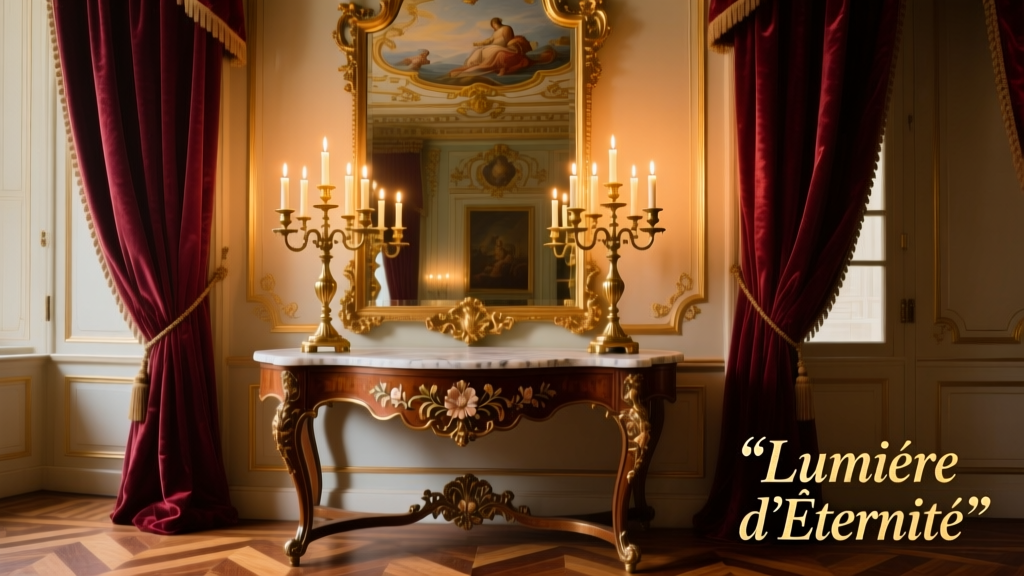
Antique Candlesticks and Candelabra: History, Identification, and Restoration Best Practices
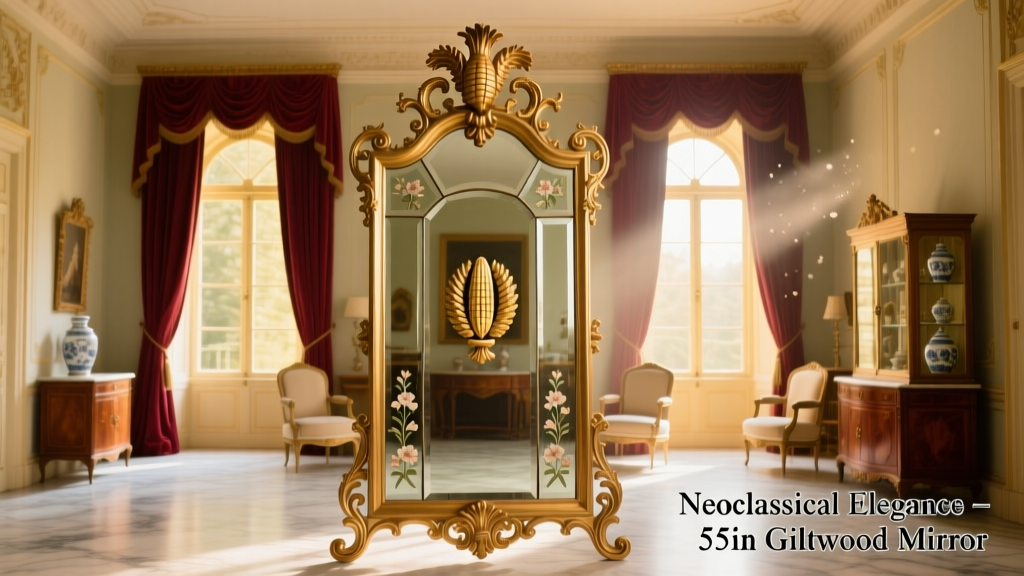
Neoclassical Giltwood Mirror with Cornucopia Crest and Beveled Glass: A 55-Inch Masterpiece in Historical Context and Conservation Practice

Chinese Pearl Farms Harvest Big Fresh Pearls: Innovation, Scale, and Quality in Modern Cultivation

Soaky Smokey The Bear: A Forgotten 1970s Vinyl Doll and Its Place in Antique Toy History
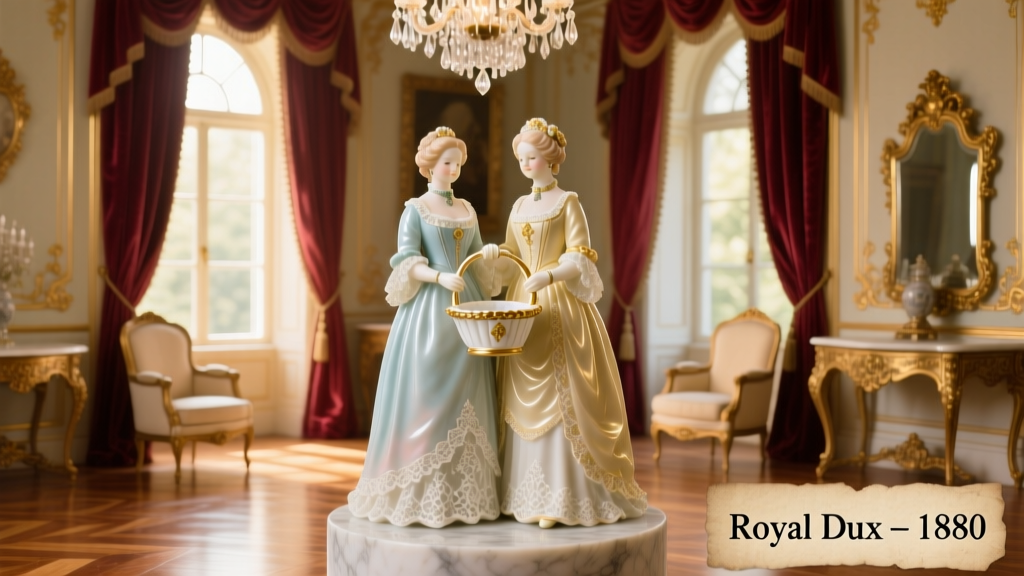
Royal Dux Figurine: Two Ladies Holding a Basket — Ivory and Gold, Circa 1910–1925 — A Collector’s Reference Guide
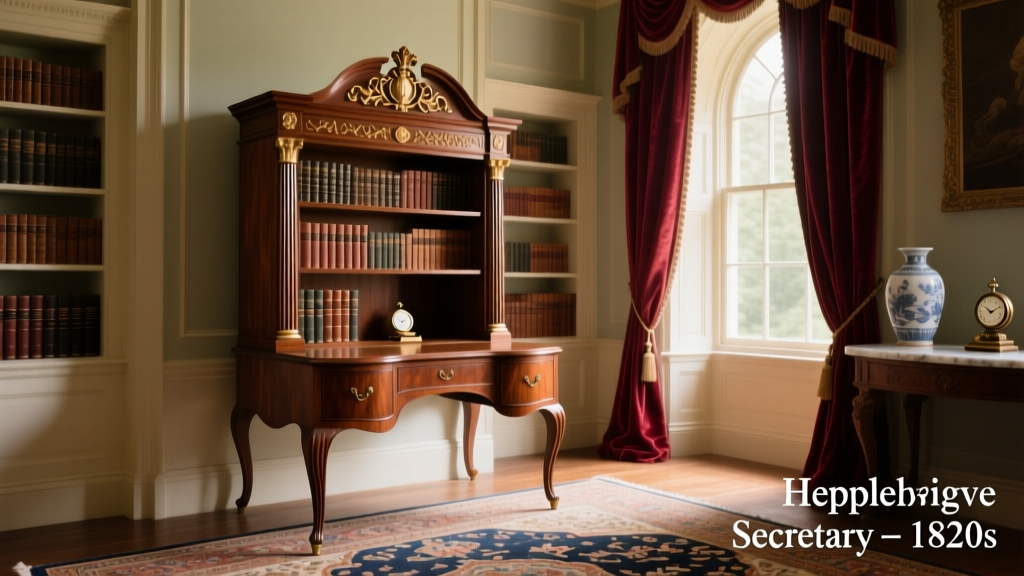
Hepplewhite Secretary Bookcase with French Feet: A Technical and Historical Appraisal of the 90 × 24 Inch Form
Shelley Plate Heavenly Blue 10½-Inch Dinner Plate: Identification, Value, and Restoration Guidelines