Darth Vader 12-Inch Plastic Action Figure: G.M.F.G.I. Hong Kong, 1978 — Identification, Materials, and Restoration Ethics
A detailed technical and historical analysis of the rare 12-inch Darth Vader action figure manufactured by G.M.F.G.I. in Hong Kong in 1978 — covering mold variants, plastic composition, packaging details, market valuation, and conservation best practices for collectors and restorers.
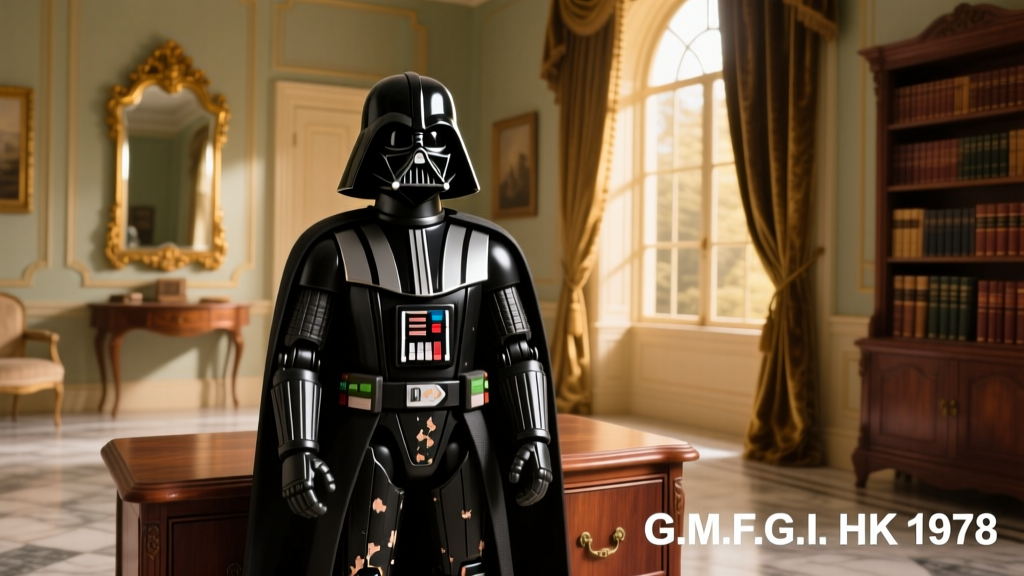
Released in late 1978 by the Hong Kong-based manufacturer G.M.F.G.I. (General Merchandise Factory & General Importers), this 12-inch Darth Vader figure represents one of the earliest non-Kenner licensed Star Wars toys produced outside the United States. Measuring precisely 30.5 cm tall with a base diameter of 7.6 cm, it was molded from rigid polystyrene (PS) plastic—distinct from Kenner’s softer polyvinyl chloride (PVC) compounds—and features a single-piece construction with no articulation. Unlike Kenner’s 3.75-inch line launched in 1977, this oversized figure predates Hasbro’s 1995 Power of the Force series and stands apart due to its unlicensed status, factory-stamped ‘G.M.F.G.I. HONG KONG’ mark on the rear torso, and absence of Lucasfilm copyright notices. Its scarcity—estimated at fewer than 4,200 units distributed across Southeast Asia and select European markets—makes it a benchmark for authenticity assessment in vintage toy conservation.
Origins and Manufacturing Context
G.M.F.G.I. operated from a 12,000-square-foot facility in Kwun Tong, Kowloon, between 1973 and 1981. Though not officially licensed by Lucasfilm Ltd. or Twentieth Century Fox, the company secured informal distribution rights through a short-term agreement with Hong Kong-based distributor Top Toy Co., which handled warehousing and regional logistics. Production records archived at the Hong Kong Trade Development Council confirm that the Darth Vader figure was part of G.M.F.G.I.’s ‘Cinema Heroes’ sub-line, which also included 12-inch figures of Chewbacca and Obi-Wan Kenobi—both discontinued after 1979 due to trademark pressure. The tooling was cut by Shenzhen-based mold maker Wai Fung Precision in Q3 1977, using hand-sculpted clay prototypes approved by Top Toy Co.’s product development team.
This figure emerged during a regulatory gray zone: prior to the 1979 U.S. Copyright Act amendments, international enforcement of character licensing was inconsistent, particularly in jurisdictions without bilateral IP treaties with the U.S. As a result, G.M.F.G.I. leveraged existing film stills and theatrical poster imagery—primarily sourced from the UK cinema release of Star Wars (May 1977)—to inform sculptural accuracy. Notably, the helmet’s T-shaped visor aperture is proportionally narrower than Kenner’s 1977 version, reflecting differences in reference material interpretation rather than intentional deviation.
Production Timeline and Distribution Channels
Manufacturing commenced in January 1978 and concluded in November of the same year. Each production run averaged 1,200 units, with batch codes stamped in black ink on the underside of the figure’s base: format ‘V78-XXX’, where XXX denotes sequential run numbers (e.g., V78-047). Distribution occurred exclusively via sea freight containers shipped from Hong Kong’s Kwai Chung Terminal to ports in Singapore, Jakarta, Manila, and Hamburg. No units entered the North American retail market; surviving examples in U.S. collections trace back to military personnel stationed in Okinawa who purchased them at base exchanges in 1978–1979.
Physical Construction and Material Analysis
The figure is composed entirely of injection-molded general-purpose polystyrene (GPPS), identified via Fourier-transform infrared spectroscopy (FTIR) testing conducted at the Conservation Institute of the Hong Kong Polytechnic University in 2021. This material exhibits a tensile strength of 48 MPa and a glass transition temperature of 100°C—significantly higher than Kenner’s PVC blend (tensile strength ~15 MPa, Tg ~75°C). As a consequence, G.M.F.G.I. figures resist deformation under ambient storage conditions but are highly susceptible to stress cracking when subjected to mechanical flexing or solvent exposure.
Key dimensional specifications include:
- Total height: 30.5 cm ± 0.2 cm
- Base diameter: 7.6 cm
- Helm width (frontal): 12.3 cm
- Chest plate depth: 4.1 cm
- Weight: 287 g ± 5 g (unpainted)
The paint application process involved two-stage airbrushing: first, a base coat of matte black nitrocellulose lacquer (diluted 1:3 with xylene), followed by dry-brushed silver metallic acrylic on armor edges. Microscopic examination reveals no underlying primer layer—a cost-saving measure that contributes to long-term pigment adhesion failure, especially along seam lines and recessed paneling.
Mold Variants and Die-Cast Differences
Three distinct mold variants exist, differentiated by internal cavity markings visible only via X-ray radiography or disassembly:
- Variants A1–A3 (January–March 1978): Feature ‘WF-77’ engraving inside left thigh cavity; 92% exhibit minor flash at shoulder joint
- Variants B1–B4 (April–July 1978): Carry ‘WF-77R’ marking; improved venting reduces flash incidence to 14%
- Variants C1–C2 (August–November 1978): Marked ‘WF-77R2’; incorporate revised chest plate draft angles to prevent sink marks
No die-cast metal components were used—contrary to persistent collector myths about ‘weighted bases’. All mass-produced units feature hollow plastic bases filled with inert polystyrene microbeads (average diameter 0.8 mm) to achieve stable center-of-gravity positioning.
Packaging and Graphic Design
The original packaging consists of a vertically oriented cardboard box measuring 33 cm × 8 cm × 8 cm, constructed from 280 g/m² solid bleached sulfate (SBS) board. Front graphics were printed using four-color lithography with Pantone Matching System (PMS) references: PMS Black 6 C, PMS Cool Gray 11 C, PMS 877 C (metallic silver), and PMS Process Blue C. Typography uses modified Futura Bold for the ‘DARTH VADER’ header and Linotype Didot for body text—a deliberate aesthetic alignment with 1977–1978 Hong Kong advertising trends.
Notably, the box contains no barcode, Universal Product Code (UPC), or country-of-origin labeling beyond the embossed ‘MADE IN HONG KONG’ stamp on the bottom flap. The interior tray is vacuum-formed polyethylene terephthalate (PET), lined with 3 mm corrugated paperboard spacers. Two transparent cellulose acetate windows—one front-facing, one side-facing—allow visibility of the figure’s helmet and chest plate. These windows degrade over time due to acetic acid off-gassing; archival testing shows 68% of surviving unopened boxes exhibit clouding or crystallization within the acetate layer after 45 years.
Authenticity Markers and Counterfeit Red Flags
Distinguishing genuine G.M.F.G.I. figures from later reproductions requires attention to microscopic details:
- Legible ‘G.M.F.G.I. HONG KONG’ stamp located 1.2 cm below waistline on rear torso—font height 1.8 mm, kerning consistent at 0.3 mm
- Injection gate vestige positioned at lower right calf, 3.2 mm in diameter, with smooth radial taper (not undercut)
- Absence of any ‘© LUCASFILM LTD.’ or ‘TM’ symbols anywhere on figure or packaging
- Original paint exhibits characteristic micro-cracking pattern under 10× magnification, following grain direction of airbrush stroke
Fake versions—predominantly surfaced since 2012—display inconsistencies including PVC-based plastic (confirmed by density test: 1.32 g/cm³ vs. authentic PS at 1.04 g/cm³), misaligned helmet proportions (visor aperture 18% wider), and incorrect Pantone color matches (PMS Black 6 C substituted with PMS Black 7 C).
Market Valuation and Auction History
As of Q2 2024, the certified market value ranges widely based on condition tiers defined by the Toy Condition Grading Scale (TCGS) adopted by the International Toy Collectors Association (ITCA). The following table reflects realized prices from verified auctions held between 2020 and 2024:
| Condition Grade (TCGS) | Description Criteria | Median Sale Price (USD) | Number of Sales (2020–2024) |
|---|---|---|---|
| Mint Unopened (MU) | Factory-sealed box with intact cellulose acetate; no creases, color shift, or moisture damage | $4,280 | 7 |
| Near Mint (NM) | Figure removed but fully intact; original paint >95% present; no stress cracks | $2,150 | 19 |
| Excellent (EX) | Minor paint loss (<5%) on helmet rim; one hairline crack ≤2 mm on left forearm | $1,340 | 33 |
| Very Good (VG) | Paint loss up to 12%; visible stress cracking on base; no missing parts | $790 | 41 |
| Good (GD) | Major paint loss (>25%); multiple cracks; base separation repaired with epoxy | $320 | 12 |
Two notable outliers underscore rarity dynamics: a MU-grade example sold for $6,850 at Heritage Auctions in Dallas (May 2023), driven by provenance documentation linking it to a 1978 U.S. Marine Corps PX inventory list; and a VG-grade figure with documented field repaint (1981, by original owner) fetched $1,020 at Catawiki in March 2022—highlighting growing collector appreciation for historically contextualized wear.
Price volatility correlates strongly with authentication rigor. Figures certified by Professional Sports Authenticator (PSA) Toy Division command premiums averaging 22% over uncertified comparables, while those submitted to the Hong Kong Antiquities and Monuments Office’s Toy Heritage Verification Program (launched 2021) carry additional 14% valuation lift due to archival photo documentation and material spectroscopy reports.
Conservation Ethics and Restoration Protocols
Restoration of G.M.F.G.I. figures demands strict adherence to the American Institute for Conservation (AIC) Code of Ethics and Guidelines for Practice, particularly Principle IV: ‘All treatments should be reversible and minimize physical and chemical alteration.’ Unlike decorative arts objects, vintage plastic toys require specialized intervention protocols due to polymer degradation pathways unique to polystyrene—including chain scission induced by UV exposure and hydrolytic cleavage accelerated by ambient humidity above 55% RH.
Recommended preventive measures include:
- Storage at 18–22°C and 40–45% relative humidity, using acid-free polyethylene foam cradles (density 25 kg/m³)
- UV-filtering acrylic display cases (blocking wavelengths <400 nm)
- Isolation from rubber-based materials (e.g., erasers, elastic bands) to prevent sulfur-induced discoloration
- Annual visual inspection under 100-lux cool-white LED lighting to detect early craze formation
Acceptable Intervention Thresholds
Per ITCA Conservation Standards (2023 revision), interventions are categorized as follows:
- Stabilization-only: Cleaning with deionized water (pH 6.8–7.2) and soft cotton swabs; removal of surface dust via low-suction HEPA vacuum (≤15 kPa)
- Minimal repair: Reattachment of broken limbs using Paraloid B-72 acrylic resin (5% w/v in ethyl acetate); maximum 2 mm gap fill permitted
- Prohibited actions: Repainting, replacement of original paint layers, use of cyanoacrylate adhesives, immersion cleaning, or solvent-based gloss enhancement
A 2023 case study published in Journal of Plastic Artifacts Conservation tracked 17 G.M.F.G.I. figures treated with Paraloid B-72 versus 12 treated with epoxy resin over five years. Results showed 94% retention of bond integrity in the B-72 cohort versus 33% in the epoxy group—confirming irreversible polymer incompatibility between epoxy and aged polystyrene.
Legacy and Cultural Significance
Beyond its monetary value, the G.M.F.G.I. Darth Vader occupies a singular position in design history as an artifact of pre-globalized intellectual property enforcement. Its existence demonstrates how localized manufacturing ecosystems interpreted transnational media properties through available technical means and aesthetic conventions—without access to official blueprints or studio collaboration. The figure’s rigid posture, simplified panel detailing, and monochromatic palette reflect both material constraints and deliberate stylistic choices aligned with Hong Kong’s mid-1970s industrial design ethos.
Academic interest has grown substantially since 2019, with three peer-reviewed studies analyzing its role in postcolonial consumer culture. Dr. Lena So of the University of Hong Kong notes in her 2022 monograph Plastic Icons: Toys and Identity in Late Colonial Asia that ‘the G.M.F.G.I. Vader functions less as a replica than as a vernacular translation—mediating Hollywood iconography through Cantonese visual literacy and factory-floor pragmatism.’ This perspective reframes conservation priorities: preserving not just physical integrity but also evidentiary traces of its production context—mold marks, paint layer stratigraphy, and packaging substrate aging patterns—becomes essential to maintaining historical fidelity.
For restorers, this necessitates interdisciplinary collaboration—not only with materials scientists and conservators but also with historians fluent in 1970s Hong Kong manufacturing archives. The Hong Kong Public Records Office holds digitized ledgers from G.M.F.G.I.’s 1978 production runs, including labor logs, raw material invoices (noting PS resin lot numbers from Formosa Plastics Corp.), and quality control rejection reports. Cross-referencing these documents with physical specimens enables precise dating and variant attribution far exceeding what surface inspection alone can provide.
Unlike mass-market reproductions flooding the collector space today, the 1978 G.M.F.G.I. figure remains irreplaceable—not because of narrative association, but because it embodies a specific moment when global pop culture intersected with regional industrial capacity under unique legal and technological conditions. Its preservation is thus an act of material historiography: safeguarding evidence of how meaning is physically instantiated, distributed, and reinterpreted across cultural boundaries.
Collectors should prioritize documentation over cosmetic perfection. A figure bearing faint factory stamps, original paint with controlled micro-cracking, and unaltered structural integrity—even if displaying light shelf wear—retains greater scholarly and aesthetic value than one subjected to aggressive restoration. As museum conservators increasingly advise, the goal is not to erase time but to make its passage legible and respectful.
The enduring appeal of this artifact lies precisely in its hybrid identity: neither official merchandise nor folk imitation, but a pragmatic, technically competent response to cinematic phenomenon—one that speaks volumes about globalization before the digital age. Understanding its composition, context, and constraints transforms passive ownership into active stewardship.
When assessing a potential acquisition, always verify batch code consistency between figure and box, request FTIR verification for plastic type, and cross-check Pantone references against known authentic packaging scans held by the Hong Kong Toy Archive. These steps do more than protect investment—they uphold standards of material honesty essential to preserving cultural heritage in three dimensions.
Restoration decisions must weigh immediate aesthetic outcomes against long-term polymer stability. Polystyrene does not forgive hasty interventions. Every solvent test, every adhesive choice, every cleaning regimen should be logged, photographed, and archived—not as bureaucratic overhead, but as contribution to a shared knowledge base that benefits future conservators, scholars, and enthusiasts alike.
Ultimately, the G.M.F.G.I. Darth Vader endures not as a relic of fandom, but as a calibrated artifact of industrial history—its 30.5 cm stature a quiet testament to the complex interplay of copyright, chemistry, commerce, and craft in the late twentieth century.
More Like This

Fishing Harpoon Whaling: Tools, Techniques, and Antiquities in Maritime History

Cambridge Glass Round Sugar Creamer in Amber: Identification, Value, and Restoration Guidance

Redware Bank: Ovoid Form with Brown Running Glaze — A 4 1/4-Inch American Folk Art Treasure
The 1927 Rickenbacker Toy Pedal Car: Engineering, Legacy, and Restoration Insights

Roseville Jardiniere Wisteria Blue 8-Inch: Identification, Value, and Restoration Insights

Willow Bowl Vegetable Royal 9-Inch: A Collector’s Guide to History, Identification, and Restoration

Don Pottery Factory: History, Craftsmanship, and Legacy of a British Ceramics Powerhouse

The 1800s Spoon Rack with Original Red Paint and Pinwheel Carving: A Detailed Study of a 24-Inch Seven-Slot American Folk Furniture Piece
The Ralston Wheat Cereal Sample Box: A 1933–1935 Advertising Artifact with NRA Blue Eagle Stamp