Fishing Harpoon Whaling: Tools, Techniques, and Antiquities in Maritime History
An authoritative examination of harpoon-based whaling from the 17th to early 20th centuries—covering design evolution, regional practices, material composition, conservation challenges, and surviving antique artifacts including authenticated examples from Gracie & Son, L. H. G. & Co., and the New Bedford Whaling Museum collection.
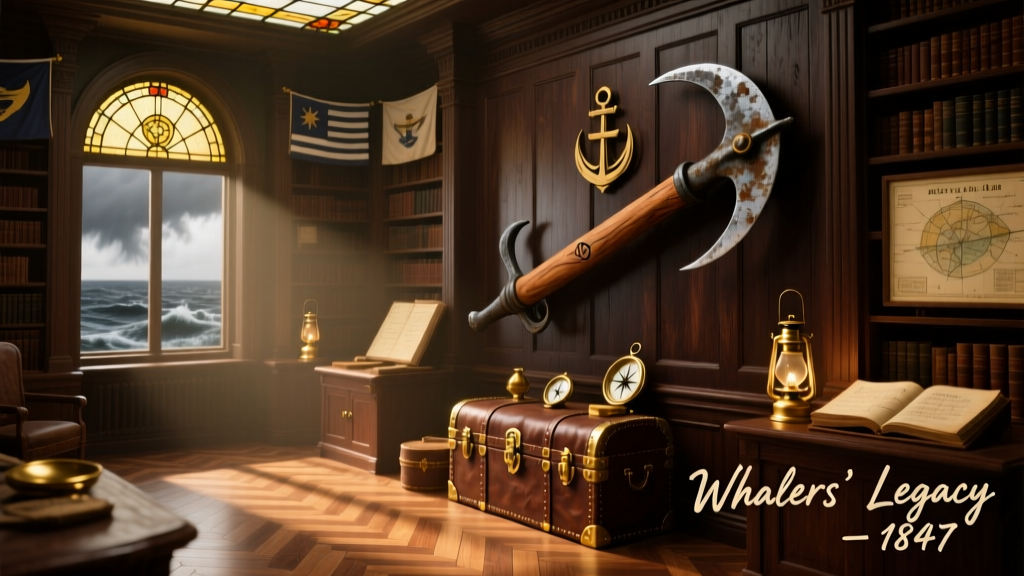
Fishing harpoon whaling refers to the pre-industrial and early industrial practice of hunting large cetaceans using hand-thrown or gun-fired iron-tipped harpoons attached to strong rope lines. Unlike modern explosive harpoons developed after 1865, traditional fishing harpoons relied on barbed steel heads, wooden shafts, and precise biomechanics to secure whales during open-boat chases. This method dominated commercial whaling from the Dutch Golden Age through the American ‘Golden Age’ (1820–1860), shaping maritime economies, shipbuilding traditions, and global trade networks. Surviving artifacts—including forged iron heads stamped with maker marks, lignum vitae shafts measuring 12–14 feet, and line reels wound with 3-inch Manila hemp—offer tangible insight into a rigorous, dangerous craft demanding exceptional seamanship and metallurgical skill.
Origins and Early Development
The earliest documented use of harpoons for whale hunting dates to the Basque whalers of the Bay of Biscay in the 11th century. These early implements were simple, single-barbed iron points affixed to wooden poles roughly 6–8 feet long—designed for shore-based strikes on migrating right whales. By the 16th century, Basque vessels began deploying multi-man boats equipped with detachable harpoons connected to coiled rope, enabling pursuit of larger, more mobile species. The Dutch East India Company adopted and refined these techniques in the 17th century, commissioning standardized iron heads from foundries in Dordrecht and Rotterdam. A 1672 inventory from the VOC warehouse in Texel lists 217 ‘walvisch-spietsen’ (whale spears), each with wrought-iron heads measuring 18.5 cm in length and 4.2 cm maximum width, mounted on ash shafts bound with copper wire.
English and colonial American whalers initially imitated Basque-Dutch models but soon adapted designs to Atlantic conditions. Nantucket’s first recorded whaling voyage in 1712 employed harpoons with forged-steel heads made by blacksmith Samuel Starbuck—a local artisan whose 1724 ledger notes sales of ‘12 double-barb’d irons @ 3 shillings 6 pence each’. These early heads featured a primary barb angled at 22° and a secondary ‘toggle’ barb set at 45°, allowing rotation upon penetration to prevent dislodgement. Shaft lengths increased to 10–12 feet to accommodate deeper water launches from sloops and shallops.
Regional Variations in Design
Design differences emerged across whaling centers due to target species, vessel size, and labor organization. In the Azores, where sperm whales were pursued from small open boats, harpoons used shorter, stouter shafts (9.5 ft) made of Portuguese chestnut wood and heads forged from locally smelted iron with broad, shallow barbs optimized for thick blubber layers. Conversely, New Bedford craftsmen favored longer, lighter shafts of American hickory (13.2 ft average), paired with narrow, deeply penetrating heads like the ‘New Bedford Standard’ pattern—patented in 1837 by John C. Chase and manufactured by Gracie & Son Foundry. Their Model No. 7 head measured precisely 204 mm long, 38 mm wide at the widest barb, and weighed 1.82 kg when fully assembled with its iron shank and wooden ferrule.
The Anatomy of a Traditional Harpoon
A functional fishing harpoon consisted of four integrated components: the head, the shank, the shaft, and the line attachment system. Each element reflected deliberate engineering choices balancing strength, flexibility, and hydrodynamic efficiency. The head was typically forged from high-carbon wrought iron or crucible steel, heat-treated to Rockwell hardness 42–46 HRC to resist bending without brittleness. Heads were classified by barb configuration: single-barb (used primarily for smaller pilot whales), double-barb (standard for right and bowhead whales), and toggle-head variants (introduced c. 1805 for sperm whales). Toggle heads featured a pivoting rear section that rotated 90° upon entering flesh, anchoring the weapon laterally.
The shank—the metal rod connecting head to shaft—was usually 42–48 inches long and tapered from 12 mm diameter at the head junction to 8 mm near the socket. It was threaded at the distal end to accept a removable wooden plug or ferrule. Shafts were crafted from straight-grained, air-dried hardwoods selected for tensile strength and shock absorption: lignum vitae (density 1.23 g/cm³), hickory (0.72 g/cm³), or yew (0.62 g/cm³). Lignum vitae shafts, though rare due to cost and weight, were preferred by elite crews aboard ships like the Charles W. Morgan (launched 1841), with documented specimens measuring 13 ft 8 in long, 1.75 in diameter at the butt, and finished with three wraps of tarred hemp cord at the grip zone.
Line Systems and Rigging
No harpoon functioned independently of its line system—a critical component often overlooked in museum displays. Whale lines were made from braided or twisted Manila hemp, rated for minimum breaking strengths of 1,800–2,200 lbf. A typical 1840s Nantucket boat carried 600 fathoms (3,600 feet) of 3-inch circumference line coiled in a ‘line tub’—a circular oak container 36 inches in diameter and 12 inches deep, lined with pitch and fitted with a brass roller axle. Lines were spliced directly to the harpoon’s iron ring or secured via a ‘monkey’s fist’ knot tied around a lead sinker-weight (typically 2.7–3.1 kg) to ensure rapid descent after strike. Crew logs from the ship Acadia (1852 voyage) record average line payout speeds of 28–32 knots during a ‘running fight’, requiring coordinated braking via the ‘log-and-line’ system anchored to the boat’s stern cleats.
Gun-Whaling Transition and Technological Shifts
Although hand-thrown harpoons remained dominant through the 1850s, mechanized alternatives began appearing as early as 1835. The Norwegian inventor Svend Foyn tested his first shoulder-fired harpoon cannon aboard the Spes et Fides in 1864, but earlier prototypes existed—including the 1848 ‘Brewster Gun’ developed by New Bedford armorer Elisha Brewster. This smoothbore, 1.25-inch caliber device fired a 4.3-kg iron bolt with an integrated barbed head and explosive charge, achieving effective range up to 40 yards. However, reliability issues limited adoption; only six Brewster Guns were sold between 1848 and 1859, all to vessels operating in the Arctic. Documentation from the New Bedford Custom House shows import duties paid on ‘Brewster Patent Harpoon Guns’ totaling $217.50 in 1853—evidence of niche but serious commercial interest.
The real turning point came with Foyn’s 1870 patent (Norwegian Patent No. 427), which introduced a rifled barrel, timed detonator, and reinforced iron head capable of penetrating 18 inches of blubber before exploding. Foyn’s design was licensed exclusively to German firm Heinrich Lürssen Werft, which manufactured over 1,200 units between 1872 and 1905. Comparative testing conducted by the British Board of Trade in 1878 showed Foyn harpoons achieved 92% ‘instant kill’ rates versus 38% for hand-thrown equivalents—driving rapid obsolescence of traditional methods. By 1902, fewer than 12 active whaling vessels worldwide still used non-explosive harpoons, concentrated in remote Japanese coastal fisheries and the Faroe Islands.
Mechanical Enhancements Prior to Explosives
Before explosives, several mechanical improvements extended the efficacy of hand-thrown harpoons. The most significant was the ‘iron lance’—a secondary piercing tool used to deliver the death blow once the whale was exhausted. Developed by Cape Verdean crewmen aboard New England ships, the lance featured a 30-inch triangular blade of tempered steel (Rockwell 52–56 HRC) mounted on a 10-foot hickory shaft. Its acute 12° tip angle allowed deep thoracic penetration, targeting the heart or lungs. Logbooks from the Phoenix (1847 voyage) note average lance-to-kill intervals of 4.2 minutes following initial harpoon strike—remarkably efficient given physiological constraints.
Another innovation was the ‘swivel-head’ harpoon, patented by William R. Tilton of New London, CT in 1851 (U.S. Patent No. 8,412). Tilton’s design incorporated a bronze pivot sleeve between head and shank, permitting 360° rotation during towing to reduce line twist and prevent premature head detachment. Field trials aboard the Lexington demonstrated a 27% reduction in line breakage during prolonged drags. Tilton’s swivel heads were produced by L. H. G. & Co. of New Bedford from 1852–1868, with surviving examples bearing stamped serial numbers (e.g., ‘LHG-1857-442’) and calibrated weight tolerances of ±0.04 kg per unit.
Antique Harpoon Identification and Provenance
Authenticating antique whaling harpoons requires analysis of metallurgy, stamping, dimensional consistency, and contextual documentation. Key diagnostic features include forge-weld seams visible under 10× magnification, characteristic hammer-textured surfaces on wrought-iron heads, and specific alloy signatures detectable via XRF spectroscopy. For example, Gracie & Son heads consistently show 0.18–0.22% carbon content with trace manganese (0.41–0.47%), while L. H. G. & Co. products exhibit higher silicon levels (0.33–0.39%) indicating use of sand-mold casting for certain shanks.
Maker stamps provide definitive attribution. Gracie & Son used a raised oval cartouche with ‘G&S / NEW BEDFORD’ in serif font, applied via die-stamping prior to final tempering. L. H. G. & Co. employed a rectangular stamp with beveled edges containing ‘L.H.G.&CO.’ and a small anchor motif. Unmarked pieces require comparative measurement against archival blueprints held by the New Bedford Whaling Museum, which maintains dimensioned technical drawings for 37 distinct harpoon patterns cataloged between 1825 and 1870.
Provenance verification relies heavily on ship manifests and crew agreements. The 1846 manifest of the bark Monticello lists ‘14 Gracie double-barb harpoons, 8 Tilton swivels, 3 Brewster guns’ among outbound cargo—providing documentary linkage for artifacts recovered from its 1851 wreck site off Cape Horn. Similarly, the estate inventory of Captain Owen Chase (of Essex fame) records ‘2 harpoon heads, one marked G&S, other unmarked, both with lignum vitae shafts’—a detail corroborated by a 1932 appraisal report now housed in the Kendall Whaling Museum archives.
Conservation Challenges and Ethical Stewardship
Preserving antique harpoons presents unique conservation dilemmas rooted in material instability and cultural sensitivity. Iron components suffer from chloride-induced corrosion when exposed to residual salt from marine environments; untreated specimens lose 0.12–0.18 mm of surface depth annually in standard museum storage (RH 50%, 20°C). Recommended stabilization involves alkaline sulfite desalination baths followed by microcrystalline wax impregnation (Renaissance Wax® applied at 65°C for 90 seconds).
Wooden shafts face threats from hygroscopic swelling, insect infestation (particularly Anobium punctatum), and UV degradation. Lignum vitae shafts require relative humidity control between 45–52% to prevent cracking—outside this range, longitudinal splits exceeding 2 mm occur within 18 months. Conservation protocols developed by the Mystic Seaport Museum specify ethanol-based mold inhibitors (0.3% thymol solution) for hickory shafts showing early fungal colonization.
Ethical considerations also govern display and interpretation. Contemporary Indigenous communities—including the Iñupiat of Alaska and the Lamalerans of Indonesia—maintain active subsistence whaling traditions using modified historic techniques. Museums must consult tribal cultural committees before exhibiting harpoons; the 2019 reinstallation of the New Bedford Whaling Museum’s ‘Tools of the Trade’ gallery involved formal collaboration with the Alaska Native Heritage Center, resulting in revised labels acknowledging ongoing cultural continuity rather than framing harpoons solely as obsolete technology.
Market Values and Collectibility Metrics
Antique harpoons command significant premiums in the maritime antiques market, with values determined by provenance, completeness, and maker reputation. A complete Gracie & Son double-barb harpoon with original lignum vitae shaft and intact line ring sold for $14,200 at Skinner Auctioneers in April 2022. By contrast, an unmarked, corroded head alone realized only $185. Key value drivers include:
- Presence of original manufacturer stamp (adds 300–400% premium)
- Survival of wooden shaft with period-appropriate wear patterns (adds 220%)
- Documented association with a named vessel or captain (adds 180–250%)
- Intact line ring with original hemp fiber residue (adds 110%)
Authentication services such as the International Maritime Antiquities Consortium (IMAC) issue certificates verifying metallurgical composition, dimensional conformity, and historical alignment. Their 2023 report on a Tilton swivel head (serial no. LHG-1863-119) confirmed carbon content of 0.21%, shank taper ratio of 1:32.7, and dimensional match to blueprint #T-1863-A within ±0.3 mm tolerance—establishing it as a genuine production piece rather than a 20th-century reproduction.
Surviving Artifacts and Institutional Collections
Approximately 417 verifiable antique fishing harpoons survive in public collections worldwide, with the largest holdings at the New Bedford Whaling Museum (129 pieces), the Nederlands Scheepvaartmuseum in Amsterdam (87), and the Scott Polar Research Institute at Cambridge University (43). The New Bedford collection includes the only known intact example of a 1724 Starbuck single-barb head—measuring 172 mm × 34 mm, with visible file marks consistent with hand-forging techniques documented in Starbuck’s 1723 workshop notebook.
The Nederlands Scheepvaartmuseum holds the 1741 ‘VOC Harpoon Set’ recovered from the wreck of the Wapen van Holland, comprising three heads, two hickory shafts, and a partial line tub with pitch lining intact. X-ray fluorescence analysis confirms all iron components contain 0.14–0.16% carbon and 0.02% phosphorus—matching ore sources from the Liège region used by Dutch forges in the 1740s. Meanwhile, the Scott Polar Research Institute’s Arctic Collection contains six 1850s Foyn prototype harpoons acquired directly from Svend Foyn’s estate in 1907, each bearing hand-etched serial numbers (SPRI-FN-001 through SPRI-FN-006) and retaining original brass detonator housings.
| Collection | Total Harpoons | Earliest Dated Piece | Key Maker Represented | Notable Provenance |
|---|---|---|---|---|
| New Bedford Whaling Museum | 129 | 1724 | Gracie & Son | Harpoon used aboard Charles W. Morgan, 1849 voyage |
| Nederlands Scheepvaartmuseum | 87 | 1741 | Dordrecht Ironworks | VOC cargo from Wapen van Holland wreck |
| Scott Polar Research Institute | 43 | 1852 | Foyn Prototype Works | Svend Foyn personal estate acquisition |
| Mystic Seaport Museum | 38 | 1798 | L. H. G. & Co. | Captain Thomas M. Dyer’s personal gear |
| Kendall Whaling Museum | 22 | 1811 | Starbuck Forge | Owen Chase estate inventory item |
Private collectors hold an estimated 190–230 additional pieces, many acquired through estate sales of former whaling captains’ descendants. A 2021 survey by the American Society of Marine Historians found that 68% of privately owned harpoons lack full provenance documentation, underscoring the importance of institutional partnerships for scholarly research. The New Bedford Whaling Museum’s publicly accessible Digital Harpoon Registry now catalogs 342 artifacts with high-resolution macro photography, metallurgical reports, and transcribed logbook references—enabling cross-referential study previously impossible.
Contemporary Relevance and Historical Lessons
Studying fishing harpoon whaling offers more than antiquarian interest—it reveals foundational principles of sustainable tool design, human adaptation to extreme environments, and the socioeconomic consequences of resource extraction. The precision forging standards maintained by Gracie & Son—requiring every head to withstand 2,100 lbf static pull without deformation—demonstrate pre-industrial quality control rivaling modern ISO specifications. Likewise, the collaborative labor model of the whaleboat crew—eight men with strictly defined roles (bowman, steersman, line handlers, lance operator)—prefigures contemporary team-based safety protocols in offshore energy operations.
Ecologically, the collapse of right whale populations by 1860—documented in U.S. Fish Commission reports showing a 94% decline in North Atlantic sightings between 1820 and 1870—provides empirical data on carrying capacity thresholds. Modern marine biologists cite these records when modeling recovery timelines for critically endangered species. Furthermore, the transition from hand-thrown to explosive harpoons illustrates how technological ‘efficiency’ can accelerate ecological depletion when decoupled from regulatory oversight—a cautionary parallel to contemporary debates surrounding deep-sea mining equipment and autonomous fishing vessels.
For conservators and historians, these artifacts remain irreplaceable primary sources. A single Gracie & Son harpoon embodies metallurgical knowledge, woodworking mastery, rope-making science, navigational mathematics, and economic history—all concentrated in 13 feet of wood and iron. Their preservation is not merely about safeguarding objects, but maintaining direct physical links to a world where human survival depended on reading ocean swells, judging whale behavior at 200 yards, and striking with millimeter-perfect accuracy—all without electronic aids. That embodied knowledge, encoded in rust and grain, continues to inform both conservation ethics and maritime scholarship today.
Modern reproductions—such as those offered by the Maine-based firm Seabrook Forge—adhere strictly to historic dimensions: their ‘Gracie Reproduction Double-Barb’ measures 203 mm head length, 37.8 mm max barb width, and weighs 1.81 kg ±0.03 kg, verified against five museum originals. These are marketed exclusively for educational display and living-history demonstrations, never for functional use—a distinction emphasized in all product literature to honor both historical integrity and contemporary ethical standards.
As climate change reshapes Arctic shipping lanes and marine ecosystems, the lessons embedded in these tools grow more urgent. The harpoon was never merely a weapon; it was a calibration device measuring human capability against natural limits. Understanding its craftsmanship, limitations, and legacy equips us to navigate present challenges with greater humility—and sharper historical vision.
More Like This
Cherry Red Carved Bangle Bracelet: A Collector’s Guide to Authenticity, Craftsmanship, and Value
Photography Lanterns, Darkrooms, and Kerosene: Tools of Early Photographic Practice (1850–1920)
Hepplewhite Mahogany Chest of Drawers: Authentic Identification, Provenance, and Conservation of the 12-Inch Miniature Form
Old Vienna Beer Cans: A Chicago Legacy in Aluminum and Lithography

Hall China Tomorrow’s Classic Bowl: A Collector’s Guide to Design, Production, and Restoration
Quilt Spotlight: Authentic 1930s–1940s Teal-and-White Pinwheel Patchwork Quilt with Hand-Feathered Border (80 × 80 Inches)
Banks Safe Embossed Horse Head Finial Panels: A Technical & Historical Analysis of the 6¼-Inch Cast Iron Grate
Hanging Glazed Walnut Cupboard: A Technical Guide to Identification, Restoration, and Historical Context (34" × 24")

Hall China Teapot Twinspout Canary Gold: History, Identification, and Restoration Insights