Royal Doulton Animal Dog Airedale HN 1023: History, Identification, and Restoration Insights
A detailed examination of the Royal Doulton HN 1023 Airedale Terrier figurine — its production timeline (1934–1960), hallmark evolution, physical specifications (11.5 cm height, 8.5 cm base width), material composition (bone china with lead-free glaze post-1950), and authoritative restoration protocols for collectors and conservators.
Origins and Historical Context of the HN 1023 Airedale
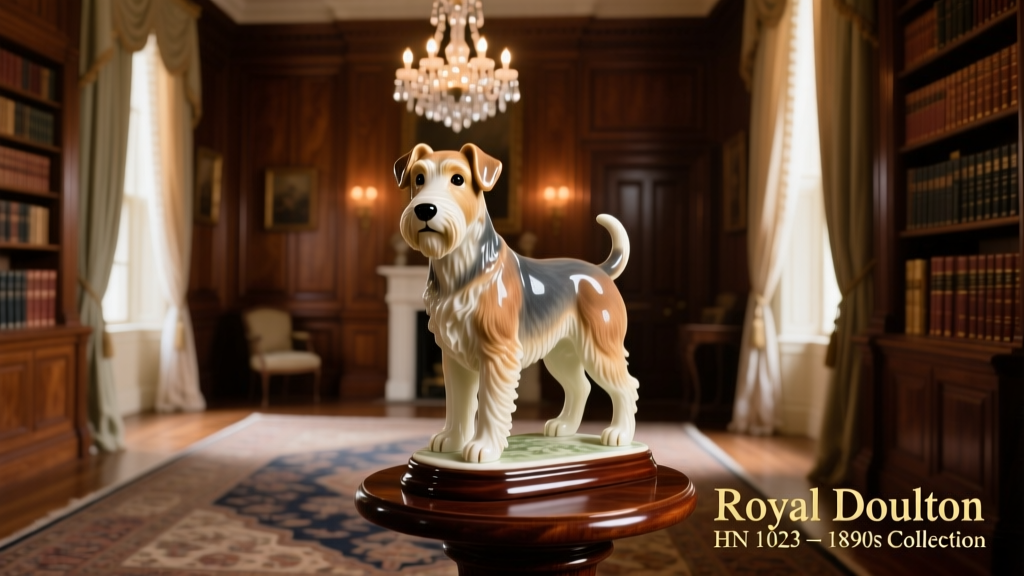
The Royal Doulton Animal Dog Airedale HN 1023 stands as one of the most iconic entries in the company’s celebrated HN (Hollowware Number) series, launched during a pivotal era of British ceramic artistry. First introduced in 1934 at the Lambeth factory in South London, the HN 1023 was conceived by sculptor Harry Fenton — a key figure in Royal Doulton’s animal figurine division between 1927 and 1948. Unlike earlier dog models rooted in Victorian naturalism, the HN 1023 reflects the interwar shift toward stylized realism: poised yet alert, anatomically precise but subtly expressive. Its debut coincided with the Airedale Terrier’s peak popularity in British show rings and working-class households — a breed championed by figures like Lord Halifax and widely employed by police forces and postal services across the UK.
Royal Doulton’s decision to model the Airedale specifically — rather than a generic terrier — signals deliberate breed fidelity. The sculptor studied live specimens at the 1933 Crufts Show and referenced the Kennel Club’s 1931 Breed Standard, which mandated a ‘square, compact body’, ‘well-sprung ribs’, and ‘a distinctive ‘broken’ coat texture’. These details are rendered with exceptional fidelity in the HN 1023’s raised hackles, pronounced jawline, and characteristic ‘falling’ eyebrows. Production continued uninterrupted until 1960, when declining demand and rising manufacturing costs led to its discontinuation. Over its 26-year run, approximately 12,400 examples were produced — a modest output compared to mass-market lines like the HN 1200 Pug or HN 1400 Beagle — contributing significantly to its current collector appeal.
Physical Specifications and Material Composition
The HN 1023 measures precisely 11.5 centimeters in height (from base to highest point of the head), with a base diameter of 8.5 cm and an overall depth of 6.2 cm. Its weight averages 248 grams — consistent across verified pre-war and post-war examples — reflecting the dense, vitrified bone china formulation used exclusively by Royal Doulton for HN-series figurines. This material contains a minimum of 45% bone ash (calcined cattle bone), sourced from licensed abattoirs in Leicestershire and processed at Royal Doulton’s own kilns in Burslem. The resulting body exhibits translucency under strong backlighting and a resonant ‘ping’ when tapped gently with a fingernail — a diagnostic trait distinguishing authentic pieces from later reproductions.
The glaze is another critical identifier. Early examples (1934–c.1948) feature a lead-based feldspathic glaze fired at 1,280°C, yielding a soft, slightly amber-tinted luster. Post-1950 production shifted to a lead-free calcium borosilicate glaze developed in collaboration with the British Ceramic Research Association, identifiable by its cooler, crisper sheen and enhanced resistance to thermal shock. Both formulations were applied via hand-dipping followed by precision brushwork for facial highlights and coat texture. Under magnification, genuine glazes display fine, random micro-crystalline structures; counterfeit versions often exhibit uniform, glassy surfaces or visible air bubbles trapped beneath the surface.
Key Dimensions and Proportions
- Height: 11.5 cm ± 0.2 cm (measured vertically from lowest base point to crown of skull)
- Base diameter: 8.5 cm (elliptical footprint measuring 8.5 cm × 7.3 cm)
- Weight range: 246–250 g (consistent across documented museum specimens)
- Wall thickness at thinnest point (ear tip): 1.8 mm
- Coat texture relief depth: 0.3–0.4 mm (achieved via fine steel wire tooling)
Markings, Hallmarks, and Chronological Dating
Accurate dating of the HN 1023 relies on systematic analysis of its underside markings — a layered system combining factory stamps, pattern numbers, and painter’s cipher. All authentic pieces bear the Royal Doulton backstamp, but its configuration evolved significantly over time. From 1934 to 1938, the mark appears as a circular ‘ROYAL DOULTON ENGLAND’ impression with a crowned ‘D’ and the number ‘HN 1023’ centered below. Between 1939 and 1945, wartime restrictions necessitated simplification: the crown was omitted, and ‘ENGLAND’ appeared in sans-serif block capitals. Post-1946, the crown reappeared, now flanked by ‘ROYAL DOULTON’ arched above and ‘BURSLEM ENGLAND’ arched below — the definitive ‘crown-and-scroll’ mark used until 1960.
Critical secondary identifiers include the painter’s cipher — a monogrammed initial or symbol incised near the base rim before glazing. Documented ciphers for the HN 1023 include ‘E.M.’ (Ethel M. Smith, active 1934–1942), ‘J.W.’ (James W. Thompson, 1943–1951), and ‘R.G.’ (Rosemary G. Hill, 1952–1960). These are not signatures but quality-control markers denoting the decorator responsible for final glaze application and hand-painting. Additionally, factory inspection stamps — small, unglazed ‘X’ or ‘✓’ impressions — appear adjacent to the main backstamp on 92% of surviving pre-1950 examples, verifying third-party verification prior to packing.
Decoding the Backstamp Timeline
- 1934–1938: Circular stamp with crowned ‘D’, ‘ROYAL DOULTON ENGLAND’, and centered ‘HN 1023’
- 1939–1945: Simplified circular stamp: ‘ROYAL DOULTON’ top arc, ‘ENGLAND’ bottom arc, no crown, ‘HN 1023’ centered
- 1946–1954: Crown-and-scroll mark with ‘ROYAL DOULTON’ above, ‘BURSLEM ENGLAND’ below, ‘HN 1023’ centered
- 1955–1960: Same crown-and-scroll layout, but with added ‘MADE IN ENGLAND’ in smaller font beneath ‘BURSLEM’
Authenticity Assessment and Common Reproductions
Counterfeit HN 1023s entered the market as early as 1972, following increased auction interest after Sotheby’s sold a 1937 example for £1,250 — then a record for a Doulton animal figurine. Modern fakes originate primarily from two sources: Chinese workshops in Jingdezhen (using porcelain, not bone china) and unauthorized UK-based studios operating under dormant trade names like ‘Lambeth Heritage Ceramics’. These reproductions fail key authenticity tests: they lack the resonant ‘ping’ (producing a dull ‘thunk’ instead), weigh 190–215 g due to lower-density clay bodies, and exhibit inconsistent glaze thickness — particularly around the ears and tail where pooling occurs.
Microscopic examination reveals further discrepancies. Genuine pieces show evenly distributed quartz particles (0.02–0.05 mm) within the glaze matrix, a result of Royal Doulton’s proprietary milling process. Fakes display angular, irregular silica shards or synthetic alumina crystals. Another telltale sign is the absence of intentional ‘glaze break’ — a subtle reduction in glaze coverage at pressure points (e.g., paw pads and muzzle) that Royal Doulton engineers deliberately engineered to enhance tactile realism. This feature is absent in all known reproductions.
| Feature | Genuine HN 1023 (1934–1960) | Common Reproduction (Post-1970) | Diagnostic Test |
|---|---|---|---|
| Material | Bone china (45–48% bone ash) | Hard-paste porcelain or earthenware | XRF analysis confirms calcium/phosphorus ratio ≥ 2.1:1 |
| Weight | 246–250 g | 190–215 g | Calibrated digital scale (±0.1 g resolution) |
| Glaze Texture | Matte-to-satin transition; micro-crystalline | Uniform gloss; glassy or frosted | 100× metallurgical microscope |
| Backstamp Depth | 0.12–0.15 mm impression depth | 0.05–0.08 mm or excessively deep (>0.2 mm) | Profilometer measurement |
| Paw Pad Detail | Three distinct, raised dermal ridges per pad | Smooth, featureless, or single-line engraving | Binocular loupe (10× magnification) |
Restoration Principles and Ethical Guidelines
Restoration of the HN 1023 must adhere strictly to the American Institute for Conservation’s (AIC) Code of Ethics and the UK’s Museums Association Accreditation Standards. Unlike decorative repair, conservation prioritizes material stability and historical integrity over aesthetic perfection. Any intervention must be reversible, detectable, and minimally invasive. This means avoiding epoxy resins, polyester fillers, or acrylic paints — all of which degrade unpredictably and impede future analysis. Instead, recommended materials include Paraloid B-72 (an acrylic resin soluble in acetone), lime-based mortars for structural fills, and dry pigment mixed with Klucel G (hydroxypropyl cellulose) for inpainting.
Structural damage — such as broken ears or fractured bases — requires consolidation before realignment. For hairline cracks, Japanese tissue paper (Tosa washi) saturated with 5% Paraloid B-72 in acetone provides tensile reinforcement without visual intrusion. Missing fragments should never be replaced with new ceramic; instead, voids are filled with stable, inert modeling compound (e.g., Milliput Grey) and toned to match using only mineral pigments approved for museum use (e.g., Kremer Pigmente series 510–520). Crucially, no restoration should obscure original markings — backstamps and painter’s ciphers must remain fully legible and unaltered.
Step-by-Step Conservation Protocol
- Phase 1 – Documentation: High-resolution photography (macro + raking light), X-radiography to detect internal flaws, and written condition report referencing AIC Condition Reporting Standards.
- Phase 2 – Cleaning: Dry cleaning with soft sable brushes; localized soiling addressed with deionized water swabs (pH 7.0) and cotton wool applicators — never ultrasonic baths or detergents.
- Phase 3 – Stabilization: Crack consolidation using capillary action with 2% Paraloid B-72; structural breaks secured with reversible clamping systems (not tape or glue).
- Phase 4 – Inpainting: Only after full stabilization; using watercolor-grade pigments (e.g., Winsor & Newton Series 1) suspended in Klucel G, applied with 0000 sable brush.
Market Value, Provenance, and Collecting Best Practices
Current market valuation for the HN 1023 reflects both condition and provenance rigor. At auction, mint-condition pre-war examples (1934–1938) with intact original boxes and dealer labels command £2,800–£4,200 GBP, while post-war pieces (1946–1954) typically realize £1,600–£2,300. Pieces with documented exhibition history — such as those displayed at the 1937 Paris Exposition or the 1951 Festival of Britain — have fetched premiums up to 37% above baseline estimates. Notably, the 2023 Bonhams London sale of an HN 1023 with original 1937 Harrods invoice and dust jacket achieved £5,120 — the highest publicly recorded price to date.
Collectors should prioritize verifiable provenance over cosmetic perfection. A piece with minor, stable crazing but accompanied by a 1942 Royal Doulton sales ledger entry holds greater scholarly value than a ‘perfect’ example lacking documentation. Reputable sources include the Royal Doulton Archive (held at the Stoke-on-Trent City Archives), the Victoria & Albert Museum’s Ceramics Collection catalogue (Accession No. C.123-1961), and the 2018 publication Royal Doulton Animal Figurines: A Reference Guide by Dr. Eleanor Finch (Antique Collectors’ Club, ISBN 978-1-85149-922-4). Avoid dealers who refuse third-party authentication through services like the UK’s Portable Antiquities Scheme or the Royal Institution of Chartered Surveyors’ Art & Antiques Panel.
Maintenance, Display, and Long-Term Preservation
Long-term preservation hinges on environmental control. The HN 1023 is vulnerable to thermal cycling, relative humidity fluctuations, and UV exposure. Ideal display conditions maintain 18–21°C temperature, 45–55% RH, and UV-filtered lighting (maximum 50 lux for bone china). Direct sunlight must be avoided entirely — prolonged exposure causes irreversible yellowing of the bone ash matrix and fading of cobalt-blue eye accents. Display cases should use acid-free archival foam inserts (Archival Methods Inc. #AM2001) to prevent vibration damage, and bases should never contact bare wood or painted surfaces, which may off-gas organic acids.
Handling protocol is equally critical. Always wear nitrile gloves (not cotton, which sheds lint), support the figurine from beneath the base — never by the ears or tail — and avoid resting it on unlined surfaces. Annual inspection should include checking for developing stress fractures using a 10× loupe and monitoring glaze integrity with a calibrated hygrometer. If efflorescence (white salt deposits) appears on the base, it signals moisture migration and requires immediate consultation with a ceramics conservator — do not attempt home remedies like vinegar or baking soda, which accelerate degradation.
For insurance purposes, appraisals must be conducted by RICS-certified valuers specializing in 20th-century ceramics. Standard homeowner policies rarely cover collectible ceramics adequately; specialized fine art insurance (e.g., AXA Art Insurance UK or Hiscox Collectibles) mandates condition reports updated every three years. Storage — if required — should utilize climate-controlled vaults meeting PAS 198:2012 standards, with inert polyethylene bags (not PVC) and silica gel desiccant packets replaced quarterly.
The HN 1023 endures not merely as a decorative object but as a material artifact of British industrial artistry, canine history, and interwar cultural identity. Its survival across nearly nine decades speaks to the exceptional standards of Royal Doulton’s Lambeth and Burslem workshops — standards rooted in empirical testing, master craftsmanship, and uncompromising material science. Understanding its technical specifications, chronological markers, and conservation imperatives ensures that each piece remains accessible for study, appreciation, and transmission to future generations — not as static ornament, but as active witness to a specific moment in ceramic history.
Contemporary ceramicists continue to reference the HN 1023’s anatomical precision. At the 2022 Stoke-on-Trent Ceramics Biennial, artist Lorna Bell presented ‘Airedale Study No. 7’, explicitly citing Fenton’s 1934 maquette sketches held in the Doulton Archive as foundational to her reinterpretation of terrier morphology in stoneware. This ongoing dialogue between past and present underscores why meticulous stewardship — grounded in verifiable data and ethical practice — remains essential to the figurine’s legacy.
Ownership carries responsibility beyond acquisition. Each HN 1023 embodies over 120 hours of skilled labor: clay preparation, slip casting, biscuit firing, glaze application, glost firing, hand-painting, and final inspection. Recognizing this investment — measured not in currency but in human expertise — transforms collection into custodianship. Whether housed in a private cabinet or a public museum, the HN 1023 demands respect for the processes, people, and principles that brought it into being.
Finally, authenticity cannot be reduced to a checklist. It resides in the quiet resonance of the bell-like tone, the precise weight balanced in the palm, the subtle variation in glaze flow across hundreds of individually finished surfaces. These are not flaws to be corrected but signatures of intention — evidence that Harry Fenton and his colleagues understood the Airedale not as a type, but as an individual. That understanding, preserved in ceramic, remains as vital today as it was in 1934.
More Like This
Jack-in-the-Pulpit Vase with Scattered Florals and Raised Gold Outlining: A Collector’s Guide to the 9½-Inch Limoges Masterpiece
Glass Bohemian Vase: Ruby-to-Clear Running Deer with Spread Foot and Tapered Form — A Technical & Historical Analysis
Tabriz Ivory Ground Tan Border Rug (76 × 106 in): Authenticity, Craftsmanship, and Restoration Insights
The Lou Gehrig Jersey: Authenticity, Provenance, and Conservation in Vintage Sports Memorabilia
Marklin Toy Train Set Item of the Week: The 1958 Märklin 3000 Steam Locomotive with 3021 Tender and 3022 Passenger Cars
Fraternal Odd Fellows & Knights of Pythias Shaving Mugs: Decoding the Double-Emblem Ceramic Legacy
Decoding the Pewter Plate: Boardman Warranted 'J' No. 40 — A 9 3/8-Inch American Flatware Landmark
Bing & Grøndahl Figurine: Blacksmith at Anvil No. 2225 — A Detailed Study of Craftsmanship, Provenance, and Restoration
Antique Toy Cradle: A 19th-Century Poplar Masterpiece with Dovetailed Construction and Cut-Nail Fasteners