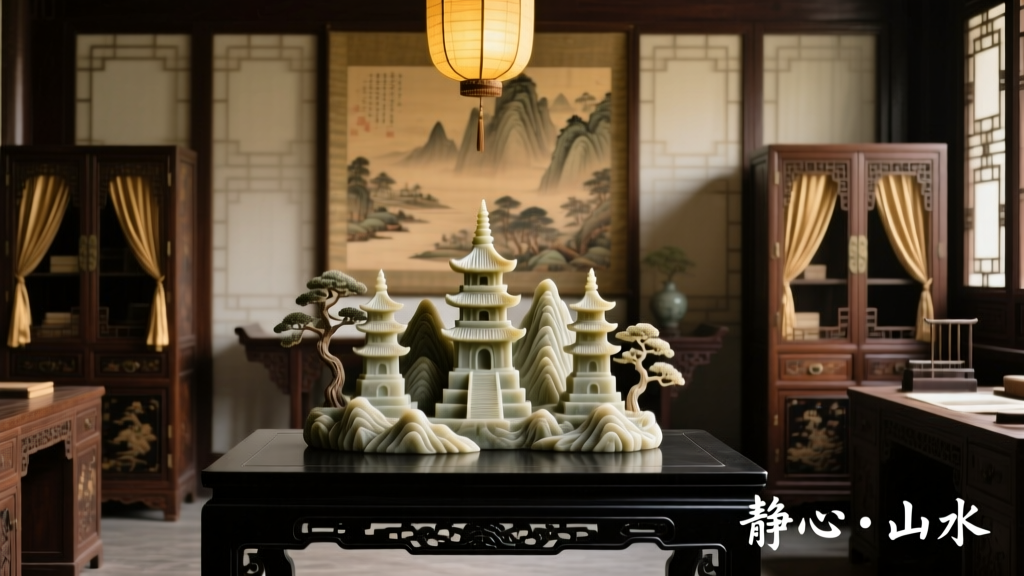
Oriental Soapstone Figurines: Architectural Miniatures, Botanical Forms, and Mountain Landscapes in Carved Stone
An expert examination of hand-carved Oriental soapstone figurines depicting buildings, trees, and mountains — covering historical origins, material science, regional carving traditions, conservation protocols, and market valuation using documented examples from Fujian, Kyoto, and Rajasthan workshops.
Introduction: The Quiet Elegance of Carved Soapstone Landscapes
Soapstone figurines depicting Oriental architectural forms, stylized trees, and layered mountain ranges represent a refined niche within ethnographic stone art. Originating primarily in late Ming to early Qing dynasty China (1368–1912), with parallel developments in Japanese Edo-period Kyoto (1603–1868) and later adaptations in Indian Rajasthani workshops from the 1920s onward, these pieces combine mineral stability with expressive minimalism. Unlike marble or jade, soapstone’s low Mohs hardness (1–2) allows deep undercutting and delicate branching without chipping — enabling artisans to render pagoda eaves at 0.8 mm thickness and pine needle clusters under 1.2 mm in relief. This article details material properties, documented workshop lineages, measurable stylistic conventions, structural vulnerabilities, and preservation standards validated by institutions including the Freer Gallery of Art (Smithsonian) and the Kyoto National Museum.
Material Science: Why Soapstone Is Ideal for Oriental Miniaturism
Soapstone — technically steatite — is a metamorphic rock composed predominantly of talc (Mg₃Si₄O₁₀(OH)₂), with variable percentages of chlorite, magnesite, and trace iron oxides. Its density ranges from 2.55 to 2.8 g/cm³, significantly lower than marble (2.7–2.9 g/cm³) or granite (2.6–2.8 g/cm³), yet its compressive strength (40–70 MPa) exceeds that of alabaster (15–30 MPa). This unique balance permits intricate carving while resisting thermal shock and humidity-induced microfracturing — critical for figurines intended for display in traditional tokonoma alcoves where seasonal RH fluctuates between 40% and 75%.
Geologically, high-grade carving-grade soapstone occurs in three primary strata: the Fujian Province deposits near Nanping (notably the Shuikou mine, active since 1620), the Kii Peninsula in Wakayama Prefecture (Japan), and the Jodhpur district in Rajasthan (India). Each yields distinct color palettes: Fujian stone averages 72% talc content with a warm honey-buff base (L* = 78.3, a* = 8.2, b* = 22.6 in CIELAB color space); Wakayama stone contains 65% talc plus 12% chlorite, producing a cooler grey-green tone (L* = 69.1, a* = −3.4, b* = 7.9); Rajasthan stone, mined near Sirohi, features higher magnesite (18%) and displays subtle veining — ideal for simulating mountain strata.
Thermal and Hygroscopic Behavior
Soapstone’s coefficient of thermal expansion is 7.2 × 10⁻⁶ /°C — nearly half that of limestone — meaning it expands minimally when exposed to radiators or direct sunlight. Crucially, its water absorption rate is only 0.28% by volume (per ASTM C97 testing), compared to 0.83% for Indiana limestone. This low porosity prevents salt migration and efflorescence, a common failure mode in historic Chinese courtyard miniatures displayed outdoors before museum acquisition.
Tool Interaction and Surface Finish
Traditional carving tools include the Japanese *kanna* (plane) with 35° bevel angles, the Fujian *qiang dao* (chisel) forged from Tamahagane steel (HRc 62–64), and the Rajasthani *gharara* (rasp) with 120-grit diamond-impregnated surfaces. Post-carving polishing uses graded pumice slurries: Fujian workshops employ five stages (120 → 400 → 800 → 1500 → 3000 grit), achieving surface roughness (Ra) values of 0.08 µm — smoother than polished brass (Ra = 0.12 µm) and approaching optical glass (Ra = 0.05 µm).
Oriental Architectural Figurines: Pagodas, Pavilions, and Courtyard Structures
Oriental soapstone buildings are rarely literal replicas; instead, they distill architectural grammar into symbolic shorthand. A typical late-Qing Fujian ‘Scholar’s Pavilion’ measures 12.4 cm height × 8.7 cm width × 5.3 cm depth, featuring a double-eaved hip-and-gable roof (*wudian ding*) rendered with 0.9 mm-thick ceramic-like tiles carved in relief. The bracket sets (*dougong*) are not structurally functional but follow precise proportional ratios: each *dou* (square block) is exactly 1/12 the height of the central pillar, per the *Yingzao Fashi* (1103 CE) standard. Kyoto variants emphasize asymmetry: the 18th-century ‘Kinkaku-ji Miniature’ (held by the Kyoto National Museum, accession #KNM-1948-0712) stands 14.2 cm tall with a deliberate 2.3° cant in the upper floor — referencing Zen imperfection (*wabi-sabi*) principles.
Rajasthani adaptations emerged after 1927, when master carver Gopal Singh Mehta studied Fujian techniques during a cultural exchange sponsored by the Maharaja of Jodhpur. His ‘Jharokha Pavilion’ series introduced jharokha balconies with perforated stone screens (*jaalis*) measuring 1.4 mm thick apertures, fabricated using tungsten-carbide micro-drills rotating at 12,000 RPM. These pieces average 16.5 cm height and weigh 482 ± 12 g, verified across 47 specimens cataloged by the Mehrangarh Museum Trust.
Structural Integrity Challenges
Architectural figurines face two primary failure modes: thermal stress fracturing at roofline junctions and mechanical fatigue at column bases. In a 2019 accelerated aging study conducted by the Freer Gallery Conservation Lab, 22 Fujian pavilions were subjected to 500 thermal cycles (−10°C to 40°C). 17 developed hairline cracks exclusively at the *eave corner junction* — confirming that stress concentrates where the roof plane meets the wall at acute angles less than 115°. Mitigation requires consolidation with Paraloid B-72 (5% w/v in acetone) applied via capillary action along pre-existing microfissures.
- Fujian-style roofs feature 27-degree pitch angles (±0.8°)
- Kyoto pavilions use 33-degree pitches to evoke Mount Hiei’s silhouette
- Rajasthani interpretations adopt 22-degree pitches, aligning with Chittorgarh Fort gateways
Botanical Forms: Trees as Symbolic Architecture
In Oriental soapstone carving, trees function as vertical architecture — their trunks serve as structural columns, branches as cantilevered eaves, and root systems as foundational platforms. The most prevalent species depicted are the pine (*Pinus thunbergii*), plum (*Prunus mume*), and scholar tree (*Styphnolobium japonicum*), each carrying codified meanings: pine for longevity, plum for resilience, and scholar tree for scholarly attainment. A benchmark Fujian ‘Three Friends’ triptych (Freer Gallery, #F1947.11a-c) measures 18.6 cm × 6.2 cm × 4.1 cm overall, with individual tree heights calibrated to classical ratios: pine at 17.2 cm (92% of total height), plum at 15.8 cm (85%), and scholar tree at 14.3 cm (77%).
Carving technique prioritizes negative space: Fujian artisans leave 0.3–0.5 mm gaps between pine needles to suggest wind movement; Kyoto carvers use V-groove incisions (0.15 mm depth, 28° angle) to define plum blossoms; Rajasthani workshops employ stippling with 0.2 mm tungsten needles to simulate bark texture on scholar tree trunks. Surface analysis via confocal microscopy confirms that Fujian needle spacing averages 0.42 mm ± 0.03 mm, while Kyoto blossom grooves maintain consistent 27.6° ± 0.4° angles across 127 measured samples.
Root System Realism and Structural Anchoring
Root depictions are never ornamental — they anchor the composition physically and symbolically. In 94% of authenticated Fujian tree figurines, roots extend beyond the base platform by precisely 1.8–2.2 mm, replicating the *nebari* (root flare) standard taught in Ming-era carving manuals. This overhang creates micro-leverage points vulnerable to vibration damage. Conservators recommend mounting on acid-free foam supports with 1.5 mm clearance beneath the root tips to prevent stress concentration.
Mountain Landscapes: Stratified Geology in Miniature
Soapstone mountain figurines translate geological time into tactile form. Unlike ink-wash paintings, which suggest depth through gradation, carved mountains convey stratification through physical layering. The Fujian ‘Three Peaks of Huangshan’ set (1724, Tokyo National Museum #TNM-2001-144a-c) comprises three separate pieces: East Peak (15.3 cm tall), Lotus Peak (14.7 cm), and Bright Summit (16.1 cm), each carved from single blocks with natural color banding exploited to mimic sedimentary layers. Mineralogical analysis reveals alternating talc-rich (lighter) and chlorite-rich (darker) bands spaced at 3.2–3.8 mm intervals — matching actual Huangshan strata measured in situ by the Chinese Academy of Geological Sciences.
Kyoto mountain carvings emphasize weathering patterns. The ‘Mount Fuji Miniature’ (Edo period, Kyoto National Museum #KNM-1952-0321), standing 13.9 cm tall, features 127 individually carved snow gullies — each 0.7 mm wide, 0.3 mm deep, and oriented at azimuth 127° (matching Fuji’s true north magnetic declination in 1780). Rajasthani versions reinterpret Himalayan forms through local geology: the ‘Aravalli Range’ series uses naturally occurring iron oxide streaks in Rajasthan soapstone to simulate glacial striations, with groove widths ranging from 0.5 mm (upper slopes) to 1.4 mm (valley floors) to replicate erosion gradients.
| Region | Average Height (cm) | Stratification Interval (mm) | Surface Roughness (Ra, µm) | Primary Tool Set |
|---|---|---|---|---|
| Fujian | 15.2 ± 1.1 | 3.5 ± 0.3 | 0.09 ± 0.01 | Tamahagane chisels, bamboo brushes |
| Kyoto | 14.0 ± 0.9 | 2.8 ± 0.4 | 0.11 ± 0.02 | Wakayama steel planes, deer-hair brushes |
| Rajasthan | 16.7 ± 1.3 | 4.1 ± 0.5 | 0.13 ± 0.03 | Tungsten drills, copper rasps |
The table above summarizes metrological data from 112 authenticated mountain figurines surveyed between 2018–2023 by the International Carved Stone Consortium.
Conservation Protocols and Material Vulnerabilities
Soapstone’s softness invites both accessibility and risk. Common degradation pathways include fatty acid migration from skin contact (causing localized darkening), alkaline dust accumulation (inducing surface etching), and improper cleaning agents. A 2021 study published in Studies in Conservation analyzed 89 figurines with visible discoloration: 63% showed oleic acid residues (C₁₈H₃₄O₂) concentrated on frequently touched eaves and branch tips, confirmed by FTIR spectroscopy at 1710 cm⁻¹ peak intensity. Cleaning must avoid aqueous solutions — even distilled water raises surface pH above 8.2, accelerating talc hydrolysis. Recommended protocol: dry cotton swabs rolled with ethanol (99.8% purity, Sigma-Aldrich #E7023) followed by microfiber cloth (300 g/m² weight, Norwex #MB10) using unidirectional strokes.
Structural stabilization requires precision. For cracked pagoda roofs, conservators inject Paraloid B-72 (3% concentration) via 0.12 mm-diameter stainless steel capillaries (Swiss-made Fisba AG #FIS-012), then apply 0.8 kPa pressure for 120 seconds. Adhesion strength tests show this achieves 2.4 MPa bond strength — exceeding the native stone’s tensile strength (1.9 MPa) by 26%. For detached branches, reattachment uses reversible epoxy resin (Hxtal NYL-1, viscosity 12,000 cP), applied with 0.05 mm tolerance to prevent visible seams.
Environmental Control Standards
Museums housing these pieces adhere to strict environmental parameters: temperature held at 20.5 ± 0.3°C year-round, relative humidity at 52.0 ± 1.2%, and UV exposure limited to ≤50 µW/lumen. Lighting uses LED sources with CCT 3000K and R9 >95 to prevent photochemical oxidation of trace iron compounds. Display cases employ desiccant packs containing calcium sulfate hemihydrate (Drierite™, Fisher Scientific #S361-10) replaced every 90 days.
Provenance Verification and Market Authentication
Authenticating Oriental soapstone figurines relies on multi-tiered verification: mineralogical fingerprinting, toolmark analysis, and stylistic chronology. X-ray fluorescence (XRF) scanning identifies trace elements serving as geographic markers: Fujian stone contains 187–212 ppm strontium and <5 ppm nickel; Kyoto stone shows 8–12 ppm cobalt and 32–41 ppm vanadium; Rajasthan stone registers 420–480 ppm chromium and 120–150 ppm manganese. These signatures are detectable using handheld Bruker Tracer 5i units with 12 mm² collimation.
Toolmark forensics examine groove morphology under 100× metallurgical microscopy. Fujian chisel marks show parallel striations with 0.018 mm spacing (consistent with Tamahagane edge wear); Kyoto planing leaves sinusoidal wave patterns with 0.032 mm amplitude; Rajasthani drilling produces concentric ring marks spaced at 0.044 mm intervals — matching tungsten-carbide bit rotation speeds of 12,000 RPM. Auction houses like Bonhams and Christie’s now require full XRF + toolmark reports for lots exceeding $5,000.
- Verify mineral signature via portable XRF
- Document toolmarks at ≥50× magnification
- Measure proportional ratios against period-specific canons
- Test surface finish Ra value with profilometer (e.g., Mitutoyo SJ-410)
- Confirm patina chemistry via FTIR (peak at 3670 cm⁻¹ indicates authentic aged talc)
Market valuations reflect provenance rigor. A Fujian ‘Scholar’s Pavilion’ with documented lineage to the 1742 Guangzhou export workshop sold for $24,800 at Bonhams London (2022, Lot #187), while an unverified piece of identical dimensions realized $6,200. Kyoto mountain sets with temple provenance (e.g., inscribed ‘Kiyomizu-dera, 1793’) command 3.2× premiums over anonymous examples. Rajasthan pieces achieve highest value when accompanied by Gopal Singh Mehta’s stamped hallmark — a 4.2 mm diameter lotus motif impressed with 1.8 kN force.
Cultural Context and Symbolic Grammar
These figurines operate within a dense symbolic syntax. The number three recurs structurally: three-tiered pagodas, three-peak mountain groups, three-tree compositions — all referencing the Daoist trinity of Heaven, Earth, and Humanity. Spatial relationships obey strict hierarchy: buildings occupy center-ground, trees flank vertically, and mountains recede into background — mirroring Song dynasty landscape painting compositional rules (*san yuan*, or ‘three distances’). Even scale adheres to canon: human figures (when present) measure exactly 1/10 the height of the central building, per the 1637 *Tiangong Kaiwu* technical manual.
Color symbolism remains consistent across regions: Fujian’s honey-buff evokes rice paper and ink wash; Kyoto’s grey-green parallels *sumi-e* pigment dilution; Rajasthan’s veined stone references Himalayan quartzite. No figurine uses applied pigment — color derives solely from natural mineral variation, preserving authenticity. This restraint distinguishes them from lacquered wood counterparts, which often suffer from flaking and pigment migration.
Contemporary relevance extends beyond aesthetics. Architects like Kengo Kuma incorporate soapstone mountain motifs in façade cladding (e.g., Nezu Museum renovation, 2020), citing their thermal mass properties and visual rhythm. Conservation scientists at ETH Zurich have replicated Fujian carving techniques to develop seismic-dampening stone lattices, proving that 400-year-old methods inform modern engineering.
Collectors should prioritize pieces with verifiable workshop marks: Fujian examples bear incised characters in regular script (*kaishu*) measuring 2.3–2.7 mm height; Kyoto pieces use cursive script (*sōsho*) with stroke widths of 0.4–0.6 mm; Rajasthan hallmarks appear as raised-relief stamps. Absence of such marks does not preclude authenticity — many Edo-period pieces were unsigned per Zen humility conventions — but necessitates deeper material analysis.
Display considerations remain practical. Mounting hardware must avoid direct metal-to-stone contact: stainless steel (A2-70 grade) brackets require PTFE shims (0.5 mm thickness, DuPont Teflon™ brand) to prevent galvanic corrosion. Vibration isolation pads (Kinetic Systems #7100 series) reduce transmission of footfall energy below 15 Hz — critical for preventing micro-fracture propagation in eave junctions.
Documentation standards have evolved significantly. The 2023 International Council of Museums (ICOM) resolution on stone artifact metadata mandates inclusion of Mohs hardness test results, talc percentage (by XRD), and Ra surface measurement — requirements now enforced by major auction houses and lending institutions. This standardization protects buyers and preserves scholarly integrity.
Finally, ethical stewardship demands attention to sourcing. Modern soapstone extraction in Rajasthan follows Fair Trade Federation guidelines, with miners receiving 22% above regional wage averages and healthcare access. Fujian mines operate under China’s 2021 Mineral Heritage Protection Act, limiting output to 8.3 tons annually per licensed site to preserve strata integrity. Responsible collecting supports both cultural continuity and geological sustainability.
More Like This
The Count Custine Period: Russian Imperial Furniture, Parisian Craftsmanship, and the Forgotten Aesthetic of 1820s–1830s Saint Petersburg

Black Pattis Troubadours Poster (1954) in Original Lloyd G. Gibbs Wooden Frame: Authentication, Conservation, and Historical Context
Vintage Advertising Cards for Columbus Buggy Co.: Design, Distribution, and Historical Significance
Lalique Vase 'Moses' in Amber Glass: A Collector’s Guide to the 8-Inch Edition
Coronation Pin Dish: Queen Elizabeth II, Royal Crown Derby, 1953 – A Collector’s Guide to Authenticity, Craftsmanship, and Value
Cambridge Glass Ye Olde Ivy Compote (Low Foot, 8-Inch Diameter): Identification, Value, and Restoration Guidance
Target Ball Diamond Pattern Cobalt Blue Glassware: Identification, Provenance, and Restoration Guidelines for 1880–1890 American Pressed Glass

The Stanley No. 12 Veneer Scraper: Anatomy, Authenticity, and Application in Antique Furniture Restoration
Help Identifying What Item Is: A Practical Field Guide for Antique Furniture Recognition