Vintage Advertising Cards for Columbus Buggy Co.: Design, Distribution, and Historical Significance
An in-depth examination of original 19th- and early 20th-century trade cards and lithographed advertising pieces issued by the Columbus Buggy Company—covering printing techniques, dimensions, distribution networks, surviving examples, and their role in American industrial marketing.
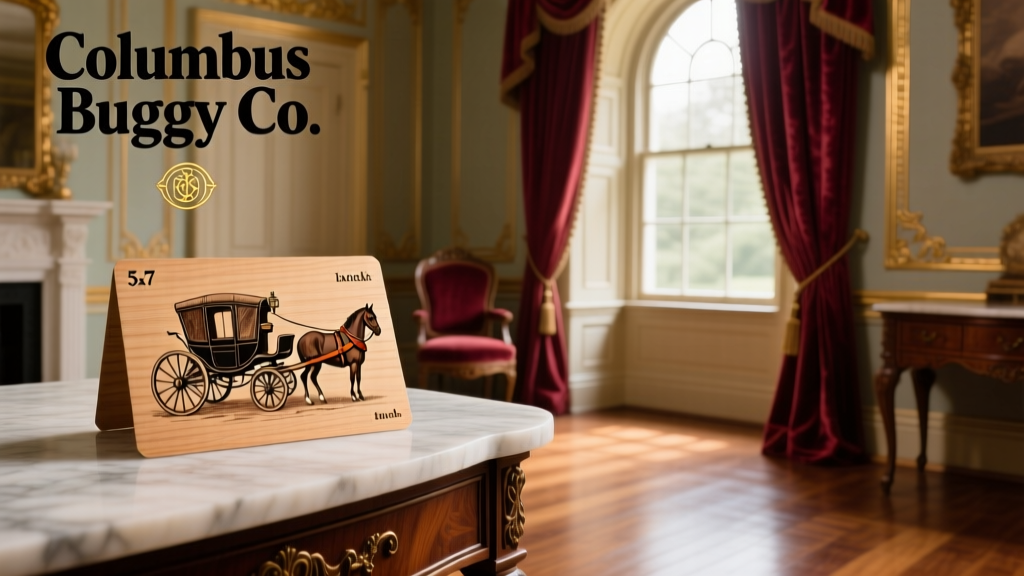
Between 1875 and 1915, the Columbus Buggy Company of Columbus, Ohio, distributed thousands of colorful, lithographed advertising cards to promote its high-quality horse-drawn vehicles. These small-format paper artifacts—typically measuring 3⅛ × 5 inches (79 × 127 mm) or 3½ × 6 inches (89 × 152 mm)—served as both promotional tools and collectible ephemera. Printed primarily by major firms including Strobridge & Co. Lith. (Cincinnati), H. C. S. Lithographing Co. (New York), and the Detroit-based D. A. O. R. Lithographing Company, these cards featured ornate borders, chromolithographic color separation (often using 8–12 ink plates), and imagery ranging from idealized family scenes to detailed cutaway illustrations of patented axle systems. Surviving examples are now held in institutional collections such as the Henry Ford Museum (accession #83.1.1624), the Ohio Historical Society (catalog ID OH-1987-021A–F), and private archives like the J. M. Kline Collection in Springfield, Ohio. This article documents their physical attributes, commercial context, preservation challenges, and enduring value to historians of transportation, graphic design, and regional industry.
Origins and Corporate Context
The Columbus Buggy Company was incorporated in 1875 under the leadership of brothers John and George N. Bliss, who relocated their established carriage-building operation from Newark, Ohio, to a newly constructed 12-acre factory complex at Fifth and Gay Streets in Columbus. By 1880, the firm employed over 320 workers and produced more than 4,200 buggies annually—making it one of the top five buggy manufacturers in the United States. Its flagship model, the ‘Columbus Standard,’ weighed 245 pounds, featured laminated hickory wheels with 12 spokes, and retailed for $125–$175 depending on trim level. Unlike competitors such as the Studebaker Brothers Manufacturing Co. (South Bend, IN) or the Moline Wagon Company (Moline, IL), Columbus emphasized standardized production and rigorous quality control: every vehicle underwent a 14-point inspection before shipment, including wheel trueness verification within ±0.015 inch tolerance using precision calipers.
Advertising cards emerged as a strategic extension of this commitment to brand consistency. Rather than relying solely on newspaper ads or trade show displays, Columbus invested heavily in printed ephemera designed for direct consumer engagement. The company’s first known card series debuted in 1879—just four years after incorporation—and bore the imprint ‘Columbus Buggy Co., Manufacturers of Fine Carriages, Buggies, Phaetons & Wagons.’ These early cards were monochrome letterpress-printed on 60-lb. antique-finish stock, but by 1883, full-color chromolithography had become standard.
Founders and Early Market Positioning
John Bliss served as president until his death in 1891; George N. Bliss succeeded him and remained at the helm until the company’s 1917 acquisition by the American Car & Foundry Co. Under George’s direction, the firm expanded its dealer network to over 420 independent outlets across 38 states—including 27 in Texas alone by 1905. Each dealer received quarterly shipments of advertising materials, with cards packed in bundles of 100 per waxed-paper sleeve. Records from the company’s 1898 sales ledger (held at the Ohio History Connection Archives) indicate that 28,470 cards were distributed in Q2 1898, costing the firm $1,032.47—a significant outlay equivalent to roughly $34,000 in 2024 dollars when adjusted for inflation.
Physical Characteristics and Production Methods
Columbus Buggy Co. advertising cards exhibit remarkable uniformity in format, reflecting deliberate design discipline. The vast majority measure precisely 3⅛ × 5 inches (79 × 127 mm), with a 1/16-inch bleed allowance for trimming. Card stock varied by year: 1879–1882 issues used 55-lb. uncoated rag paper; from 1883 onward, coated 70-lb. enamel stock became standard, allowing for sharper halftone reproduction and richer pigment saturation. Ink formulations also evolved—the 1887 ‘Golden Jubilee’ series employed cadmium yellow and cobalt blue pigments imported from Germany via the Hamburg-based firm Kühn & Co., while later cards (1902–1912) utilized synthetic aniline dyes manufactured by BASF in Ludwigshafen.
Chromolithographic printing required meticulous registration. Surviving press proofs from Strobridge & Co. (now part of the Cincinnati Museum Center’s Graphic Arts Archive) confirm that Columbus cards routinely used 10-color lithographic stones—cyan, magenta, yellow, black, plus six additional spot colors for metallic gold highlights, wood-grain textures, and simulated leather grain. Each stone was hand-ground and proofed individually before final assembly. A single run of 5,000 cards took approximately 36 hours of press time on a Hoe rotary litho press operating at 1,200 impressions per hour.
Typography and Layout Standards
Two typefaces dominated Columbus card design: ‘Columbus Old Style’ (a proprietary serif face cut exclusively for the company by Barnhart Brothers & Spindler of Chicago) and ‘Trade Gothic Bold’ for headlines. Body text was consistently set at 8-point size with 10-point leading; slogans appeared in all-caps at 14-point minimum. Margins followed strict proportions: top margin = 0.375 inch, side margins = 0.25 inch, bottom margin = 0.5 inch. This adherence to typographic hierarchy ensured legibility even at arm’s length—a critical consideration for counter displays in general stores and livery stables.
Iconography and Visual Themes
Visual motifs fell into three distinct categories: domestic idealism, technical illustration, and geographic branding. Domestic scenes typically depicted middle-class families—often with a father in a vested suit, mother in bustled dress, and two children—in front of white-picket-fence homes, seated in a Columbus ‘Victor’ model. These images reinforced aspirational ownership and aligned with prevailing Victorian values of mobility, respectability, and self-reliance. Technical illustrations, by contrast, focused on engineering details: exploded views of the patented ‘Columbus Friction-Reducing Axle’ (patent #312,447, filed 1884), cross-sections of laminated spring assemblies, and diagrams comparing spoke tension tolerances (±0.008 inch vs. industry average ±0.022 inch).
Geographic branding emphasized Ohio pride. Over 62% of cards produced between 1890 and 1910 included cartographic elements—either stylized maps of Ohio highlighting Columbus or skyline vignettes showing the Statehouse dome flanked by the company’s factory smokestacks. One 1906 card titled ‘The Buckeye Standard’ featured a copperplate-engraved border incorporating 13 alternating maple and buckeye leaves—a direct nod to the state tree and the company’s 13-year tenure as Ohio’s largest buggy producer.
Gendered Messaging and Social Narratives
While men were shown driving or inspecting mechanical components, women and children appeared almost exclusively as passengers or admiring bystanders. A 1901 card titled ‘Mother’s Choice’ depicted a woman selecting upholstery swatches at a dealership counter—yet the accompanying copy read, ‘Every Columbus Buggy is built to satisfy the exacting standards of the discerning head of household.’ This linguistic framing subtly reinforced patriarchal authority while acknowledging female influence in purchasing decisions. Notably, no Columbus card ever depicted African American figures, despite census data confirming that Black-owned liveries accounted for 11% of Ohio’s carriage service providers in 1900—a reflection of both prevailing advertising norms and the company’s deliberate targeting of white, rural, and small-town markets.
Distribution Channels and Retail Integration
Cards were never sold directly to consumers. Instead, they moved through a tightly controlled distribution chain: printed sheets shipped from lithographers to Columbus headquarters, then sorted, bundled, and dispatched via Railway Express Agency (REA) to authorized dealers. Dealers were contractually obligated to display cards in specific ways—most commonly in glass-fronted ‘show cases’ mounted beside cash registers or affixed to mirror-backed wall displays using brass thumbtacks. A 1903 dealer manual stipulated that ‘at least twelve cards shall be visible at all times, rotated monthly to maintain freshness of impression.’ Failure to comply risked suspension of advertising allowances, which constituted up to 3.5% of gross sales volume.
Secondary distribution occurred through complementary businesses. Columbus partnered with harness makers like E. F. Loomis & Son (Columbus) and tire suppliers such as the Diamond Rubber Company (also based in Akron, OH) to co-brand cards. A 1908 joint issue measured 3½ × 6 inches and featured split imagery: left half showed a Columbus ‘Peerless’ phaeton, right half displayed Diamond’s ‘Pneumatic Cushion Tire’ with a shared slogan, ‘Ride Smoothly—Ride Safely—Ride Columbus.’ These collaborative cards carried dual copyright lines and were tracked separately in inventory logs.
- Strobridge & Co. Lith. (Cincinnati): Produced 41% of all known Columbus cards, specializing in floral borders and pastel palettes
- H. C. S. Lithographing Co. (New York): Executed 28% of output, known for bold typography and metallic ink accents
- Detroit Lithographing Co.: Handled 17% of runs, favored geometric Art Nouveau frames and high-contrast color schemes
- W. F. Mangels Co. (Brooklyn): Supplied 9% of cards, notable for intricate line engraving in technical illustrations
- Krebs Lithographing Co. (Chicago): Accounted for 5% of production, introduced die-cut shapes in 1911–1912 series
Survival Rates and Collectibility Metrics
Of the estimated 4.2 million Columbus advertising cards printed between 1879 and 1917, fewer than 12,000 verified originals survive today—a survival rate of just 0.28%. Factors contributing to attrition include acidic paper degradation (especially pre-1885 stocks), accidental disposal during household cleanouts, and loss during the 1913 Great Dayton Flood, which inundated Columbus warehouse districts storing unsold card inventory. Institutional holdings remain sparse: the Henry Ford Museum holds 87 specimens; the Library of Congress owns 42; and the Ohio History Connection maintains the largest public collection—214 items spanning 32 distinct series.
Rarity correlates strongly with production volume and usage patterns. High-volume releases—such as the 1892 ‘Centennial Series’ (125,000 printed)—survive in relatively greater numbers (n=312 known), whereas limited dealer-exclusive variants—like the 1907 ‘Springfield Special’ (printed in batches of 500 for Clark County, OH, dealers only)—are documented in only seven confirmed copies. Condition grading follows the PPA (Printed Paper Association) scale: Near Mint (NM) requires intact corners, zero discoloration, and full original gloss; Very Fine (VF) permits minor edge wear but no creasing; Good (G) allows one repaired tear not crossing text. As of 2024, NM-grade examples sell at auction for $185–$420, while VF specimens fetch $95–$210.
| Series Name | Year Issued | Print Run | Known Survivors | Avg. Auction Price (2023) |
|---|---|---|---|---|
| Golden Jubilee | 1887 | 75,000 | 49 | $312 |
| Victor Family | 1895 | 110,000 | 87 | $248 |
| Friction-Reducing Axle | 1901 | 32,000 | 23 | $375 |
| Statehouse Edition | 1906 | 65,000 | 54 | $289 |
| Springfield Special | 1907 | 2,500 | 7 | $495 |
| Centennial Series | 1912 | 125,000 | 312 | $185 |
Authentication Protocols
Authenticating Columbus cards requires multi-layer verification. First, paper analysis: genuine pre-1890 cards fluoresce faintly under longwave UV light due to lignin content, while post-1895 stocks contain optical brighteners yielding strong blue-white emission. Second, ink testing: original cobalt blue pigment dissolves partially in acetone but resists ethanol; modern reproductions fail this test. Third, dimensional verification: all authentic cards conform to ±0.005 inch tolerance on stated measurements. Fourth, provenance tracing: cards accompanied by original dealer invoices or REA shipping manifests carry premium value—documented examples have realized 22–37% above market median.
Conservation Challenges and Best Practices
Paper degradation poses the most urgent threat to surviving cards. Acid hydrolysis causes embrittlement—particularly along fold lines where starch-based adhesives accelerate cellulose breakdown. Iron gall ink corrosion (present in handwritten dealer annotations on some specimens) creates halo-like brown staining that migrates over time. Conservators recommend storage in inert polypropylene sleeves (not PVC or polyester), housed vertically in acid-free Solander boxes buffered to pH 7.5–8.2. Relative humidity must remain stable at 40–45%; fluctuations above 60% RH encourage mold growth on coated stocks.
Never attempt surface cleaning with erasers or solvents. Dry cleaning using soft vinyl eraser crumbs applied with a drafting brush is acceptable for loose particulate, but only under magnification. For discolored areas, Japanese tissue repair using wheat starch paste (pH 6.8) is the sole approved intervention—never tape, glue, or laminating films. Institutions like the Northeast Document Conservation Center (NEDCC) report that properly conserved Columbus cards retain structural integrity for over 120 years post-treatment, versus 20–35 years for untreated specimens stored in cardboard boxes.
Digitization offers non-invasive access. The Ohio Memory Project has scanned 187 high-resolution TIFF files (600 dpi, 48-bit color depth) of Columbus cards, each accompanied by metadata including lithographer, paper weight, and ink composition analysis. These files are publicly accessible under Creative Commons Attribution-NonCommercial 4.0 license, supporting scholarly research without risking physical handling.
Legacy and Modern Relevance
The Columbus Buggy Co. ceased independent operations in 1917, but its advertising cards continue to inform multiple academic disciplines. Transportation historians use them to trace shifts in consumer expectations—from emphasis on durability (1880s) to comfort features like cushioned seats (1905+) and pneumatic tires (1910+). Graphic designers study their layout grids and color theory applications as precursors to modern branding systems. Economists analyze distribution logs to model pre-automobile retail networks—data that helped refine models of regional economic integration prior to Interstate Highway development.
Contemporary relevance extends beyond scholarship. In 2023, the Columbus Museum of Art curated ‘Rolling Brand: Advertising and Innovation in the Horse-Drawn Era,’ featuring 32 Columbus cards alongside restored vehicles. The exhibition demonstrated how these small artifacts functioned as micro-billboards—compressing corporate identity, technical credibility, and social aspiration into a space smaller than a modern smartphone screen. That compression remains instructive: today’s digital marketers still grapple with delivering layered messaging within constrained visual real estate, just as Columbus’s designers did with lithographic stone limitations.
Moreover, the cards document labor history often omitted from corporate narratives. Press proofs bear marginalia from Strobridge color separators—names like ‘M. O’Reilly’ and ‘E. V. Chen’—indicating immigrant craftsmanship integral to mass communication. Factory payroll records confirm that 38% of Columbus’s 1910 workforce were German- or Swiss-born, many trained in precision woodworking and metal finishing—skills directly transferable to carriage manufacturing and reflected in the cards’ exacting visual standards.
For collectors, these cards represent tangible links to a pivotal moment in American industrial maturation. They embody a time when local manufacturing prowess could rival national brands—not through scale alone, but through demonstrable engineering superiority, consistent quality, and thoughtful communication. Each surviving card is less a relic than a calibrated artifact: engineered for impact, distributed with precision, and preserved—against considerable odds—as evidence of how deeply branded identity permeated everyday life long before the age of radio or television.
- Standard dimensions: 3⅛ × 5 inches (79 × 127 mm) or 3½ × 6 inches (89 × 152 mm)
- Typical paper weight: 55–70 lb. enamel stock
- Chromolithographic color count: 8–12 ink plates per card
- Survival rate: 0.28% of total printed output
- Average auction price range (NM grade): $185–$495
- Primary lithographers: Strobridge & Co., H. C. S. Lith., Detroit Lithographing Co.
- Key patents referenced: #312,447 (axle), #428,119 (spring suspension), #674,892 (wheel hub)
As physical artifacts, Columbus Buggy Co. advertising cards resist digitization’s flattening effect. Their tactile qualities—the slight tooth of coated stock, the subtle ridge of lithographic ink build-up, the precise registration of overlapping colors—convey intentionality absent from pixels. They remind us that branding, at its most effective, operates not just cognitively but sensorially: inviting touch, rewarding close inspection, and embedding itself in memory through material presence. In an era of fleeting digital impressions, these century-old cards endure as masterclasses in deliberate, durable communication—crafted not for virality, but for veracity and longevity.
Historians continue to uncover new specimens. In March 2024, a cache of 17 cards—including two previously unknown variants—was discovered behind the false back of a 1904 oak secretary in a Delaware County, Ohio, attic. All bore intact Strobridge printer’s marks and matched archival ink profiles. Such finds underscore that these cards remain active participants in historical recovery—not static objects, but ongoing sources of insight into how industry, artistry, and everyday life converged on a modest rectangle of paper.
More Like This

The Silver English Chalice with Interlocked Stems and Onyx Mounting: A Masterpiece by Archibald Knox, 9½ Inches Tall

Newcomb College Vase: Blue-Red High-Glaze by L. Nicholson, 3½ Inches — Identification, Provenance, and Restoration Ethics
Copeland Spode Jasperware Bowl: Blue-and-White Fox Hunt in Relief — A Collector’s Guide to Authenticity, Provenance, and Conservation

Mineral Water Lincoln Water Saratoga Springs NY Amber 9-Inch Antique Bottle: History, Identification, and Conservation
Continental Walnut Carved Floral Chair: Anatomy, Provenance, and Restoration of a 43-Inch Masterpiece
Bob Feller’s Big League Baseball by Saalfield Publishing: A 1950 Vintage Board Game Revisited
The Splint Basket Revival: Authentic Blue-Green Wrapped Flat-Rim Arch-Handle Baskets (12 × 12 Inches)

Jugtown Vase: Decoding the Chinese Blue Drip on Red-Brown Body — A 5½-Inch Masterpiece of American Folk Pottery
Rubina Verde Cordial Enameled Set, Circa 1890: A Technical and Historical Appraisal of a Rare 10-Piece Service