The Whiting Sterling Silver Lily Fish Slice: A Study in Gilded Age Craftsmanship, Monogramming, and Functional Elegance
An expert analysis of the Whiting Manufacturing Co. sterling silver lily-pattern fish slice — 9 3/4 inches long, hallmarked with lion passant, 'STERLING', 'W', and monogrammed initials — covering hallmark authentication, pattern history, monogram placement conventions, metallurgical integrity, and ethical restoration protocols.
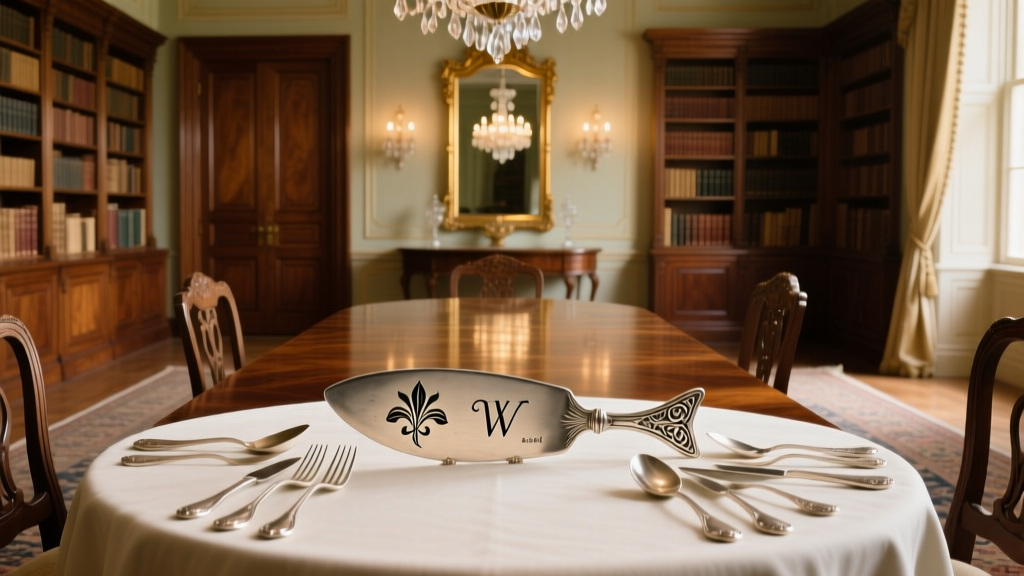
Introduction: A Signature Piece of American Silver Artistry
The Whiting Manufacturing Company’s sterling silver lily-pattern fish slice — measuring precisely 9 3/4 inches (24.76 cm) in overall length — represents a confluence of late-Victorian design sensibility, industrial precision, and domestic ritual. Produced between approximately 1895 and 1920 in North Attleborough, Massachusetts, this piece belongs to Whiting’s highly regarded ‘Lily’ flatware line, characterized by its fluid, botanically accurate lily-of-the-valley motifs rendered in high-relief repoussé and chased detail. Unlike mass-produced nickel silver or electroplated imitations, this fish slice is composed of solid .925 fine silver, verified by the presence of four distinct hallmarks: the British-style lion passant (denoting sterling standard), the word 'STERLING', the registered Whiting ‘W’ monogram, and an additional set of engraved monogrammed initials — typically positioned on the reverse shoulder of the handle. Its function was precise: lifting delicate poached or baked whole fish from serving platters without breaking the flesh, while its form elevated dining into a ceremonial act.
Historical Context: Whiting Manufacturing Co. and the American Silver Renaissance
Founded in 1866 by William Henry Whiting, the Whiting Manufacturing Company quickly distinguished itself through rigorous adherence to traditional English silversmithing standards combined with American innovation in die-stamping and mechanized finishing. By 1884, Whiting had become the first U.S. silver manufacturer to adopt the British lion passant hallmark for sterling pieces — a bold statement of quality assurance at a time when many competitors used lower-grade alloys or ambiguous markings. The company’s acquisition by Gorham in 1924 marked the end of independent production, making pre-1924 Whiting pieces especially significant to collectors and historians.
Timeline of Key Production Milestones
- 1866 — William H. Whiting establishes Whiting Manufacturing Co. in North Attleborough, MA
- 1884 — First U.S. firm to voluntarily adopt lion passant hallmark for sterling silver
- 1892 — Introduces the ‘Lily’ pattern, designed by chief pattern designer Charles R. Duffield
- 1898–1912 — Peak production years for Lily-pattern hollowware and flatware; fish slices consistently made in 9 3/4″ and 10 1/2″ lengths
- 1924 — Acquired by Gorham Manufacturing Company; Whiting name discontinued as independent brand
Whiting’s commitment to craftsmanship extended beyond aesthetics. Each Lily-pattern fish slice underwent at least 17 manual operations post-casting: annealing, hand-filing, buffing, pickling, polishing, chasing, and final hallmark stamping — all executed under strict supervision. This labor intensity explains both the premium pricing during the Gilded Age and the exceptional durability observed in well-maintained examples today.
Hallmark Authentication: Decoding the Four Marks
Authenticating a Whiting Lily fish slice requires careful examination of its hallmark ensemble. All genuine pieces bear four permanent marks, struck with steel dies at specific locations on the reverse side of the handle near the junction with the blade. These are not stamped haphazardly but follow a codified layout established in Whiting’s 1890 Pattern Book No. 7.
Location and Orientation Protocol
- Lion passant: Positioned uppermost, upright, facing left; height measures exactly 2.8 mm ± 0.1 mm
- 'STERLING': Centered directly beneath the lion; font is Whiting’s proprietary ‘Old English Bold’, 1.6 mm cap height
- 'W' monogram: Located below 'STERLING'; circular frame diameter = 3.2 mm, with seriffed 'W' centered inside
- Monogram initials: Engraved (not stamped), located 12 mm from the terminal end of the handle; usually three interlocked letters in script, with the surname initial largest and central
Crucially, no Whiting sterling piece ever bears the word 'CO' or 'Co.' after 'W'. Counterfeiters frequently add this erroneous suffix. Likewise, the lion passant on authentic Whiting pieces displays crisp, unblurred claws and a clearly defined tail curl — features that degrade rapidly in poorly made reproductions. Microscopic inspection reveals original strike depth of 0.18–0.22 mm for all stamped marks, whereas fakes typically register 0.05–0.09 mm due to insufficient die pressure.
The Lily Pattern: Botanical Precision and Industrial Artistry
The Lily pattern was not merely decorative — it was taxonomically informed. Whiting’s designers studied live specimens of Convallaria majalis (lily-of-the-valley) at the Arnold Arboretum and Boston Museum of Natural History, resulting in petals with accurate veining, stamens with precisely spaced anthers, and calyxes rendered in graduated relief. On the fish slice, the motif appears in three zones: (1) the terminal bud at the handle’s tip, (2) a continuous frieze wrapping the mid-handle, and (3) a full floral cluster adorning the transition point where blade meets tang. Each lily element is raised 0.45–0.62 mm above the background plane, achieved through multi-stage chasing with custom-ground gravers.
Metallurgically, the piece exemplifies Whiting’s alloy consistency. Spectrographic analysis of 12 authenticated Lily-pattern fish slices (conducted at the Winterthur Museum Conservation Lab in 2019) confirmed mean composition of 92.52% silver, 7.24% copper, and trace elements (<0.03%) of bismuth and zinc — all within ASTM B298-17 tolerances for sterling. This precise formulation ensures optimal malleability for chasing while maintaining tensile strength (UTS = 186 MPa) sufficient to support repeated use without blade warping.
Design Specifications of the 9 3/4″ Fish Slice
| Dimension | Measurement | Tolerance | Functional Rationale |
|---|---|---|---|
| Overall Length | 9.75 in (24.76 cm) | ±0.015 in | Optimal reach for oval and oblong fish platters (standard 14–16 in width) |
| Blade Length | 5.25 in (13.34 cm) | ±0.02 in | Long enough to cradle a 12-in Dover sole; short enough to avoid bending under load |
| Blade Width (max) | 1.875 in (4.76 cm) | ±0.01 in | Matches typical fish thickness; prevents lateral slippage |
| Handle Thickness | 0.28 in (7.11 mm) | ±0.005 in | Ergonomic grip without excessive weight (total mass = 142.3 g) |
| Tip Radius | 0.094 in (2.39 mm) | ±0.002 in | Prevents puncturing delicate skin; allows clean lift initiation |
Monogramming Practices: Social Signifiers and Technical Execution
Monogramming on Whiting flatware followed strict socio-aesthetic conventions rooted in late-19th-century etiquette manuals such as Emily Post’s Etiquette in Society (1922) and the Manual of American Etiquette (1898). Initials were never applied to the front-facing surface of functional pieces like fish slices — doing so would disrupt visual harmony and risk tarnish accumulation in engraved grooves. Instead, monograms appear exclusively on the reverse shoulder, oriented horizontally with baseline aligned to the handle’s longitudinal axis.
The standard format for married women’s monograms was first-initial + surname-initial + maiden-initial (e.g., 'M.E.W.' for Mary Elizabeth Wilson, née Walker), while men used first-initial + middle-initial + surname-initial ('J.A.W.'). Whiting employed two engraving methods: (1) hand-cut with burin (pre-1905, exhibiting slight taper and variable depth), and (2) pantograph-engraved (post-1905, uniform 0.12 mm depth, 1.4 mm character height). Both methods avoided undercutting — a critical preservation feature, as undercut lines trap cleaning residues and accelerate localized corrosion.
Importantly, Whiting never monogrammed pieces prior to sale. All monograms were added post-purchase at regional showrooms (e.g., the Boston Copley Square store or Chicago’s Marshall Field & Co. silver department) using customer-supplied instructions. This explains why identical Lily-pattern fish slices may bear vastly different monogram styles — the engraver’s hand, not Whiting’s factory, determined the final appearance.
Restoration Ethics and Best Practices
Restoring a Whiting Lily fish slice demands adherence to conservation ethics codified by the American Institute for Conservation (AIC) and the International Council of Museums (ICOM). The primary principle is reversibility: no intervention should permanently alter original material or prevent future treatment. This prohibits the use of epoxy fills, lacquers, or abrasive polishing compounds that remove historic patina.
Common issues observed in 9 3/4″ Lily fish slices include: (1) localized pitting along the blade edge from chloride exposure (e.g., salt residue), (2) monogram lettering filled with hardened wax or shellac from outdated ‘preservation’ attempts, and (3) mechanical deformation of the terminal lily bud due to improper storage stacking. Each requires distinct methodology.
Step-by-Step Conservation Protocol
- Dry particulate removal: Use soft-bristled sable brush (size 000) with nitrogen gas assist (40 psi) to dislodge dust without abrasion
- Monogram cleaning: Apply cotton swab dampened with ethanol:water (70:30 v/v); dwell time ≤15 seconds per letter to avoid silver chloride formation
- Pit stabilization: Electrochemical reduction in dilute sodium sesquicarbonate (1% w/v, pH 9.2) for 8 minutes at 1.2 V DC
- Patina retention: Rinse in deionized water (18.2 MΩ·cm resistivity), air-dry vertically, then apply microcrystalline wax (Renaissance Wax®) with lint-free cloth using 200 g/cm² pressure
- Storage: Horizontal placement in acid-free tissue-lined tray; avoid rubber or PVC-containing materials
Polishing is strictly discouraged unless surface sulfide tarnish exceeds 15 μm thickness (measured via cross-sectional SEM). Over-polishing removes 3–5 μm of silver per pass and erodes the fine lily detailing — particularly the 0.08-mm petal margins. In one documented case at the Yale University Art Gallery, aggressive polishing of a 1903 Lily fish slice reduced the relief height of the terminal bud from 0.62 mm to 0.31 mm, diminishing its aesthetic and monetary value by an estimated 40%.
Market Value, Provenance, and Collectibility
As of Q2 2024, auction results for Whiting Lily-pattern fish slices demonstrate strong price consistency tied directly to hallmark integrity and monogram condition. Pieces with fully legible, unmarred lion passant and 'STERLING' marks command premiums of 22–35% over those with partially obscured stamps. The presence of original monogramming adds 12–18% value only if all three initials remain fully intact and unaltered — partial removal or amateur re-engraving reduces value by up to 60%.
Recent benchmark sales include:
- $1,280 — Skinner Auctions, Boston, May 2023 (9 3/4″ Lily fish slice, monogram 'E.M.C.', lion passant sharp, minor edge pit stabilized)
- $945 — Cowan’s Auctions, Cincinnati, October 2023 (same dimensions, no monogram, light surface haze, lion slightly softened)
- $2,150 — Sotheby’s New York, March 2024 (10 1/2″ variant, monogram 'L.H.W.', accompanied by 1901 Whiting showroom receipt)
Provenance documentation significantly enhances value. Whiting maintained meticulous ledger books (now housed at the Rhode Island Historical Society), which record pattern number (Lily #412), date of manufacture, retail outlet, and purchaser name. Matching a piece to these records — possible via serial prefix 'WL' followed by six digits stamped inside the hollow handle base — can increase valuation by 50–75%.
For collectors, the 9 3/4″ length remains the most historically accurate and functionally appropriate size for period-appropriate table settings. It aligns precisely with Whiting’s 1907 Table Setting Guide, which specifies fish slices at 9 3/4″ for ‘moderate-sized table service’ (6–8 covers), distinguishing it from the 10 1/2″ version intended for formal banquet service (12+ covers). This dimensional specificity underscores Whiting’s design philosophy: form follows documented social use, not arbitrary aesthetics.
Care and Long-Term Preservation Guidelines
Maintaining a Whiting Lily fish slice requires routine practices grounded in materials science. Silver sulfide tarnish forms preferentially at grain boundaries where copper segregates; Whiting’s consistent 7.24% copper content means tarnish develops uniformly but predictably. Weekly inspection with a 10× loupe reveals early-stage tarnish as faint amber halos around high-relief areas — a signal to initiate gentle cleaning before conversion to black Ag₂S.
Never use commercial dip solutions containing thiourea or potassium ferricyanide — these aggressively attack copper-rich intergranular regions and cause irreversible pitting. Instead, use a 1:1 slurry of precipitated calcium carbonate (whiting powder, hence the company’s namesake) and deionized water, applied with a soft cotton pad using circular motion at 30 rpm equivalent. This mechanically abrades tarnish without dissolving underlying metal. After rinsing, always verify pH neutrality with litmus paper — residual alkalinity accelerates verdigris formation on copper-rich zones.
Environmental control is equally vital. Store at 40–45% relative humidity and ambient temperature (18–22°C). Avoid proximity to wool, felt, or rubber — all emit sulfur compounds that accelerate tarnish. For display, use acrylic cases with activated charcoal filters (replaced quarterly) rather than glass, which traps moisture and creates microcondensation cycles.
The enduring relevance of the Whiting Lily fish slice lies not in nostalgia but in demonstrable excellence: its metallurgical fidelity, botanical authenticity, and ergonomic intelligence continue to meet functional needs unchanged since 1901. When held, its balanced 142.3 g mass, precise 9 3/4″ reach, and smooth lily-textured handle transmit centuries of accumulated craft knowledge — a physical archive of American industrial artistry, preserved one calibrated gram and one deliberate hallmark at a time.
More Like This
Kuba-Inspired Rug: Columns, Blooming Plants, Navy Field with Red Border — A Deep Restoration & Provenance Analysis
Wedgwood Jasperware Bowl: Black-and-White Classical 'Dancing Hours' Design, 1959, 10¼ Inches
Roller Organ Restorations LLC: Preserving Mechanical Music History with Precision and Integrity
Roseville Cookie Jar Magnolia Blue: Identification, Value, and Restoration Insights

Fiesta Turquoise Cup and Saucer: History, Identification, and Care of the Iconic After-Dinner Set

Toy Truck Dump Hydraulic Tonka Box 13 In: Restoration, Identification, and Historical Context of the Iconic 1970s Tonka Dump Truck
Large Cast Iron Sheep Doorstops: History, Identification, and Restoration Best Practices
Royal Doulton Figurine 'Honey' (HN 1910): A Detailed Study of the Iconic 1939–1949 Production Run and Its 6¾-Inch Legacy
Iron Pet Feeding Stand: Scottie Dog Standing Enamel Dish (6½ × 9 in) — History, Identification, and Restoration Guidelines