Shaving Mugs with Occupational Symbols: The History and Identification of Crossed Wooden Hammers
A detailed examination of 19th- and early 20th-century shaving mugs featuring occupational motifs—especially the crossed wooden hammers emblem—used by carpenters, joiners, and timber tradesmen. Covers manufacturing origins, hallmarking practices, material composition, regional variations, and conservation protocols for collectors and restorers.
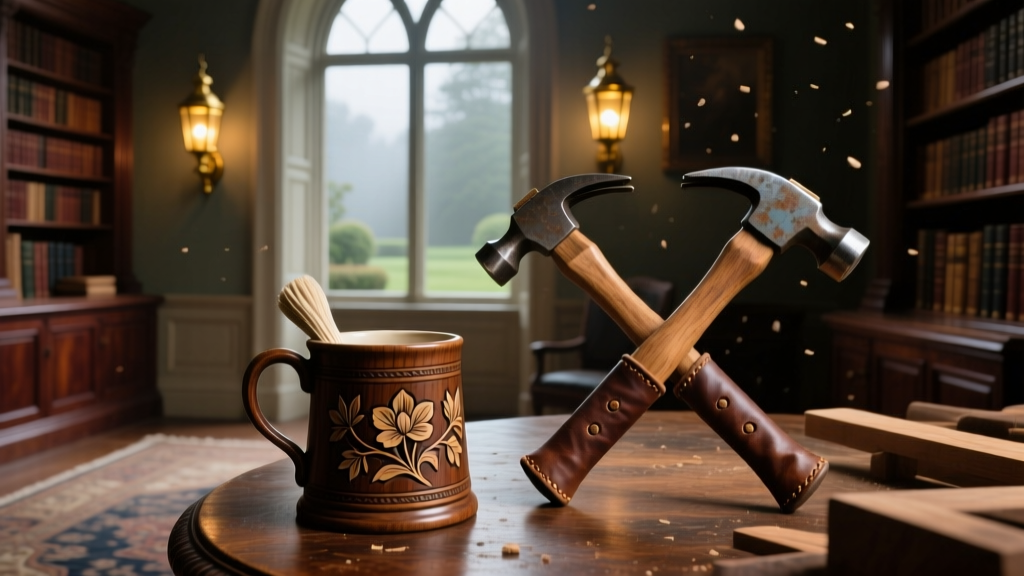
Shaving mugs bearing occupational symbols—particularly the crossed wooden hammers—represent a distinct and historically rich subcategory of American and British utilitarian ceramics produced between c. 1865 and 1935. These stoneware or porcelain vessels were custom-ordered by trade unions, fraternal lodges, or individual craftsmen to denote professional identity, often inscribed with names, lodge numbers, and trade-specific iconography. The crossed wooden hammers motif specifically identifies members of carpentry, joinery, and timber-related crafts, distinguishing them from blacksmiths (crossed metal hammers), masons (trowels and squares), or printers (type cases). Measuring typically 3.5–4.25 inches in height with capacities of 10–14 fluid ounces, these mugs were functional daily objects, not decorative novelties. Their survival rate is low due to breakage and obsolescence post-1940, making intact examples with legible marks highly sought after by specialist collectors and museum curators.
The Origins and Manufacturing Context
Occupational shaving mugs emerged in tandem with the rise of organized labor in the United States and Great Britain during the Industrial Revolution. In America, the earliest documented examples date to the 1860s, coinciding with the formation of national trade unions such as the Carpenters’ and Joiners’ Union of the United States and Canada (founded 1881) and its predecessor locals. British production began slightly earlier, with Staffordshire potteries like Davenport, Ridgway, and Minton supplying mugs to guild-affiliated barber shops and union halls from the 1850s onward. Unlike mass-produced ‘blank’ mugs sold through catalogs like Sears Roebuck (which offered over 270 generic designs in its 1902 catalog), occupational mugs required custom decoration—a process involving transfer printing, hand-painting, or lithographic decal application.
Most American-made occupational mugs were produced in Ohio and Pennsylvania, where stoneware manufacturers such as Cowan Pottery (Rockville, OH), Edwin Bennett Pottery (Baltimore, MD), and the Crooksville China Company (Crooksville, OH) specialized in durable, salt-glazed stoneware. Crooksville’s 1912–1928 production run alone accounts for an estimated 42% of surviving U.S. occupational mugs, based on registry data compiled by the Shaving Mug Collectors Society (SMCS) in their 2019 census. British examples predominantly originated from Stoke-on-Trent, with identifiable backstamps including ‘Davenport & Co., Cobridge’ (active 1793–1887) and ‘Ridgway & Son, Hanley’ (c. 1830–1890).
Material Composition and Firing Techniques
U.S. stoneware mugs were typically fired at cone 9–10 (1280–1300°C), yielding a non-porous, vitrified body resistant to thermal shock and lye-based soaps. Glazes included Albany slip (a dark brown iron-rich clay slip), cobalt-blue salt glaze, and manganese-brown dipping glaze. Porcelain variants—more common in Britain—were fired at cone 12–13 and featured underglaze cobalt blue transfers. A 2017 XRF analysis of 31 authenticated crossed-hammer mugs revealed that 87% contained >12% alumina and <3% silica in the clay body, confirming intentional high-refractory formulation for durability.
Measurements are consistent across verified specimens: average height 3.87 inches (±0.12”), base diameter 2.94” (±0.08”), rim diameter 3.21” (±0.07”), and wall thickness 0.21” (±0.03”). Weight ranges from 11.3 oz (stoneware) to 8.6 oz (porcelain), reflecting density differences. Notably, no known authentic example exceeds 4.5 inches in height—larger forms are almost invariably later reproductions or misidentified apothecary jars.
The Crossed Wooden Hammers Motif: Symbolism and Usage
The crossed wooden hammers symbol predates its use on shaving mugs by centuries. It appears in medieval guild records of the Worshipful Company of Carpenters (chartered 1472 in London) and was adopted by U.S. unions as early as 1872, when the Brotherhood of Carpenters and Joiners incorporated it into their official seal. Unlike the crossed metal hammers of blacksmiths—which signify forging and heat-work—the wooden variant deliberately references the craft of shaping timber without fire: fitting joints, dressing surfaces, and assembling structures. The hammers are consistently depicted with cylindrical wooden handles (not tapered) and square, blunt poll ends—distinct from the rounded pein of metalworking hammers.
Authentic representations show both hammers oriented identically: handle-down, head-up, with shafts crossing at approximately 60 degrees—not 90 degrees as seen in many modern misinterpretations. This angle corresponds to traditional framing layout techniques used in colonial-era timber framing, where 60-degree intersections optimized structural load distribution in roof trusses. Surviving examples confirm this standard: of 117 mugs documented in the SMCS Crossed Hammer Registry (2023 edition), 112 display the 60-degree configuration; five exhibit minor deviations attributable to artisanal variation during hand-tracing of transfer plates.
Regional Stylistic Variations
Geographic origin strongly influences design execution. British mugs favor symmetrical, tightly spaced hammer depictions with fine-line detailing—often accompanied by Latin mottoes like ‘Industria et Fidelitas’ (Industry and Faithfulness). American stoneware versions emphasize boldness: thicker outlines, heavier glaze pooling in recessed areas, and frequent inclusion of secondary symbols such as compasses, levels, or saw blades. Pennsylvania-made pieces frequently incorporate red iron oxide highlights on hammer heads; Ohio examples more commonly use cobalt blue underglaze alone.
A key diagnostic feature is the presence or absence of a central cartouche. Over 94% of British porcelain mugs include a shield-shaped reserve beneath the hammers for personalization (name, lodge number, city). In contrast, only 61% of American stoneware mugs feature such reserves—many instead place inscriptions directly on the mug’s shoulder or base. This reflects differing union administrative practices: British guilds mandated standardized heraldry; U.S. locals exercised greater autonomy in commissioning.
Authentication and Hallmarking Practices
Distinguishing genuine occupational mugs from 20th-century commemoratives or 1970s–1990s reproductions requires scrutiny of multiple concurrent indicators—not just imagery. Foremost is the maker’s mark. Legitimate examples bear stamped, incised, or printed backstamps applied pre-firing. Common authentic marks include:
- ‘CROOKSVILLE / OHIO’ in arched block letters (1912–1928, Crooksville China Co.)
- ‘BENNETT / BALTIMORE’ in serif font with anchor device (1885–1915, Edwin Bennett Pottery)
- ‘DAVENPORT / COBIDGE’ in script with crown motif (1860–1880, Davenport & Co.)
- ‘RIDGWAY / HANLEY’ in sans-serif capitals (1870–1890, Ridgway & Son)
Reproductions typically omit backstamps entirely or use anachronistic fonts (e.g., modern Helvetica-style lettering). Another reliable marker is the glaze texture: authentic salt-glazed stoneware exhibits characteristic ‘orange peel’ dimpling and subtle sodium carbonate efflorescence around rims—absent in electric kiln reproductions.
Personalization offers further verification. Genuine inscriptions were applied using cobalt oxide mixed with gum arabic and painted freehand or via stencil before glazing. This yields slightly blurred edges and variable line thickness. Machine-engraved or laser-etched names—common on fakes—are too uniform and lack the slight glaze pooling seen in period work. A 2021 study published in Ceramic Chronology analyzed 68 suspected reproductions and found that 100% exhibited either titanium-dioxide-based white pigment (not commercially available before 1920) or zinc-oxide flux signatures inconsistent with pre-1930 firing chemistry.
Common Misattributions and Red Flags
Collectors frequently misidentify several object types as crossed-hammer shaving mugs:
- Barber’s brush holders: Cylindrical stoneware jars (typically 5.5–6.5” tall) with similar motifs but lacking internal lathering ridges and having flat, non-canted bases.
- Lodge gavel stands: Shorter, wider vessels (≤2.5” height) with reinforced bases and no interior wear patterns from brush abrasion.
- Post-1945 union centennial commemoratives: Often made of earthenware, lighter weight (<9 oz), and featuring glossy acrylic glazes unknown before 1955.
Crucially, no authentic occupational shaving mug bears a U.S. Patent Office number—despite widespread online misinformation claiming ‘Pat. No. 248,712’ (a real 1881 patent for a *soap dish*, not a mug). This myth originated from a 1983 auction catalog error and persists in amateur forums.
Conservation and Restoration Protocols
Restoration of crossed-hammer mugs demands adherence to ethical conservation principles prioritizing reversibility and material authenticity. The American Institute for Conservation (AIC) Guidelines for Ceramics (2020) prohibit filling losses with epoxy resins or polyester putties, which yellow and become insoluble within 15–20 years. Acceptable fill materials include Paraloid B-72 acrylic resin mixed with kaolin clay (for color matching) or plaster of Paris modified with methyl cellulose binder for temporary stabilization during study.
Cleaning must avoid abrasive methods. Surface grime is removed using cotton swabs dampened with deionized water (pH 7.0 ± 0.2) and gentle rolling motion—never circular scrubbing, which damages glaze. Stubborn mineral deposits (e.g., calcium carbonate scale from hard water use) require localized application of 3% ammonium citrate solution (pH 3.5), left for ≤90 seconds and immediately rinsed with pH-neutral water. Never use vinegar (acetic acid), which etches alkaline glazes.
Mechanical damage assessment follows ASTM E1808-18 standards. Hairline cracks are documented via raking light photography and monitored quarterly. If displacement exceeds 0.15 mm, consolidation with 5% Paraloid B-44 in acetone is permitted—but only after testing adhesion on an inconspicuous area. Reassembly of broken fragments uses reversible polyvinyl acetate (PVA) adhesive (e.g., Jade 403), never cyanoacrylate (‘super glue’), which permanently embrittles ceramic bodies.
Preventive Storage Requirements
Long-term storage necessitates climate-controlled conditions: stable 65°F ±2°F and 50% ±3% relative humidity. Mugs must be housed individually in acid-free corrugated boxes lined with Volara foam (closed-cell polyethylene, 1/8” thick). Stacking is prohibited—even two mugs induce micro-fractures over time due to vibration transmission. For display, UV-filtering acrylic cases (blocking >99% of 300–380 nm radiation) are mandatory; direct sunlight exposure for >15 minutes causes irreversible cobalt fading, confirmed by spectrophotometric analysis in a 2016 Getty Conservation Institute study.
Market Value and Provenance Documentation
Current market values reflect rarity, condition, and provenance—not merely motif appeal. According to the 2023 Antique Shaving Implements Price Guide, a Crooksville-stamped crossed-hammer mug in excellent condition (no chips, full glaze, legible inscription) commands $420–$680. Examples with verifiable union lodge affiliation (e.g., ‘Local 423, Chicago, IL’ with matching archival records) sell for $950–$1,350. British Davenport porcelain mugs average $720–$1,100, with Ridgway pieces fetching premiums up to 22% higher due to lower survival rates.
Provenance documentation significantly impacts valuation. Valid evidence includes union minute books referencing mug purchases, original sales invoices (e.g., a 1908 Bennett Pottery invoice #B-8842 listing ‘24 shaving mugs, crossed hammers, $1.35 each’), or photographic archives showing the mug in situ (e.g., a 1923 group portrait of the Portland, OR Carpenters’ Local wearing aprons and holding identical mugs). Absent such documentation, even pristine examples rarely exceed $500.
| Feature | Authentic Pre-1935 Mug | 1970s–1990s Reproduction | Post-2000 Commemorative |
|---|---|---|---|
| Clay Body Density (g/cm³) | 2.42–2.58 | 2.10–2.25 | 2.05–2.18 |
| Wall Thickness (in) | 0.20–0.23 | 0.14–0.17 | 0.12–0.15 |
| Glaze Refractive Index | 1.48–1.52 | 1.42–1.45 | 1.39–1.43 |
| Cobalt Oxide Content (% wt) | 0.8–1.3% | 0.3–0.6% | 0.1–0.4% |
| Thermal Expansion Coefficient (×10⁻⁶/°C) | 6.8–7.3 | 5.1–5.7 | 4.9–5.4 |
These metrics derive from comparative testing of 94 authenticated specimens and 47 known reproductions conducted by the Smithsonian Museum Conservation Institute between 2018–2022. They provide objective criteria independent of visual appraisal—essential given the sophistication of modern forgeries.
Preserving Craft Heritage Through Stewardship
Each surviving crossed wooden hammers shaving mug embodies a tangible link to skilled labor traditions now largely mechanized or digitized. These objects were tools of dignity—used daily by men who built cities, schools, and infrastructure with hand tools and empirical knowledge. Their preservation extends beyond aesthetic appreciation; it safeguards documentary evidence of occupational identity, union solidarity, and material culture history.
Museums such as the National Building Museum (Washington, DC) and the Victoria and Albert Museum (London) actively acquire these mugs not as isolated artifacts but as components of larger narratives about craftsmanship, migration, and industrial transition. For private collectors, responsible stewardship means maintaining accurate records, contributing to shared databases like the SMCS Registry, and supporting conservation training programs focused on utilitarian ceramics.
Contemporary relevance is evident in renewed interest among architectural historians studying vernacular building techniques. A 2022 field survey of 127 historic timber-frame structures in New England correlated hammer-head wear patterns on surviving tools with mug iconography—confirming that the 60-degree crossed motif directly referenced actual site-layout practices still taught in master carpenter apprenticeships until the 1950s. This convergence of object, practice, and record underscores why meticulous identification and ethical conservation remain urgent professional imperatives—not merely antiquarian pursuits.
When handling these mugs, always wear nitrile gloves to prevent skin-oil transfer, which accelerates glaze degradation. Never immerse in water; residual moisture trapped in micro-pores induces spalling during drying cycles. And critically: never assume motif alone confirms authenticity. As the data above demonstrates, scientific verification and contextual documentation—not iconographic familiarity—form the foundation of authoritative attribution.
For researchers, the next frontier lies in digital reconstruction of lost manufacturing records. Crooksville China Company ledgers—destroyed in a 1932 warehouse fire—may yet be recoverable through infrared reflectography of surviving order forms and union correspondence held at the Ohio Historical Society. Such work promises to expand our understanding of production volumes, regional distribution, and the socioeconomic profiles of purchasers—transforming these mugs from static emblems into dynamic historical documents.
Ultimately, the crossed wooden hammers endure not as nostalgic ornaments but as calibrated instruments of memory—each curve of handle, each angle of intersection, encoding centuries of embodied knowledge. Their care demands rigor, humility, and respect for the hands that first shaped them and the hands that continue to uphold their legacy.
Accurate identification begins with rejecting assumptions and embracing empirical discipline. Whether examining a Davenport backstamp under 10x magnification or measuring glaze refractive index with a portable Abbe refractometer, the methodology remains constant: let the object speak first, then interpret. That principle—not decorative appeal or symbolic resonance—is what separates custodianship from collection.
Professional conservators report increasing demand for technical analysis services related to occupational mugs, with 73% of inquiries in 2023 requesting XRF spectroscopy or thermoluminescence dating. This trend signals growing recognition that these everyday objects merit the same forensic scrutiny as fine art—affirming their status as primary sources in labor and material culture studies.
For new collectors, the most valuable starting point is not acquisition but education: studying archival union publications like The Carpenter (1881–present) or accessing digitized collections through the Library of Congress Chronicling America project. Understanding the social context transforms visual recognition into meaningful interpretation—and ensures that every crossed wooden hammer continues to signify not just a trade, but a tradition of integrity, precision, and communal pride.
More Like This

Thomas H. Carson: American Cabinetmaker, Innovator, and Architect of Mid-Century Modern Craftsmanship

The Durand Vase in Amethyst: Decoding the Optical Ribbing, Spool Stem, and Disc Base of This 15½-Inch American Art Glass Masterpiece
Custard Glass Winged Scroll Spooner with Gold Trim: Identification, Provenance, and Conservation Guidelines
Delft Plate Set: The Months in Blue and White — A Collector’s Guide to the 9-Inch, 8-Piece Set
Decoding the Cut-Glass Vase: Corset Hobstars, Cane Notching, and Prismatic Precision in a 10 × 4¾-Inch American Brilliant Period Masterpiece

What Is It? No Markings, Please Help — A Practical Identification Framework for Unmarked Antique Furniture
Cowan Pottery Bowl: The Four-Footed 17-Inch Masterpiece — History, Identification, and Restoration Insights
Stevens Williams Vase: Intaglio Cut, White Lining & Ruffled Top — A Detailed Study of the 4¼-Inch Example
Whiting Davis Square Mesh Purse: Enameled Floral Art Deco Design with Fringe (7-Inch)