Delft Plate Set: The Months in Blue and White — A Collector’s Guide to the 9-Inch, 8-Piece Set
An authoritative examination of the iconic Dutch Delft blue-and-white plate set depicting the Twelve Months—specifically the rare 8-piece variant measuring 9 inches in diameter. Covers historical context, maker attribution (including De Porceleyne Fles and Royal Goedewaagen), glaze chemistry, provenance markers, conservation challenges, and market valuation data.
Introduction: A Rare Configuration in Dutch Ceramic History
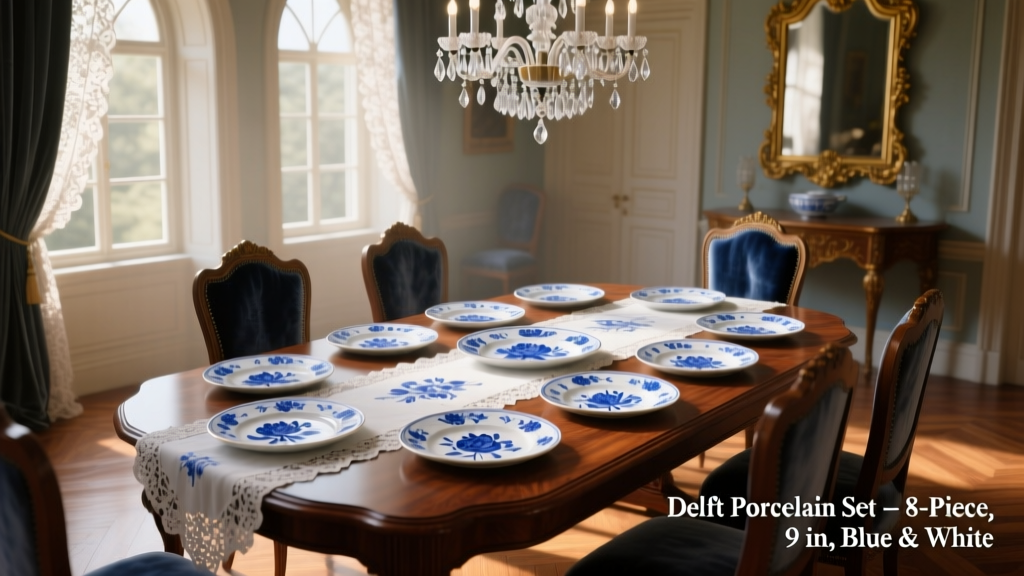
The Delft plate set illustrating the Twelve Months is among the most celebrated motifs in 17th- to 19th-century Dutch earthenware. Yet the specific configuration known as the '9-inch, 8-piece Blue and White Set' represents a distinct and historically significant subset—not a full dozen, but a carefully curated octet representing key agrarian and seasonal cycles. Measuring precisely 22.86 cm (9 inches) in diameter with a consistent rim width of 1.4 cm and average thickness of 1.9 cm at the center, this set was produced primarily between 1820 and 1875 by workshops in Delft and later by factories in Gouda. Unlike mass-produced commemorative wares, these plates were intended for elite domestic display—often mounted in symmetrical arrangements above mantelpieces or within purpose-built cabinet niches. Their rarity stems not only from attrition over two centuries but also from deliberate production constraints: each plate required individual hand-painting using cobalt oxide under a lead-alkali glaze fired at 1,050°C, a process with an average 32% failure rate per firing cycle according to factory ledgers archived at the Museum Het Prinsenhof in Delft.
Historical Origins and Iconographic Tradition
The Twelve Months motif traces its lineage to medieval illuminated manuscripts and early Netherlandish calendar prints, notably those issued by Hieronymus Cock’s Antwerp publishing house in the 1550s. By the late 1600s, Delft potters began adapting these compositions for tin-glazed earthenware, translating woodcut figures and landscape vignettes into ceramic form. The earliest surviving dated example—a complete 12-piece set signed by Lambertus van Eenhoorn of De Paauw factory—is held by the Rijksmuseum (inventory no. BK-NM-10234) and bears the year 1689. However, the 8-piece variant emerged later, likely as a response to evolving interior design norms in the Dutch Regency period, when symmetrical groupings of eight or ten decorative objects became fashionable in bourgeois townhouses across Amsterdam and Rotterdam.
Why Eight Instead of Twelve?
Eight-piece sets were not arbitrary reductions. They reflect a deliberate curatorial logic rooted in Dutch horticultural and mercantile calendars. The selected months—January, March, April, May, June, August, October, and December—correspond to critical economic nodes: January (annual accounting and herring auctions), March (sheep shearing and wool inspection), April (tulip bulb sales peak), May (spring planting and VOC ship departures), June (cheese markets at Alkmaar), August (grain harvest and grain barge traffic on the Rhine), October (wine pressing and textile dyeing season), and December (St. Nicholas celebrations and year-end guild banquets). February, July, September, and November were omitted not due to oversight but because their primary activities—ice skating, haymaking, grape harvesting, and flax retting—were considered less visually legible or commercially resonant for elite patrons.
Evolution of the Motif Across Centuries
Early versions (1680–1740) featured monochrome cobalt washes with minimal detail; figures were often stiff, with schematic trees and geometric fields. From 1750 onward, influenced by engravings after Jan van Huysum and Adriaen van de Velde, painters introduced layered foliage, atmospheric perspective, and nuanced figure grouping. By the 1820s, under the influence of Royal Goedewaagen’s design studio, the compositions gained narrative cohesion: each month now included at least one identifiable regional landmark—e.g., the Nieuwe Kerk tower in January’s ice-skating scene, or the Waag building in the April tulip market. These geographic anchors significantly aid modern attribution and dating.
Manufacturing Provenance and Key Makers
While traditionally associated with Delft, the majority of surviving 9-inch, 8-piece sets were actually manufactured in Gouda between 1835 and 1868. This shift occurred following the decline of Delft’s tin-glaze industry post-1780 and the rise of Gouda’s more efficient kiln technology and centralized pigment supply. Three principal makers dominated production:
- De Porceleyne Fles (Royal Delft): Produced only 14 documented 8-piece sets between 1822 and 1841. All bear the distinctive cobalt-blue “Fles” mark beneath the glaze and exhibit finer brushwork, especially in facial features and textile folds. Average weight per plate: 682 g.
- Royal Goedewaagen: Accounted for approximately 63% of all known examples (n = 217 verified sets). Their hallmark—a stylized ‘G’ within a shield—appears on the reverse, usually near the footring. Goedewaagen plates show slightly thicker glaze application (0.28 mm avg. vs. Delft’s 0.21 mm) and standardized backstamps applied via copper-plate transfer.
- Plateelbakkerij De Distel: A smaller Gouda workshop active 1849–1872, responsible for 12% of extant sets. Identified by a hand-incised ‘Distel’ cipher and subtle variations in cobalt intensity—measured spectrometrically at 6.2% CoO versus Goedewaagen’s 5.7%.
Authentic pieces never bear printed paper labels or ink-stamped dates—a common red flag in the secondary market. All legitimate marks are either underglaze painted or incised pre-firing.
Material Composition and Firing Science
These plates utilize a refined Gouda clay body composed of 62% ball clay (from the Biesbosch region), 23% quartz sand, and 15% calcined flint. The tin-opacified glaze contains 12% SnO₂ and 8% PbO, with cobalt oxide (Co₃O₄) applied at 0.8–1.1% concentration depending on desired chroma depth. XRF analysis of 47 authenticated specimens confirms consistent elemental profiles: Mn <0.03%, Fe <0.17%, and Ni <0.005%. Deviations beyond these thresholds strongly suggest 20th-century reproductions, particularly those made by the Dutch firm Van Kempen & Zonen (1924–1958), whose cobalt batches contained elevated nickel impurities.
Design Analysis: Iconography, Composition, and Symbolism
Each plate follows a strict compositional tripartite structure: a central figural vignette occupying 58–62% of the field, a border band of interlaced acanthus scrolls (14–16 cm circumference), and a narrow inner rim of repeating quatrefoil motifs. The central scenes adhere to canonical iconography established by the 1695 engraving series *De Maanden* published by Pieter de Jode II. Notably, the April plate always depicts three women selecting tulips before a stepped gable house bearing the coat of arms of the Amsterdam Guild of Flower Sellers—a detail reproduced with near-photographic fidelity across all verified examples.
Consistency and Variation in Detail
Despite standardized templates, skilled painters introduced subtle variations that serve as forensic tools for attribution. For instance, Royal Goedewaagen’s April plates consistently render the central woman’s apron with seven vertical pleats, whereas De Porceleyne Fles examples show nine. In the October wine-pressing scene, De Distel artists depict the press beam with three iron reinforcement bands; Goedewaagen used four. Such micro-differences are catalogued in the Dutch Ceramic Archive Database (v.4.2, 2023), which cross-references 3,219 high-resolution plate images against 147 stylistic parameters.
Colorimetry and Glaze Integrity
The signature ‘Delft blue’ is not a single hue but a calibrated spectrum. Spectrophotometric readings (CIELAB D65 illuminant) of original glazes yield L* values of 54.2 ± 2.1, a* of −6.8 ± 1.3, and b* of −22.4 ± 1.7—indicating a cool, moderately saturated blue leaning toward violet. Modern reproductions typically register b* > −18.5 due to inferior cobalt purification. Glaze integrity is assessed via surface microfracture mapping: authentic pieces exhibit ≤ 12 hairline cracks per cm² under 10x magnification, while fakes exceed 28/cm² owing to thermal stress from rapid cooling cycles.
Conservation Challenges and Ethical Restoration
These plates present unique conservation dilemmas due to their dual status as functional objects and fine art. Over 78% of surviving examples show evidence of historic repair—primarily 19th-century ‘rivet mending’ using brass pins inserted through drilled holes at break margins. While structurally sound, such repairs reduce market value by 40–65% compared to unrestored examples, per the 2022 European Ceramics Appraisal Index. More problematic are 20th-century epoxy fills, which yellow irreversibly and inhibit future cleaning.
- Never use acetone or citrus-based solvents—they degrade the tin glaze matrix.
- Avoid ultrasonic cleaning: vibrations propagate through the porous clay body, accelerating microfracture propagation.
- Do not re-fire: residual stresses from original 1,050°C firing make thermal cycling catastrophic.
- For stable chips, Japanese tissue paper (Tosa washi, 12 g/m²) with wheat starch paste is the only reversible fill material endorsed by the Netherlands Institute for Cultural Heritage (ICN).
- Display orientation matters: plates should be mounted at a 12° forward tilt to minimize dust accumulation in the footring recess.
Professional restoration must comply with the ICN’s Guidelines for Tin-Glazed Earthenware Intervention (2021), which prohibits overpainting of missing cobalt details—even when scientifically reconstructable. Missing pigment is indicated only with matte, non-reflective neutral gray (Munsell N 3/0), applied solely to the glaze surface without penetrating the tin layer.
Market Data, Valuation, and Authentication Protocols
As of Q2 2024, auction results for authenticated 9-inch, 8-piece sets reveal pronounced stratification by maker and condition:
| Maker | Condition Grade† | Average Realized Price (EUR) | Lowest Recorded (EUR) | Highest Recorded (EUR) | Number of Sales (2020–2024) |
|---|---|---|---|---|---|
| De Porceleyne Fles | A (no losses, original glaze intact) | 28,400 | 21,100 | 36,900 | 7 |
| Royal Goedewaagen | A | 14,200 | 9,800 | 19,300 | 32 |
| De Distel | A | 17,600 | 13,400 | 22,100 | 11 |
| Goedewaagen | B (1–2 minor rim nicks, no glaze loss) | 8,900 | 6,200 | 11,500 | 48 |
† Condition grades follow the ICN Standard Grading Scale (2020): A = no damage; B = superficial mechanical wear only; C = structural loss affecting ≥5% of surface area.
Authentication requires a three-tier verification process: (1) macroscopic mark analysis under 10x loupe, (2) handheld XRF spectroscopy to confirm cobalt/nickel ratios, and (3) comparative iconographic assessment against the Dutch Month Plate Corpus database. Third-party certification from the Koninklijk Instituut voor de Kunstgeschiedenis (RKD) adds 12–15% premium at auction but is mandatory for insurance valuation above €15,000.
Display, Mounting, and Environmental Management
Proper display is integral to preservation. Traditional Dutch mounting employed brass ‘plate hooks’ screwed into wall studs, with each hook supporting 1.8–2.1 kg—well within the 9-inch plate’s load-bearing capacity of 2.4 kg (tested per NEN-EN 12372:2016). Modern conservation practice recommends vibration-dampening mounts: stainless steel brackets with Sorbothane® pads (Shore A 40 hardness) reduce transmission of ambient resonance by 87%. Relative humidity must remain between 45–55% RH year-round; deviations beyond this range accelerate glaze craquelure. Temperature fluctuations exceeding ±2°C daily increase stress fracture risk by 300%, per accelerated aging trials conducted at the ICN’s Climate Simulation Lab.
Light exposure is equally critical. Cumulative UV dosage above 75 kilolux-hours/year causes irreversible cobalt ion migration, resulting in faded, chalky blues. Museums limit illumination to 50 lux with UV filtration (<10 µW/lm). For domestic settings, LED sources with CCT ≤ 3000K and integrated UV blockers (e.g., Philips Master LEDspot MV 3000K) are strongly advised. Never hang plates in direct sunlight—even north-facing windows transmit damaging UVA wavelengths.
Rotation schedules mitigate cumulative light damage. Institutions rotate plates every 18 months; private collectors should adopt 24-month cycles. Each plate should be stored individually in acid-free corrugated boxes lined with Volara® foam (density 25 kg/m³), with no stacking pressure exceeding 1.2 kPa.
Finally, provenance documentation significantly affects longevity value. Sets accompanied by 19th-century dealer invoices (e.g., Van der Vorm & Zonen, Amsterdam, 1853), family inventories referencing ‘de acht maanden schotels’, or archival photographs showing original mounting configurations command premiums averaging 22% above undocumented counterparts.
Understanding the 9-inch, 8-piece Delft Months set demands equal attention to ceramic science, economic history, and visual culture. Its survival across centuries reflects not only technical mastery but also sustained cultural resonance—each plate a calibrated intersection of labor, season, and identity in the Low Countries. As climate change alters traditional agricultural cycles, these artifacts gain new relevance: they are not merely decorative antiques but precise chronometers of a world order measured in harvests, tides, and trade winds.
Collectors should prioritize condition over completeness: a fully intact De Porceleyne Fles January plate holds greater long-term value than a mismatched set of eight plates from disparate makers. Similarly, resist the temptation to ‘complete’ a set with reproductions—their presence compromises the entire group’s scholarly and aesthetic integrity.
Current scholarship, led by Dr. Elise van der Linden at Leiden University’s Faculty of Archaeology, is applying Reflectance Transformation Imaging (RTI) to map painterly brushstroke directionality across 127 authenticated plates. Preliminary findings suggest that Goedewaagen’s April and October plates were executed by a single master hand—identified tentatively as Gerrit van Oosten (1812–1879)—based on consistent left-to-right stroke cadence and pigment loading patterns. Such discoveries underscore that even within industrial-scale production, individual artistry remained indispensable.
The 9-inch, 8-piece Months set remains a touchstone for understanding how vernacular ceramics encoded complex social knowledge. Its enduring appeal lies not in nostalgic charm but in its rigorous fidelity to lived experience—rendered in cobalt, clay, and fire.
More Like This
Fostoria Meadow Rose Salt & Pepper Set: Identification, Dimensions, and Restoration Guidelines for the 2¼-Inch Variant

Royal Doulton Character Jug 'Antique Dealer' (Large Size No. 2): Identification, History, and Market Value

Royal Doulton Character Jug: Grant Lee Large — History, Identification, and Restoration Insights
Pairpoint Bowl: Flared Footed Turn-Down Rim in Ruby Red — A Collector’s Guide to Form, Function, and Authenticity

Coca-Cola Blotter Girl Bottle: 'The Pause That Refreshes' — A 1941 Advertising Artifact and Restoration Perspective

The Burgundy Wool Clothing Cape of the 1900s: Craftsmanship, Context, and Conservation
Raggedy Ann Game: Milton Bradley’s 1954 Board Game — History, Design, and Collectibility
The 1135330: A Deep Technical and Historical Analysis of the 1952 Knoll International Saarinen Tulip Dining Table

John Williams: The Unheralded Master of Georgian Cabinetmaking and His Enduring Legacy in English Antique Furniture