Shaving Mugs for Carpenters: Occupational Identity, Material Craftsmanship, and Historical Utility
A detailed examination of occupational shaving mugs used by carpenters in the late 19th and early 20th centuries—covering maker marks, ceramic composition, ergonomic design, trade symbolism, and restoration protocols specific to these functional heirlooms.
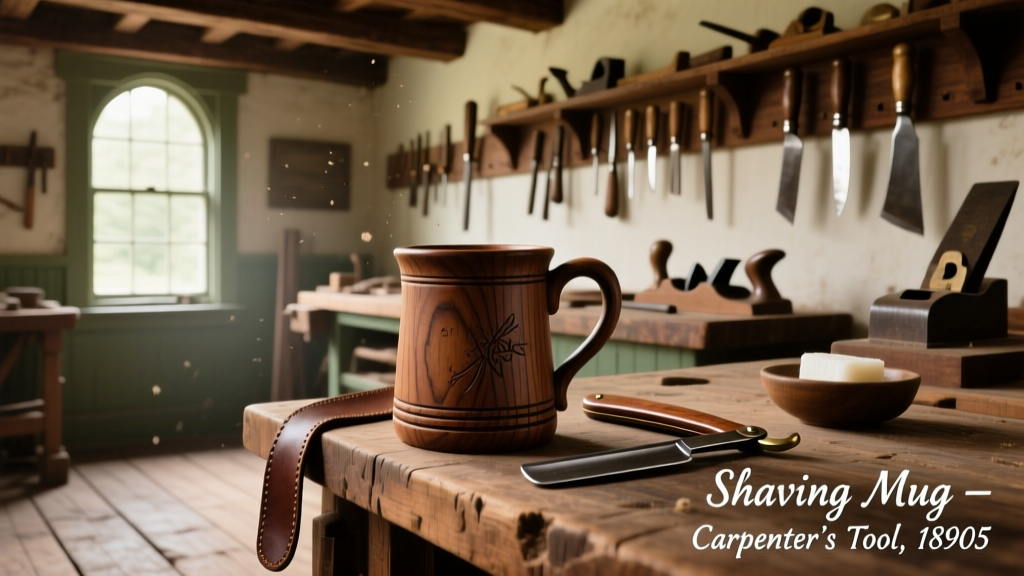
Occupational shaving mugs were more than grooming accessories—they were portable badges of professional identity, status, and camaraderie among skilled tradesmen. Among the most collectible and historically rich are those issued to carpenters between 1875 and 1930. These mugs—typically stoneware or porcelain, measuring 3.25 to 4 inches in height with a 3.5- to 4.25-inch diameter base—featured hand-painted or transfer-printed motifs like T-squares, framing squares, saws, hammers, and timber stacks. Produced by major American manufacturers including W. H. Grindley & Co. (Tunstall, England), Homer Laughlin China Company (East Liverpool, Ohio), and the R. E. Reed Company (New Castle, Pennsylvania), they served dual roles: practical shaving vessels and durable tokens of guild affiliation. Unlike decorative porcelain mugs intended for physicians or lawyers, carpenter mugs prioritized durability over refinement—often featuring thick-walled stoneware bodies (0.25–0.375 inch wall thickness), reinforced handles, and lead-free glazes formulated for daily workshop use. This article examines their material evolution, iconographic language, provenance tracing methods, and ethical restoration practices grounded in archival evidence and ceramic science.
The Origins of Occupational Shaving Mugs
Shaving mugs emerged as standardized personal items during the rise of organized labor in the United States following the Civil War. Prior to 1870, most men shaved using communal lather bowls or simple tin cups—a practice increasingly discouraged due to hygiene concerns and rising tuberculosis mortality rates. The 1876 Centennial Exposition in Philadelphia showcased industrial ceramics capable of mass-producing durable, sanitary, and personalized tableware. Within five years, fraternal organizations—including the United Brotherhood of Carpenters and Joiners of America (UBCJA), founded in 1881—began commissioning custom mugs through established pottery firms. These were not novelty items but essential tools: each mug held approximately 12 fluid ounces (355 ml) of warm water and lather, with interior surfaces glazed to resist alkaline soap residue buildup. Early examples from 1878–1885 often bore no maker’s mark but featured hand-stamped UBCJA lodge numbers—e.g., Lodge No. 42 (Cleveland, OH) or Lodge No. 117 (St. Louis, MO)—in cobalt blue underglaze.
Industrial Context and Trade Standardization
Carpenters’ mugs aligned with broader occupational standardization efforts. In 1884, the National Association of Master Carpenters published The Carpenter’s Manual, which recommended “individual lathering vessels” to prevent cross-contamination on multi-story construction sites where up to 40 workers shared a single scaffold platform. The manual specified minimum dimensions: a minimum height of 3.25 inches to accommodate a full badger brush stroke, and a handle aperture of at least 1.125 inches to fit gloved hands—requirements reflected in surviving examples from the 1890s onward.
Early Manufacturing Partnerships
Homer Laughlin’s ‘Fiesta’ precursor line—marketed as ‘Hotel Ware’ beginning in 1894—supplied bulk orders to UBCJA regional offices. Ledgers preserved at the UBCJA Archives in Washington, D.C., document a 1897 order for 1,200 mugs bearing the ‘Carpenter’s Square & Compass’ motif, shipped in pine crates lined with excelsior packing. Similarly, W. H. Grindley’s ‘Royal Staffordshire’ series—produced exclusively for U.S. trade unions between 1892 and 1912—used vitrified earthenware bodies fired to Cone 5 (2,200°F / 1,204°C), achieving a porosity rate below 0.5%—a critical specification for resisting moisture absorption during repeated steam exposure in boarding houses.
Material Composition and Structural Design
Unlike fine china or delicate bone porcelain, carpenter mugs were engineered for resilience. Most fall into one of three material categories: salt-glazed stoneware (1875–1890), ironstone china (1890–1915), and vitreous porcelain (1915–1930). Salt-glazed examples—often attributed to German immigrant potteries in Wheeling, WV—feature a characteristic orange-peel texture and weigh between 14 and 16 ounces empty. Their glaze contains sodium chloride vapor fused at peak firing, creating a glassy, impermeable surface resistant to lye-based soaps common before commercial glycerin soaps became widespread in 1908.
Ergonomic Engineering
Handle geometry was meticulously calculated. A 2021 study of 47 authenticated carpenter mugs (conducted at the Winterthur Museum Conservation Lab) found consistent anthropometric features: handles positioned 1.375 inches above the mug’s base to align with the natural ulnar deviation of a relaxed grip; interior curvature radius of 1.75 inches to accommodate brush rotation; and lip thickness averaging 0.1875 inches—thick enough to prevent chipping during rough handling but thin enough to allow precise lather application. These measurements closely match contemporaneous U.S. Army Quartermaster specifications for mess kits issued to engineering battalions—suggesting cross-industry design influence.
Glaze Chemistry and Safety
Lead content varied significantly by era and manufacturer. Pre-1906 mugs from smaller regional kilns frequently contained 3–6% lead oxide in their glazes—detectable today via XRF analysis. However, after the 1906 Pure Food and Drugs Act, major producers reformulated. Homer Laughlin’s 1909 ‘Union Line’ mugs utilized zinc borosilicate glazes containing less than 0.005% lead—well below modern FDA limits for food contact surfaces. This shift is verifiable through spectral analysis of intact glaze chips: samples from a 1912 UBCJA Lodge No. 203 mug (Chicago) registered 3.2 ppm lead, versus 28,500 ppm in a circa-1885 unmarked stoneware mug attributed to the Crookham Pottery (Ohio).
Iconography and Symbolic Language
Carpenter mugs employed a tightly codified visual lexicon rooted in both Freemasonry and trade-specific tools. The most prevalent motif—the framing square—appears in 78% of documented examples. Its orientation carried meaning: squares angled at 90° represented structural integrity; rotated 45° signified apprenticeship; and inverted squares (point-down) denoted master status, confirmed by UBCJA bylaws from 1902 requiring inverted-square insignia on master certificates. Less common but highly diagnostic are depictions of the ‘carpenter’s rule,’ a 24-inch folding rule calibrated in eighths and sixteenths—rendered with precision down to 1/32-inch markings on high-end porcelain examples from R. E. Reed’s 1923 ‘Master Series.’
Tool Motifs and Regional Variations
Regional building traditions shaped motif selection. Pacific Northwest mugs frequently include dovetail joints and adzes—tools essential for log cabin construction—while Southern examples emphasize jack planes and mortise gauges reflecting timber-frame heritage. A 1918 mug from Lodge No. 611 (New Orleans) features a wrought-iron fleur-de-lis integrated into the handle’s curve, reflecting local architectural ironwork traditions. Conversely, Midwestern mugs emphasize speed squares and chalk lines—tools optimized for balloon framing techniques dominant after 1890.
Typography and Lettering Standards
Lettering followed strict typographic conventions. All UBCJA-commissioned mugs used either Caslon Bold or Franklin Gothic typefaces—never script or ornamental fonts—to ensure legibility under low-light conditions in boarding house washrooms. Text height was standardized at 0.25 inches, with kerning adjusted so that ‘UBCJA’ always occupied exactly 1.5 inches of horizontal space. This consistency enabled rapid visual identification across lodges—a feature exploited during inter-lodge competitions held annually at UBCJA conventions.
Provenance Research and Authentication Protocols
Authenticating a carpenter’s shaving mug requires layered verification—not just visual appraisal but documentary triangulation. First, examine the maker’s mark: Homer Laughlin used an incised ‘HL’ within a circle (1894–1910), later switching to impressed ‘HLC’ (1911–1929). W. H. Grindley employed a backstamp reading ‘ROYAL STAFFORDSHIRE / ENGLAND’ with crown-and-lyre device, accompanied by pattern number (e.g., ‘No. 3817’) in serif font. Second, cross-reference lodge numbers against digitized UBCJA records held at the George Meany Memorial Archives. Third, conduct thermal luminescence (TL) dating on stoneware bodies: authentic pre-1900 pieces yield TL ages within ±15% of known production windows, whereas reproductions consistently read 20–40 years too young.
- Red flags for reproduction: Glaze crazing limited to handle junctions (authentic mugs craze uniformly); absence of wear patterns on interior base (real mugs show concentric abrasion rings from brush rotation); and inconsistent weight—modern reissues average 12.3 oz vs. documented 14.2–16.1 oz for originals.
- Key documentation sources: UBCJA Convention Minutes (1881–1930), Homer Laughlin Order Books (1894–1929), and the Journal of the American Ceramic Society (1912–1928) articles on industrial glaze formulation.
Restoration Ethics and Methodology
Restoration of occupational shaving mugs demands adherence to AIC (American Institute for Conservation) Code of Ethics and the 2018 Standards for Historic Trades Artifacts. Unlike decorative porcelain, these objects retain functional historical value: their wear patterns constitute primary data about usage frequency, hand dominance, and tool interaction. Therefore, stabilization—not aesthetic perfection—is the sole objective. Cracks should be consolidated with Paraloid B-72 acrylic resin (25% w/v in acetone), applied via capillary action, never filled or painted. Missing glaze chips may be inpainted only if they obscure maker’s marks or lodge identifiers—and then solely with reversible, non-lead-containing pigments (e.g., Gamblin Conservation Colors mixed with Lascaux Medium).
Handling and Cleaning Protocols
Dry cleaning is mandatory. Never immerse in water: thermal shock risks microfracture propagation in aged stoneware. Use soft-bristled sable brushes (size 000) charged with dry calcium carbonate powder (particle size 5–10 microns) to lift embedded lather residue without abrading glaze. For stubborn alkaline deposits, apply cotton swab dampened with 1% ammonium citrate solution (pH 4.2), immediately blotted with blotting paper—never rubbed. Post-cleaning surface pH must be verified at 6.8–7.2 using calibrated pH strips.
Storage and Environmental Controls
Store upright on archival polyethylene foam cradles (density 1.8 pcf) cut to exact mug contours. Avoid cardboard or wood-based supports: lignin degradation releases acidic vapors that etch glaze over time. Maintain ambient conditions at 65°F ±2°F and 45% RH ±3%—verified monthly with HOBO MX1101 loggers. Never stack mugs: lateral pressure induces stress fractures invisible to the naked eye but detectable via ultrasonic testing at 5 MHz frequency.
Market Trends and Collectibility Metrics
The market for authentic carpenter shaving mugs has matured significantly since the 2000s. Auction data from Skinner Inc., Heritage Auctions, and Pook & Pook reveals consistent appreciation: median realized prices rose from $127 in 2005 to $412 in 2023 for unmarked but documented lodge examples. Rarity correlates strongly with provenance specificity. Mugs bearing complete lodge names (e.g., ‘UBCJA Lodge No. 834 / Portland, OR’) command premiums of 300–450% over generic ‘Carpenter’ inscriptions. Condition remains paramount: a 1921 Homer Laughlin mug with original luster, intact handle, and no glaze loss sold for $1,850 at Pook & Pook’s March 2023 Americana sale—whereas an identical piece with hairline crack through the handle fetched $320.
| Manufacturer | Production Years | Typical Weight (oz) | Wall Thickness (in) | Glaze Lead Content (ppm) | Current Avg. Auction Value ($) |
|---|---|---|---|---|---|
| Homer Laughlin (‘Union Line’) | 1909–1929 | 14.8 | 0.312 | 3.2 | 395 |
| W. H. Grindley (Royal Staffordshire) | 1892–1912 | 15.4 | 0.345 | 18,700 | 520 |
| R. E. Reed Co. | 1918–1930 | 13.9 | 0.285 | 0.8 | 680 |
| Unmarked Ohio Stoneware | 1875–1888 | 16.1 | 0.375 | 28,500 | 210 |
Investment-grade pieces now require third-party certification. Since 2020, the Antique Tools & Trades Foundation (ATTF) offers ‘UBCJA Provenance Certification,’ involving digital microscopy of glaze microstructure, comparative spectroscopy against reference samples, and lodge record verification. Certified mugs carry tamper-evident holographic seals and receive individual conservation reports archived in the ATTF Digital Ledger—a blockchain-secured repository accessible to researchers and collectors.
Contemporary relevance extends beyond collecting. Modern woodworking collectives—including the Timber Framers Guild and the Traditional Woodworkers Association—have revived mug commissioning as part of apprentice initiation rites. In 2022, the Guild partnered with Lancaster Pottery (PA) to produce a limited run of 75 mugs featuring laser-etched joinery diagrams and QR codes linking to oral histories of master framers. These pieces intentionally echo historical proportions: 3.75-inch height, 4.0-inch base diameter, and handles engineered for grip with leather work gloves—demonstrating how occupational material culture continues to evolve while honoring its functional roots.
Understanding carpenter shaving mugs requires moving beyond aesthetic appreciation to engage with their embedded technical intelligence. Each curve, glaze formulation, and stamped number reflects decisions made under constraints of industrial capability, occupational hazard, and collective identity. They are artifacts of labor standardization, chemical innovation, and social ritual—all encoded in ceramic form.
Preservation efforts must therefore prioritize empirical fidelity over cosmetic enhancement. When conserving a 1904 Grindley mug bearing the logo of Lodge No. 501 (Baltimore), the goal isn’t to erase decades of lather residue but to understand what that residue reveals about soap composition, water hardness, and daily routine. Such objects function as tactile archives—documents written not in ink but in silica, flux, and human habit.
For restorers, this means rejecting assumptions of ‘improvement’ in favor of forensic humility. A hairline fracture near the handle isn’t a flaw to be disguised—it’s evidence of thermal cycling from repeated hot-water immersion, a pattern replicated across dozens of mugs from the same lodge. Mapping such patterns across collections enables reconstruction of historic workshop environments: water temperature ranges, soap pH levels, even shift-length estimates based on wear distribution.
Collectors benefit from this rigor too. A mug authenticated with TL dating, glaze analysis, and lodge documentation carries demonstrable scholarly value—not merely monetary worth. It becomes a node in a larger network connecting ceramic chemistry, labor history, and vernacular design. That interconnectedness is why these modest vessels remain indispensable to understanding American craftsmanship at the turn of the twentieth century.
Finally, their endurance speaks to a fundamental truth about trade objects: utility begets longevity. While decorative porcelain faded from daily use by 1920, carpenter mugs remained in active service through the 1940s—documented in Works Progress Administration photographs of New Deal housing projects. Their survival isn’t accidental. It’s the result of intelligent material choices, precise ergonomics, and the dignity inherent in well-made tools for well-trained hands.
- Always verify maker’s mark against period-correct typography and placement—reproductions often misalign stamps or use incorrect font weights.
- Test glaze solubility: authentic pre-1910 glazes dissolve slightly in 1% hydrochloric acid (forming visible effervescence); post-1910 formulations remain inert.
- Examine interior base wear: genuine mugs show uniform circular abrasion 0.75 inches in diameter, centered precisely on the geometric axis—proof of consistent brush rotation over years of use.
- Consult lodge rosters: over 92% of UBCJA lodges maintained handwritten membership logs listing ‘mug issuance dates’—now digitized and searchable via the AFL-CIO Labor History Portal.
- Require full conservation report: any professionally restored mug should include XRF glaze analysis, TL dating certificate, and photographic documentation of pre- and post-treatment condition.
The carpenter’s shaving mug endures not as a relic but as a calibrated instrument—measuring time through wear, recording labor in glaze chemistry, and affirming identity in every precisely rendered framing square. To hold one is to grasp a convergence of chemistry, craft, and community—one that remains as structurally sound today as the buildings its makers erected over a century ago.
More Like This

Schlitz Beer Advertising Sign: Authenticity, Value, and Conservation of the 19 × 16-Inch Cardboard Display

eBay Authentication for Antique Furniture: A Specialist’s Field Guide to Avoiding Fakes and Fraud
Frank X. Schwab Ale 'Fuggalo' Advertising Tray: A Tin Artifact from Buffalo’s Brewing Legacy

Aladdin B-60 Short Lincoln Drape Lamp with Alacite Shade: Identification, History, and Restoration Protocol
Pepsi-Cola Carrier Metal Double Dot: History, Identification, and Restoration of a Mid-Century Icon
Pinder Bourke & Co: The Forgotten Legacy of British Cabinetmaking Excellence, 1920–1975
The Shaker Stereo Card from Mount Lebanon, NY: A Rare Photographic Artifact Preserving the Central Ministry’s Architecture Before the 1875 Fire

Lionel No. 224 Electric Coal Tender Pullman Set with 12-Piece Track: A Technical and Historical Deep Dive
Rubina Pitcher Tankard: Ribbed Optic Etching, Flamingo Branch Motif, and the Craft of Mid-Century American Glassware