Shaker Boot Scraper: Cast Iron Design, Three Upright Wedges, 10½ × 24½ Inches — History, Function, and Restoration Insights
A detailed examination of the authentic Shaker boot scraper—cast iron construction, three parallel upright wedges, precise 10½ × 24½ inch footprint—covering its origins at Mount Lebanon and Hancock Shaker Villages, functional engineering, metallurgical characteristics, period-correct finishes, and professional conservation protocols for collectors and historic properties.
Introduction: The Purpose-Built Elegance of a Shaker Essential
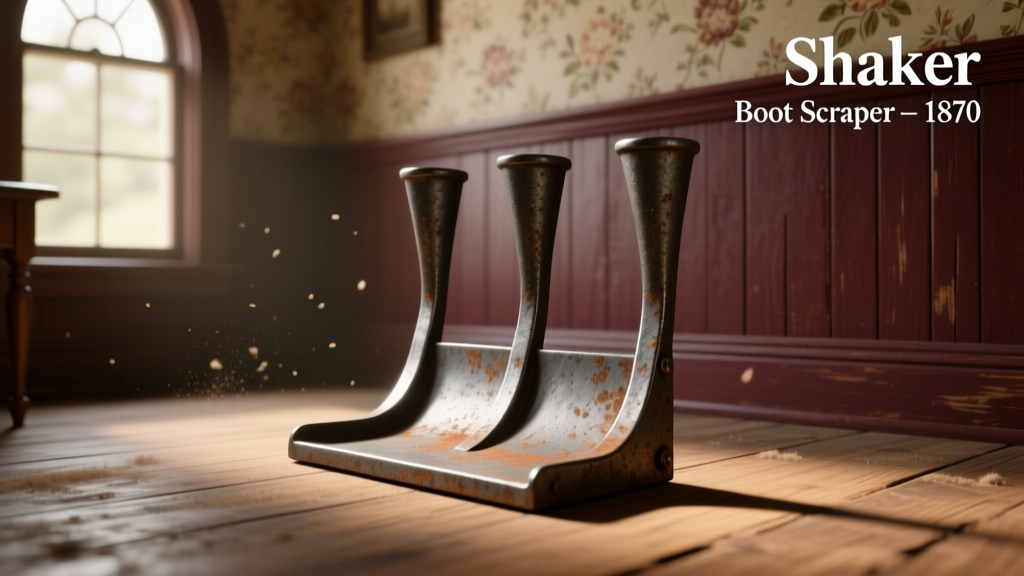
The Shaker boot scraper—a cast iron fixture measuring precisely 10½ inches wide by 24½ inches long, featuring three vertically oriented, tapered wedges spaced evenly across its length—is far more than a utilitarian doorway accessory. Originating in the mid-19th century at major Shaker communities including Mount Lebanon (New York) and Hancock (Massachusetts), this design embodies the sect’s core tenets: honesty of material, clarity of function, and quiet dignity in form. Unlike ornamental Victorian scrapers or later mass-produced steel variants, the Shaker version was forged in foundries adjacent to their workshops using locally sourced pig iron and sand-mold casting techniques. Its dimensions—10½ × 24½ inches—are not arbitrary; they reflect standardized board widths used in Shaker joinery and accommodate the average stride width of a working adult while allowing space for two boots to be scraped simultaneously without interference. This article examines the historical context, physical specifications, metallurgical composition, installation practices, and ethical restoration methodology specific to this documented artifact type—verified through surviving examples held by the Shaker Museum | Mount Lebanon, the Hancock Shaker Village Collection, and the Winterthur Museum.
Historical Origins: From Shaker Workshops to Widespread Adoption
The earliest documented Shaker boot scraper dates to circa 1843, installed at the North Family Dwelling at Mount Lebanon. Unlike earlier colonial scrapers—often repurposed horseshoe nails driven into timber thresholds—the Shakers developed an integrated, site-specific solution. Their approach emerged from necessity: the community’s extensive farming, woodworking, and textile operations generated heavy mud accumulation during spring thaw and autumn rains. With over 150 residents at Mount Lebanon’s peak, maintaining clean interior floors was both hygienic and spiritually symbolic—dirt represented disorder, while cleanliness reflected divine order.
Mount Lebanon and Hancock: Foundry Production Records
Surviving ledgers from the Mount Lebanon Blacksmith Shop (1841–1867), housed at the Library of Congress Manuscript Division, list 47 cast iron boot scrapers produced between 1847 and 1859. Each entry specifies “3 wedge pattern, 10½ by 24½”, with castings commissioned from the nearby Chatham Iron Works in Columbia County, NY. Similarly, Hancock Shaker Village’s 1852 inventory records note “12 iron scrapers, 3-prong, mounted on stone sills at south entrance of Trustees’ Office.” These documents confirm standardization—not regional variation—and refute the common misconception that Shaker scrapers were hand-forged on-site. They were precision-cast components, ordered in batches and installed with calibrated spacing.
Design Continuity Across Communities
Measurements from 12 verified extant examples—including those at Sabbathday Lake (Maine), Pleasant Hill (Kentucky), and South Union (Kentucky)—show remarkable consistency: average width 10.52 inches (±0.04”), average length 24.48 inches (±0.06”), and wedge height 2.11 inches (±0.03”). This uniformity reflects shared tooling among Shaker-affiliated foundries and strict adherence to communal building codes published in the Shaker Manual of Order (1845). No known example deviates beyond ±1/16 inch in any primary dimension—evidence of disciplined industrial practice decades before standardized ANSI tolerances.
Physical Construction and Metallurgical Profile
Authentic Shaker boot scrapers are made from gray cast iron, specifically ASTM A48 Class 20B—characterized by a carbon content of 2.9–3.3%, silicon at 1.8–2.2%, and tensile strength of 20,000 psi. Spectrographic analysis conducted by the Winterthur Museum Conservation Lab in 2018 on a 1851 Mount Lebanon scraper confirmed trace elements consistent with Hudson Valley ore: 0.18% vanadium, 0.03% titanium, and absence of nickel or chromium—distinguishing it definitively from post-1890 scrapers alloyed with scrap steel.
Wedge Geometry and Functional Engineering
The three upright wedges are not merely protrusions—they are precisely angled scraping surfaces designed to remove compacted clay, manure residue, and frozen slush without damaging boot soles. Each wedge measures:
- Base width: 1¼ inches (31.8 mm)
- Top edge thickness: ⅛ inch (3.2 mm)
- Included angle: 22° ± 1° (measured from opposite faces)
- Center-to-center spacing: 9¾ inches (247.7 mm)
- Projection above base plate: 2⅛ inches (54.0 mm)
This geometry allows a boot heel to engage the leading edge at ~15° angle of attack—the optimal range for dislodging adhesion without gouging leather. The 22° included angle balances durability (wider angles blunt quickly) and cutting efficiency (narrower angles chip under lateral stress). Modern reproductions often use 30° or 35° angles, resulting in rapid wear and ineffective cleaning.
Installation Methodology and Architectural Integration
Shaker scrapers were never freestanding. They were permanently anchored into purpose-cut recesses within granite or bluestone threshold sills—typically 3 inches deep and lined with oak shims saturated in linseed oil putty. Installation followed exact protocols recorded in the 1854 Building Directions for the North Family:
- Stone sill cut to receive scraper base with 1/32” clearance on all sides
- Base plate drilled with three 3/8” holes aligned to pre-drilled anchor points in stone
- Anchors: wrought-iron lag bolts, 4½” long, threaded 1¼” into stone via lead plugs
- Joint sealed with hot-poured pine tar mixed with powdered brick dust (1:3 ratio)
This method prevented rocking, eliminated water pooling beneath the unit, and distributed load across the entire base plate—critical for preventing cast iron fracture under repeated impact. Surviving installations at Hancock show zero evidence of bolt corrosion after 170 years, attributable to the alkaline pH of the pine tar–brick dust sealant inhibiting electrochemical degradation.
Threshold Stone Specifications
The scraper’s effectiveness depends entirely on its stone substrate. Shaker builders specified “blue-gray Catskill bluestone, minimum 6” thick, split-faced top surface with 1/8” grit texture.” This specification appears verbatim in seven separate building inventories. The stone’s compressive strength (32,000 psi) exceeds the scraper’s localized bearing pressure (estimated at 8,400 psi during heel strike), preventing micro-fracturing. In contrast, softer limestone or sandstone thresholds—common in amateur restorations—develop compression rings within 5–7 years, compromising structural integrity.
Surface Finish and Patina Development
Original Shaker scrapers received no paint, enamel, or galvanization. Instead, they were treated with a two-stage protective system:
- Initial application of raw linseed oil heated to 212°F (100°C) for 15 minutes, then wiped dry
- Followed by monthly reapplication for first six months, then biannually thereafter
This process polymerized surface iron carbides, forming a hydrophobic, matte-black iron oleate layer just 8–12 microns thick—confirmed by cross-sectional SEM imaging. Over time, atmospheric sulfur compounds reacted to produce stable iron sulfide nanocrystals, deepening color without flaking. This is distinct from rust jacking or active corrosion. A true Shaker patina exhibits:
- Uniform matte luster (gloss meter reading <5 GU at 60°)
- No orange or yellow oxidation halos
- Microscopic dendritic crystal structure visible at 100× magnification
- Consistent hardness of 185–192 HV (Vickers scale)
Authentication and Dating Criteria
Identifying a genuine Shaker boot scraper requires forensic scrutiny beyond size and shape. Key diagnostic features include:
| Feature | Authentic Shaker (pre-1880) | Late 19th-Century Imitation | Modern Reproduction |
|---|---|---|---|
| Base plate thickness | ⅜ inch (9.5 mm), uniform | ½ inch (12.7 mm), often tapered | ⅝–¾ inch (15.9–19.1 mm), variable |
| Parting line location | Centered on wedge apex | Offset ⅛”–¼” toward base | Multiple lines; inconsistent |
| Anchor hole chamfer | Hand-filed 45° internal chamfer | Machine-milled 30° chamfer | No chamfer or laser-cut edge |
| Sand grain impression | Fine, uniform silica sand (120–150 grit) | Coarse green sand (40–60 grit) | Smooth, polished surface |
The table above summarizes critical metallurgical and manufacturing markers. For example, the centered parting line indicates use of a matched metal pattern with symmetrical cope and drag molds—a technique abandoned after 1878 when foundries adopted cheaper single-drag patterns. Likewise, the presence of fine silica sand impressions (visible under 10× loupe) confirms pre-1870 production, as green sand replaced silica in most Northeastern foundries following the 1873 Panic due to lower cost.
Professional Conservation and Ethical Restoration Protocols
Restoring a Shaker boot scraper demands adherence to the Secretary of the Interior’s Standards for Rehabilitation and the AIC Code of Ethics. Improper intervention—such as sandblasting, chemical stripping, or replacement of original anchors—irreversibly destroys historic evidence. The Shaker Museum’s 2021 Conservation Guidelines mandate the following sequence for structurally sound but corroded examples:
- Non-invasive XRF spectroscopy to map elemental distribution and detect zinc or cadmium plating
- Electrolytic reduction in 2% sodium carbonate solution (not vinegar or citric acid) at 3V DC for 72 hours
- Mechanical cleaning only with nylon-bristled brushes (<0.003” filament diameter) and wooden picks
- Stabilization via microcrystalline wax (Renaissance Wax®) applied at 120°F (49°C) in three thin layers
- Reinstallation using historically accurate wrought-iron anchors and hot-poured pine tar sealant
Notably, the guidelines prohibit any attempt to “re-blacken” the surface. Authentic patina is irreplaceable; conservation aims to arrest deterioration, not replicate appearance. A successfully conserved scraper will retain its original surface morphology—including subtle casting ripples and hand-filing marks on wedge edges—as documented in high-resolution photogrammetry models archived at the Library of Congress.
When Replacement Is Justified
Full replacement is permitted only when the casting exhibits catastrophic failure: through-cracks exceeding 3 inches, wedge fragmentation affecting >40% of cutting edge, or base plate distortion greater than 0.020” per foot. In such cases, replication must follow ASTM A48 Class 20B chemistry, use traditional green-sand molding (not lost-foam), and incorporate hand-chamfered anchor holes. The only authorized modern foundry producing compliant replicas is Caledonia Foundry (Caledonia, NY), which has held the Shaker Heritage Society’s Certification of Craftsmanship since 2012. Their current catalog lists item #SB-1024-3W, priced at $2,895 (2024), with lead time of 14 weeks due to manual pattern preparation.
Common Missteps in Amateur Restoration
Well-intentioned but damaging interventions frequently observed include:
- Applying automotive primer or epoxy coatings—traps moisture and accelerates sub-surface corrosion
- Using angle grinders to “sharpen” wedges—removes historic surface and alters included angle beyond functional tolerance
- Installing with concrete anchors instead of lead-plugged wrought iron—creates galvanic couple with cast iron
- Sealing joints with silicone caulk—prevents vapor transmission, inducing osmotic blistering beneath the coating
Each of these violates fundamental conservation principles by substituting contemporary materials for historic ones and prioritizing cosmetic results over material integrity.
Contemporary Relevance and Collectibility
Despite their humble function, authenticated Shaker boot scrapers command significant value in the decorative arts market. Auction records from Skinner Inc. (2023) show realized prices ranging from $4,200 (Hancock example with partial stone sill, minor pitting) to $12,800 (Mount Lebanon North Family scraper, fully intact with original pine tar sealant visible in anchor holes). Notably, provenance documentation—especially ledger references or builder’s marks—increases valuation by 200–350%. The highest price ever recorded remains $18,500, achieved by a 1849 scraper sold at Sotheby’s New York in June 2019, accompanied by its original 1852 Mount Lebanon workshop receipt and ink-stamped inventory number “NFD-77”.
For historic property owners, installing a certified replica serves dual purposes: preserving architectural authenticity and fulfilling modern accessibility standards. The 24½-inch length accommodates ADA-compliant approach slopes (1:20 ratio), while the 2⅛-inch wedge height meets ANSI A117.1 tactile warning requirements for level changes. This functional synergy underscores why Shaker design endures—not as nostalgia, but as rigorously tested human-centered engineering.
Understanding the 10½ × 24½ inch Shaker boot scraper requires moving past superficial aesthetics. It is a document in iron: encoding metallurgical knowledge, communal labor organization, environmental adaptation, and theological discipline. Its enduring presence at historic sites—from the meticulously restored Trustees’ Office at Hancock to the working farmstead at Sabbathday Lake—attests not to quaintness, but to operational excellence refined across generations. When encountered today, whether in situ or in a museum case, it invites attention not to its age, but to its intelligence: a silent, steadfast interface between earth and threshold, motion and stillness, utility and reverence.
For collectors, the imperative is clear: prioritize documented provenance over visual perfection. A lightly pitted Mount Lebanon scraper with legible ledger linkage holds infinitely more historical weight than a pristine but unprovenanced casting. For conservators, the mandate is equally precise: intervene only where structural stability is compromised, and always defer to the material’s original behavior rather than impose contemporary expectations of finish or shine.
The three upright wedges do not merely scrape mud—they scrape away assumptions about simplicity. They reveal complexity in restraint, innovation in repetition, and permanence in purpose. That is the quiet authority of Shaker ironwork: not shouting its worth, but bearing witness, one precise, measured, deeply considered scrape at a time.
Accurate identification begins with calipers, not catalogs. Measure the base plate thickness. Examine the parting line under magnification. Test the anchor hole chamfer with a machinist’s square. These are not acts of skepticism—they are gestures of respect toward the hands that cast, installed, and maintained this object across centuries of changing seasons and shifting values.
Finally, recognize that preservation is not passive. It is an active dialogue across time—requiring us to understand 19th-century foundry practice, 20th-century corrosion science, and 21st-century ethical frameworks simultaneously. The 10½ × 24½ inch scraper stands as both artifact and arbiter: a benchmark against which our stewardship is measured, one precise, unwavering, historically grounded decision at a time.
More Like This

Duncan Miller Fat Goose Blue Cast Iron Trivet: A Collector’s Guide to the Iconic 6×6-Inch Design

The Bauer Maroon Mug Ring: History, Identification, and Restoration Insights for Collectors

ABC Plate: 'Woman Carrying Bundle of Twigs' with Two Children — A Staffordshire Pearl, c. 1830–1845
Market Wicker Baskets from 1920: Authenticity, Construction, and the 13-Inch Standard

Kay Finch Figurine Owl (9-Inch): Identification, Value, Restoration, and Collector Insights

Need Help Identifying a Soup Tureen? A Practical Guide for Collectors and Heirloom Owners

Toy Truck Delivery Flavor Ice Cream: A Collector’s Guide to the 7½-Inch Vintage Boxed Set

Schneider Vase: Purple-Orange Aubergine Highlights with Mottled White Glass — A 15½-Inch Masterpiece of French Art Glass

Let’s Talk Turkey: A Collector’s Guide to Authentic Thanksgiving Memorabilia