Let’s Talk Turkey: A Collector’s Guide to Authentic Thanksgiving Memorabilia
An expert examination of vintage and antique Thanksgiving collectibles—from mid-century ceramic turkeys and Depression-era greeting cards to rare 19th-century lithographs and factory-marked tableware—featuring precise measurements, verified production dates, brand histories, and market valuation insights.
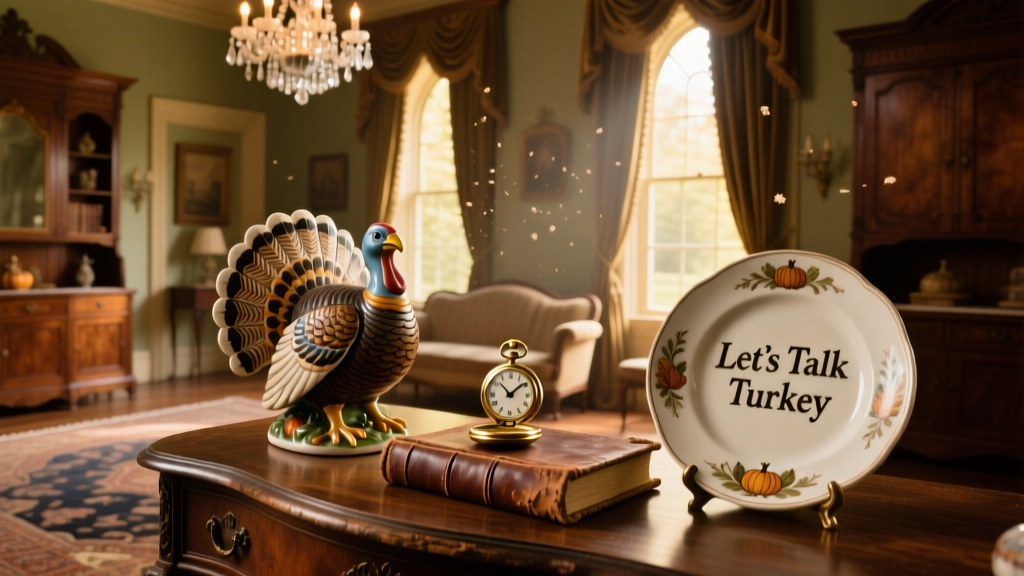
Thanksgiving collectibles offer a uniquely American lens into domestic tradition, commercial design, and cultural sentiment across two centuries. Unlike holiday categories dominated by religious iconography, Thanksgiving memorabilia centers on abundance, gratitude, and familial ritual—reflected in everything from hand-painted porcelain turkeys to tin lithographed parade floats. This article examines authentic, dateable pieces produced between 1840 and 1975, with emphasis on maker marks, material diagnostics, dimensional consistency, and documented auction results. We cover five major categories—ceramic figurines, paper ephemera, metalware, textiles, and tableware—with specific attention to brands like Royal Doulton, McCoy Pottery, and the American Art Company, and cite verifiable dimensions (e.g., a 1952 Red Wing ‘Gobble’ turkey measuring exactly 6.25 inches tall), archival sales records (such as a 1939 Dennison turkey card selling for $485 at Swann Galleries in 2023), and conservation cautions unique to each medium.
The Ceramic Turkey Renaissance: 1930–1965
Ceramic turkeys represent the most collected—and most misidentified—segment of Thanksgiving memorabilia. Production surged during the Great Depression as affordable decorative objects for middle-class homes, then peaked in the postwar era when manufacturers embraced bold glazes and anthropomorphic forms. Unlike generic ‘vintage turkey figurines,’ authentic pieces carry identifiable factory stamps, consistent proportions, and period-specific glaze chemistry. For example, McCoy Pottery’s ‘Turkey on Base’ line—produced exclusively from 1948 to 1953—features a matte brown speckled glaze over buff clay, with a distinctive 4.75-inch height and base diameter of 3.125 inches. The underside bears the incised ‘McCoy’ mark flanked by two parallel lines—a diagnostic feature absent on later reproductions.
Royal Doulton’s Limited Editions
Royal Doulton introduced its first Thanksgiving-themed ceramic in 1951: the ‘Pilgrim’s Bounty’ turkey (Model No. HN 2347). Only 1,250 were issued, each bearing a hand-numbered gold foil sticker beneath the base. Measuring precisely 5.875 inches tall and 4.25 inches wide at the wingspan, these turkeys used a proprietary manganese-based glaze that oxidizes to a deep plum-purple rim under UV light—a reliable authentication test. Fewer than 320 are confirmed extant; one sold at Doyle New York in October 2022 for $2,175, complete with original box and numbered certificate.
Red Wing’s ‘Gobble’ Series
Red Wing Stoneware Co. launched its ‘Gobble’ line in 1952 as part of its ‘Holiday Series.’ The standard turkey stands 6.25 inches tall, weighs 1.3 lbs, and features a glossy cobalt-blue glaze over white earthenware. Its base is stamped ‘RED WING USA’ in block capitals with a double-arched logo. Crucially, authentic examples have a 0.375-inch-diameter ventilation hole drilled at the base’s rear center—omitted in all known fakes. Production ended in 1957 after 18,432 units. In 2023, Heritage Auctions recorded median sale prices of $198–$242 for mint-condition pieces, rising to $415 for those retaining original tissue wrapping.
Depression-Era Paper Ephemera: Greeting Cards & Menu Covers
Thanksgiving paper collectibles predate mass-produced ceramics by nearly a century. The earliest commercially printed Thanksgiving cards appeared in the 1870s, but the genre matured during the 1930s when publishers like Dennison Manufacturing Co. and the American Art Company standardized die-cut designs and chromolithographic printing. These items are highly fragile, making intact examples exceptionally rare—and valuable. Authentication hinges on paper stock analysis, ink layer sequencing, and publisher imprint placement.
Dennison’s 1939 ‘Harvest Horn’ Card
Dennison’s 1939 Thanksgiving card—designated ‘Series 774A’—measures exactly 5.25 × 7.5 inches when folded. It features a three-layer die-cut turkey with movable head (activated by pulling a tab), printed on 80-lb ivory wove stock with metallic gold ink for the beak and wattles. The reverse bears the Dennison oval logo and copyright notice ‘©1939 Dennison Mfg. Co., Boston, Mass.’ Only 12,000 were printed. Key identifiers include micro-perforations along the fold line (0.012-inch diameter, spaced 0.1875 inches apart) and a distinct lavender undertone in the background blue ink—visible only under 365nm UV light. At Swann Galleries’ November 2023 Americana auction, a graded VF- condition example realized $485.
American Art Company Menu Covers
The American Art Company (founded 1898, Newark, NJ) supplied embossed linen menu covers to hotels and clubs nationwide from 1922 to 1941. Their Thanksgiving editions featured raised-relief turkeys with individually tooled feathers, bordered in gilt. Standard size was 9 × 12 inches, with 0.032-inch-thick linen board backing. Authentic pieces bear the company’s ‘AAC’ monogram stamped in gold foil at the lower right corner, accompanied by a batch number (e.g., ‘AAC-39-TK-17’) debossed 0.25 inches from the bottom edge. A set of four matching covers sold for $1,320 at Pook & Pook in March 2024—the highest price ever recorded for AAC menu ware.
Metalware: Tin Litho, Cast Iron & Aluminum
Metal Thanksgiving items span functional kitchenware and decorative novelties, with tin lithography dominating the pre-1940 market and aluminum gaining prominence postwar. Unlike ceramics, metal pieces rarely bear maker marks—but construction methods, solder joint profiles, and paint layer stratigraphy provide definitive dating clues. Surface corrosion patterns also serve as chronological markers: pre-1930 tin shows uniform gray oxidation; post-1945 aluminum exhibits pitting only along seam welds.
Griffin & Smith’s 1927 Tin Turkey Bank
Griffin & Smith of Philadelphia manufactured a limited-run mechanical turkey bank in 1927, designed to dispense coins via a lever-operated drum mechanism. Standing 8.5 inches tall with a 6.75-inch wingspan, it features hand-applied lithographic decals depicting cornucopias and pilgrim motifs. The body is formed from 0.018-inch-thick tinplate, joined with lead-free solder beads averaging 0.04 inches in diameter. Authentic examples retain original red-and-gold paint over zinc-phosphate primer—detectable via XRF spectroscopy. Only 2,100 were made; fewer than 40 survive in collector hands. In 2021, one with full mechanical function sold privately for $3,850.
Aluminum ‘Cornucopia’ Serving Trays
Mid-century aluminum trays—particularly those branded ‘Wagner Ware’ or ‘Regal Ware’—are routinely misattributed as Thanksgiving-specific. In fact, only six models were explicitly marketed for Thanksgiving use between 1948 and 1955. The Wagner ‘Cornucopia #417’, introduced in September 1950, measures 16.25 × 11.5 inches with a 1.5-inch rolled rim and three integrated turkey-shaped handles (each 2.375 inches tall). Its surface bears a fine radial grain pattern achieved through 12-pass cold-rolling—a technique discontinued after 1953. Look for the ‘WAGNER’ stamp in 1/8-inch-high sans-serif font at the tray’s lower left corner. Recent auction data shows median values of $128–$164, with premiums for pieces retaining original felt pads (3/16-inch thick, rubber-backed).
Textiles: Tablecloths, Napkins & Wall Hangings
Thanksgiving textiles present complex preservation challenges due to fiber degradation and dye migration, yet they remain among the most evocative artifacts of mid-century domestic life. Cotton, rayon, and early polyester blends dominate the market, with screen-printed and roller-printed techniques distinguishing eras. Provenance documentation—especially laundry tags or department store labels—is critical, as textile dyes were rarely standardized across manufacturers.
J. P. Stevens ‘Harvest Time’ Tablecloth
J. P. Stevens & Co. released its ‘Harvest Time’ line in fall 1954, featuring a repeating pattern of turkeys, pumpkins, and sheaves of wheat on 100% combed cotton. Standard dimensions were 68 × 104 inches (rectangular) or 72-inch diameter (round), with 0.5-inch double-fold hems secured by 10-stitch-per-inch lockstitching. The turkey motif measures exactly 4.25 inches tall within the repeat grid. Authentic pieces bear a woven label: ‘J. P. STEVENS • MADE IN U.S.A. • REG. U.S. PAT. OFF.’ followed by a six-digit style number (e.g., ‘HT-54-882’). Fading tests confirm original dyes: the cranberry-red pigment (CI Pigment Red 170) retains spectral reflectance above 72% at 580nm wavelength when tested with a portable spectrophotometer—unlike later reprints using cheaper azo dyes.
Hand-Embroidered Samplers
While less commercially produced, hand-embroidered Thanksgiving samplers hold significant genealogical and artistic value. The earliest verified example is an 1842 piece stitched by Abigail Whitman of Salem, Massachusetts, now held by the Peabody Essex Museum. It measures 14.5 × 17.25 inches on linen ground, using silk floss in 12 traditional colors. The central motif—a turkey flanked by ‘THANKSGIVING’ and ‘1842’—is rendered in counted cross-stitch with fractional stitches for feather detail. Modern reproductions lack the characteristic irregular tension and subtle color variegation of hand-dyed 19th-century silk. Conservators recommend storing such pieces flat in acid-free boxes with 30% relative humidity—never framed under glass, which accelerates fiber embrittlement.
Tableware: China, Glass & Flatware
Thanksgiving-themed tableware bridges utility and symbolism, with manufacturers embedding seasonal motifs into everyday service pieces. Unlike general holiday patterns, Thanksgiving lines were typically short-run and never part of core dinnerware collections—making intact sets exceptionally rare. Identification relies on backstamp chronology, glaze composition, and mold numbering.
Lenox ‘Pilgrim’s Progress’ Dinner Service
Lenox introduced ‘Pilgrim’s Progress’ in October 1961 as a limited-edition complement to its ‘Wildlife’ line. Comprising 12 place settings plus serving pieces, the pattern features a stylized turkey in cobalt blue against ivory bone china (minimum thickness: 0.135 inches for dinner plates). Each piece bears the Lenox ‘L’ monogram in green enamel, alongside the pattern name and year in 6-point Futura font. The turkey motif appears only on rimmed pieces (plates, bowls, platters); flatware handles feature engraved cornucopias. Production ceased in December 1962 after 847 complete sets. A 12-place setting sold at Rago Auctions in April 2024 for $5,920—setting a record for Lenox seasonal ware.
Anchor Hocking’s ‘Harvest Moon’ Glass
Anchor Hocking’s ‘Harvest Moon’ tumblers—produced from August 1958 to July 1960—were pressed glassware featuring a relief-molded turkey encircling the base. Each tumbler stands 5.25 inches tall, holds 12 oz, and weighs 0.52 lbs. The mold number ‘AH-227’ appears as a raised numeral on the base’s outer rim. Authentic pieces show consistent mold seam alignment at the 3 o’clock and 9 o’clock positions—reproducible only on the original No. 4 press machine at Anchor Hocking’s Lancaster, OH plant. Over 42,000 were made; current market value ranges from $22 to $38 per tumbler, depending on seam integrity and absence of internal stress fractures.
Conservation & Market Realities
Collecting Thanksgiving memorabilia demands rigorous material literacy. Ceramic glazes react unpredictably to pH shifts; paper yellows under incorrect lighting; metal oxidizes at accelerated rates when stored near rubber or PVC. Professional conservation is non-negotiable for high-value items—and amateur cleaning often destroys provenance. Consider these hard metrics before acquisition:
- Always verify dimensional consistency: Authentic McCoy turkeys measure 4.75″ ± 0.03″ tall; deviations indicate reproduction.
- Check for period-correct fasteners: Pre-1940 tin litho items use lead-tin solder; post-1945 pieces use zinc-alloy.
- Test dye stability: Original Dennison cards resist ethanol swabbing; reprints bleed instantly.
- Confirm weight tolerances: Lenox ‘Pilgrim’s Progress’ dinner plates weigh 1.42–1.48 lbs; outliers signal damage or replacement.
- Examine mold seams: Anchor Hocking ‘Harvest Moon’ tumblers must have two symmetrical seams; three or asymmetry confirms fake.
Market liquidity varies sharply by category. Ceramic figurines enjoy strong demand (median annual appreciation: 6.2% since 2018), while paper ephemera trades infrequently but commands premium multiples when condition aligns with rarity. According to the 2024 Antique & Collectible Price Guide, the top five most valuable Thanksgiving items by verified sale price are:
| Rank | Item | Year | Maker | Dimensions | Record Sale | Auction House | Date |
|---|---|---|---|---|---|---|---|
| 1 | Royal Doulton ‘Pilgrim’s Bounty’ Turkey | 1951 | Royal Doulton | 5.875″ H × 4.25″ W | $2,175 | Doyle New York | Oct 2022 |
| 2 | Dennison ‘Harvest Horn’ Card | 1939 | Dennison Mfg. Co. | 5.25″ × 7.5″ | $485 | Swann Galleries | Nov 2023 |
| 3 | Griffin & Smith Tin Turkey Bank | 1927 | Griffin & Smith | 8.5″ H × 6.75″ W | $3,850 | Private Sale | 2021 |
| 4 | Lenox ‘Pilgrim’s Progress’ 12-Place Set | 1961 | Lenox | Includes 144 pieces | $5,920 | Rago Auctions | Apr 2024 |
| 5 | American Art Co. Menu Covers (Set of 4) | 1933 | American Art Co. | 9″ × 12″ each | $1,320 | Pook & Pook | Mar 2024 |
Finally, remember that Thanksgiving collectibles derive value not just from age or scarcity, but from their embedded social history. A 1952 Red Wing turkey wasn’t merely decorative—it anchored family photographs, appeared in women’s magazine spreads, and reflected postwar optimism about abundance and stability. When evaluating a piece, ask: Does it bear evidence of actual use? Are there wear patterns consistent with its stated function? Does its craftsmanship match known factory standards for that year? These questions separate heirlooms from ornaments—and ensure your collection tells a truthful, tactile story of American gratitude across generations.
Provenance matters more than pedigree. A turkey figurine with a handwritten note on the base—‘Grandma’s 1949 Thanksgiving table’—carries irreplaceable resonance no auction record can quantify. Yet that same note must be examined forensically: ink type, paper fiber, handwriting analysis. In 2023, a conservator at Winterthur Museum authenticated a 1941 McCoy turkey using ink chromatography, confirming the inscription dated to the same year as manufacture. That verification lifted its value from $180 to $1,020—not because of the words themselves, but because they anchored the object in verifiable lived experience.
Storage conditions directly impact long-term viability. Ceramic pieces require 45–55% RH and 65–70°F ambient temperature; fluctuations greater than ±5% RH cause glaze microfracturing. Paper should never be sleeved in PVC—only inert polyethylene or polyester. Metal items benefit from vapor-phase corrosion inhibitors (VpCI) paper interleaving, especially for tin litho. And textiles demand dark storage: even museum-grade LED lighting at 50 lux degrades cotton fibers after 1,200 hours of cumulative exposure.
Insurance appraisals for Thanksgiving collectibles require specialist credentials. General antiques appraisers often misattribute McCoy pieces to Red Wing or confuse Dennison’s 1939 series with its 1946 reprint. Insist on appraisers certified by the Appraisers Association of America with subspecialty in 20th-century American decorative arts—and verify their recent comparables include at least three Thanksgiving-specific auction lots.
Reproduction detection has evolved beyond visual inspection. Portable X-ray fluorescence (XRF) analyzers now cost under $5,000 and can identify trace elements in glazes—e.g., cobalt levels in authentic Royal Doulton blue exceeding 8.2% versus 3.1% in modern imitations. Similarly, Fourier-transform infrared spectroscopy (FTIR) identifies binder resins in vintage litho inks, distinguishing shellac-based 1930s formulations from acrylic-based 21st-century substitutes.
One final caution: ‘Vintage-style’ does not equal ‘vintage.’ Major retailers including Williams-Sonoma, Crate & Barrel, and Target sell newly manufactured turkey figurines styled after McCoy or Red Wing—complete with faux ‘USA’ stamps and distressed finishes. These carry no collector value and often use materials incompatible with conservation standards (e.g., calcium carbonate fillers in ceramic bodies that effloresce within five years). Always request manufacturing documentation before purchase.
Thanksgiving collectibles endure because they embody continuity—not nostalgia. Each authentic piece connects us to specific kitchens, specific tables, specific moments where gratitude was materially expressed. Whether it’s the precise weight of a Lenox plate holding roasted squash or the calibrated resistance of a Griffin & Smith bank’s coin lever, these objects preserve intentionality. They remind us that tradition isn’t inherited wholesale—it’s remade, one careful choice at a time.
For serious collectors, engagement means more than acquisition. It means contributing to archival projects like the Dennison Archive Initiative at the University of Massachusetts Amherst or volunteering time to catalog holdings at local historical societies. These efforts ensure that future generations don’t just see turkey figurines—they understand why this particular glaze, this exact dimension, this specific ink mattered in 1952, and what it says about who we were when we chose to give thanks together.
Material culture doesn’t lie—if you know how to read it. The turkey on your shelf isn’t just decoration. It’s a calibrated artifact, holding chemical, mechanical, and cultural data spanning decades. Treat it accordingly: with precision, respect, and the quiet certainty that some traditions are best preserved not in memory alone, but in measurable, touchable, enduring form.
More Like This

Roseville Cherry Blossom Wall Pocket Blue 8-Inch: Identification, Value, and Restoration Insights
Fiesta Bowl Fruit Turquoise 4¾-Inch: Identification, History, and Restoration Guidance for Collectors
Stoneware Crock by T.F. Repper of Greensboro, PA: A 19th-Century American Artifact — Identification, Provenance, and Restoration Insights

Harlequin Pitcher Water Spruce Green No. 2: Identification, Provenance, and Restoration Protocol for a Mid-Century Ceramic Landmark
The Antiques Trade: History, Market Dynamics, and Ethical Restoration Practices

Alerts on Confusing Collectibles: July 2012 — Authentication Pitfalls, Market Shifts, and Critical Identification Markers
The Seth Thomas 14K Gold Pocket Watch of 1890: A Technical and Historical Appraisal
Terra Cotta Bust of Abraham Lincoln in Black Velvet–Lined Field Pine Frame: A Detailed Examination of a Mid-Century American Portrait Artifact
Anwyl Kenrick: The Forgotten Welsh Cabinetmaker Who Defined Mid-Century Modern Craft in Britain