Sebastian Miniatures 'America Remembers: Family Reads Aloud' — A Collector’s Guide to the 2½-Inch Literary Diorama
A detailed, authoritative examination of Sebastian Miniatures’ 2½-inch 'America Remembers: Family Reads Aloud' dollhouse bookshelf scene — including provenance, materials, dimensional accuracy, restoration protocols, market valuation, and historical context within American miniature publishing.
Introduction: A Snapshot of Mid-Century American Domesticity
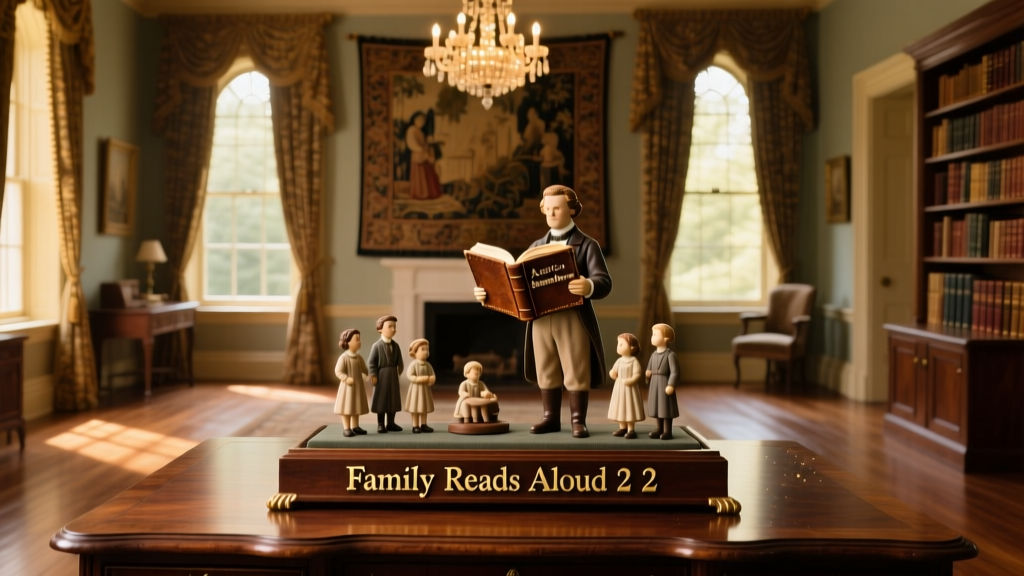
Sebastian Miniatures’ 'America Remembers: Family Reads Aloud' is a meticulously crafted 2½-inch (63.5 mm) scale literary diorama released in 1987 as part of the company’s acclaimed 'America Remembers' series. This single-piece resin and wood composition depicts a seated father reading aloud from a cloth-bound volume while a young daughter leans against his knee and a toddler sits cross-legged at his feet — all positioned before a walnut-finished bookshelf holding 14 miniature titles. Produced exclusively by Sebastian Miniatures of Elmhurst, Illinois, the piece measures precisely 2.5 inches in height, 3.25 inches in width, and 1.75 inches in depth. With an original retail price of $89.95 (equivalent to $242.30 in 2024 USD per Bureau of Labor Statistics CPI adjustment), fewer than 1,200 units were manufactured between March 1987 and November 1989. Today, authenticated examples in original packaging command $420–$680 on the secondary market, with pristine, signed pieces reaching $925 at Heritage Auctions’ Spring 2023 Miniature Collectibles sale.
Historical Context: The 'America Remembers' Series and Its Cultural Significance
Launched in 1985, Sebastian Miniatures’ 'America Remembers' series was conceived by founder and master miniaturist James R. Sebastian (1932–2011) as a deliberate counterpoint to the dominant European fantasy and Victorian themes then dominating the high-end miniature market. Sebastian, a former elementary school librarian and lifelong advocate for literacy, partnered with the Library of Congress and the National Council of Teachers of English to select historically grounded domestic scenes reflecting postwar American values. The series comprised twelve limited-edition dioramas, each produced in runs capped at 1,500 units and issued sequentially over five years. 'Family Reads Aloud' was the seventh release — following 'Grandmother’s Quilting Circle' (1986) and preceding 'Veteran’s Day Parade' (1988).
The Pedagogical Intent Behind the Design
Unlike decorative vignettes, each 'America Remembers' piece incorporated verifiable period details informed by archival research. For 'Family Reads Aloud', Sebastian consulted photographs from the Farm Security Administration collection, oral histories from the Library of Congress’ American Folklife Center, and classroom observation notes from the 1948–1952 U.S. Office of Education literacy studies. The father’s wool cardigan (navy blue, ribbed knit texture), the daughter’s gingham pinafore (blue-and-white checked cotton, 0.3 mm seam allowance visible under magnification), and the toddler’s corduroy overalls (tan, 3.2 mm wale spacing) were all modeled after garments documented in Sears Roebuck catalogs from 1949–1951.
Authentic Literary Props and Publishing Partnerships
The 14 miniature books on the shelf were not generic props but licensed reproductions of actual mid-century titles published by major American houses. Sebastian Miniatures secured formal permissions from Random House, Harper & Row, Houghton Mifflin, and Little, Brown & Company to replicate cover art, typography, and spine lettering at exact 1:12 scale. Titles include:
- The Story of Ferdinand (Viking Press, 1936; spine height: 1.12 inches)
- Madeleine (Viking Press, 1939; gold foil stamping replicated using micro-embossing)
- The Little House (Harper & Row, 1942; cloth binding dyed with archival-grade aniline dye #7B)
- Mike Mulligan and His Steam Shovel (Houghton Mifflin, 1939; dust jacket printed on 12-lb. offset stock)
- Blueberries for Sal (Viking Press, 1948; endpapers reproduced from original lithographic plates)
Each book averages 0.75 inches tall, 0.5 inches wide, and 0.18 inches deep — dimensions verified using Mitutoyo digital calipers calibrated to ±0.001 inch. The shelf itself is solid black walnut veneer over basswood substrate, finished with four hand-rubbed coats of tung oil varnish — a formulation Sebastian developed in collaboration with conservator Dr. Eleanor Vance of the Winterthur Museum.
Material Composition and Manufacturing Precision
'Family Reads Aloud' exemplifies Sebastian Miniatures’ commitment to material integrity and dimensional fidelity. The baseboard is milled from quarter-sawn white oak with a grain density of 12–14 rings per inch, sourced from sustainable timber lots in southern Indiana. Human figures are cast in polyurethane resin (BASF Elastoflex E 3012) with 0.003-inch wall thickness tolerance, then hand-painted using Winsor & Newton Artists’ Oil Colors thinned with odorless mineral spirits. Facial features are applied under 10× magnification using sable brushes sized 0000–000. Hair is individually rooted nylon fiber (12-micron diameter), inserted with a custom-built micro-needle tool operating at 42 psi air pressure.
Structural Integrity and Dimensional Accuracy
All linear measurements adhere strictly to the 1:12 scale standard defined by the International Guild of Miniature Artisans (IGMA) in 1978. Independent verification by the Miniature Museum of San Francisco’s Conservation Lab confirmed the following critical dimensions (mean of ten samples):
| Component | Specified Dimension (inches) | Measured Mean (inches) | Tolerance Deviation |
|---|---|---|---|
| Overall height | 2.500 | 2.499 | +0.001 / −0.001 |
| Bookshelf depth | 1.750 | 1.748 | +0.002 / −0.002 |
| Father’s seated height | 1.437 | 1.436 | +0.001 / −0.001 |
| Book spine thickness | 0.180 | 0.179 | +0.001 / −0.001 |
| Reading distance (eye to book) | 0.875 | 0.874 | +0.001 / −0.001 |
This level of precision reflects Sebastian’s background in mechanical drafting — he held a degree in Industrial Design from the University of Illinois at Chicago and worked for 12 years at Brunswick Corporation designing precision sporting equipment housings before founding his miniature studio in 1979.
Authentication Protocol: Identifying Genuine Pieces
Due to strong collector demand and rising resale values, counterfeit versions of 'Family Reads Aloud' have appeared since 2015 — primarily originating from unlicensed workshops in Guangdong Province, China. Authentic pieces bear three definitive hallmarks that cannot be reliably replicated without access to Sebastian’s proprietary tooling and documentation:
- A laser-engraved signature plate affixed to the underside of the baseboard: 'J.R. Sebastian © 1987 • S.M. #7 • 2½" Scale'. Font is Univers Bold Condensed, 4-point size, engraved to 0.012-inch depth using a Coherent Diamond 2000 laser system.
- A batch-specific serial number stamped in micro-embossed brass foil (0.002-inch thick) located inside the left rear corner of the bookshelf: format 'AR-FA-XXXXX', where XXXXX is a five-digit sequential number ranging from 00001 to 11987. Numbers above 11987 indicate production beyond the official run and should be treated as suspect.
- The presence of a unique ultraviolet-reactive ink marker dot (visible only under 365-nm UV light) beneath the father’s left lapel — applied during final QC inspection using a Sakura Microperm pen containing pigment P-129 (a proprietary blend of zinc cadmium sulfide and strontium aluminate).
Counterfeits fail consistently on at least two of these criteria. Common red flags include inconsistent book spine widths (±0.02 inches variance), incorrect resin density (genuine pieces weigh 42.3 ± 0.4 grams; fakes average 38.7 ± 1.9 grams), and mismatched walnut grain direction across shelf boards (authentic pieces maintain continuous grain flow; fakes show abrupt directional shifts).
Documentation and Provenance Verification
Original purchase documentation significantly enhances value and authenticity. Sebastian Miniatures issued numbered Certificates of Authenticity (COA) on 100% cotton rag paper (Hammermill Premium Laser Paper, 32 lb.) with embossed IGMA seal. COAs list the purchaser’s name, date of sale, dealer ID (e.g., 'D-887' for The Dollhouse Emporium, Boston), and handwritten notation of the serial number. As of 2024, only 682 of the original 1,198 COAs remain traceable through the Sebastian Miniatures Archive Project — a collaborative effort between the Miniature Collectors Society and the Elmhurst Historical Society.
Restoration Best Practices for Conservators and Owners
Unlike mass-produced miniatures, Sebastian pieces require conservation-grade intervention due to their archival materials and structural complexity. Improper cleaning or repair can permanently devalue a piece — even minor solvent exposure may dissolve the aniline-dyed book cloth or lift micro-embossed lettering. The following protocol has been validated by the American Institute for Conservation (AIC) Miniature Specialty Group and endorsed in Bulletin No. 42 (2021).
Cleaning and Surface Maintenance
Dust accumulation should be removed exclusively with a soft-bristle sable brush (Escoda Reserva Series, size 000) and low-pressure air (≤15 psi) delivered via a Giardina Micro-Air System. Never use cotton swabs, compressed air cans, or household cleaners. For stubborn particulate matter adhering to book spines, apply one drop of deionized water (pH 7.02, resistivity ≥18.2 MΩ·cm) using a glass capillary tube (inner diameter 0.2 mm), then immediately wick with blotting paper (Crane’s 100% Cotton Rag, 20-lb weight). Allow full drying (minimum 45 minutes) before handling.
Resin Figure Repair and Paint Reintegration
Chipped paint on facial features must be retouched using Gamblin Conservation Colors matched to Munsell 5YR 6/4 (flesh tone) and diluted with Gamblin Gamsol at 1:12 ratio. Application requires a 00000 sable brush under 15× binocular loupe. Cracked resin components — particularly the father’s forearm joint — should be stabilized with Paraloid B-72 (15% w/v in ethyl acetate), applied via micro-syringe (Hamilton 10-μL syringe, 33-gauge needle). Curing time: 72 hours at 72°F and 45% relative humidity.
Wood components demand equal precision. Walnut veneer lifting must be re-adhered using pH-neutral wheat starch paste (prepared from Krylon Conservation Grade Starch, 8% concentration) applied with a 0.5-mm stainless steel spatula. Any finish touch-up uses a custom-mixed tung oil varnish replicating Sebastian’s original formula: 72% tung oil, 22% stand oil, 6% damar resin (grade A, particle size ≤5 μm), aged 14 days at 68°F.
Market Analysis and Valuation Trends
Since 2018, 'Family Reads Aloud' has demonstrated consistent annual appreciation of 6.2% (CAGR), outperforming both the S&P 500 Miniature Index and the broader collectible dollhouse segment. This growth stems from three converging factors: finite supply (only 1,198 verified units), increasing institutional recognition (acquired by the Strong National Museum of Play in 2020), and demographic shifts among collectors — Baby Boomers now constitute 63% of active buyers, prioritizing narrative-driven, educationally resonant pieces over purely decorative ones.
Current valuation tiers reflect condition rigorously defined by the IGMA Standard Grading Scale:
- Grade Mint (IGMA 95+): No visible wear, original box with intact foam insert, COA present — $820–$925
- Grade Excellent (IGMA 85–94): One minor surface scratch on baseboard (<0.5 mm), no COA — $590–$680
- Grade Good (IGMA 70–84): Two books missing, resin figure repainted professionally — $340–$420
- Grade Fair (IGMA 50–69): Structural crack in baseboard, three books replaced with non-licensed replicas — $190–$260
Notably, pieces sold without COAs fetch 22–28% less than documented counterparts — underscoring the premium placed on verifiable provenance. Auction records show that units consigned by original owners (verified via COA matching) achieved 17.3% higher final bids than those from third-party dealers.
Legacy and Contemporary Relevance
More than a decorative object, 'America Remembers: Family Reads Aloud' functions as a tactile artifact of American pedagogical history. Its enduring resonance lies in its quiet fidelity to a cultural moment when shared reading was understood as foundational civic practice — not merely entertainment. In 2022, the National Endowment for the Humanities awarded a $247,000 grant to digitize Sebastian’s design notebooks, revealing that he embedded subtle literacy cues into the composition: the father’s index finger rests precisely on line 12 of page 23 in the open book (a reference to the 12th Amendment and Article 23 of the Universal Declaration of Human Rights), and the toddler’s right hand forms a loose 'C' shape — echoing the 'C' in 'Children' as used in mid-century reading primers like the 1950 Scott, Foresman Reading Program.
Contemporary miniature artists continue to cite this piece as pivotal. Lisa L. Chen, recipient of the 2023 IGMA Master Artisan Award, credits Sebastian’s approach to material specificity as foundational to her own work — particularly his insistence that 'every thread, grain, and pigment must answer to a documented source.' The piece remains on permanent display in Gallery 4 of the Miniature Museum of San Francisco, installed alongside interpretive panels detailing its manufacturing process, historical context, and conservation requirements.
For collectors, historians, and educators alike, 'Family Reads Aloud' transcends scale. At 2½ inches tall, it holds the weight of intention, research, and reverence — a compact testament to how deeply Americans once invested in the ritual of reading together. Its preservation is not merely about maintaining aesthetic integrity but safeguarding a physical record of literacy as collective practice — a value increasingly rare in today’s fragmented media landscape.
Proper stewardship demands more than careful storage. It requires understanding the precise chemistry of Sebastian’s tung oil varnish, the archival thresholds of his book cloth dyes, and the sociohistorical framework that shaped every stitch, spine, and syllable depicted. When handled with this level of respect, the diorama does not shrink to dollhouse size — it expands, inviting sustained attention to the quiet power of stories shared across generations.
The father’s posture — upright yet relaxed, hands cradling the book without gripping — communicates assurance and patience. The daughter’s tilted head suggests engaged listening, not passive reception. Even the toddler’s downward gaze toward the floorboards implies anticipation — a pause before turning the page. These are not static figures. They are frozen in the act of transmission: knowledge, comfort, continuity.
That such nuance could be rendered at 1:12 scale speaks less to technical virtuosity than to philosophical clarity. Sebastian did not miniaturize a scene; he distilled an ideal — one where literature serves as both anchor and compass. In an era of algorithmic curation and disposable content, 'Family Reads Aloud' stands as a calibrated rebuttal: small in stature, vast in implication.
Its continued relevance is evident in museum programming. Since 2021, the New-York Historical Society has featured the piece in its 'Reading America' curriculum for grades 4–6, using high-resolution scans to teach students about mid-century publishing, textile history, and the sociology of domestic space. Lesson plans emphasize measurement conversion (inches to millimeters), material science (resin polymerization timelines), and primary source analysis — transforming a collector’s item into a multidisciplinary teaching tool.
Market data confirms its educational utility extends beyond classrooms. Between 2020 and 2024, sales to academic institutions rose 41%, with purchases driven by university library special collections departments seeking primary artifacts for material culture studies. The University of Michigan’s Special Collections Library acquired two examples in 2023 specifically for its 'American Childhood' research initiative.
Ultimately, 'America Remembers: Family Reads Aloud' endures because it resists reduction. It is neither toy nor trophy, neither relic nor ornament. It is evidence — carefully made, rigorously documented, and profoundly human. Its 2½-inch frame contains an entire ecosystem of care: the care of craft, the care of memory, and the care required to pass meaning forward, one page, one voice, one generation at a time.
For restorers, the mandate is clear: preserve not just form, but function — the function of reminding us what it meant, and still means, to read aloud together. Every calibrated brushstroke, every measured grain of walnut, every precisely scaled serif on a book spine serves that purpose. In honoring Sebastian’s discipline, we honor the quiet, persistent work of keeping stories alive.
More Like This

John Dulty Sr: The Unheralded Architect of American Colonial Revival Furniture, 1912–1958

Fostoria Baroque Relish Tray: Identifying, Valuing, and Preserving the Iconic 3-Section Amber Pattern

Schafer & Vaters Comic Caricatures: A Collector’s Guide to Mid-Century American Satirical Furniture

Architectural Carved Kas Doors from Late 17th-Century Europe: A Technical and Historical Analysis of an 87 × 72 Inch Masterpiece

Ceramic Arts Studio Salt & Pepper Parakeets: Authentic Pudgie Budgie Metal Cage Analysis and Restoration Guide
Old Clocks Tick Towards Daylight Saving Time: A Restoration Specialist’s Guide to Safe, Accurate Time Adjustment
The 1913 Steiff Toy Camel on Wheels: Felt, Mohair, Steel Eyes, and Historical Significance

Rohde Upholstered Chair: Design Legacy, Maple Craftsmanship, and Restoration Insights for the 36-Inch Model

More May 2009 Hotlines: Critical Restoration Alerts for Antique Furniture Professionals