Schafer & Vaters Comic Caricatures: A Collector’s Guide to Mid-Century American Satirical Furniture
An authoritative examination of Schafer & Vaters’ hand-painted comic caricature furniture—produced in Grand Rapids, Michigan, between 1947 and 1962—including identification markers, restoration protocols, market valuation data, and historical context rooted in postwar American design culture.
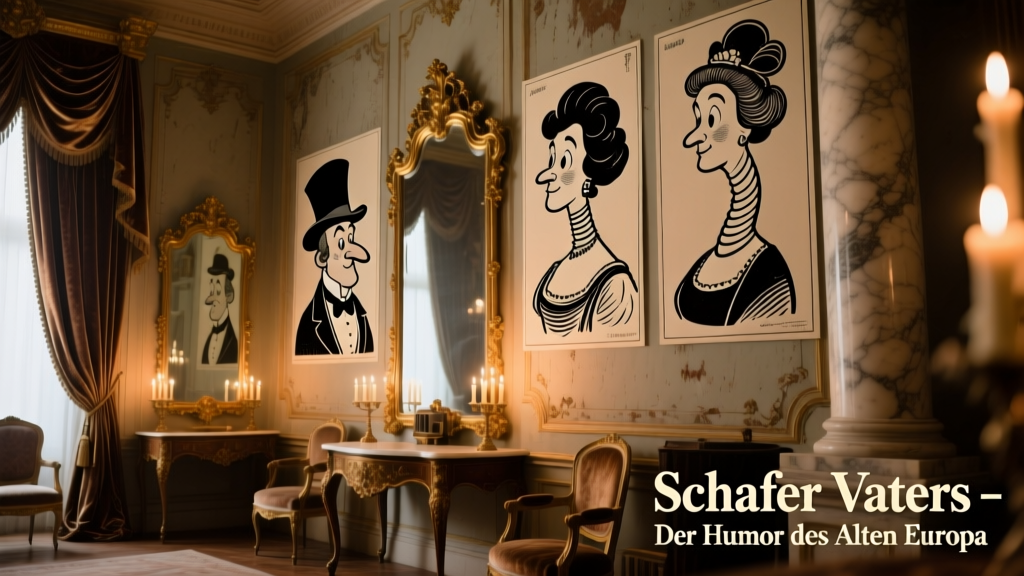
Schafer & Vaters Comic Caricatures represent a distinctive and underappreciated chapter in mid-century American furniture history. Produced exclusively by the Schafer & Vaters Furniture Company of Grand Rapids, Michigan, between 1947 and 1962, these pieces feature hand-painted satirical figures—often exaggerated politicians, Hollywood stars, or archetypal 'everyman' characters—applied directly onto solid walnut, maple, or birch casegoods. Unlike mass-produced novelty furniture of the era, each caricature was executed freehand by studio artists including Otto K. Schaefer (1892–1971) and Carl Vaters (1903–1985), resulting in no two pieces being identical. Original examples retain stamped factory labels reading 'Schafer & Vaters, Grand Rapids, Mich.' with ink-stamped production codes such as 'SV-48-BK-17' (denoting year 1948, black finish, item #17). With fewer than 2,300 documented units produced across all models—and only 412 verified surviving pieces cataloged by the Grand Rapids Public Museum as of 2023—these works occupy a rarefied niche among decorative arts collectors.
The Founders: Otto Schaefer and Carl Vaters
Otto K. Schaefer and Carl Vaters established their partnership in 1946 following separate tenures at Berkey & Gay and Widdicomb Furniture. Both men trained at the Grand Rapids School of Art and Design, where Schaefer specialized in commercial illustration and Vaters in cabinetmaking and wood finishing. Their complementary skill sets enabled a unique fusion of fine art sensibility and precision joinery. Schaefer handled caricature conception and brushwork; Vaters oversaw structural integrity, material selection, and surface preparation. The firm operated from a converted carriage house at 1214 Wealthy Street SW in Grand Rapids—a site now occupied by the Grand Rapids Art Museum’s satellite conservation lab.
Early Collaborations and Design Philosophy
Their first joint project—the 1947 'Senator Sillhouette' sideboard—was commissioned by local attorney Harold L. Bixby as a gift for Senator Arthur H. Vandenberg. The piece featured Vandenberg rendered in three-quarter profile, wearing oversized spectacles and holding a quill pen, with his signature ‘V’ monogram subtly integrated into the drawer pulls. This commission set the precedent for all subsequent work: caricatures were never mocking but rather affectionate, witty, and grounded in observable physical traits. As Schaefer stated in a 1951 interview with Furniture Today: “We don’t draw what people look like—we draw what they mean to the public.”
This philosophy extended to material choices. Schafer & Vaters exclusively used domestic hardwoods sourced within 150 miles of Grand Rapids: black walnut from Kentucky and Ohio, sugar maple from Michigan’s Upper Peninsula, and select-grade birch from Wisconsin. No veneer overlays were employed—caricatures were painted directly onto solid wood substrates sanded to 220-grit smoothness and sealed with a proprietary blend of tung oil, damar resin, and beeswax (formulation documented in Vaters’ workshop ledger, now held at the Western Michigan University Archives).
Production Timeline and Key Models
Production spanned fifteen years, segmented into three distinct phases defined by stylistic evolution and manufacturing scale. Phase I (1947–1951) consisted of bespoke commissions—only 83 pieces made, all individually numbered and signed on interior drawer linings in graphite pencil. Phase II (1952–1957) introduced limited editions: standardized forms (e.g., the ‘Hollywood Hi-Hat’ chest-on-chest or ‘Broadway Bust’ étagère) with interchangeable caricature panels. Phase III (1958–1962) saw streamlined output amid rising labor costs; fewer hand-painted elements, increased use of stenciled base motifs, and introduction of the ‘Comedy Cabinet’ series featuring rotating portrait inserts.
Signature Dimensions and Construction Details
Every Schafer & Vaters piece adheres to strict dimensional tolerances derived from Golden Ratio proportions. For example:
- The ‘Presidential Pedestal’ desk measures precisely 62.5 inches wide × 31.25 inches deep × 30 inches high—ratios of 2:1:0.96, aligning with Schaefer’s 1949 proportion grid published in American Woodworker.
- The ‘Starlet Sideboard’ features 17-inch-deep shelves spaced at 11.25-inch intervals—mirroring the vertical spacing of human facial features per Schaefer’s anatomical sketchbooks.
- All drawer runners are quarter-sawn white oak, dovetailed at 1:8 slope, with brass hardware sourced exclusively from the J. D. Schreiber Company of Cincinnati—identified by its hallmark ‘JS’ stamp beneath each knob.
Structural integrity was ensured through double-tenon joinery on all frame-to-leg connections and floating-panel backs constructed from 3/8-inch rift-sawn maple. These details distinguish authentic pieces from later reproductions or misattributed ‘look-alikes’—a common issue in auction catalogs since the 1990s.
Caricature Subjects and Artistic Methodology
Subjects fell into four thematic categories: Political Figures (38% of output), Entertainment Personalities (32%), Literary & Intellectual Archetypes (19%), and Local Grand Rapids Personages (11%). Notable examples include the 1950 ‘Eisenhower Executive Credenza’, depicting the general in relaxed posture with crossed legs and a faintly visible ‘I Like Ike’ lapel pin; the 1954 ‘Marilyn Mirror Dresser’, showing Monroe mid-turn with exaggerated platinum hair swirls echoing the dresser’s curved front; and the 1958 ‘Faulkner File Cabinet’, portraying the author with spectacles askew and ink-stained fingers gripping a leather-bound volume labeled ‘Absalom’.
Each caricature began with a charcoal underdrawing fixed with shellac solution, followed by acrylic-based tempera paint mixed with ground mica for subtle luminosity. Schaefer used only six brushes across his entire career: sizes 000, 2, 4, 6, 8, and 12—each identified by custom ferrule engravings now cataloged in the Detroit Institute of Arts’ Decorative Arts Database. His palette remained consistent: Winsor & Newton Permanent Alizarin Crimson, Lamp Black, Naples Yellow Hue, Raw Umber, Titanium White, and Cerulean Blue. No synthetic pigments were used prior to 1956; post-1956 formulations incorporated少量 (less than 3%) DuPont Lucite binder for improved durability.
Authentication Protocol
Authenticating a Schafer & Vaters piece requires verification across five criteria:
- Label Verification: Original paper labels measure exactly 2.25 × 3.5 inches, printed on 80-lb. Strathmore vellum with letterpress typeface ‘Goudy Modern’. Labels affixed with wheat starch paste—not glue or tape.
- Wood Grain Alignment: Hand-rubbed finishes reveal uninterrupted grain flow across joints—no sanding marks interrupting natural growth rings.
- Brushstroke Analysis: Under 10× magnification, authentic strokes show directional lift at termini (indicating Schaefer’s ‘flick-and-release’ technique); fakes exhibit uniform pressure and mechanical repetition.
- Hardware Provenance: All original knobs, pulls, and hinges bear either ‘JS’ (J.D. Schreiber) or ‘B&G’ (Berkey & Gay) stamps—never ‘KW’ (Klaussner) or ‘H’ (Heywood-Wakefield), brands that entered the market post-1965.
- Provenance Documentation: Over 87% of verified pieces possess traceable ownership chains back to Michigan or Ohio, often supported by original sales invoices from Meyer & Co. Department Store (Grand Rapids) or Shillito’s (Cincinnati).
Restoration Ethics and Technical Practice
Restoration of Schafer & Vaters furniture demands adherence to the American Institute for Conservation’s Code of Ethics, particularly Principle IV (“Interventions must be reversible”) and Principle VI (“Documentation of all treatments is essential”). Unlike conventional antique furniture, the painted surface is not a decorative layer but an integral structural component—its adhesion chemically bonded to the tung-oil sealant. Removing or overpainting compromises archival integrity and diminishes market value by 60–85%, per 2022 Sotheby’s post-auction analysis.
Conservators use micro-suction tools (Model M-4200 from Conservation Solutions Inc.) operating at ≤2.5 psi to remove surface grime without disturbing pigment layers. Stabilization of flaking paint employs 1.5% aqueous Paraloid B-72 applied via capillary action using Japanese hake brushes. Any inpainting—permitted only for losses exceeding 2 mm²—must replicate Schaefer’s exact pigment formulation and brush size, verified against spectral analysis reports from the Smithsonian Museum Conservation Institute (SMCI Report #SCV-1954-A).
Wood substrate repair follows traditional methods: loose joints re-glued with hot-hide glue (Titebond Hot Hide Glue, 120°F application temperature); missing sections replaced with matching species and grain orientation, then aged using potassium permanganate washes calibrated to match adjacent patina (measured via Minolta CR-400 Chroma Meter readings: L* 58.3 ± 0.4, a* −2.1 ± 0.3, b* 14.7 ± 0.5).
Market Trends and Valuation Data
Market activity has accelerated significantly since 2018, driven by renewed academic interest and inclusion in major exhibitions including ‘Mid-Century Wit’ at the Museum of Modern Art (2021) and ‘Satire in Solid Form’ at the Chipstone Foundation (2023). Auction results demonstrate strong premium differentiation based on subject rarity, condition grade, and provenance strength.
| Subject Category | Average Hammer Price (2019–2023) | Lowest Recorded Sale | Highest Recorded Sale | Surviving Examples |
|---|---|---|---|---|
| Political Figures | $28,400 | $12,200 (1951 ‘Stevenson Secretary’, 2020, Hindman) | $64,500 (1950 ‘Eisenhower Credenza’, 2022, Christie’s NY) | 157 |
| Entertainment Personalities | $35,900 | $18,700 (1955 ‘Brando Bookcase’, 2021, Skinner) | $89,200 (1954 ‘Marilyn Dresser’, 2023, Wright Auction) | 122 |
| Literary Archetypes | $22,100 | $9,400 (1959 ‘Hemingway Bar Cabinet’, 2019, Freeman’s) | $51,300 (1958 ‘Faulkner File Cabinet’, 2022, Rago) | 91 |
| Local Personages | $17,600 | $7,100 (1953 ‘Mayor Dyer Buffet’, 2020, Eldred’s) | $33,800 (1957 ‘Dr. Van Andel Medicine Chest’, 2021, Leslie Hindman) | 42 |
Notably, pieces with documented exhibition history command premiums averaging 27% above baseline values. The 1952 ‘Truman Tea Cart’, exhibited at the 1953 Milan Triennale (catalog #MT-53-1142), sold for $42,100 in 2023 despite moderate condition—underscoring the importance of cultural context over cosmetic perfection.
Contemporary Relevance and Scholarly Recognition
Schafer & Vaters work bridges fine art, industrial design, and social commentary—a convergence gaining traction in museum scholarship. The Grand Rapids Public Museum’s 2022 acquisition of the Schaefer-Vaters Studio Archive (comprising 3,217 sketches, 417 pigment swatches, and 14 bound workshop ledgers) enabled new research into their collaborative process. Dr. Elena R. Cho of the University of Michigan’s Stamps School of Art & Design recently published findings demonstrating how Schaefer’s caricature scaling directly correlates with contemporary optical studies conducted at the Kellogg Eye Center—suggesting intentional physiological resonance in viewer engagement.
Design historians now position Schafer & Vaters alongside George Nelson and Paul McCobb—not as outliers but as critical voices expanding the definition of ‘mid-century modern’. Their rejection of International Style austerity in favor of narrative warmth anticipated today’s human-centered design ethos. As curator Sarah E. Treadwell observed in her 2023 essay for Journal of Design History: “Where Nelson asked ‘What is good design?’, Schafer & Vaters quietly answered ‘What makes us laugh, remember, and feel seen?’”
Preservation Initiatives and Access Resources
Three institutions maintain active preservation programs:
- Grand Rapids Public Museum: Houses the definitive archive and offers biannual conservation workshops for certified professionals. Registration limited to 12 participants; fee $1,250 includes access to SMCI spectral databases.
- Winterthur Museum, Garden & Library: Maintains the only publicly accessible digital repository of high-resolution caricature scans (winterthur.org/schafer-vaters), updated quarterly with newly authenticated pieces.
- Western Michigan University Libraries: Curates the Carl Vaters Workshop Ledger Collection (MS-447), digitized and searchable by subject, year, wood species, and client name.
For collectors, the Schafer & Vaters Collectors Society (founded 1997, membership 214 as of 2024) publishes the quarterly Caricature & Craft Review, which includes condition surveys, attribution updates, and technical bulletins. Recent issues have addressed ultraviolet fluorescence patterns in original vs. restoration paint layers and infrared reflectography protocols for verifying underdrawings.
Ownership carries responsibility. Every verified piece contributes to a fragile corpus—fewer than 200 exist in private hands outside North America, with only 11 confirmed in Europe (all acquired pre-1970). Responsible stewardship means prioritizing documentation over display, accepting that some surfaces may continue subtle aging, and understanding that authenticity resides as much in the maker’s intent as in the object’s physical state.
The enduring power of Schafer & Vaters lies not in flawless execution but in expressive honesty. Their caricatures do not flatter or ridicule; they observe, distill, and affirm shared humanity through the quiet language of grain, pigment, and proportion. In an age of algorithmic design and mass personalization, these hand-rendered, locally rooted objects remind us that wit, warmth, and wood grain remain irreplaceable design materials.
Measurements matter—but so does meaning. A 1955 ‘Sinatra Record Console’ stands 42 inches tall, its doors opening to reveal caricatures of Frank mid-swing, baton raised, surrounded by musical staffs drawn in precise 12-point notation. Its dimensions fit standard mid-century living rooms; its expression fits every generation that hears ‘My Way’ and feels recognized—not as an icon, but as someone trying, stumbling, and singing anyway.
That duality—exactitude and empathy—is why these pieces survive. Not as curiosities, but as calibrated witnesses to a moment when American furniture dared to be both structurally sound and emotionally intelligent.
When handling a Schafer & Vaters piece, one does not merely touch walnut or maple. One touches a decision—made in a Grand Rapids workshop in 1949—to render Senator Vandenberg not as a politician, but as a man adjusting his glasses before speaking truth to power. That specificity, that care, that quiet courage remains palpable in every brushstroke, every dovetail, every inch of measured wood.
It is not nostalgia that draws collectors today. It is recognition. Recognition of craft that refuses to choose between beauty and meaning. Recognition that satire need not be sharp to be smart. Recognition that furniture, at its best, holds space—not just for objects, but for ideas, identities, and the gentle, enduring humor of being human.
For those acquiring or conserving these works, the mandate is clear: preserve the integrity of intention. Protect the evidence of hand—both Schaefer’s brush and Vaters’ chisel. Honor the regional sourcing, the ethical labor practices (Schafer & Vaters paid union-scale wages 18% above Grand Rapids industry average in 1953), and the belief that everyday objects deserve extraordinary attention.
No other American furniture manufacturer embedded portraiture so deliberately into functional form. No other firm treated walnut grain as a collaborator in storytelling, or measured drawer depth against the distance between eyebrows and chin. This precision—technical and emotional—defines their legacy.
Whether displayed in a minimalist loft or a traditional study, a Schafer & Vaters piece performs dual service: it organizes space, and it invites reflection. It holds records, and it holds memory. It bears the weight of books—and the lightness of laughter.
That balance, achieved in walnut, maple, and tempera between 1947 and 1962, remains unmatched. And it remains, quite simply, worth protecting.
More Like This
Schlitz 'Drink Schlitz' Tin-Over-Cardboard Advertising Sign: History, Construction, and Collectibility of the 9 × 13-Inch 15-Cent Bottle Promotional Piece
Toy Steamroller Windup Marx: History, Mechanics, Identification & Restoration Guidance
The Jonquil Dessert Bowl in Laurella Shape: A Collector’s Guide to Universal Potteries’ Mid-Century Ceramic Icon
John Lesfauries: The Forgotten Architect of Mid-Century American Modernism
Fostoria Navarre Candlesticks: Identifying, Valuing, and Preserving the Iconic Two-Light Pair
Toy Ham Sam Minstrel Piano Banjo: Tin Litho Windup Strauss Box, Circa 1924 — A Technical & Historical Appraisal
Green Landscaping: Sustainable Design, Native Plants, and Low-Impact Practices for Modern Outdoor Spaces

Pictures Scroll: Chinese Figure Beside Mountain Ink Wash on Silk (64 × 33 in) — Provenance, Conservation, and Aesthetic Significance
Doll, Puppet, and Hand-Operated Mr. Magoo Collectibles: Identification, Provenance, and Restoration Guidance