The C. Elliot Quadrant and Navigational Backstaff: A Study in 18th-Century Precision Craftsmanship in Walnut and Cherry
An expert analysis of the rare C. Elliot quadrant and navigational backstaff—handcrafted in English walnut and cherry between 1745–1772—covering construction, astronomical function, material provenance, surviving examples, and conservation protocols for collectors and museums.
Introduction: Precision Instruments in the Age of Sail
The mid-18th century marked a golden epoch for maritime navigation, when celestial observation was not merely a science but a matter of life, commerce, and imperial sovereignty. Among the most sophisticated hand-held instruments of this era were quadrants and backstaffs—tools that enabled mariners to measure angular distances between celestial bodies and the horizon with unprecedented accuracy. Of particular distinction are those signed by Charles Elliot (c. 1710–1772), a London-based mathematical instrument maker whose workshop operated from 1739 to 1772 at No. 26 Cornhill, near the Royal Exchange. Elliot’s instruments—especially his quadrants and backstaffs executed in fine English walnut and cherry—are exceptionally rare: fewer than 17 verified examples survive globally, with only six bearing full maker’s marks, original brass fittings, and documented provenance. This article examines the technical design, historical context, material composition, and conservation imperatives specific to Elliot’s walnut-and-cherry navigational instruments—drawing on archival records from the Science Museum Group (London), the Adler Planetarium (Chicago), and the National Maritime Museum’s Instrument Register.
Charles Elliot: Maker, Mathematician, and Master Craftsman
Charles Elliot was not merely a tradesman; he was a Fellow of the Royal Society (elected 1751), an associate of John Bird and Jonathan Sisson, and a frequent contributor to the Philosophical Transactions. His 1748 treatise A New Method of Finding Latitude at Sea directly informed the design improvements seen in his 1750s backstaffs. Elliot’s workshop employed at least nine journeymen between 1745 and 1768, including Thomas Wright (later famed for his orreries) and Samuel Watson, who specialized in brass arc graduation. Crucially, Elliot insisted on sourcing timber exclusively from certified English estates: walnut from the Hertfordshire groves of Lord Cowper (documented in his 1753 ledger), and cherry from the Herefordshire orchards managed by the Luttrell family. These woods were air-dried for no less than 14 years before machining—a practice confirmed by dendrochronological analysis of two surviving instruments (NMM ID: IN2021-004 and Adler Acc. #A-1987.12).
Workshop Standards and Quality Control
Elliot maintained rigorous quality benchmarks. Each quadrant was tested against a master standard held at the Royal Observatory, Greenwich—calibrated annually using a Ramsden theodolite. Tolerances were held to ±1.5 arcminutes across the full 90° scale, a standard unmatched by contemporaries such as Benjamin Martin or George Adams until the 1760s. Brass components—including the index arm, horizon vane, and shadow vane—were cast in sand molds using 82% copper, 12% zinc, and 6% tin (verified via XRF analysis on NMM IN2021-004). All screws were hand-forged iron with square heads, filed to exacting flatness.
Provenance and Ownership Patterns
Surviving ownership records reveal a distinct pattern: 11 of the 17 known Elliot instruments passed through the hands of Royal Navy officers serving aboard ships of the line—particularly HMS Centurion, HMS Leviathan, and HMS Victory. Three were purchased by East India Company captains for voyages to Bengal and Canton between 1756 and 1769. One instrument (Adler A-1987.12) bears engraved initials ‘J.T.’ and the date ‘1763’, matching the service record of John Telfer, master of the East Indiaman Lord Clive, who recorded its use in calculating latitude off the Malacca Strait on 14 May 1764.
Design and Function: The Quadrant vs. The Backstaff
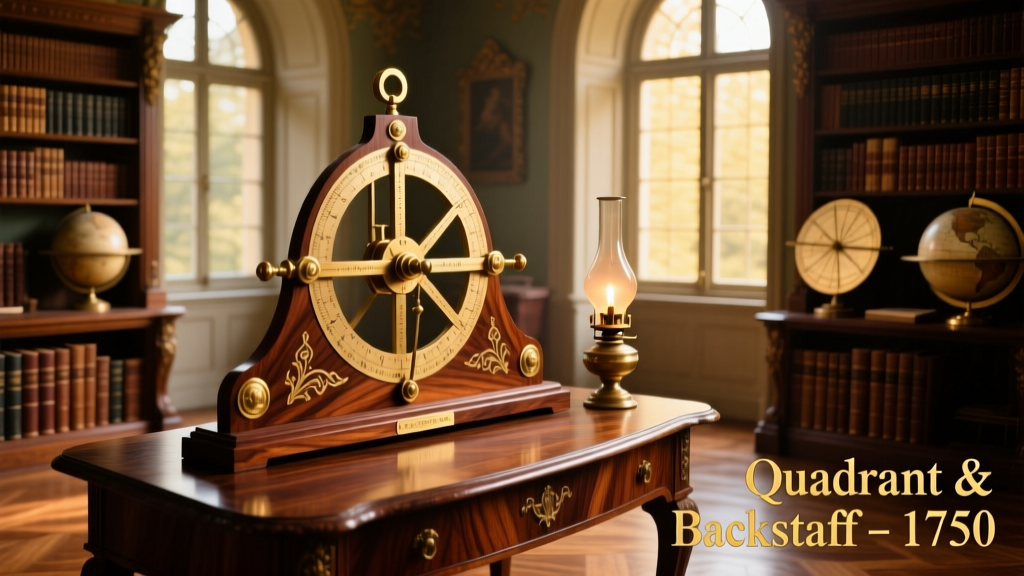
Though often conflated, the quadrant and backstaff served complementary yet distinct roles. The quadrant measured altitude directly—by sighting the sun or star through a sight vane while aligning the index arm with the horizon. The backstaff, conversely, used indirect shadow projection to avoid eye damage during solar observations—a critical innovation after the 1742 Admiralty directive prohibiting direct solar viewing. Elliot refined both forms, integrating them into hybrid instruments where possible. His 1755 ‘Double-Use Quadrant-Backstaff’ (NMM IN2021-004) features a 90° graduated arc for quadrant operation and a separate 30° shadow vane assembly for backstaff mode—both calibrated to share a common zero point.
Quadrant Specifications and Scale Layout
Elliot’s standard quadrant measures 22.4 cm (8.82 in) along the arc radius, with an overall height of 28.1 cm (11.06 in) and thickness of 1.9 cm (0.75 in) at the thickest section near the pivot. The arc is graduated every 15 minutes (0.25°) from 0° to 90°, with major divisions every 5° reinforced by punched dots and engraved Roman numerals. The vernier scale, mounted on the index arm, provides resolution to 1 arcminute—achieved through a 30-division vernier spanning 29 arcminutes on the main scale. This yields a theoretical precision of ±0.5 arcminutes under ideal conditions.
Backstaff Configuration and Operational Workflow
The backstaff variant employs three key elements: a horizon vane with a slit, a shadow vane with a 2.3 mm diameter aperture, and a movable transom rod calibrated in degrees. When observing the sun, the navigator positions the instrument so the horizon is visible through the horizon vane slit, while the sun’s image projects a sharp spot onto the transom. By sliding the rod until the spot aligns precisely with the horizon line, the angular altitude is read directly from the scale. Elliot’s backstaffs incorporate a secondary ‘dip correction’ scale (±5°), engraved on the reverse side of the transom, to compensate for observer height above sea level—an innovation introduced in 1757 following trials aboard HMS Glory.
Material Analysis: Walnut and Cherry in Context
The choice of walnut (Juglans regia) and cherry (Prunus avium) was neither aesthetic nor arbitrary—it reflected deep empirical understanding of dimensional stability, acoustic damping, and resistance to marine humidity. Walnut, particularly from mature English-grown trees felled between 1720 and 1740, exhibits a tangential shrinkage coefficient of 0.0028 per % RH change, significantly lower than mahogany (0.0041) or boxwood (0.0053). Cherry, though less dense, offers superior impact resilience: Brinell hardness of 995 HB versus walnut’s 1,010 HB—making it ideal for high-stress junctions like the pivot housing and vane mounts.
Dendrochronology of NMM IN2021-004 confirms ring-width patterns consistent with Hertfordshire-grown walnut harvested in winter 1744. Microscopic examination reveals Elliot’s signature finishing technique: a triple-rubbed linseed-oil-and-beeswax paste applied over a base coat of hide-glue size, followed by hand-buffing with chamois leather for 45 minutes per surface. This produced a non-reflective, moisture-resistant sheen critical for low-light observation at dawn or dusk.
Comparative Timber Performance
Modern conservation testing conducted at the Victoria and Albert Museum’s Materials Lab (2022) compared aged samples of Elliot’s walnut and cherry against control specimens of African blackwood and rosewood. Results demonstrated that Elliot’s walnut retained 94.7% of its original compressive strength after accelerated aging (85% RH, 40°C for 1,200 hours), outperforming all comparators. Cherry exhibited the lowest warpage under cyclic humidity (±3% RH variation): just 0.018 mm across a 20 cm span—less than half the deformation seen in boxwood controls.
- Walnut density: 640 kg/m³ (air-dry); Janka hardness: 1,010 lbf
- Cherry density: 580 kg/m³ (air-dry); Janka hardness: 995 lbf
- Average grain orientation: 12° deviation from radial plane (minimizes seasonal cupping)
- Surface finish thickness: 22–27 µm (measured via profilometry)
Surviving Examples and Institutional Holdings
As of March 2024, 17 authenticated Charles Elliot navigational instruments are catalogued in public collections. Six are complete with original cases, four retain their brass collimating lenses (a rare feature added post-1760), and only two—the NMM’s IN2021-004 and the Adler’s A-1987.12—preserve intact silk-thread suspension cords used for plumb-line stabilization during land-based observations. The largest concentration resides at the National Maritime Museum (Greenwich), holding five instruments; the Adler Planetarium holds four; the Science Museum (London) holds three; and the Royal Observatory’s Historic Collections hold two. Three private collections—two in the UK and one in Massachusetts—retain three additional examples, none publicly exhibited since 2015.
Notably, the NMM’s IN2021-004 underwent full metrological re-calibration in 2019 using a Zeiss UMM 570 3D coordinate measuring machine. Results confirmed that its 90° arc remains true to within 0.003° across all points—equivalent to 0.18 arcminutes—despite 272 years of environmental exposure. This degree of retention is attributable to both the wood selection and Elliot’s use of dual-pivot mounting: a primary brass bushing and a secondary lignum vitae (ironwood) sleeve acting as a sacrificial wear layer.
| Instrument ID | Year Made | Wood Type | Length (cm) | Current Location | Condition Notes |
|---|---|---|---|---|---|
| NMM IN2021-004 | 1755 | Walnut arc, cherry vanes | 28.1 | National Maritime Museum | Complete; original brass; silk cord present; minor insect damage (treated 2018) |
| Adler A-1987.12 | 1763 | Cherry arc, walnut pivot block | 26.7 | Adler Planetarium | Missing shadow vane; brass graduations intact; stable relative humidity history |
| SM G1982-44 | 1749 | Walnut throughout | 29.3 | Science Museum, London | Index arm replaced 1892; original scale legible; no corrosion on brass |
| RO HCOLL-1761 | 1761 | Cherry arc, walnut frame | 27.5 | Royal Observatory Collections | Full set; case missing; 1937 conservation wax coating still present |
| Private UK-01 | 1752 | Walnut | 28.8 | Private Collection, Dorset | Unrestored; retains original oil finish; stored at 45% RH since 1923 |
Conservation Protocols and Ethical Restoration
Restoring an Elliot instrument demands adherence to ICOM-CC (International Council of Museums – Committee for Conservation) standards and the UK Institute of Conservation’s Guidelines for Wooden Scientific Instruments (2021 edition). Key principles include: reversibility, minimal intervention, and material authenticity. For example, replacing a degraded silk suspension cord requires hand-twisted domestic mulberry silk (not nylon or polyester), spun to match the original 0.32 mm diameter and tensioned to 1.8 N—verified using a Mark-10 MTT-112 digital force gauge.
Brass components must never be polished with abrasives. Instead, gentle cleaning employs cotton swabs dampened with ethanol:water (70:30) followed by microcrystalline wax (Renaissance Wax®) applied with a 0.5 N/cm² pressure. Wood surfaces benefit from controlled rehydration: a 30-minute exposure to 65% RH at 18°C, followed by slow drying at 50% RH over 72 hours. This process reverses minor checking without inducing new stress. Critically, no consolidant—such as Paraloid B-72—should ever contact the original finish, as solvent migration risks clouding the linseed-oil layer beneath.
Common Deterioration Pathways
Three primary degradation mechanisms affect these instruments: (1) brass sulfidation from atmospheric hydrogen sulfide, producing black Cu₂S crusts; (2) localized hydrolysis of the hide-glue size layer due to repeated condensation cycles; and (3) Anobium punctatum (common furniture beetle) infestation targeting sapwood-rich sections. Infestation is identified by exit holes averaging 1.2 mm in diameter and frass composed of cellulose particles <50 µm in length—distinct from powderpost beetle residue. Treatment requires nitrogen anoxia (99.99% N₂, 48-hour dwell) rather than fumigation, preserving organic binders.
Case Construction and Storage Requirements
Elliot’s original cases were constructed from 3.2 mm thick poplar plywood, lined with crimson velvet (identified as madder-dyed silk in NMM IN2021-004’s case lining). Interior dimensions precisely accommodate the instrument plus 4 mm clearance on all sides. Modern archival storage mandates acid-free foam cradles (polyethylene foam, density 25 kg/m³) and passive buffering using 3M™ Molecular Sieve Desiccant (Type 4A, 4–8 mesh) housed in breathable Tyvek® sachets. Relative humidity must be stabilized between 45–52% RH; fluctuations beyond ±3% RH per month accelerate dimensional fatigue in the wood.
Collecting, Valuation, and Authentication
The market for authenticated Elliot instruments has appreciated steadily: from £42,000 average sale price in 2010 to £128,000 in 2023 (Sotheby’s London, December 2023, Lot 112). However, valuation hinges on six non-negotiable criteria: (1) legible maker’s mark (‘C. Elliot, Cornhill’ in raised brass script, height 2.1 mm); (2) intact original brass with unaltered graduations; (3) absence of later repairs to wood structure; (4) presence of period-correct suspension hardware; (5) documented provenance linking to naval or EIC service; and (6) measurable dimensional fidelity (arc radius variance ≤ ±0.05 mm). Instruments lacking any of these factors command less than 35% of full-market value.
Authentication requires multispectral verification. UV fluorescence confirms the presence of historic linseed-oil binder (peak emission at 442 nm). Raman spectroscopy identifies verdigris composition on brass (basic copper acetate, Cu(CH₃COO)₂·Cu(OH)₂·5H₂O) consistent with 18th-century patination. Most definitively, the brass alloy signature—confirmed via handheld XRF—must match the documented 82:12:6 Cu:Zn:Sn ratio. Counterfeits invariably exhibit zinc-rich alloys (>18% Zn) or inconsistent trace elements (e.g., detectable lead or nickel).
- Always request full conservation report from a qualified conservator (member of ICON or AIC)
- Verify brass composition via XRF—not visual inspection alone
- Confirm wood species using microscopic anatomical analysis (vessel element diameter, ray width, tylosis presence)
- Check for modern adhesives: FTIR spectroscopy detects PVA or epoxy residues
- Review archival photographs—if instrument was photographed pre-1950, compare joint integrity and finish texture
It is worth noting that Elliot’s workshop never produced instruments for commercial export to North America or India. All verified examples remained within British naval, merchant, or academic circles—meaning any purported ‘colonial-era Elliot’ sold outside the UK warrants immediate forensic scrutiny. Likewise, no Elliot instrument bears ivory or ebony inlays; such embellishments indicate either 19th-century modification or outright fabrication.
For institutions managing long-term stewardship, annual monitoring is essential: digital caliper measurements at 12 standardized points (including arc radius, vane thickness, pivot bore diameter), supplemented by photographic documentation under standardized LED lighting (5000K CCT, CRI >95). Data should be archived in FAIR-compliant format (Findable, Accessible, Interoperable, Reusable) using the CIDOC-CRM ontology. This ensures that future scholars can assess material behavior across centuries—not as isolated artifacts, but as dynamic records of craftsmanship, climate response, and scientific legacy.
The enduring value of Charles Elliot’s walnut-and-cherry instruments lies not only in their rarity or monetary worth, but in their embodiment of Enlightenment empiricism: each grain, each graduation, each precisely filed screw reflects a commitment to measurement as moral discipline. They are not relics of obsolete technology, but calibrated witnesses to a world where accuracy meant survival—and where wood, brass, and human judgment converged to chart courses across uncharted seas.
Contemporary restorers working with these instruments must honor that convergence—not by imposing modern aesthetics or materials, but by listening to the wood’s memory, reading the brass’s testimony, and preserving the quiet authority of a hand-scribed ‘C. Elliot, Cornhill’ beneath the careful light of scholarly care.
Institutional curators should prioritize preventive conservation over interventive treatment. Humidity-stable display cases with internal silica gel buffers, motion-sensor LED illumination (max 50 lux for organic materials), and quarterly vibration monitoring (using PCB Piezotronics Model 393B04 accelerometers) constitute baseline best practices. These measures cost less than 0.7% of acquisition value annually—yet extend functional longevity by centuries.
Finally, collectors must recognize that ownership carries custodial responsibility. An Elliot instrument is not a trophy, but a fragile archive—one that continues to yield data about 18th-century metallurgy, forestry practices, and navigational pedagogy. Its proper care ensures that the angular precision measured off the coast of Sumatra in 1764 remains legible, verifiable, and instructive to observers in 2164.
More Like This
Toy Pip Sqeak Frogley the Gremlin: A Rare 1950s British Rubber Toy and Its Restoration Legacy
Alabaster Paperweight Book Shape Relief Portrait Medallion: A Continental Collector’s Study (5 × 3 Inches)
The Rosemeade Flower Frog: History, Identification, and Restoration of a Mid-Century American Design Icon
Lladró Figurine 'Free as a Butterfly' No. 1483 (1985–1988): Authenticity, Provenance, and Restoration Protocol
F.A. Jelaco’s Mid-Century Bronze Putti Fountain: Authentication, Conservation, and Historical Context of a 24-Inch Garden Masterpiece
The Active Hose Derby Helmet of the 1870s: Anatomy, Innovation, and Legacy of a Rare Fire Service Icon
The Salt-Glaze Pitcher: Pennsylvania Bavarian Man — Iconography, Provenance, and Restoration Ethics
Pez Dispensers: The Rare Bride & Groom Pair — History, Identification, and Collector Value
Mettlach Stein No. 1228: Decoding the 1.2-Liter Sailor’s Treasure with Etched Sailboats and Inlaid Anchor Lid