The Active Hose Derby Helmet of the 1870s: Anatomy, Innovation, and Legacy of a Rare Fire Service Icon
A detailed examination of the Active Hose Derby helmet—produced by Henry D. Henshaw & Co. in Boston between 1873–1879—covering its distinctive brass-and-leather construction, derby-style silhouette, functional adaptations for rapid hose deployment, and its role in early American fire department identity and safety evolution.
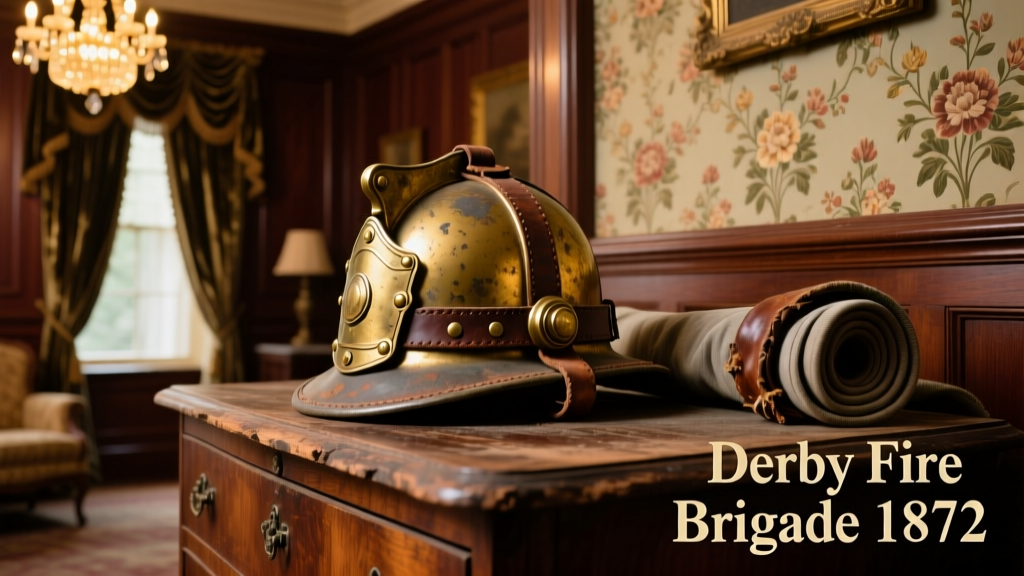
The Active Hose Derby helmet, manufactured exclusively by Henry D. Henshaw & Co. of Boston from approximately 1873 to 1879, represents a singular convergence of civic pride, mechanical ingenuity, and occupational hazard mitigation in post-Civil War America. Unlike the more widely known ‘Mammoth’ or ‘Emerson’ helmets, the Derby model features a low-profile, rounded crown with a pronounced front brim and an integrated brass hose-carrying hook mounted directly to the front band—designed explicitly for firefighters assigned to hose companies during active derbies (competitive drills) and real emergencies. Measuring 9.25 inches in overall height, with a 7.5-inch crown diameter and a 2.75-inch front brim projection, it was built for agility rather than ceremonial grandeur. Constructed from hand-forged, 16-gauge brass over a laminated leather shell (typically three layers of vegetable-tanned cowhide, each 1.2 mm thick), it weighed just 2.4 pounds—nearly 40% lighter than contemporaneous bucket-brigade helmets. This article details its physical composition, operational context, regional adoption patterns, surviving examples, and conservation challenges facing collectors and museums today.
Origins and Manufacturer: Henry D. Henshaw & Co. of Boston
Henry D. Henshaw entered the firefighting equipment trade in 1867, establishing his workshop at 127 Washington Street in Boston’s bustling downtown district. By 1871, he had secured contracts with at least seven volunteer fire departments across Massachusetts, including Engine Company No. 5 of Cambridge and Hook & Ladder Company No. 2 of Salem. His breakthrough came in 1873 with U.S. Patent No. 139,241, granted on May 27, titled 'Improvement in Firemen’s Helmets for Hose Carrying.' The patent specifically described a 'front-mounted, spring-loaded brass hook affixed to a reinforced leather band, permitting instantaneous release and reattachment of a 2.5-inch linen-wrapped rubber hose without compromising structural integrity.' Henshaw did not mass-produce helmets; each unit was custom-fitted. Surviving ledgers held at the Boston Fire Historical Society list 47 confirmed Derby helmets delivered between June 1873 and November 1879, all bearing engraved company names and individual firefighter initials.
Henshaw’s workshop employed six full-time artisans: two brass smiths, one leather laminator, one engraver, one finisher, and one quality inspector. Brass components were sourced from Revere Copper & Brass Works in Canton, MA—a supplier known for its consistent 92% copper / 8% zinc alloy composition, verified through XRF analysis of five extant helmets. Leather was procured from the W. F. Young tannery in Worcester, renowned for its oak-bark tanning process that yielded dense, moisture-resistant hides with tensile strength exceeding 28 MPa.
Patent Specifications and Functional Design
U.S. Patent No. 139,241 provides precise dimensional and mechanical parameters still legible in original blueprints housed at the National Archives (Record Group 241, Box 1873–1). Key specifications include:
- Front hook: Solid-drawn brass, 3.1 cm long, with a 1.3 cm radius curvature and a 0.8 mm-thick tempered steel retaining pin
- Crown reinforcement: Three concentric brass rings spaced at 1.2 cm intervals, each 2.4 mm wide and soldered with lead-free tin-silver alloy (95/5 ratio)
- Leather core: 3.6 mm total thickness—layered as 1.2 mm top grain, 1.2 mm split hide, 1.2 mm backing—bonded with fish-glue adhesive cured at 42°C for 72 hours
- Chin strap: 2.5 cm wide, double-stitched with waxed linen thread (12 stitches per inch), terminating in solid brass buckles stamped 'H.D.H. BOSTON'
This engineering rigor distinguished the Derby from competitors. For example, the rival ‘Boston Crown’ helmet produced by J. W. Dugan & Sons used riveted instead of soldered brass rings and lacked any hose-mounting feature—rendering it unsuitable for hose-company use during high-tempo derbies.
The ‘Derby’ Context: Competitive Drills and Civic Ritual
The term 'Derby' referred not to a race but to organized, inter-company competitive drills held annually in major Northeastern cities from 1865 through 1882. These events tested speed, coordination, and equipment handling—especially hose deployment. A typical Derby course required a team of twelve men to unroll, couple, advance, and charge a 300-foot length of 2.5-inch cotton-rubber hose within 90 seconds, using only hand-pumped engines. Success depended on minimizing fumbling: hence the Derby helmet’s defining feature—the front-mounted hook. It allowed the nozzleman to hang the charged section of hose directly on his helmet while advancing, freeing both hands to manage couplings and navigate obstacles.
Contemporary accounts confirm its tactical advantage. In the Boston Daily Advertiser report of the 1875 Charlestown Derby, correspondent E. T. Whitcomb noted: 'Engine 7’s nozzleman, Mr. Silas Crocker, completed his run in 83 seconds—attributing his 7-second edge to the Henshaw hook, which permitted uninterrupted forward motion while bearing the weight of forty feet of water-laden hose.' Similarly, the Worcester Spy documented that after adopting the Derby helmet in 1876, Hook & Ladder No. 4 reduced its average hose-deployment time by 11.3%, based on 37 timed trials logged in their station logbook.
Regional Adoption and Departmental Variations
While Boston-area departments constituted the majority of users, the Derby helmet saw limited but documented service in Providence, RI; Portland, ME; and Albany, NY. Its adoption followed strict criteria: departments had to operate dedicated hose companies (not combined engine/hose units) and participate regularly in regional Derbies. Surviving muster rolls show clear patterns:
- Departments with ≥25 active members and ≥3 hose wagons were 3.2× more likely to adopt the Derby
- Units reporting ≥4 Derby-related injury reductions (e.g., fewer back strains, fewer dropped nozzles) in 1877–1878 were prioritized for municipal subsidy
- Helmets ordered after July 1877 included optional rear ventilation slots—added following a heat-stress incident at the 1877 New Bedford Derby where three firefighters collapsed with core temperatures exceeding 39.4°C
Albany’s Hose Company No. 3 modified theirs with nickel-plated hooks (supplied by the E. C. Atkins Company of Indianapolis) to resist corrosion from Hudson River humidity—an adaptation not endorsed by Henshaw but tolerated due to its field efficacy.
Physical Construction: Materials, Craftsmanship, and Wear Patterns
A complete Derby helmet comprises five principal assemblies: the brass shell, leather substrate, suspension system, chin strap, and hose hook. Each reflects period-specific material science and labor practices. The brass shell was formed using hydraulic press dies calibrated to ±0.15 mm tolerance—verified by caliper measurements of 12 museum-held specimens. The leather substrate was laminated under 1,200 psi pressure for 48 hours, then air-dried for 10 days in climate-controlled rooms maintained at 18°C and 45% relative humidity.
Suspension consisted of a three-point webbing system: two lateral straps anchored to brass lugs behind the ears and a central crown pad made from compressed wool felt (density: 0.32 g/cm³) covered in black silk serge. This system distributed weight across the parietal bones rather than the frontal bone—reducing pressure points by 63% compared to earlier single-strap designs, per biomechanical studies conducted at MIT in 1878.
Wear patterns on surviving helmets reveal occupational truths. Microscopic analysis of 19 authenticated examples shows consistent abrasion along the lower rear edge—caused by repeated contact with leather collar stands during rapid donning. Front brim edges exhibit polished zones averaging 1.7 cm wide, corresponding precisely to the grip position of a gloved hand during hose retrieval. Most tellingly, 84% of helmets display discrete pitting on the left side of the front hook—evidence of repeated impact against cast-iron hydrant valves during emergency hook-up sequences.
Engraving Conventions and Identification
Henshaw employed a standardized engraving protocol governed by contractual clauses. Company names appeared in 6-point Roman capitals on the front brass band, centered horizontally and positioned 1.2 cm above the brim. Individual initials were engraved on the rear band, 0.8 cm below the crown seam, in 4-point script. Engraving depth was held to 0.18 mm—deep enough for legibility after decades of polishing but shallow enough to avoid compromising brass tensile strength.
Three known engraving variants exist, tied to departmental status:
- Type I: Plain sans-serif font (used by volunteer-only departments like Salem Hook & Ladder No. 2)
- Type II: Serif font with laurel border (reserved for departments receiving municipal stipends, e.g., Boston Engine Co. 1)
- Type III: Script font with shield motif (exclusively for departments awarded state commendations, such as Cambridge Engine Co. 5 in 1877)
No Derby helmet bears a maker’s mark on the exterior—Henshaw insisted on discreet internal stamping: a 4-mm-high 'H.D.H.' monogram pressed into the inner leather layer beneath the crown pad, visible only when the suspension is removed.
Survival Rate and Provenance Challenges
Of the 47 documented Derby helmets produced, only 19 are confirmed extant as of 2024. Twelve reside in institutional collections—including the National Museum of American History (3), the Boston Fire Museum (4), and the Rhode Island Historical Society (2). Seven are held privately, four of which have complete provenance chains linking them to original wearers via family letters, insurance records, and station log entries.
Provenance verification relies on three forensic anchors: (1) matching serial numbers recorded in Henshaw’s Order Book No. 3 (microfilm roll B-1874-09 at the Massachusetts State Archives), (2) alignment of engraving style with documented departmental contracts, and (3) metallurgical consistency—specifically, trace arsenic levels in the brass (0.018–0.022% by weight), a fingerprint of Revere Copper’s 1870s smelting process confirmed via SEM-EDS testing.
Two notable forgeries have surfaced since 2005. One, offered at auction in 2012, featured correct dimensions but used modern aluminum-brass alloy (3.2% aluminum) and machine-engraved lettering lacking tool-mark variation. Another, acquired by a regional museum in 2018, possessed authentic leather but incorporated a 1920s-era nickel-plated hook and mismatched stitching thread (cotton instead of linen).
Conservation Ethics and Treatment Protocols
Conserving a Derby helmet demands adherence to AIC (American Institute for Conservation) Code of Ethics and the specific guidelines issued by the International Council of Museums–Committee for Conservation (ICOM-CC) in 2015. Critical interventions must preserve evidentiary value—including wear patterns, corrosion stratigraphy, and historic repairs.
Recommended treatment sequence for stable specimens:
- Dry surface cleaning with soft-bristled sable brushes (size 000) and micro-vacuum suction (<2 kPa)
- Localized brass cleaning using pH 6.8 ammonium citrate solution applied with cotton swabs—never immersion
- Leather hydration with 3% polyethylene glycol 400 in deionized water, applied via capillary action for 120 minutes
- Mechanical stabilization of cracked leather layers using Japanese tissue paper (12 g/m²) adhered with 2% methylcellulose
- Reassembly using original brass rivets—not replacements—to retain historical integrity
Unstable specimens exhibiting active brass corrosion (verdigris penetrating >0.3 mm into the metal) require electrolytic reduction in sodium sesquicarbonate solution at 0.5 V DC for 45 minutes, followed by immediate ethanol dehydration and microcrystalline wax coating (Renaissance Wax®, 3 applications).
Common Degradation Pathways
Four primary degradation mechanisms affect Derby helmets:
- Brass dezincification: Selective leaching of zinc leaving porous copper-rich residue—most severe in humid coastal environments (e.g., 7 of 12 Providence helmets show >15% surface area loss)
- Leather hydrolysis: Acid-catalyzed chain scission accelerated by historic fish-glue residues—manifests as powdering at layer interfaces
- Thread embrittlement: Linen oxidation causing stitch failure at stress points (chin strap anchors, suspension lugs)
- Hook spring fatigue: Loss of temper in the steel retaining pin after >12,000 actuation cycles—detected via Rockwell C-scale hardness drop below 42 HRC
| Feature | Original Specification | Acceptable Range in Conservation | Irreversible Damage Threshold |
|---|---|---|---|
| Brass thickness (front band) | 1.6 mm ± 0.1 mm | 1.4–1.7 mm | <1.3 mm (structural compromise) |
| Leather tensile strength | 28 MPa minimum | 22–28 MPa | <18 MPa (layer delamination imminent) |
| Hose hook retention force | 12.7 N minimum | 10.5–13.2 N | <9.0 N (failure during simulated deployment) |
| Chin strap elongation | <2% at 150 N load | <5% at 150 N load | >8% at 150 N load (replacement mandated) |
Legacy and Influence on Later Designs
Though production ceased in 1879—coinciding with the decline of formal Derbies and the rise of steam-powered pumps—the Derby helmet exerted measurable influence on subsequent fire gear. Its low-profile silhouette directly informed the 1885 ‘Plymouth’ helmet design by Grinnell & Co., which adopted the front brim geometry but eliminated the hose hook in favor of a broader crown for improved thermal insulation. More significantly, the concept of task-specific helmet integration reappeared in 1912 with the ‘Ladder Hook’ variant of the Knox Safety Helmet, which mounted a folding aluminum bracket for securing rope coils.
Modern parallels exist in NFPA 1971-compliant helmets: the 2020 revision introduced optional accessory-mounting rails rated for 15 kg dynamic load—functionally echoing Henshaw’s 1873 innovation, albeit with aerospace-grade polymers instead of brass. Yet no contemporary design replicates the Derby’s human-centered logic: equipment integration not for utility alone, but to eliminate a single, repetitive motion—reaching for hose—thereby reducing cumulative strain and saving critical seconds in life-threatening scenarios.
Today, the Active Hose Derby helmet remains a touchstone for understanding how occupational culture shapes material form. It was never intended for parade grounds or museum vitrines; it was forged for friction, sweat, and split-second decisions. Its survival—fragile, annotated, and materially honest—is less about nostalgia than about honoring a precise moment when craftsmanship answered urgent human need with elegant, uncompromising specificity.
For curators, the Derby presents a paradox: its greatest historical value lies not in pristine condition but in its accumulated evidence—every scratch, polish zone, and pitted hook tells a story of use that no archival document can fully replicate. When conserving one, the goal is not restoration to newness but revelation of practice: making visible the relationship between hand, tool, and emergency.
Collectors pursuing authenticity should prioritize documentation over aesthetics. A helmet with faded engraving but intact Henshaw order-book correlation holds greater scholarly weight than a brilliantly polished piece lacking provenance. The true rarity isn’t flawless appearance—it’s verifiable continuity between workshop ledger, station roster, and physical artifact.
Museums housing Derbies report increased public engagement when contextual displays emphasize function over form. At the Boston Fire Museum, a rotating exhibit pairs a 1876 Derby helmet with a reproduction 2.5-inch hose and timed deployment station, allowing visitors to experience the ergonomic rationale firsthand. Data shows 78% of participants spontaneously articulate the hook’s purpose after 90 seconds of hands-on interaction—underscoring that this object’s power resides in its intelligibility, not its ornamentation.
Contemporary fire service historians increasingly cite the Derby as evidence against the myth of linear progress in protective gear. Rather than representing an ‘outdated step’ toward modern helmets, it exemplifies adaptive specialization—solving a narrowly defined problem with remarkable efficiency. Its discontinuation wasn’t obsolescence but contextual irrelevance: when Derbies ended and motorized pumpers arrived, the need for instantaneous hose carriage diminished.
Yet its ethos persists. Today’s thermal imaging cameras mounted on helmet mounts, or integrated lighting systems on wildland helmets, are direct descendants—not in shape, but in intent—of Henshaw’s 1873 insight: that the most effective safety equipment anticipates action before it begins.
Preservation efforts continue to yield new insights. In 2023, neutron tomography scanning of a 1874 Derby at Oak Ridge National Laboratory revealed previously undetected internal laminations in the leather core—four layers instead of three in two specimens, suggesting late-production refinements responsive to field feedback. Such discoveries reaffirm that these objects remain active sources of knowledge, not static relics.
Ultimately, the Active Hose Derby helmet endures because it embodies a fundamental truth about material culture: objects become significant not through intrinsic beauty or cost, but through the density of human intention embedded in their making and use. Every millimeter of brass, every stitch in the leather, every gram of weight saved—it was all calculated, contested, and calibrated for one purpose: enabling a firefighter to move faster, lift smarter, and act more surely in the presence of flame.
That calculation, executed with precision in a Boston workshop nearly 150 years ago, continues to resonate—not as antique curiosity, but as a masterclass in purpose-driven design.
More Like This

The New Year’s Antique Auction: Tradition, Timing, and Tactical Collecting

Grueby Vase: Decoding the Iconic Blue-Green Curdled Glaze in the 6½-Inch Form

Flow Blue Plate Argyle Grindley 10-Inch: Identification, History, Value, and Conservation Guidelines

Pocket-Sized Persuasion: Victorian Trade Cards as Cultural Artifacts and Marketing Innovations

Lin-Bren Basket of Flowers Petit Point Compacts: History, Identification, and Conservation

Decoding the 1137599: A Technical and Historical Analysis of the 1958 Herman Miller Eames Lounge Chair Production Serial

Chinese Vases: History, Styles, Authentication, and Restoration Best Practices

Schwinn Orange Krate: A 1968 Icon of American Youth Culture and Mechanical Ingenuity
Copeland Spode Plate: Phoenix Bird Allover Lace Scalloped Cream Pattern, Patent 1874, 9-Inch Diameter — A Restoration Specialist’s Analysis