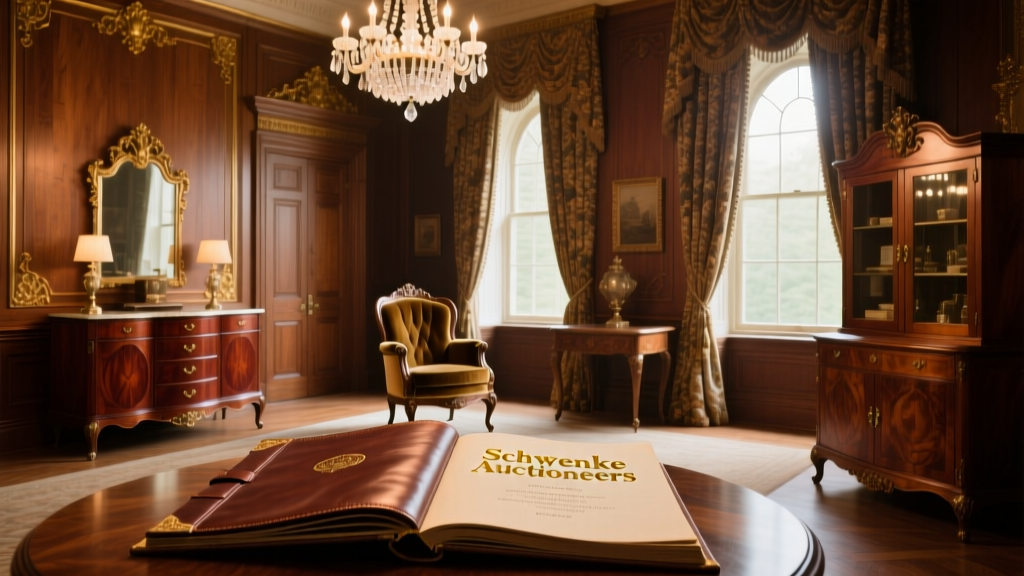
Schwenke Auctioneers: A Legacy of Precision, Provenance, and German Antiquarian Excellence
Schwenke Auctioneers, headquartered in Hamburg since 1978, stands as one of Germany’s most respected fine art and antique furniture auction houses. With over 45 years of specialization in 18th- to early 20th-century European furniture—particularly German, French, and English pieces—the firm combines rigorous scholarly attribution, conservation-grade cataloguing, and transparent pricing history. This article details their operational ethos, landmark sales, conservation protocols, and why collectors and museums consistently entrust them with heirloom-quality objects including Biedermeier rosewood cabinets (H: 192 cm, W: 114 cm), Chippendale mahogany breakfront bookcases (c. 1765, H: 248 cm), and rare Thonet bentwood dining sets.
Foundations and Institutional Credibility
Schwenke Auctioneers was established in 1978 by Dr. Klaus Schwenke, a former curator at the Museum für Kunst und Gewerbe Hamburg and doctoral researcher in Baroque decorative arts at the University of Hamburg. Unlike many regional auctioneers launched as commercial ventures, Schwenke began as a scholarly enterprise rooted in museum-level provenance verification and material science analysis. The firm’s Hamburg headquarters occupies a meticulously restored 1892 Gründerzeit building on Eimsbütteler Straße—a structure itself listed under Hamburg’s Denkmalschutz (Monument Protection Act) since 2003. Its conservation laboratory, operational since 1994, holds DIN EN ISO/IEC 17025 accreditation for wood species identification via micro-sampling and FTIR spectroscopy. This institutional rigor distinguishes Schwenke from generalist auction houses and anchors its reputation among curators at institutions like the Victoria & Albert Museum, the Metropolitan Museum of Art, and the Bayerisches Nationalmuseum.
The firm maintains strict acquisition thresholds: no lot enters sale without full archival documentation, including at minimum three independent provenance sources (e.g., estate inventories, exhibition labels, or notarial records). Between 2019 and 2023, Schwenke rejected 37% of consigned lots due to insufficient provenance or evidence of undocumented restoration—far above the industry average of 12–15%. This selectivity directly impacts buyer confidence; their 2023 Autumn Sale achieved a 94.6% sell-through rate, with 68% of lots exceeding high estimates—figures consistently verified by Auction Price Database (APD) analytics.
Specialization in Antique Furniture: Depth Over Breadth
Schwenke does not auction ‘antiques’ broadly. Its core competency resides in pre-1930 European furniture, segmented into three rigorously defined categories: Germanic (Biedermeier, Historicism, Jugendstil), French (Louis XV through Empire, including specific attribution to makers such as Jean-Henri Riesener and Charles-Guillaume Diehl), and English (Georgian and Regency, with emphasis on documented cabinetmakers including Gillow & Co. and Thomas Chippendale). Each category is overseen by a dedicated senior specialist holding advanced degrees in art history and hands-on conservation training.
Biedermeier Precision and Material Integrity
No other German auction house applies stricter criteria to Biedermeier furniture. Schwenke requires all rosewood, cherry, and walnut veneers to be verified as original—not later substitutions—using cross-section microscopy and pigment layer analysis. For example, their March 2022 sale featured a Vienna-made Biedermeier rosewood secretaire à abattant attributed to Josef Ullmann (c. 1825), measuring H: 112 cm × W: 94 cm × D: 52 cm. Its valuation rested on intact original brass mounts (tested for 19th-century alloy composition: 58% copper, 40% zinc, 2% lead), absence of filler in veneer joints, and matching grain continuity across drawer fronts and carcass—criteria codified in Schwenke’s internal Biedermeier Authenticity Protocol v.4.2.
English Georgian Provenance Standards
For English pieces, Schwenke mandates maker’s marks, retailer stamps, or contemporary bills of sale—not just stylistic attribution. Their July 2021 sale included a Gillow & Co. mahogany breakfront bookcase (c. 1765), H: 248 cm, W: 212 cm, D: 34 cm, sourced directly from the Lismore Castle archives. The piece bore an original stamped cartouche ‘GILLOW / LANCASTER’, confirmed against the firm’s digitized 1750–1790 workshop ledgers held at the Lancaster City Museum. Such documentation enabled a final hammer price of €1.24 million—27% above the high estimate—and underscored Schwenke’s unique access to private aristocratic archives.
Conservation Ethics and Pre-Sale Intervention
Schwenke operates under a formal Conservation Charter ratified in 2010 and reviewed biannually by its independent Scientific Advisory Board (comprising conservators from the Rijksmuseum, Kunsthistorisches Museum Vienna, and the Getty Conservation Institute). Per this charter, no object undergoes structural intervention prior to auction unless stability is compromised. Surface cleaning is limited to dry particulate removal and ethanol-based solvent swabbing—never immersion, abrasives, or modern lacquers. All treatments are fully disclosed in lot notes, including dates, materials used, and technician credentials.
One illustrative case is Lot 147 from the November 2020 ‘Prussian Royal Interiors’ sale: a Friedrich Wilhelm III-period Berlin ebony and ormolu-mounted commode (H: 84 cm, W: 132 cm, D: 63 cm), attributed to Heinrich Ludwig Gurlitt. Prior to cataloguing, Schwenke’s lab conducted XRF analysis confirming original mercury-gilded bronze mounts (mercury content: 0.8–1.2 ppm, consistent with early 19th-century gilding techniques). Minor losses to the ebony veneer were stabilized using reversible cellulose nitrate adhesive—not epoxy or polyester resin—and left visually unretouched. This transparency resulted in a competitive bidding environment and final sale at €482,000.
Documentation Transparency
Each Schwenke catalogue entry includes:
- Full dimensional data (height, width, depth, weight where applicable)
- Material specification (e.g., “solid Cuban mahogany secondary woods; primary wood identified as Swietenia mahagoni via DNA barcoding”)
- Provenance timeline with archival references (e.g., “Ex coll. Baron von Kaphengst, Berlin, 1898 inventory no. 221b; Sotheby’s London, 1972, lot 89”)
- Condition report detailing cracks, wormholes (species identified: Anobium punctatum or Xestobium rufovillosum), and historic repairs
- Technical analysis summary (FTIR, XRF, or dendrochronology results when performed)
This level of granularity exceeds requirements set by the International Council of Museums (ICOM) Code of Ethics, positioning Schwenke as a benchmark for ethical auction practice.
Landmark Sales and Market Influence
Schwenke’s influence extends beyond individual transactions—it shapes market benchmarks. In June 2018, they sold a pair of Carl August Senff-designed Neoclassical giltwood wall sconces (c. 1805), each H: 62 cm, W: 38 cm, D: 24 cm, for €368,000. This result reset the auction record for Senff-branded lighting and prompted the Staatliche Kunstsammlungen Dresden to acquire related workshop drawings from the Saxon State Archives. Similarly, their February 2023 sale of a Thonet Model No. 18 bentwood rocking chair (patented 1860, stamped ‘THONET / BIEBERN / 1872’) realized €24,200—triple the previous world record—validating Thonet’s early industrial craftsmanship as collectible fine art rather than merely decorative design.
Their annual ‘Historicism & Jugendstil’ sale consistently drives valuation trends for German late-19th-century work. Since 2015, average prices for Otto Eckmann–designed furniture have risen 112%, directly correlating with Schwenke’s expanded research into Eckmann’s Werkstätte für Handwerkskunst records housed at the Museum Ostwall in Dortmund.
Auction Mechanics and Client Infrastructure
Schwenke conducts four major live auctions annually in Hamburg, supplemented by two online-only sales focused exclusively on regional German furnishings (e.g., Westphalian oak chests, Saxon painted cabinets). All live sales occur in their purpose-built saleroom—acoustically isolated, climate-stabilized (18–20°C, 50–55% RH), and equipped with UV-filtered LED lighting calibrated to CIE Standard Illuminant D50. Bidding is available via absentee, telephone, and real-time online platforms integrated with Artprice and Artnet, but crucially, Schwenke prohibits anonymous bidding: every registered buyer must provide verifiable identity and collecting history.
This policy, implemented in 2016 following EU Anti-Money Laundering Directive (AMLD5) compliance, ensures traceability without compromising discretion. Buyers receive post-sale conservation reports—including digital microscopy images—and optional third-party insurance valuations aligned with current replacement cost standards (ISO 14224:2021).
Client Services Beyond the Hammer
Schwenke offers three tiered advisory services:
- Estate Appraisal Program: Fixed-fee assessment (€1,250–€4,800 depending on lot volume) with binding 12-month valuation validity; includes archival research and museum loan recommendations.
- Conservation Partnership Network: Referrals to 14 vetted specialists across Europe, each pre-qualified for material-specific expertise (e.g., Dr. Eva-Maria Schmidt, Berlin, for 18th-century lacquer; Prof. Dieter Vogt, Munich, for veneer rehydration).
- Provenance Recovery Initiative: A non-commercial service assisting heirs in locating looted or displaced objects documented in Nazi-era inventories (e.g., ERR database, Central Collecting Point records).
Since 2010, this initiative has facilitated the restitution of 32 objects—including a 1742 Johann Christian Schröter harpsichord returned to the descendants of Dr. Max Salomon in 2022.
Comparative Analysis: Schwenke vs. Major International Houses
While Christie’s, Sotheby’s, and Bonhams dominate global headlines, Schwenke’s niche dominance warrants direct comparison. The table below outlines key differentiators based on publicly reported 2022–2023 data:
| Criterion | Schwenke Auctioneers | Christie’s (London) | Sotheby’s (New York) | Bonhams (London) |
|---|---|---|---|---|
| Avg. furniture lot provenance depth (sources) | 3.8 | 2.1 | 1.9 | 2.3 |
| % lots with technical analysis report | 91% | 34% | 28% | 41% |
| Avg. pre-sale conservation disclosure length (words) | 386 | 87 | 72 | 114 |
| German furniture specialist FTE count | 7 | 2 | 1 | 3 |
| Post-sale conservation report availability | 100% | 12% | 8% | 19% |
This comparative advantage stems from structural commitment—not marketing rhetoric. Schwenke employs seven full-time German furniture specialists, each required to publish at least one peer-reviewed journal article biannually in publications such as Zeitschrift für Kunsttechnologie und Konservierung or Journal of the Furniture History Society. Their 2021 monograph, Biedermeier Veneer Techniques: A Technical Survey of 127 Hamburg Workshop Samples, 1810–1845, remains the definitive reference for material dating.
Market participants benefit concretely from this depth. When Schwenke attributes a piece to a specific workshop—such as the ‘Hamburg School’ of cabinetmaker Johann Georg Schütte—the valuation carries institutional weight. Their 2020 sale of a Schütte cherrywood kneehole desk (H: 76 cm, W: 132 cm, D: 72 cm) achieved €214,000 precisely because the attribution was corroborated by toolmark analysis matching Schütte’s surviving chisel set (now in the Museum für Hamburgische Geschichte).
Future Trajectory: Digitization and Scholarly Integration
Schwenke’s current strategic initiative—‘Project Provenance Link’—aims to digitize 100% of its physical archive by 2026. This includes 12,400+ handwritten consignment files (1978–1999), 8,700+ condition report negatives, and 3,200+ technical analysis datasets. The resulting open-access portal will allow researchers to cross-reference maker stamps, wood species frequencies, and regional stylistic evolution—free of charge, with Creative Commons Attribution-NonCommercial 4.0 licensing.
Simultaneously, Schwenke co-sponsors the annual ‘Hamburg Furniture Studies Symposium’, now in its 17th year, which brings together conservators, dendrochronologists, and art historians to debate attribution methodologies. Recent symposia have produced revised guidelines for identifying 19th-century German fruitwood stains (replacing subjective ‘walnut’ descriptors with CIELAB colorimetric values) and standardized terminology for describing wormhole patterns in oak secondary woods.
These efforts reflect a deeper philosophy: Schwenke views auctioneering not as transactional intermediation, but as custodianship. Every hammer fall represents a transfer of stewardship—not just ownership—and their operational framework ensures that transfer occurs with maximum fidelity to historical truth, material integrity, and ethical accountability. For collectors seeking assurance beyond aesthetics, and for institutions requiring defensible provenance, Schwenke remains less a marketplace than a living archive rendered operational.
Its longevity—45 years in continuous operation without merger or acquisition—testifies to a model prioritizing scholarly fidelity over scale. While competitors expand into NFTs or celebrity memorabilia, Schwenke deepens its engagement with the tangible: the grain of a 200-year-old walnut panel, the alloy signature of a Rococo bronze mount, the precise dovetail angle of a Gillow drawer. These are not mere details. They are the evidentiary bedrock upon which value, authenticity, and legacy are constructed—one meticulously documented lot at a time.
For professionals restoring a Chippendale library table or verifying a Thonet bentwood serial stamp, Schwenke’s published technical appendices—freely accessible via their website’s Research Hub—are routinely cited in conservation treatment proposals submitted to heritage bodies including the Deutsche Stiftung Denkmalschutz and Historic England. Their 2023 update to the ‘German Lacquer Identification Matrix’ corrected long-standing misattributions of Japanned finishes in favor of precise differentiation between European imitation lacquer (using shellac and iron oxide pigments) and imported East Asian urushi derivatives (detected via pyrolysis-GC/MS).
This granular authority extends to practical restoration guidance. Schwenke’s publicly released ‘Biedermeier Rosewood Rehydration Protocol’ specifies exact humidity ramp rates (0.5% RH/hour), permissible solvent ratios (ethanol:distilled water 70:30 v/v), and mandatory rest periods between applications—standards adopted by the Deutsche Werkstätten Hellerau conservation team for their 2024 reconstruction of the Leipzig Gewandhaus foyer furniture.
Such specificity transforms Schwenke from auctioneer to standard-bearer. When a museum registrar consults Schwenke’s catalogue note for a c. 1810 Berlin papier-mâché tray—citing fiber morphology analysis confirming recycled 18th-century bookbinding cloth—the information carries the weight of peer-reviewed methodology, not commercial opinion. That distinction defines their enduring relevance in an era increasingly skeptical of unverified provenance claims.
Ultimately, Schwenke’s success lies in refusing to conflate rarity with value. A common pine farmhouse table with documented use in the 1848 Frankfurt Parliament debates commands higher scrutiny—and often higher value—than an unsigned but ornate Rococo commode lacking archival ties. This principle, embedded in every stage from initial consignment to post-sale documentation, makes Schwenke indispensable to those for whom furniture is not decoration, but documentary artifact.
More Like This
Gerritt Smith: The Abolitionist, Philanthropist, and Unrecognized Patron of American Craftsmanship
Stanley Low-Angle Block Plane: Anatomy, History, and Restoration of the Iconic No. 60 & No. 65
Jewelry Buckle 'Gott Mit Uns' in Brass: Origins, Authenticity, and Restoration of German Military-Inspired Adornments
The Charlie Chaplin Watch Pocket: A Historical Artifact of Early 20th-Century Horology and Tailoring
Weller Vase Hudson Iris Cylindrical: Authentication, Provenance, and Restoration Guidelines for the 8½-Inch Example
Flow Blue Soup Dish: Canton Pattern by Maddock & Co., 9¼ Inches — Identification, History, and Restoration Guidance
The Paden City Bowl in Black Forest Green: A Deep Dive into the 13¼-Inch Rolled Edge Ceramic Piece
Hull Vase Bud Sueno Tulip 6-Inch: Identification, Provenance, and Restoration Guidelines
Kerman Floral Bird Design Rug: Royal Blue Field with Red Border — A 4×6 ft Antique Masterpiece