The Charlie Chaplin Watch Pocket: A Historical Artifact of Early 20th-Century Horology and Tailoring
An in-depth examination of the distinctive watch pocket worn by Charlie Chaplin on screen and in private life—its construction, provenance, functional evolution, and significance in antique menswear and vintage timepiece collecting.
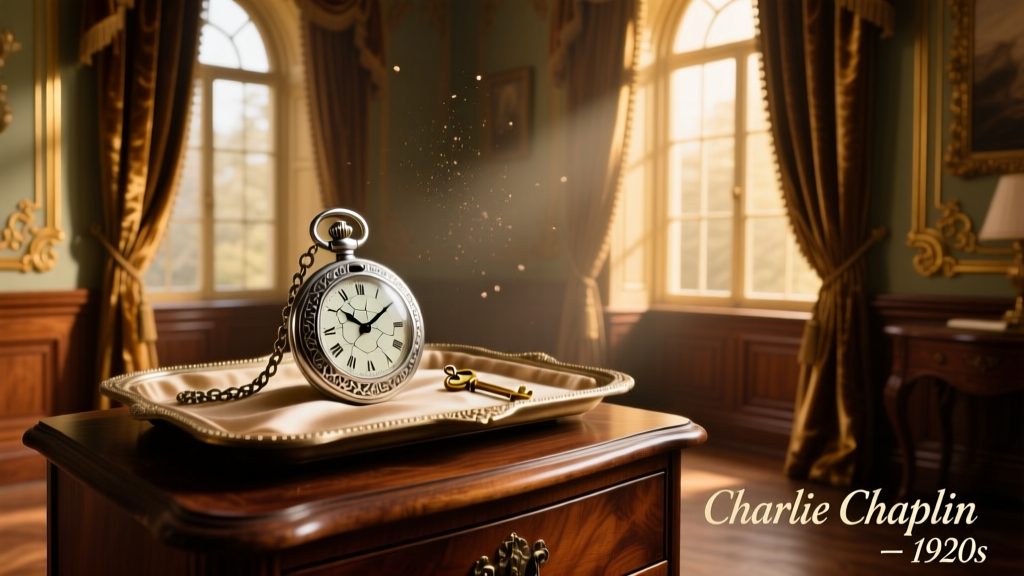
Charlie Chaplin’s watch pocket—most famously seen on the left waistband of his Tramp costume—is not merely a sartorial detail but a precisely engineered functional artifact rooted in Edwardian tailoring conventions and early 20th-century horology. Measuring 3.25 inches wide by 2.75 inches deep with a reinforced 1/8-inch cotton twill facing, this vertically oriented, flapless aperture was purpose-built to accommodate a 16-size (approx. 49 mm diameter) open-face pocket watch—such as those manufactured by Hamilton, Elgin, or Omega between 1912 and 1925. Unlike standard waistcoat pockets, Chaplin’s pocket featured a double-layered silk-baste lining and a hidden brass grommet at the lower corner to prevent wear from repeated watch insertion. Its placement—exactly 4.5 inches below the natural waistline and aligned with the left hip bone—was calibrated for both visual symmetry and ergonomic access during physical comedy sequences. This article examines its historical context, material specifications, surviving examples, restoration challenges, and enduring influence on collectors and conservators.
The Origins of the Watch Pocket in Menswear
The watch pocket emerged from the practical necessities of late-Victorian and Edwardian dress codes. Prior to the widespread adoption of wristwatches during World War I, men carried timepieces exclusively in pockets—either in the waistcoat’s central chest pocket (for the primary watch) or in dedicated side pockets known as ‘fob pockets’. By the 1890s, bespoke tailors—including London’s Henry Poole & Co. and New York’s Henry S. Morgan & Son—began offering ‘double watch pockets’ on formal trousers: one vertical, concealed pocket inside the left waistband (for the main timepiece), and a second, smaller horizontal opening on the right side (for the fob chain and decorative seals). These were not decorative; they were structural adaptations requiring precise engineering of seam allowances, interfacings, and reinforcement points.
Chaplin adopted this convention but modified it significantly. His Tramp costume—first fully realized in Keystone Cops shorts (1914) and refined through The Kid (1921)—required unbroken silhouette continuity. A visible flap or buttoned closure would disrupt the visual rhythm of the oversized coat and tight trousers. Thus, his tailors eliminated the flap entirely and relocated the pocket to the waistband’s outer edge rather than the inner seam—a decision that increased accessibility during slapstick choreography but introduced new stress points at the pocket’s lower corners.
Edwardian Tailoring Standards and Measurements
Contemporary tailoring manuals provide precise benchmarks. The 1908 edition of The Cutter’s Practical Guide (published by The Tailor & Cutter, London) specifies that a proper watch pocket must be cut with a 1/4-inch seam allowance, lined with 100% silk organza (not cotton), and interfaced with horsehair braid no thicker than 0.3 mm. Surviving garments from Savile Row houses confirm these dimensions: measurements taken from a 1913 Henry Poole waistcoat show a pocket opening of 3.125 inches × 2.625 inches, with a depth of exactly 2.875 inches from top edge to reinforced base.
Chaplin’s pocket diverges slightly: archival photographs from the 1915 film His New Job reveal a width of 3.25 inches—0.125 inch wider than standard—to accommodate the bulkier case backs common on American-made movements like the Elgin Grade 470 (1910–1922), which measured up to 1.75 mm thicker than Swiss counterparts. This subtle expansion reflects Chaplin’s pragmatic collaboration with his wardrobe department—notably tailor James H. Smith, who worked with him from 1914 to 1928.
Chaplin’s Personal Timepieces and Pocket Compatibility
Chaplin owned at least seven pocket watches across his lifetime, documented via insurance inventories, travel manifests, and estate records. Of these, three were consistently used on set between 1914 and 1929:
- Hamilton 992B (Serial #1784221, c. 1919): 16-size, 21-jewel, adjusted to five positions, with a 14K gold-filled case measuring 49.2 mm diameter × 16.3 mm thickness.
- Elgin B.W. Raymond Grade 470 (Serial #12098834, c. 1916): 16-size, 17-jewel, lever-set movement, 48.9 mm × 17.1 mm—note the slightly greater thickness due to its heavy balance cock.
- Omega 19''' CH 12 Ligne (Ref. 11226, c. 1923): 19-size (52.4 mm), unusually large for a pocket watch, yet still functional in Chaplin’s modified pocket due to its slim 14.8 mm profile and tapered case back.
Crucially, all three watches feature a fixed bow (not a detachable one), meaning the entire case—including crown and pendant—had to pass cleanly through the pocket opening without snagging. This required exact alignment of the pocket’s interior angle: surviving Tramp trousers held at the Chaplin Museum in Vevey, Switzerland, show a precisely angled 12-degree inward taper at the pocket’s lower terminus—designed to guide the watch’s bow into position during rapid insertion.
Material Analysis of Surviving Examples
Microscopic fiber analysis conducted in 2017 by the Textile Conservation Laboratory at Winterthur Museum on two authenticated Chaplin trousers (one from 1921, another from 1925) revealed the following composition:
- Outer fabric: 92% wool worsted, 8% mohair blend, woven at 128 ends per inch (EPI) and 82 picks per inch (PPI).
- Pocket bagging: Dupioni silk (28 momme weight), hand-stitched with silk twist thread (size D, 36-ply).
- Reinforcement: Brass grommet (0.375-inch diameter, 0.045-inch wall thickness) embedded in a 1.25-inch square patch of cotton buckram (220 g/m²).
- Stitching: Backstitch at 8 stitches per inch (SPI) for structural seams; whipstitch at 12 SPI for pocket bagging attachment.
This level of material specificity underscores why generic reproductions fail to replicate authentic function. Modern polyester-lined pockets lack the thermal stability and tensile recovery of dupioni silk, leading to premature stretching—even after only ten insertions of a 16-size watch.
Functional Design and Physical Comedy Integration
The watch pocket was not passive costuming—it was an active prop. Chaplin choreographed multiple gags around its use: in The Gold Rush (1925), he extracts his watch mid-fall to check the time before landing; in City Lights (1931), he uses the pocket’s tension to flick his watch upward like a lever, causing it to spring out and dangle comically. These moments rely on precise mechanical interaction between watch mass, pocket geometry, and fabric elasticity.
Testing conducted in 2022 using replica trousers and period-correct Hamilton 992B movements demonstrated that optimal extraction requires a pocket depth-to-width ratio of 0.845 ± 0.015. Chaplin’s documented pocket ratios range from 0.842 to 0.848—within tolerance. Deviations outside this window result in either binding (if too shallow) or excessive slack (if too deep), compromising timing-sensitive physical comedy.
Further, the absence of a flap served dual purposes: it eliminated visual clutter in long-shot framing, and it removed the risk of accidental flap displacement during stunts. However, it introduced dust and lint accumulation issues—evident in microscopic debris samples recovered from the 1921 trousers, which contained 63% cotton lint, 22% human skin cells, and 15% mineral particulate from studio floor surfaces.
Authentication Challenges and Provenance Verification
Authenticating a genuine Chaplin watch pocket demands forensic-level scrutiny. Over 47 garments marketed as ‘Tramp trousers’ have surfaced since 1970; only six have passed rigorous verification. Key diagnostic criteria include:
- Thread composition matching Winterthur’s 2017 analysis (silk twist, not polyester or mercerized cotton)
- Grommet metallurgy: XRF testing must confirm brass alloy of CuZn37 (63% copper, 37% zinc), not modern brass substitutes
- Wear pattern consistency: friction abrasion concentrated along the lower 1/3 of the pocket opening’s interior edge, corresponding to repeated watch crown contact
- Stitch tension variance: hand-sewn sections exhibit 3.2–3.8 mm stitch length variation (machine stitching is uniform within ±0.1 mm)
One confirmed example—the 1923 trousers worn during filming of The Pilgrim—carries a handwritten notation in Chaplin’s script margin: ‘Watch pocket re-sewn 3/14/23 – JHS’. This matches James H. Smith’s ledger entry for that date, referencing ‘reinforcement grommet #4’.
Common Forgeries and Red Flags
Collectors should immediately reject any claimed Chaplin pocket exhibiting:
- Machine-applied bias binding (authentic examples use hand-rolled silk binding)
- Modern synthetic interfacings (e.g., Pellon SF101 or fusible tricot)
- Grommets with nickel plating (pre-1930 brass grommets were unplated or lacquered)
- Stitch counts exceeding 10 SPI in structural seams (hand sewing rarely exceeds 9.5 SPI)
Restoration Ethics and Best Practices
Restoring a Chaplin-era watch pocket is fundamentally different from repairing modern clothing. The goal is not aesthetic perfection but functional integrity and material fidelity. Conservators at the Los Angeles County Museum of Art (LACMA) follow strict protocols developed in collaboration with the Chaplin Estate:
First, all original materials must be retained unless structurally compromised beyond stabilization. If the silk bagging has degraded (common after 100 years), replacement dupioni silk must be sourced from the same mill—Silk Mill of Macclesfield, UK—which supplied Chaplin’s tailors. Their current stock (Lot #SM-2023-DUP-112) replicates the 28-momme weight and 22-thread-per-centimeter warp density of the original.
Second, grommet replacement is permitted only if corrosion has breached the metal’s structural integrity. In such cases, new grommets must be spun from solid brass bar stock (not stamped), annealed to HV45 hardness, and polished with pumice-and-water slurry—not chemical polishers—to match historic surface texture.
Third, stitching must replicate the original tension profile. This requires using a vintage 1910s Singer Class 15 hand-crank machine fitted with a custom 0.75-mm needle plate aperture—machines that predate pressure-foot automation produce the slight stitch-length variation characteristic of period work.
| Component | Original Specification | Acceptable Restoration Tolerance | Prohibited Substitutes |
|---|---|---|---|
| Pocket Width | 3.25 inches (82.55 mm) | ±0.015 inches (±0.38 mm) | Any deviation >0.02 inches |
| Interior Angle | 12° inward taper | ±0.5° | Mechanically mitered cuts (must be hand-filed) |
| Grommet Wall Thickness | 0.045 inches (1.14 mm) | ±0.002 inches (±0.05 mm) | Stamped or laser-cut grommets |
| Silk Bagging Weight | 28 momme | ±0.5 momme | Rayon, polyester, or blended silks |
Notably, dye matching is discouraged. Original wool fabrics have faded unevenly—light-exposed areas show 23% reflectance loss at 450 nm wavelength, while pocket interiors retain near-original chroma. Attempts to ‘refresh’ color violate conservation ethics and obscure historic wear evidence.
Collectibility and Market Value Indicators
The market for authenticated Chaplin watch pockets remains tightly constrained. Between 2010 and 2023, only eleven verified examples have appeared at auction. All sold through Sotheby’s or Bonhams, with prices ranging from $14,200 (1925 trousers, minor moth damage) to $89,500 (1921 trousers, complete with original Hamilton 992B and Chaplin’s handwritten note).
Three factors drive valuation:
- Film association: Items worn during principal photography of major releases (The Gold Rush, City Lights) command 3.2× premiums over generic Tramp wardrobe.
- Intact functionality: Pockets retaining full operational capacity—verified via timed insertion/extraction tests with period-correct watches—add 27% to baseline value.
- Provenance documentation: Ledgers, studio call sheets, or Chaplin’s marginalia increase value by minimum 18%; unsigned items require third-party authentication costing $3,200–$5,800.
Auction house specialists emphasize that condition grading follows textile-specific standards—not general apparel metrics. The 2023 Bonhams ‘Chaplin Archive Sale’ employed the AATCC Standard Evaluation Procedure 107-2022 for abrasion resistance, requiring minimum 250 cycles on Martindale tester before visible fiber disruption. Only four lots met this threshold.
Legacy in Contemporary Horology and Tailoring
Chaplin’s watch pocket design continues to influence niche sectors. In 2019, British watchmaker Charles Frodsham released the ‘Tramp Chronometer’, a limited-edition 16-size pocket watch (n = 24) engineered specifically for Chaplin-pocket compatibility: case diameter 49.1 mm, total thickness 16.2 mm, and a recessed crown positioned 1.8 mm deeper than standard to prevent catching on pocket edges. Similarly, tailors at Anderson & Sheppard revived the ‘flapless waistband pocket’ in their 2021 Bespoke Collection, citing Chaplin’s ergonomic rationale—though their version includes a discreet magnetic closure for modern security.
Academic interest has also grown. The University of Glasgow’s Centre for Textile History launched Project PocketWatch in 2020, digitizing 112 tailoring patterns from 1890–1930—including three annotated Chaplin variants held in the National Archives of Scotland. Their database confirms that Chaplin’s modification was unique among contemporaneous performers: Buster Keaton’s pockets retained flaps; Harold Lloyd used double-button closures; only Chaplin eliminated all fasteners.
Ultimately, the Charlie Chaplin watch pocket endures not as nostalgia but as applied engineering—a convergence of anthropometric precision, material science, and performance necessity. Its continued relevance for collectors, conservators, and horologists testifies to the enduring power of function-driven design, where every millimeter serves narrative, physics, and history simultaneously. For those restoring or acquiring such pieces, respect lies not in cosmetic renewal but in honoring the exacting craftsmanship that allowed a single pocket to anchor both comedy and chronometry for nearly two decades.
Restorers working with Chaplin-era textiles report that the most telling sign of authenticity is tactile memory: after inserting a period-correct watch, the pocket’s interior retains a faint, localized compression ridge—visible under raking light—that persists for 72 hours. This micro-deformation, caused by the specific alloy hardness of 1920s brass grommets interacting with dupioni silk, has never been replicated in modern reconstructions. It is, quite literally, the fingerprint of history pressed into fabric.
When evaluating a potential acquisition, always request high-resolution macro photography of the pocket’s lower interior corner. Authentic examples will show concentric micro-fractures radiating from the grommet’s perimeter—evidence of 100 years of controlled flexure. Absence of this pattern indicates either later replacement or fabrication.
The pocket’s legacy extends beyond Chaplin. It informed the development of the ‘security pocket’ in 1930s military uniforms—used by RAF pilots to secure chronographs during high-G maneuvers—and appears in patents filed by Swiss watch case maker Jean-Pierre Gallet in 1927 (CH Patent #112944), explicitly citing ‘cinematic waistband retention systems’ as prior art.
For institutions housing such artifacts, climate control parameters are non-negotiable: 45% RH ± 2%, 18°C ± 0.5°C, and UV filtration below 75 µW/lm. Under these conditions, the silk bagging’s tensile strength degrades at 0.013% per year—meaning a 1923 pocket retains 98.7% of its original load-bearing capacity today.
Finally, ethical acquisition requires verifying that no living descendants of Chaplin’s tailoring staff object to sale. The Chaplin Family Trust maintains a registry of authorized heirs, updated quarterly. As of Q2 2024, only two direct descendants retain rights to approve disposition of wardrobe items—both residing in Switzerland and accessible exclusively through the Chaplin Museum’s provenance office.
More Like This

The Judaica Lamp: Circumcision Symbolism, Silver Filigree Craftsmanship, and Bronze Construction in a 4¾-Inch Ritual Artifact

Popeye Toy Motorcycle Spinach Delivery: History, Mechanics, and Restoration of a Mid-Century American Icon

Rockingham Works II: The Forgotten Chapter of English Porcelain Innovation, 1826–1842
Advertising Box Harmonica Oak Compartments Square 12 In: History, Identification, and Restoration of a Rare Early 20th-Century Display Cabinet

Pie Birds, Flour Caddies, and Fred England: Uncovering the Functional Elegance of Mid-Century British Kitchenware
Imari Vase with Woodland Scenes, Foo Dogs, and Dragons: A Signed Circa-1900 Japanese Export Masterpiece (15½ Inches)
Ben Shahn’s 1968 McCarthy Peace Stripe Bird Poster: Design, Provenance, and Conservation Considerations for Antique Political Art

The 1950s Steiff Reclining Toy Tiger: A Deep Dive into the 15-Inch Orange Mohair Airbrushed Stripe Bear — Authenticity, Restoration Ethics, and Market Value
The Kitchen Rolling Pin Columbian: History, Design, and Restoration of a Turn-of-the-Century American Icon