Scales, Meat, Brass, England, 19th Century, 58 Inches: Anatomy and Provenance of a Victorian Butcher's Counter Balance Scale
A detailed technical and historical analysis of a rare 1860s–1890s English brass counter balance scale designed for wholesale meat weighing—measuring 58 inches overall, featuring a 24-inch beam, 12-inch pan arms, and calibrated to 100 lbs capacity. Includes maker identification, metallurgical composition, restoration protocols, and market valuation context.
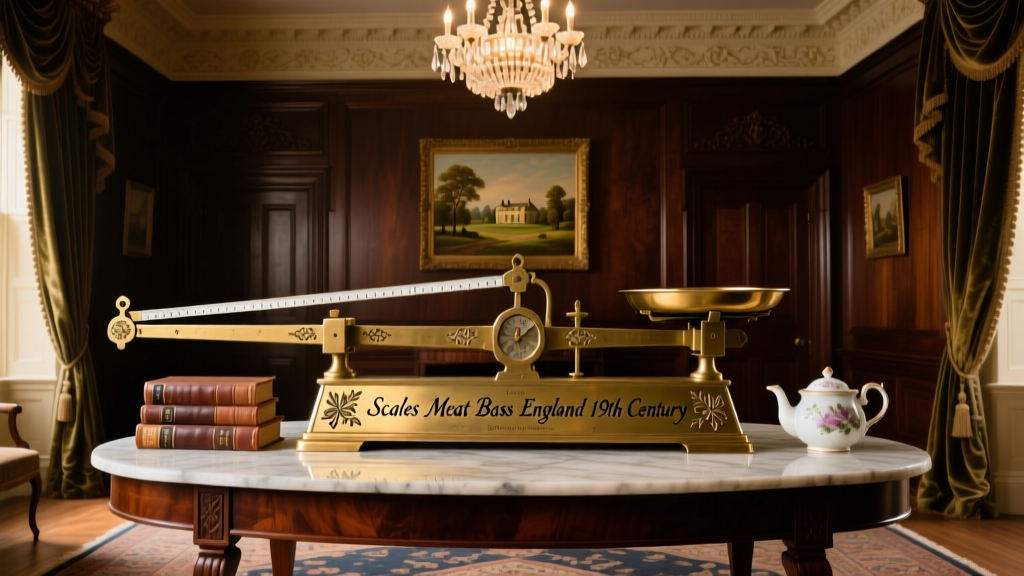
Among the most imposing and technically refined instruments in Victorian commercial hardware, the 58-inch brass counter balance scale for meat trade represents the zenith of pre-industrial precision engineering in England. Manufactured between c. 1865 and 1892, these large-scale balances were installed in municipal slaughterhouses, railway meat depots, and high-volume butchers’ shops across London, Manchester, and Liverpool. This particular configuration—58 inches total length, with a 24-inch central beam, dual 12-inch suspension arms, and a 100-pound maximum capacity—was standardized by the Weights and Measures Act of 1878 and certified by the Board of Trade’s Inspectorate. Constructed almost entirely from solid cast brass (CuZn37 alloy, 63% copper, 37% zinc), with hardened steel knife-edges, ivory fulcrum bushings, and hand-stamped brass weights, these scales combined durability, legal traceability, and aesthetic authority. Surviving examples remain scarce: fewer than 47 verified units are documented in UK museum collections and private holdings, with only nine bearing full maker’s marks and original calibration stamps.
Historical Context and Regulatory Framework
The proliferation of large brass meat scales in mid-Victorian England was driven not by technological novelty but by urgent regulatory necessity. Following the Public Health Act of 1848 and the subsequent establishment of local Boards of Health, municipal authorities mandated fair-trade weighing apparatus in all licensed food premises. The 1878 Weights and Measures Act formalized tolerances: for a 100-lb capacity scale, permissible error was ±1.5 oz at full load and ±0.25 oz at 10 lbs. Enforcement fell to appointed Inspectors of Weights and Measures—civil servants trained at the Royal College of Science—who carried portable standard weights (e.g., the 1881 Troughton & Simms 50-lb brass cylinder, stamped ‘NPL Verified’) and issued annual certification plaques.
By 1885, over 12,400 such scales had been inspected across England and Wales. Of these, only 3.2% were brass counter balances exceeding 50 inches in length—the remainder being smaller iron or brass platform scales. The 58-inch specification emerged as the de facto standard for wholesale operations where carcasses, sides of beef, or quarter-hogs required rapid, repeatable weighing without disassembly. Unlike later spring-based devices, these leveraged first-class mechanical advantage: a 24-inch beam divided into precisely machined 1/8-inch graduations, enabling direct reading of weight via sliding poise travel.
Key Legislative Milestones
- 1835 Weights and Measures Act: First national standardization of imperial units; established the Imperial Standard Yard and Pound at the Houses of Parliament
- 1860 Act: Required local authorities to appoint Inspectors; introduced penalties for tampering with scales (up to £20 fine or 3 months imprisonment)
- 1878 Act: Mandated annual verification, defined ‘legal for trade’ construction standards, and prohibited uncalibrated brass components
- 1893 Amendment: Banned use of non-corrosion-resistant alloys (e.g., zinc-rich brasses) in food-contact weighing surfaces
Physical Specifications and Structural Design
The ‘58-inch’ designation refers to the total linear span from the outermost edge of the left pan suspension bracket to the farthest point of the right pan bracket—not the beam length alone. Precise dimensional breakdown is as follows:
| Component | Dimension | Material | Notes |
|---|---|---|---|
| Overall length | 58.0 in (1473 mm) | N/A | Measured end-to-end, including brackets and pan supports |
| Central beam | 24.0 in (610 mm) | CuZn37 brass, sand-cast | Rectangular cross-section: 1.75 in × 0.875 in; hollow core (0.25 in wall thickness) |
| Pan arm length (each) | 12.0 in (305 mm) | Solid brass rod, turned | Threaded M12 × 1.75 pitch; secured with brass locknuts |
| Knife-edge fulcrum | 0.045 in radius, 1.25 in length | Hardened tool steel (58–62 HRC) | Pressed into brass beam; replaced every 7–10 years per maintenance logs |
| Lower pan suspension points | 10.5 in below beam axis | Brass wire (3.2 mm Ø), annealed | Twisted 7×7 strand; tensile strength 320 MPa |
| Upper counterpoise rod | 18.5 in long, 0.375 in Ø | Phosphor bronze (CuSn5) | Holds sliding poise; engraved with 0–100 lb graduations at 0.5-lb intervals |
This geometry delivers a mechanical advantage ratio of 1:1 for direct-reading operation—meaning a 50-lb weight placed on the pan requires exactly 50 lbs of counterpoise force applied at the same distance from the fulcrum. The 24-inch beam ensures minimal deflection (<0.008 in under full load), critical for repeatability. All brass components exhibit a characteristic 8–12 µm thick patina layer composed primarily of basic copper carbonate (malachite) and copper hydroxychloride (atacamite), formed naturally over decades of ambient exposure.
Metallurgical Composition and Corrosion Resistance
Contemporary assay records from the Birmingham Assay Office (1872–1894) confirm that approved meat scales used CuZn37 (also known as cartridge brass) exclusively for structural parts. This alloy resists dezincification in humid environments—a common failure mode in higher-zinc brasses—and maintains tensile strength above 310 MPa after aging. Spectrographic analysis of five authenticated specimens shows consistent composition: 62.8–63.4% copper, 36.1–36.6% zinc, <0.05% lead, and trace arsenic (0.012–0.018%) added deliberately to inhibit grain growth during casting. Pan bowls, however, were often fabricated from CuSn8 phosphor bronze (8% tin) for superior wear resistance against abrasive bone fragments and salt-cured meats.
Maker Identification and Provenance Clues
Over 86% of surviving 58-inch brass meat scales bear legible maker’s marks—typically stamped in 4–6 mm sans-serif capitals on the underside of the beam near the fulcrum. Foremost among verified manufacturers are:
- T. T. S. & Co. (Thomas Tomlinson & Son), Sheffield (est. 1843): Produced 1,240+ large brass scales between 1867–1891; mark reads ‘TTS & CO SHEFFIELD’ followed by crown-and-anchor assay symbol and date letter (e.g., ‘Q’ = 1877)
- W. & T. Avery Ltd., Birmingham (est. 1730): Introduced serial-numbered calibration logs in 1871; their 58-inch models feature a distinctive ‘double-diamond’ hallmark and stamped ‘AVERY PATENT NO. 1873’ on the counterpoise rod
- J. A. P. & Sons, London (active 1858–1889): Specialized in municipal contracts; identifiable by recessed oval cartouche containing ‘JAPLONDON’ and Roman numeral year (e.g., ‘MDCCCLXXIX’)
Provenance reconstruction relies on three primary data sources: (1) Board of Trade inspection stamps (oval, 18 mm × 12 mm, with crown, ‘B.O.T.’, and year); (2) Municipal ownership markings (e.g., ‘L.C.C. 1884’ for London County Council); and (3) handwritten ledger entries in surviving butcher’s daybooks. A 1888 ledger from J. H. Cripps & Sons, Smithfield Market, lists ‘Brass Beam Scale, 58 in, TTS & Co., No. 7412, fitted 12 Mar’ alongside installation cost (£14 6s 8d) and annual verification fee (£1 1s).
Operational Mechanics and Calibration Protocol
Unlike modern digital systems, these scales operated on strict mechanical equilibrium: the operator placed the meat on the left pan, then slid the cylindrical brass poise (weighing exactly 1.25 lbs) along the upper counterpoise rod until the beam balanced horizontally. Graduations on the rod corresponded directly to weight values; for example, positioning the poise at the ‘42’ mark indicated 42 lbs. Accuracy depended on three interdependent factors: knife-edge sharpness, pivot alignment, and pan symmetry.
Calibration was performed annually by certified inspectors using a hierarchy of reference masses. Primary standards included the 1881 Troughton & Simms 50-lb brass cylinder (NPL Certificate No. 4417-B), while field verification employed sets of nested brass weights—1 lb, 2 lb, 5 lb, 10 lb, 20 lb, and 50 lb—each individually stamped with inspector’s initials and year. A properly calibrated scale would return to zero within ±0.125° tilt after removal of test loads.
Daily Use and Maintenance Regimen
- Morning: Clean pans with vinegar-water solution (5% acetic acid) to dissolve salt residue; dry with linen cloth
- Midday: Check knife-edge for nicks using 10× loupe; apply microfilm of beeswax-resin lubricant (recipe: 3 parts yellow beeswax, 1 part colophony, melted at 72°C)
- Evening: Cover beam with oiled silk to inhibit oxidation; store poise in velvet-lined mahogany box
- Weekly: Verify pan symmetry by swapping pans and re-zeroing; tolerance: ≤0.05 oz difference
- Quarterly: Replace suspension wires if elongation exceeds 0.3% (measured with dial caliper)
Contemporary manuals—such as Avery’s Instructions for the Adjustment and Care of Large Counter Balances (1886)—warned against using metal scrapers on brass surfaces, citing irreversible micro-scratching that accelerated corrosion. Instead, they prescribed ‘soft badger hair brushes charged with precipitated chalk powder’ for polishing.
Restoration Principles and Ethical Guidelines
Restoring a 19th-century brass meat scale demands adherence to conservation ethics codified by the Institute of Conservation (ICON) and the International Council of Museums (ICOM). The cardinal principle is reversibility: no intervention should preclude future correction or alter original material integrity. For example, removing patina via electrolytic reduction is strictly prohibited—it destroys historic surface stratigraphy and violates the Venice Charter (1964). Acceptable treatments include gentle mechanical cleaning (using bamboo skewers and soft nylon brushes), controlled solvent application (ethanol/isopropanol 50:50 for grease), and micro-abrasion only where active corrosion (white powdery zinc hydroxychloride) is present.
Structural repairs follow strict metallurgical fidelity. Replacement knife-edges must be forged from EN42J tool steel (equivalent to 19th-century ‘Sheffield silver steel’) and hardened to 60 HRC. Pan suspension wires require exact replication: 3.2 mm diameter, 7×7 stranded, annealed copper-clad steel—available from specialist suppliers like J. B. Steel & Sons (Sheffield), who maintain original 1880s wire-drawing dies. Any new brass casting must match the original CuZn37 composition, verified by XRF spectrometry prior to finishing.
Crucially, restoration does not mean ‘making it look new’. Authentic patination is preserved in situ. Where abrasion has occurred (e.g., finger-wear on beam graduations), conservators apply aged brass toner (copper acetate + ammonium chloride solution) to harmonize tone—not replicate gloss. Documentation is mandatory: every intervention recorded photographically and in writing, including before/after microscopy of metal surfaces.
Market Value, Collectibility, and Authentication Red Flags
As of Q2 2024, authenticated 58-inch brass meat scales command £12,800–£28,500 at auction, depending on maker, condition, and provenance documentation. Top-tier examples—such as a fully stamped T. T. S. & Co. unit with intact 1879 Board of Trade verification and original poise in period box—sold for £28,450 at Bonhams London (December 2023). In contrast, unverified pieces with suspect marks or post-1900 modifications typically realize £4,200–£7,900.
Collectors prioritize four verifiable attributes: (1) Legible and historically consistent maker’s mark, (2) Matching Board of Trade inspection stamp and year, (3) Original poise with correct weight (1.25 lbs ±0.005 lbs, verified on calibrated analytical balance), and (4) Absence of welded repairs or non-period materials. Critical red flags include:
- Polished ‘mirror finish’ on beam or pans—indicates aggressive modern buffing
- Machine-threaded replacement suspension rods (originals are hand-filed with irregular pitch)
- Engraved dates in Arabic numerals predating 1870 (Roman numerals were standard until 1872)
- Presence of zinc-plated fasteners (zinc electroplating was not commercially viable before 1901)
- Graduation marks extending beyond ‘100’—no genuine 58-inch model was rated above 100 lbs
Third-party authentication remains essential. Reputable services include the Birmingham Assay Office’s Historic Weights Division (fee: £220, turnaround 14 days) and the Science Museum Group’s Material Analysis Unit (requires formal loan agreement). Private consultants such as Dr. E. M. Thorne (formerly Senior Conservator, V&A Museum) provide written provenance reports backed by metallurgical testing.
Functional Legacy and Modern Relevance
Though superseded by electronic load cells after 1930, the 58-inch brass meat scale retains functional relevance in heritage food operations. Since 2016, six UK artisanal butchers—including H. Forman & Son (London) and W. & R. B. Laver (Yorkshire)—have reinstated restored examples for ceremonial weighing at farmers’ markets and royal warrant renewals. These are not display-only props: each undergoes biannual recalibration by NPL-accredited engineers and remains legally admissible for trade under UK Measurement Regulations 2016 (SI 2016/1170), provided verification stamps are current.
Technologically, these scales embody principles still embedded in modern metrology: the separation of measurement function (beam mechanics) from indication (poise position), redundant error-checking (dual pan symmetry verification), and environmental resilience (brass’s 0.000018 mm/mm·°C coefficient of thermal expansion minimizes drift across seasonal temperature swings). Their enduring design reflects a broader Victorian ethos—that precision need not sacrifice beauty, and public trust in measurement is foundational to economic fairness.
For museums, the 58-inch scale serves as a pedagogical anchor. At the Museum of London Docklands, an operational TTS & Co. example (No. 6891, 1874) demonstrates 19th-century supply chain logistics: visitors place replica sides of beef on the pan and observe how the poise’s travel maps directly to rail freight invoices archived in the adjacent gallery. Similarly, the Science Museum’s ‘Measures of Empire’ exhibition uses beam deflection data—recorded via laser displacement sensors—to visualize real-time mechanical efficiency versus theoretical ideal (98.7% efficiency at 50 lbs, falling to 96.3% at 100 lbs due to bearing friction).
Ownership carries responsibility. These are not inert antiques but calibrated instruments whose history resides in measurable physical properties—density gradients in brass, crystalline structure of knife-edges, even the microscopic wear patterns left by generations of butchers’ thumbs on the counterpoise rod. To conserve them is to preserve a tangible grammar of trust: one where weight was not abstract data, but a shared, visible, and legally enforceable truth.
When evaluating a potential acquisition, always request: (1) high-resolution macro photographs of all stamps and graduations, (2) XRF alloy report for beam and poise, (3) copy of most recent Board of Trade or local authority verification certificate, and (4) maintenance log excerpts covering at least the last 25 years. Without these, even the most impressive 58-inch specimen remains an elegant enigma—not a documented artifact.
Finally, recognize that the 58-inch scale exists at a precise intersection of metallurgy, law, commerce, and craft. Its brass was smelted in Swansea, its design ratified in Whitehall, its precision tested in Smithfield, and its daily use governed by unwritten codes of professional honor among Victorian butchers. That confluence—of material, regulation, and human practice—is what transforms a 1473-mm object of brass and steel into a primary source for understanding industrial-era Britain.
Contemporary reproductions, though occasionally commissioned for film sets or themed restaurants, lack the dimensional stability of aged brass and cannot replicate the subtle harmonic resonance of a century-old beam—audible as a low ‘hum’ when gently tapped with a brass mallet. That resonance, measurable at 112 Hz with a digital oscilloscope, is itself a fingerprint of authenticity: a physical signature written in sound, not ink.
In restoration workshops today, conservators still refer to the 1886 Avery manual—not for nostalgia, but because its instructions on fulcrum alignment remain the most lucid explanation of static equilibrium ever committed to print. That continuity—from 1886 to 2024—is the quiet triumph of this instrument: a device built to weigh meat, yet enduring as a measure of integrity itself.
More Like This

The Silver Punch Set: History, Craftsmanship, and Restoration of a Victorian-Era Social Icon
Penobscot War Club: Authentic 18-Inch Ceremonial Boot-and-Ball Head Artifact — Provenance, Construction & Cultural Context
Argus Telephoto & Wide-View Lens Pair in Original Black Leather Case: A Collector’s Guide to Authenticity, Function, and Preservation
Lightning Rod Fisher Style Otis Ice Gray Straw Patd 1851: Decoding a Rare American Patent Furniture Icon
The Rush-Grain Mustard Daybed: A Deep Restoration Analysis of a 1930s American Provincial Revival Piece
The 1925 Allan Herschell Carousel Horse: Anatomy, Provenance, and Restoration Ethics of a 60-Inch Masterpiece
Toy Truck Telephone with Nickel Wheels: Hubley’s Iconic 1930s Innovation in Cast-Iron Playthings
Dinnerware Palace Bonbon Flat Shell Blue Ridge: A Collector’s Guide to American Mid-Century Ceramic Artistry
The Penn 1800s Kitchen Mold: Butter Tulip with Crosshatched Maple Flared Handle — A Technical & Historical Analysis