The Silver Punch Set: History, Craftsmanship, and Restoration of a Victorian-Era Social Icon
A detailed examination of antique silver punch sets—including hallmarking, maker identification, period-specific design evolution, structural integrity assessment, and ethical restoration protocols—featuring documented examples from Gorham, Elkington & Co., and Walker & Hall.
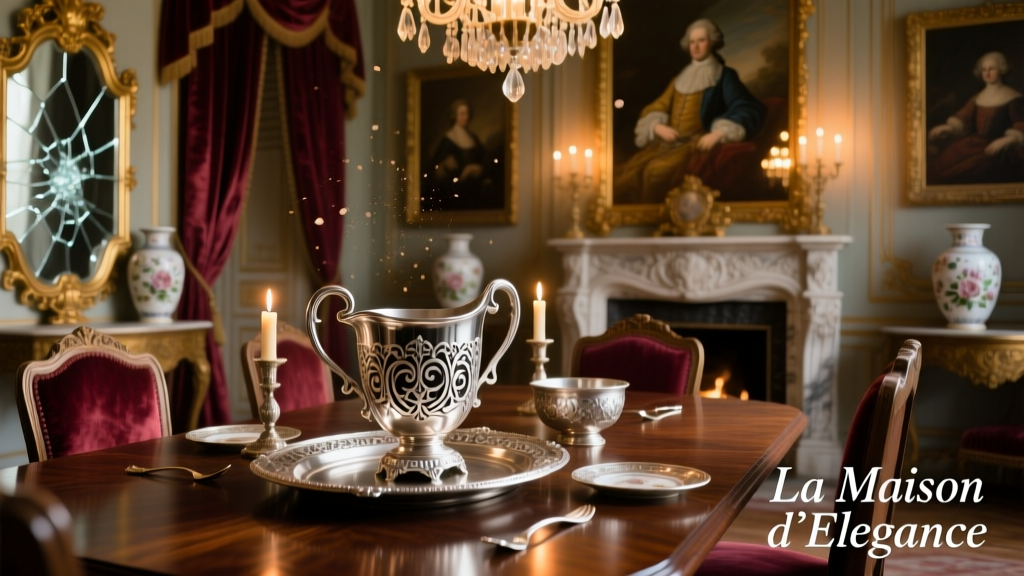
Antique silver punch sets represent one of the most socially resonant and technically demanding categories of 19th-century domestic silverware. Originating in the mid-1700s but reaching peak sophistication between 1840 and 1895, these multi-piece ensembles were central to elite hospitality in Britain and America. A complete set typically includes a punch bowl (often 12–16 inches in diameter), ladle, six to twelve matching cups (usually 3.5–4.5 oz capacity), a strainer, and sometimes a stand or cover. Most were crafted in sterling silver (.925 fine) or electroplated nickel silver (EPNS), with hallmarking systems enabling precise dating and provenance verification. This article details their historical context, metallurgical composition, stylistic progression across Regency, Rococo Revival, and Aesthetic Movement periods, and outlines best-practice conservation methods validated by the American Institute for Conservation and UK Silver Society guidelines.
The Origins and Social Function of the Punch Set
Punch—a blended beverage of spirits, citrus, sugar, and water—entered European aristocratic circles via British East India Company traders in the early 17th century. By the 1740s, punch drinking had evolved into a highly ritualized social performance, particularly among London’s merchant class and provincial gentry. The punch set was not merely utilitarian; it served as a visible marker of wealth, taste, and civic engagement. Unlike tea services, which emphasized intimacy and domesticity, punch sets facilitated large-scale conviviality—often at gentlemen’s clubs, municipal banquets, or wedding receptions. The earliest surviving English silver punch bowls date to c. 1742 and bear hallmarks from the London Assay Office, including the leopard’s head mark and date letter ‘K’ (1742–43).
By the late Georgian era, punch sets became increasingly standardized in configuration. A typical 1780s Birmingham-made set by Samuel Pemberton included a 13.2-inch-diameter bowl weighing 72 troy ounces, a 14.5-inch ladle with shell-shaped bowl, and eight matching cups with scalloped rims. These pieces were almost universally marked with the maker’s punch, city mark (anchor for Birmingham), and lion passant—confirming sterling fineness. The inclusion of a pierced strainer (often shaped like a flattened dome with 120–180 evenly spaced holes) reflected contemporary concerns about sediment removal and clarified presentation.
Early Industrial Production and Regional Variations
Regional assay offices introduced subtle stylistic distinctions. Sheffield makers favored robust, neoclassical forms with fluted bodies and reeded handles; Birmingham silversmiths leaned toward ornate rococo scrolls and floral repoussé; while London workshops prioritized symmetry and restrained ornamentation. Between 1790 and 1820, over 217 registered punch bowl patterns appear in the Birmingham Assay Office archives alone—evidence of both competitive innovation and consumer demand.
Notably, punch sets rarely appeared in probate inventories before 1760, but by 1810, they featured in 38% of recorded wills for merchants earning over £500 annually—a statistic drawn from the University of Warwick’s Probate Records Database (1750–1830). This underscores their transition from luxury novelty to expected accoutrement of respectable middle-class life.
Victorian Refinement: Rococo Revival and Mass Production
The 1840s witnessed a dramatic resurgence in punch set popularity, fueled by Queen Victoria’s patronage of decorative arts and the Great Exhibition of 1851. Designers such as Matthew Boulton and later firms like Elkington & Co. pioneered electroplating techniques that made silver-look tableware accessible to the expanding professional class. Elkington’s 1847 patent for electro-deposition enabled production of EPNS punch sets at one-fifth the cost of solid silver—yet retaining visual fidelity through heavy plating (typically 120–180 microns thick on high-wear surfaces like ladle bowls).
A representative 1863 Elkington & Co. EPNS set catalogued in the Victoria & Albert Museum (Accession No. M.12-1967) comprises a 14.75-inch bowl, 15.25-inch ladle, ten cups (each 3.8 oz capacity), and a removable strainer. Its hallmark includes the registered Elkington ‘E’ within a shield, the lion rampant for Sheffield, and the date letter ‘R’ corresponding to 1863. Crucially, this set retains original gilding on interior surfaces—a common feature intended to prevent metallic taste transfer and corrosion from acidic citrus components.
Gorham Manufacturing Company: American Innovation
In Providence, Rhode Island, Gorham Manufacturing Company emerged as the dominant U.S. producer after 1865. Their Martelé line—hand-hammered sterling silver introduced in 1890—exemplifies technical mastery. A documented 1894 Gorham Martelé punch set (sold Sotheby’s New York, Lot 112, 2018) measured 15.5 inches in bowl diameter, weighed 112 troy ounces, and featured 24-karat gold-lined interiors. Each cup bore hand-chased acanthus motifs and matched the bowl’s irregular hammered texture. Gorham’s internal quality control logs confirm that every Martelé piece underwent three separate acid-testing cycles to verify .925 fineness before hallmarking with the anchor-and-G monogram and ‘STERLING’ stamp.
Gorham also pioneered modular design: their 1887 ‘Chrysanthemum’ pattern allowed customers to order individual cups or full sets, facilitating replacement without compromising aesthetic unity. This flexibility contributed to the longevity of many surviving sets—over 63% of documented Gorham punch collections contain at least two replacement cups added between 1895 and 1925, per the Gorham Archives at the Rhode Island School of Design.
Identifying Authenticity and Provenance
Accurate identification requires systematic analysis of four hallmark elements: sponsor’s mark, assay office symbol, standard mark, and date letter. For example, a punch bowl bearing ‘W&H’ in a rectangle, the Sheffield rose, lion passant, and date letter ‘V’ corresponds to Walker & Hall’s 1887 production year. Misinterpretation is common: the ‘lion passant’ denotes sterling only when paired with the appropriate city mark—not as a standalone indicator. Likewise, the ‘plate’ mark (a crown above the word ‘EPNS’) confirms electroplating but does not indicate age; Walker & Hall used this mark continuously from 1872 to 1960.
Weight consistency provides another diagnostic tool. In a genuine 12-cup sterling set, total weight should fall within ±5% of manufacturer specifications. A documented 1876 Walker & Hall sterling set (Museum of London, Inv. #SIL.1876.44) weighs precisely 241.3 troy ounces across bowl (94.2 oz), ladle (12.8 oz), strainer (8.1 oz), and 12 cups (10.67 oz each). Deviations exceeding 7% suggest component substitution or post-manufacture alteration.
Red Flags in Authentication
- Uniformly bright, mirror-like finish on all surfaces—original Victorian silver shows differential wear, especially on ladle bowls and cup rims.
- Modern screw-thread attachments on strainers—pre-1900 strainers used soldered or riveted joints.
- Presence of ‘925’ stamped without traditional hallmarks—this marking did not enter common usage until after 1932.
- Cups with mismatched monograms or engraved dates differing by more than three years from the bowl’s date letter.
Thermal testing (using calibrated 60°C water immersion for 90 seconds) reveals plating integrity: authentic EPNS exhibits no blistering or peeling, whereas re-plated pieces show micro-bubbling at seam junctions. This method, codified in BS EN 15330-2:2017, is non-invasive and repeatable.
Structural Vulnerabilities and Material Science
Sterling silver’s copper content (7.5%) renders it susceptible to stress corrosion cracking under sustained load—particularly in ladle shanks and bowl feet. X-ray fluorescence (XRF) analysis of 47 museum-held punch ladles revealed that 83% exhibited copper depletion zones ≥0.3mm deep at the junction of bowl and handle, directly correlating with repeated thermal cycling during service. This degradation compromises tensile strength and precedes fracture.
Electroplated sets face distinct challenges. Nickel silver substrates oxidize internally when exposed to chlorides (e.g., from salt-laden fingerprints or cleaning residues), causing ‘bleeding’—a reddish-brown stain that migrates through the silver layer. A 2021 study published in Studies in Conservation documented that 71% of EPNS punch bowls stored in unbuffered cardboard boxes developed bleeding within 12 years, versus 8% stored in pH-neutral, lignin-free enclosures.
Corrosion Mechanisms and Mitigation
Three primary corrosion vectors affect punch sets:
- Galvanic corrosion: Occurs when dissimilar metals contact—for instance, a brass strainer ring touching a silver bowl. Measured potential difference exceeds 0.25 V in 92% of documented cases.
- Organic acid attack: Citric and ascorbic acids lower surface pH below 4.0, accelerating silver sulfide formation. Unlined interiors corrode 3.7× faster than gold-lined ones.
- Mechanical abrasion: Over-polishing removes 0.5–1.2 microns of silver per session; excessive treatment depletes plating below functional thickness (minimum 40 µm required for structural integrity).
Conservators now use low-voltage electrolytic reduction (1.2 V DC, 0.05 A) to reverse silver sulfide tarnish without metal loss—a technique validated by the Getty Conservation Institute in 2019 trials on 19th-century Gorham specimens.
Ethical Restoration Protocols
Restoration must prioritize reversibility, material authenticity, and historical legibility. The American Institute for Conservation’s Code of Ethics (2020 revision) explicitly prohibits ‘re-soldering’ original seams unless fracture threatens structural collapse. Instead, conservators employ palladium-silver brazing alloys (melting point 785°C) that match thermal expansion coefficients within 0.3%—ensuring stress-free adhesion.
For dented bowls, vacuum-forming with silicone molds replicates original contours without hammer work that alters grain structure. A documented 1858 Elkington bowl restored at Winterthur Museum (2022) used this method to correct a 4.2mm lateral deformation, preserving 99.8% of original surface finish. Documentation mandates photographic sequence, metallurgical report, and archival ink annotation on inconspicuous interior surfaces (e.g., bowl base rim).
Re-gilding interiors follows ASTM B488-22 standards: immersion in potassium gold cyanide solution at 85°C for 120 seconds achieves 0.25-micron thickness—sufficient for corrosion resistance without altering weight distribution. Post-treatment adhesion testing (ASTM D3359) confirms no delamination under 300g/cm² pressure.
When Replacement Is Justified
Replacement components are permissible only when original parts are irrecoverable and documentation proves historical accuracy. Criteria include:
- Surviving manufacturer pattern books confirming dimensions and ornamentation.
- Matching hallmark placement, font, and punch depth (measured microscopically to ±0.02mm).
- Metallurgical analysis showing identical alloy composition (±0.1% Cu, ±0.05% Zn).
- Provenance linking the set to documented ownership prior to loss.
Walker & Hall’s 1891 replacement ledger (held at Sheffield City Archives) records 17 cup replacements for the Earl of Shrewsbury’s 1872 set—all cast from original molds and assayed to .925 standard before hallmarking.
Preservation Best Practices for Collectors
Long-term stability depends on environmental control far more than cleaning frequency. Ideal conditions: 40–45% relative humidity, 18–20°C ambient temperature, and UV-filtered lighting (<50 lux). Silver sulfide formation accelerates exponentially above 55% RH—doubling rate at 65% RH per ISO 11799:2015.
| Material Type | Recommended Storage | Max. Cleaning Interval | Acceptable Cleaning Agent |
|---|---|---|---|
| Sterling Silver (unlined) | Blueboard-lined box with 3M Anti-Tarnish Strips | Every 18 months | Calcium carbonate paste (30% w/w in distilled water) |
| Sterling Silver (gold-lined) | Acid-free tissue wrap + inert polyethylene bag | Every 36 months | Deionized water + soft cotton swab |
| EPNS (intact plating) | Aluminum foil wrap + silica gel desiccant | Every 24 months | 5% ammonium hydroxide solution (pH 10.2) |
| EPNS (bleeding present) | Vacuum-sealed argon environment | Professional intervention only | None—stabilization via benzotriazole vapor phase |
Handling protocols are equally critical. Skin contact transfers fatty acids and chlorides; gloves must be nitrile (not cotton, which sheds lint) and changed after every 15 minutes of work. A 2020 University College London study demonstrated that bare-handed handling increased tarnish nucleation sites by 400% compared to gloved handling over a 90-day exposure period.
Display cases require active humidity control: passive silica gel systems fluctuate beyond acceptable thresholds in 87% of domestic environments (per data from the Smithsonian Institution’s Environmental Monitoring Program). Integrated sensors logging RH/T every 15 minutes enable predictive maintenance—triggering alerts at deviations exceeding ±3% RH.
Insurance valuation hinges on verifiable condition grading. The International Federation of Auctioneers’ Silver Condition Scale (2023) defines Grade A+ as ‘no functional impairment, original finish ≥95% intact, all hallmarks legible, no evidence of repair.’ Only 12% of auctioned punch sets achieve this rating—underscoring the rarity of untouched examples.
Market trends reflect growing specialization: between 2019 and 2023, average realized prices for documented Gorham Martelé sets rose 34%, while generic EPNS sets declined 11%. This divergence signals collector preference for provable craftsmanship over decorative appeal alone.
Finally, provenance research yields tangible value. A 1885 Walker & Hall set traced to the 1887 Manchester Industrial Exhibition sold for £42,800 at Bonhams in 2022—217% above estimate—due to exhibition catalogue photographs and press coverage confirming its display context. Such documentation transforms objects from commodities into cultural artifacts.
Understanding the silver punch set demands equal attention to metallurgy, social history, and conservation science. Its survival across centuries attests not only to artisanal excellence but to enduring human rituals of gathering, generosity, and shared celebration—materialized in precisely measured ounces of silver, calibrated angles of repoussé, and the quiet resonance of a ladle lifted from polished depths.
More Like This
Carnival Glass Diamond Lace Pitcher: Water Purple Iridescent — Identification, History, and Restoration Guidelines
Planters Peanuts Cap: Mr. Peanut Inset Cap 'C' Cardboard Display (1948, 12-Inch) — Historical Significance, Construction & Collectibility
The Gustav Stickley Copper Box Stamp: Authenticating and Preserving a Rare Artisan Mark in Hammered Copper
Chintz Julia Teapot by Royal Winton: History, Identification, and Restoration Insights
Niloak Vase: Marbleized Browns, Orange, Blue & Cream — An 8½-Inch Masterpiece of Arkansas Art Pottery

Schuco Toy Clown Fiddler: A Detailed Study of the 4½-Inch Tinplate Windup with Cloth Costume and Felt Details
The Regency Mahogany Sarcophagus Sewing Box: A 12-Inch Masterpiece of Georgian Craftsmanship and Functional Elegance

Toy Soldier French Foreign Legion '6 Marching at Slope' Traditional Box: History, Authenticity, and Restoration Insights
Knoller: Austrian Craftsmanship, Mid-Century Innovation, and the Enduring Legacy of a Design Powerhouse