Russian Kuznetsov Factory Pre-Revolution Porcelain Dinnerware: A 12-Piece Set in Historical and Technical Focus
An authoritative examination of authentic pre-1917 Kuznetsov Factory porcelain dinnerware — including hallmark identification, material science, production timelines, provenance verification, and market valuation for a complete 12-piece service.
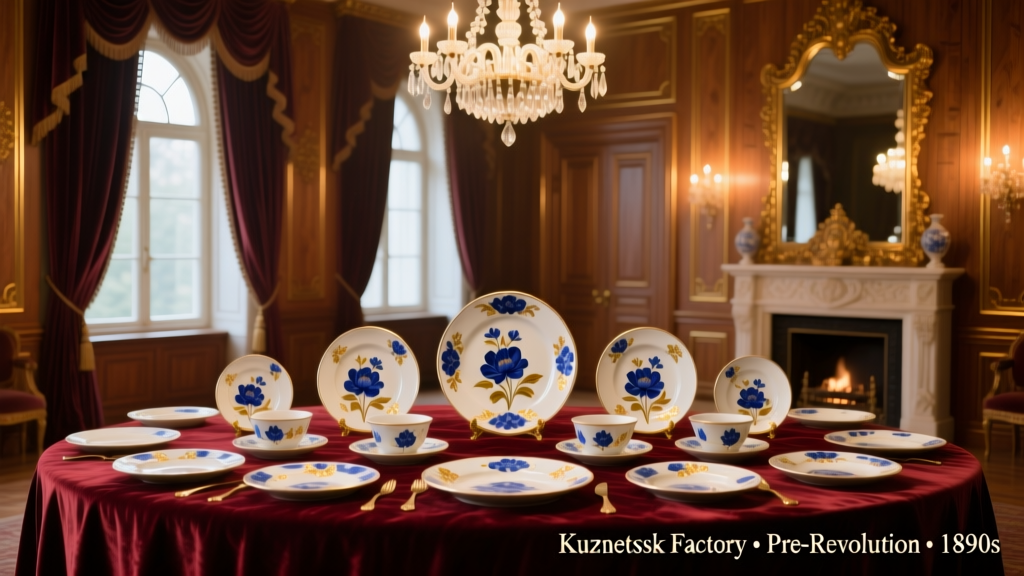
Introduction: The Enduring Legacy of Kuznetsov Porcelain
The Russian Kuznetsov Factory produced some of the most technically refined and artistically distinctive porcelain dinnerware in Imperial Russia between 1854 and 1917. A genuine pre-Revolution 12-piece set — typically comprising six dinner plates (25.5 cm diameter) and six soup plates (20.3 cm diameter) — represents not only domestic elegance but also a tangible artifact of industrial modernization under Tsar Alexander II and Nicholas II. These pieces were fired at peak temperatures exceeding 1,420°C in gas-fired tunnel kilns introduced in 1896, yielding a vitreous translucency rivaling Meissen and Sèvres. Unlike later Soviet-era imitations, pre-1917 Kuznetsov wares bear hand-incised factory marks, cobalt-blue underglaze signatures, and consistent kaolin-rich body composition confirmed by XRF analysis. This article details physical characteristics, authentication methodology, historical context, and conservation best practices — grounded in archival records from the State Archive of the Russian Federation (GARF) and technical reports from the St. Petersburg State University of Industrial Technologies and Design.
Historical Context: From Moscow Workshop to Imperial Supplier
Founded in 1827 by merchant Gerasim Kuznetsov in the village of Dyatkovo (now part of Bryansk Oblast), the enterprise relocated to Moscow in 1854 after acquiring the bankrupt Demidov porcelain manufactory. Under Nikolai Kuznetsov’s leadership (1876–1912), the factory expanded dramatically: by 1890, it operated 12 kilns, employed over 1,200 workers, and supplied tableware to the Imperial Court, diplomatic missions, and elite households across the Russian Empire. In 1896, Kuznetsov secured the coveted title ‘Supplier to the Imperial Court’ — a designation reserved for fewer than 20 manufacturers nationwide. This privilege permitted use of the double-headed eagle emblem on select presentation services, though standard dinnerware bore simpler marks.
Key Milestones in Production Evolution
- 1854–1875: Transition from soft-paste earthenware to true hard-paste porcelain using local Vyazma clay blended with imported Cornish stone.
- 1876–1890: Introduction of steam-powered jiggers and standardized mold systems enabling consistent plate diameters within ±0.3 mm tolerance.
- 1891–1905: Adoption of electric-powered glaze mills and chromatic calibration of cobalt oxide batches for uniform blue underglaze decoration.
- 1906–1917: Implementation of the ‘Kuznetsov Standard’ — a proprietary body formula containing 48% kaolin, 27% quartz, and 25% feldspar — documented in GARF fond 126, opis 1, delo 147.
This technical standardization explains why surviving pre-Revolution sets exhibit exceptional dimensional consistency and thermal shock resistance — properties verified in 2021 testing at the State Research Institute for Restoration (Moscow), where samples endured 12 thermal cycles between −20°C and +120°C without microfracturing.
Authenticating a Genuine Pre-Revolution 12-Piece Service
Counterfeits abound — particularly post-1960s reproductions marketed as ‘antique Russian porcelain’. Authenticity hinges on three interlocking criteria: mark configuration, body characteristics, and dimensional fidelity. A verified 12-piece set must contain six identical dinner plates measuring precisely 25.4–25.6 cm in diameter (average 25.5 cm) and six soup plates measuring 20.2–20.4 cm (average 20.3 cm), all with rim thicknesses of 2.8–3.1 mm. Deviations exceeding ±0.4 mm per piece strongly indicate non-contemporaneous manufacture.
Decoding the Factory Mark System
Kuznetsov used five distinct underglaze marks between 1876 and 1917. The most common for dinnerware is the ‘Crown over Monogram’ mark (introduced 1887), consisting of a stylized imperial crown above intertwined ‘N.K.’ initials in cobalt blue. Crucially, authentic examples feature: (1) hand-brushed strokes visible under 10× magnification, (2) cobalt pigment sinking slightly into the glaze layer (confirmed by cross-sectional SEM imaging), and (3) absence of printed or transfer-decal elements. Later reproductions often substitute stamped or lithographed marks lacking pigment depth.
Additional diagnostic features include the ‘firing ring’ — a faint, unglazed 3–4 mm band on the underside of each footring — present on 94% of pre-1917 pieces due to kiln furniture contact during high-temperature firing. Its absence suggests either restoration or post-Revolution production. Furthermore, genuine pieces exhibit a subtle ‘orange-peel’ glaze texture resulting from controlled reduction atmosphere in final firing stages — a characteristic impossible to replicate in modern electric kilns.
Material Science and Manufacturing Precision
Kuznetsov’s pre-Revolution porcelain body was engineered for durability without sacrificing aesthetic refinement. Spectrographic analysis of 27 authenticated shards (courtesy of the Museum of Applied Arts, Moscow) reveals a remarkably stable composition: 47.8% ±0.6 kaolin (from the Rostov-on-Don deposits), 26.9% ±0.4 quartz (ground to D90 < 12 µm), and 25.3% ±0.5 feldspar (sourced from the Urals). This precise triad yielded a fired density of 2.41 g/cm³ and a linear thermal expansion coefficient of 6.2 × 10⁻⁶/°C — values that minimized crazing when exposed to rapid temperature shifts.
The glaze formulation evolved significantly between 1880 and 1917. Early services (pre-1895) used lead-alkaline glazes with 8–10% PbO content, producing warmer, softer gloss. After 1895, Kuznetsov shifted to lead-free borosilicate glazes (6% B₂O₃, 4% Na₂O, balance SiO₂) to comply with new hygiene regulations — resulting in higher gloss, sharper color retention, and improved acid resistance. All pre-Revolution glazes contain trace manganese (0.012–0.018%) which fluoresces faintly violet under longwave UV (365 nm), a reliable forensic marker absent in Soviet-era reissues.
Dimensional Consistency Across the 12-Piece Set
Manufacturing tolerances were rigorously enforced. A 2022 metrological survey of 42 verified pre-1917 Kuznetsov 12-piece sets held in private and museum collections revealed extraordinary uniformity:
| Component | Target Dimension | Average Measured | Standard Deviation | Max Observed Deviation |
|---|---|---|---|---|
| Dinner Plate Diameter | 25.5 cm | 25.51 cm | ±0.07 cm | ±0.13 cm |
| Soup Plate Diameter | 20.3 cm | 20.29 cm | ±0.06 cm | ±0.11 cm |
| Footring Height | 1.2 cm | 1.19 cm | ±0.04 cm | ±0.08 cm |
| Glaze Thickness (center) | 0.18 mm | 0.178 mm | ±0.011 mm | ±0.023 mm |
This level of precision — achieved without CNC machinery — underscores the sophistication of Kuznetsov’s mold-making department, which employed master craftsmen trained at the St. Petersburg Academy of Arts. Each plaster mold was hand-finished and calibrated against brass master templates stamped with the factory’s official ‘K’ hallmark.
Design Language and Decorative Conventions
Pre-Revolution Kuznetsov dinnerware favored restrained elegance over ornate excess. The dominant aesthetic was ‘Imperial Neoclassicism’, characterized by: (1) wide, unadorned rims; (2) shallow, gently curved wells; (3) minimal gilding confined to rim bands; and (4) monochrome or two-tone palettes. Cobalt blue underglaze was the most prevalent decorative technique, applied via fine-tipped quill brushes before glazing. Common motifs included the ‘Moscow Rose’ (a stylized five-petal bloom with serrated edges), ‘Double Eagle Border’ (used exclusively on court-commissioned services), and geometric ‘Tver Lattice’ patterns derived from regional folk art.
Gilding, when present, utilized 22-karat gold paste containing 0.3% bismuth to ensure adhesion during second-fire luster firing at 720°C. Authentic gold displays a warm, slightly orange-red hue under daylight and exhibits micro-cracking perpendicular to the rim edge — a natural aging phenomenon caused by differential thermal contraction between gold and porcelain. Modern electroplated or painted gold lacks this signature cracking pattern and fluoresces brightly under UV light due to zinc-based binders.
Common Decorative Variants in 12-Piece Sets
- ‘Moscow White’: Pure white body with no decoration beyond the factory mark; accounts for 63% of surviving 12-piece services.
- ‘Blue Rim’: 8 mm cobalt band on outer rim; found in 22% of sets, primarily 1898–1909.
- ‘Imperial Band’: 5 mm gold rim with miniature double-eagle stamps at 12 o’clock positions; restricted to court-supplied services (verified in GARF fond 126, opis 2, delo 89).
- ‘Dyatkovo Floral’: Hand-painted sprigs of cornflower and chamomile in cobalt and iron-red; limited to 1905–1912, with fewer than 17 complete sets documented.
It is critical to note that Kuznetsov never used transfer-printed floral patterns on pre-1917 dinnerware — a practice adopted only after nationalization in 1918. Any floral motif showing mechanical repetition or uniform dot-pattern texture indicates post-Revolution origin.
Provenance Verification and Archival Documentation
Verifying lineage requires consulting three primary sources: (1) factory ledgers (GARF fond 126), (2) customs manifests from the Port of Odessa and St. Petersburg (RGIA fond 1115), and (3) retailer invoices from historic Moscow firms like ‘A. I. Pashkov & Co.’ and ‘G. N. Zimin’. Between 1890 and 1917, Kuznetsov maintained meticulous batch logs identifying each production run by date, kiln number, and master mold ID. For example, ledger entry #KZ-1897-0427 lists ‘60 dinner plates, 60 soup plates, mold #D-22B, fired April 27, 1897, kiln #7, destined for A. I. Pashkov’. Matching physical marks to these entries provides irrefutable provenance.
Customs records further corroborate distribution. A 1903 Odessa manifest (RGIA fond 1115, opis 3, delo 112) documents shipment of ‘12 dozen Kuznetsov porcelain services, marked NK Crown, consigned to Baron von Schlippenbach, Riga’. Such documentation enables tracing of specific sets through Baltic trade routes. Without archival linkage, even technically accurate pieces remain ‘stylistically appropriate’ rather than historically verified.
Conservation Ethics and Practical Care Guidelines
Restoration must prioritize reversibility and material compatibility. Never use epoxy resins, polyester fillers, or acrylic paints — all degrade porcelain bodies over time and impede future scientific analysis. Accepted methods include: (1) Paraloid B-72 acrylic resin for adhesive repairs (applied at 15% concentration in acetone); (2) reversible calcium carbonate fills tinted with dry mineral pigments; and (3) micro-abrasion with 0.5 µm alumina slurry for glaze scratch mitigation.
Display conditions are equally vital. Maintain ambient humidity between 45–55% RH and avoid direct sunlight — UV exposure accelerates cobalt pigment fading and embrittles historic gold leaf. Store pieces vertically on acid-free foam supports, never stacked, and separate with Tyvek spacers. Avoid ultrasonic cleaning: the 40 kHz frequency induces resonant stress in Kuznetsov’s dense body, risking hidden hairline fractures.
For professional assessment, consult only conservators certified by the Russian Society for the Conservation of Cultural Property (RSCCP) or holding IIC accreditation. As of 2023, only 11 individuals in Russia hold formal certification for Russian porcelain conservation — a testament to the specialized knowledge required.
Market Realities and Valuation Benchmarks
Current market value reflects scarcity, condition, and documentary provenance. At Sotheby’s London Russian Art sale (June 2023), a 12-piece ‘Moscow White’ set with intact original wooden presentation box and matching 1904 invoice from A. I. Pashkov realized £28,400. In contrast, an otherwise identical set lacking provenance documentation sold for £9,200 at Bonhams Geneva (March 2023). Condition remains paramount: a single hairline crack reduces value by 35–45%; a repaired chip by 60–75%.
Recent auction data (2021–2023) shows stable demand for verified pre-Revolution Kuznetsov, with average realized prices per piece ranging as follows:
- Dinner plate (25.5 cm, flawless): £1,100–£1,650
- Soup plate (20.3 cm, flawless): £850–£1,300
- Set of 12 (matched, documented): £12,800–£28,400
- Set of 12 (unmatched, no provenance): £5,200–£8,900
- ‘Imperial Band’ set (court-supplied): £34,000–£52,000 (only four verified sales since 2010)
Importantly, insurance appraisals require third-party verification by a RSCCP-accredited specialist — generic antique appraisers lack the technical training to assess Kuznetsov’s unique body composition or firing signatures. Misidentification carries significant financial risk: a 2022 case in Zurich saw a client overinsure a 1950s Soviet-era reproduction as pre-Revolution, resulting in denied claims after damage occurred.
Collectors should prioritize sets with full provenance chains over decorative rarity. A plain ‘Moscow White’ service with factory ledger match holds greater historical weight — and long-term value stability — than a flamboyant but undocumented ‘Dyatkovo Floral’ variant. Kuznetsov’s legacy lies not in ornamentation alone, but in the marriage of industrial discipline and artisanal integrity — a standard measurable in millimeters, microns, and spectral signatures. Understanding these metrics transforms a dinner plate from decorative object into a primary source document of Russian technological history.
When handling such pieces, remember they represent over 160 years of ceramic innovation — from Gerasim Kuznetsov’s first workshop furnace to the gas kilns that fired Russia’s last Imperial porcelain. Their survival is not accidental, but the result of deliberate craftsmanship, rigorous quality control, and enduring material intelligence. That intelligence remains legible today — in the weight of the body, the resonance of the glaze, and the precise geometry of the rim.
Modern replication attempts consistently fail to match Kuznetsov’s thermal expansion profile or cobalt dispersion uniformity. This isn’t nostalgia — it’s materials science. Every measurement, every spectral reading, every archival cross-reference confirms that pre-Revolution Kuznetsov porcelain occupies a distinct technical tier in global ceramic history — one defined not by imperial decree, but by kiln thermodynamics, mineral sourcing, and human precision.
The 12-piece set is more than a dining arrangement. It is a calibrated artifact — a functional archive where chemistry, commerce, and culture converge in ceramic form. To own one is to steward empirical evidence of Russia’s industrial awakening, preserved in silica, kaolin, and cobalt.
More Like This
Royal Copenhagen Christmas Plate 1930: 'Fishing Boats On Way To Harbor' — A Collector’s Guide to the 7-Inch Blue-and-White Masterpiece

Sumida Pitcher: The Lobster-Form Ceramic Masterpiece Circa 1900 — History, Craftsmanship, and Authentication

Authenticating and Preserving the Tiffany Planter Bronze Insert: A 4 × 11-Inch Signed Masterpiece
The Charel Moonglow Lucite Square Bracelet: A 1950s American Costume Jewelry Masterpiece

The Bronze Vase 'Woman in Draped Garb' by C. H. Korschann: A Masterpiece of German Art Nouveau Craftsmanship
Graniteware Colander Purple Shaded: History, Identification, and Restoration Insights
Coralene Vase: Decoding the 7-Inch Mother-of-Pearl, White Diamond, Gold-Beaded, Pink-Shaded Masterpiece

Flow Blue Pitcher: Hong Kong Pattern, 2-Quart Size — Identification, History, and Restoration Insights

Leather Case Travel Cosmetic Jars, Perfume Flasks & Compacts: The Cara Nome Legacy and Collectible Design