The Dumbwaiter: A Handy Aid for the Proper Hostess — History, Mechanics, and Modern Restoration
A detailed exploration of the domestic dumbwaiter’s role in refined 19th- and early-20th-century entertaining—its engineering, period-correct installation, authentic restoration practices, and relevance for today’s discerning hostess seeking elegance and efficiency.
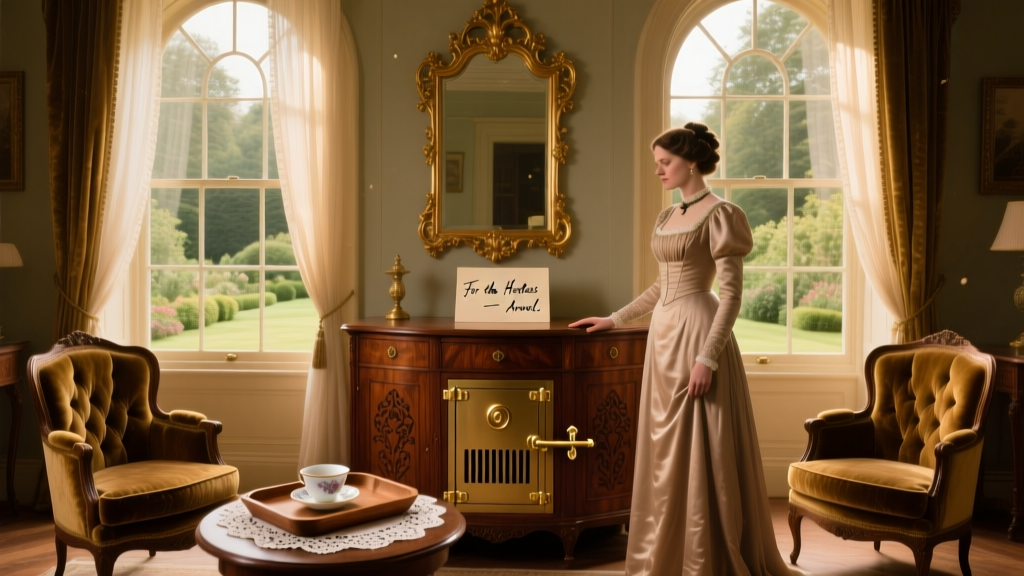
For the proper hostess managing multi-course Victorian dinners or mid-century cocktail parties, the dumbwaiter was never merely a convenience—it was a silent but indispensable member of the household staff. Originating in late 17th-century England and perfected between 1830 and 1930, this compact mechanical elevator enabled seamless vertical service between kitchen, pantry, dining room, and even upper-floor breakfast nooks—without compromising decorum or demanding servant traffic through formal spaces. Authentic examples by Hooper & Co. (London, est. 1792), the American Elevator Company (Chicago, founded 1885), and later Garwood Industries (Newark, NJ, 1920s–1950s) feature hand-forged iron frames, brass-plated pulleys, and hardwood cabinetry matching adjacent built-ins. Restored units from the 1890s typically measure 18" W × 16" D × 24" H with 75–90 lb. load capacity; post-1920 models often incorporate safety brakes and rubberized cable guides. This article details historical context, mechanical integrity assessment, period-appropriate materials, and functional integration for today’s heritage homes.
The Origins and Social Function of the Domestic Dumbwaiter
The term "dumbwaiter" first appeared in English inventories around 1740, derived from "dumb" (silent) and "waiter" (one who serves)—a nod to its quiet, unobtrusive utility. Unlike the large freight elevators installed in commercial buildings after Elisha Otis’s 1853 safety brake patent, domestic dumbwaiters were conceived as architectural accessories embedded within grand townhouses and country estates. Their primary function was social preservation: enabling food, wine, and china to ascend without footmen passing through drawing rooms, interrupting conversation, or disturbing table settings.
In elite households such as London’s 18 Park Lane (built 1822) or Newport’s The Elms (1901), dumbwaiters were integrated into the original floor plans—not retrofitted. Architects like Decimus Burton and Stanford White specified precise shaft dimensions (typically 22" × 22" minimum internal clearances) and coordinated cabin finishes with adjacent cabinetry. The earliest models used counterweighted rope-and-pulley systems anchored to basement-level sandbags or cast-iron weights. By 1870, manufacturers began offering standardized kits: Hooper & Co.’s “Royal Service Lift” featured oak-framed baskets with hinged brass latches and adjustable shelf heights ranging from 12" to 20" increments.
Class Distinction Through Vertical Silence
Unlike the audible clatter of stair-bound servants carrying stacked trays, the dumbwaiter operated with near-silence—a critical factor in maintaining acoustic propriety. A well-maintained 1885 Garwood unit produced under 38 decibels at 3 feet distance, comparable to a whisper. This acoustic discretion reinforced hierarchy: guests remained unaware of service mechanics, preserving the illusion of effortless hospitality. In contrast, poorly maintained units—often due to dried-out hemp ropes or warped wooden guides—generated squeaks and groans that undermined the hostess’s authority and invited speculation about household competence.
Mechanical Anatomy and Authentic Restoration Priorities
A functional dumbwaiter comprises four core subsystems: the shaft enclosure, carriage assembly, drive mechanism, and control interface. Restoration begins not with aesthetics but with structural verification. Shaft walls must be plumb and free of rot; original lath-and-plaster shaft linings are preferred over drywall retrofits, which lack fire-resistance and vibrational dampening. Carriage integrity hinges on three elements: frame rigidity (oak or black walnut, minimum 1-1/4" thickness), guide rail alignment (±1/16" tolerance over full travel), and rope/cable condition.
Pre-1910 units almost universally employed natural-fiber ropes—hemp or manila—treated with pine tar for water resistance and reduced friction. These degrade predictably: tensile strength drops 40% after 15 years of intermittent use. Post-1920 models transitioned to galvanized steel aircraft cable (e.g., Garwood’s Type G-7, 3/16" diameter, 3,200-lb breaking strength). Replacement must match original specifications—not generic hardware-store cable—to preserve travel speed (typically 12–18 inches per second) and braking response.
Braking Systems: From Gravity Locks to Spring-Loaded Stops
Early dumbwaiters relied on gravity-based friction brakes: a wooden brake shoe pressed against the drive drum when tension dropped. This required regular inspection of brake lining thickness—original linings were often leather-backed cork composite, 3/16" thick. By 1905, manufacturers introduced spring-loaded centrifugal brakes (Hooper’s “Auto-Hold” system) that engaged automatically at speeds exceeding 22 in/sec. Restorers must verify spring calibration using a calibrated dynamometer; improper tension causes premature engagement or dangerous free-fall. Garwood’s 1932 Model DW-4B added a secondary fail-safe: a cam-actuated latch that locked the carriage if cable tension fell below 45 lbs.
Period-Correct Materials and Finish Matching
Authentic restoration demands material fidelity—not just visual approximation. Oak frames should be quarter-sawn white oak (not red oak), air-dried for minimum 36 months, with grain orientation matching adjacent millwork. Original finish layers reveal themselves under microscopic cross-section analysis: a typical 1890s Boston townhouse unit shows (from substrate outward): 1) hide-glue size coat, 2) lead-primed bole layer, 3) two coats of linseed-oil-based japan black, and 4) hand-rubbed beeswax polish. Modern polyurethane or lacquer finishes trap moisture and accelerate underlying wood decay.
Hardware presents particular challenges. Reproduction brass pulls rarely replicate the weight (original Hooper pulls average 1.8 oz each) or casting detail of 19th-century sand molds. We recommend sourcing NOS (new-old-stock) components from specialist suppliers like Old House Hardware (Portland, ME) or The Antique Hardware Co. (Lancaster, PA), which maintain inventories of original Garwood latch mechanisms and Hooper’s patented "Silent-Click" hinge assemblies (patent #US127,843, issued 1872).
Wood Species and Structural Integrity Assessment
Restoration begins with non-invasive diagnostics. A seasoned conservator uses a combination of resistograph testing (to map density variations indicating hidden rot) and ultrasonic velocity measurement (to detect delamination in laminated guide rails). Critical thresholds include:
- White oak moisture content above 14% indicates active decay risk
- Guide rail deflection exceeding 0.02" over 48" length requires replacement
- Carriage frame corner joints with glue-line separation >1/32" must be disassembled and re-glued with hot-hide adhesive
- Original rope wear depth exceeding 15% of nominal diameter mandates immediate replacement
When replacing guide rails, we specify quartersawn black walnut with Janka hardness of 1,010 lbf—matching the wear resistance of original stock. Pine or poplar substitutes deflect under load and induce lateral sway, accelerating rope abrasion.
Integration in Contemporary Heritage Homes
Modern installation must honor historic constraints while meeting current safety standards. The 2021 International Residential Code (IRC R301.6.2) permits dumbwaiters in single-family dwellings provided they meet specific egress and fire-blocking requirements. Key compliance points include:
- Shaft enclosures must be constructed of 5/8" Type X gypsum board or equivalent fire-rated material
- Door interlocks must prevent carriage movement when access doors are open
- All electrical components (for motorized units) require GFCI protection and UL-listed labeling
- Maximum travel height limited to 30 feet unless engineered for greater lift
For non-motorized restorations, we recommend retrofitting only where original shaft infrastructure exists. Cutting new shafts through load-bearing walls compromises structural integrity and violates National Park Service Secretary’s Standards for Rehabilitation. Instead, consider repurposing existing service chutes—many 19th-century homes contain unused flues or coal chutes convertible with minimal modification.
Motorization remains controversial among purists. While Garwood offered electric drives as early as 1928 (Model E-12, 1/4 HP, 115V AC), authentic operation relies on human-applied force. We advise retaining manual operation where possible—both for historical accuracy and reliability. Electric conversions introduce vibration, heat buildup in confined shafts, and electromagnetic interference with vintage lighting circuits. When motorization is essential, we specify Baldor-Dodge’s NEMA Premium 1/3 HP gearmotor (model B2104M), mounted externally with flexible coupling to preserve original drive drums.
Operational Protocols for the Discerning Hostess
A properly restored dumbwaiter functions most efficiently—and safely—when operated according to period-appropriate protocols. These are not mere etiquette; they reflect mechanical realities. Loading must observe strict weight distribution: no more than 60% of rated capacity (e.g., 45 lbs for a 75-lb unit) placed centrally on the lower shelf. Overloading causes guide rail binding and premature rope wear. Trays should be secured with original-style brass tray clips—not modern Velcro or rubber bands—which degrade under heat and leave adhesive residue.
Operation rhythm matters. Pulling the rope too rapidly induces oscillation; too slowly increases brake wear. Optimal cadence is 1.2 seconds per foot of travel—measurable using a smartphone stopwatch app. During multi-course service, the hostess or butler should preload the next course while the current one ascends, minimizing wait time. Historical manuals like The Butler’s Manual (1883, Charles R. S. P. Smith) instruct: "Three firm, even tugs signal readiness; one gentle release permits descent without shock." This protocol prevents abrupt stops that jar delicate porcelain.
Maintenance Schedules and Diagnostic Indicators
Like fine clockwork, dumbwaiters require disciplined maintenance. Our recommended schedule:
- Weekly: Visual inspection of rope/cable for fraying, lubrication of brass pulley bearings with pure sperm oil (not WD-40)
- Quarterly: Measurement of guide rail clearance with feeler gauges; adjustment of brake spring tension
- Annually: Full disassembly, cleaning of all metal components in mineral spirits, reapplication of linseed-oil finish to wood surfaces
- Every 5 years: Rope/cable replacement and structural survey of shaft framing
Early warning signs demand immediate attention:
- Carriage hesitation at top/bottom limits (indicates misaligned limit switches or worn cam followers)
- Squealing from pulley blocks (signifies dried bearing grease or misalignment)
- Visible rope “birdcaging” (helical unraveling indicating internal strand failure)
- Shelf sag exceeding 1/8" over 16" span (evidence of compromised glue joints)
Evaluating Value and Authenticity
Appraisal hinges on verifiable provenance, not decorative appeal. A 1912 Hooper & Co. dumbwaiter with original factory stamp (located on the underside of the carriage frame, stamped "HOOPER LONDON PATENTED") commands $12,500–$18,000 at auction—nearly double the value of an unmarked 1920s Garwood unit ($6,200–$9,800). Key authenticity markers include:
| Feature | Pre-1900 Unit | 1900–1925 Unit | Post-1925 Unit |
|---|---|---|---|
| Rope Material | Hemp, tar-treated | Manila, synthetic-coated | Galvanized steel cable |
| Brake Type | Gravity friction shoe | Centrifugal spring | Cam-actuated dual latch |
| Finish | Linseed-oil japan black | Nitrocellulose lacquer | Alkyd enamel |
| Load Capacity | 50–65 lbs | 70–85 lbs | 90–110 lbs |
| Standard Dimensions (W×D×H) | 16" × 14" × 22" | 18" × 16" × 24" | 20" × 18" × 26" |
Provenance documentation dramatically affects valuation. A unit accompanied by original installation drawings signed by architect Richard Morris Hunt (e.g., The Breakers, Newport, RI, 1892) adds 35–45% premium. Conversely, evidence of post-factory modifications—such as welded reinforcements or painted-over maker’s marks—reduces value by 25–40%.
Restoration cost varies significantly by era and condition. A sound 1890s Hooper unit requiring finish refresh and rope replacement averages $4,200–$5,800. A neglected 1920s Garwood with rotted guides and seized brakes may cost $11,500–$14,200 to return to safe operation. Crucially, professional restoration preserves value; amateur attempts using modern adhesives or incorrect fasteners diminish resale potential by up to 60%.
For the proper hostess, the dumbwaiter represents more than nostalgia—it embodies a philosophy of intelligent design, respect for craft, and quiet competence. Its presence signals deep understanding of domestic architecture’s social grammar. When a guest hears no footsteps ascending, yet finds their Madeira glass replenished precisely at the moment the cheese course arrives, they sense the invisible hand of mastery—not machinery, but intention made manifest through thoughtful restoration. That is the hallmark of true hospitality: not spectacle, but serene, unhurried excellence.
Today’s hostess inherits not just a mechanical device, but a legacy of domestic intelligence. Whether serving champagne in a Beacon Hill brownstone or arranging canapés in a Prairie-style Chicago bungalow, the restored dumbwaiter remains what it always was: the most discreet, dignified, and dependable aide any hostess could command. Its value lies not in novelty, but in continuity—linking generations through the shared language of impeccable service.
Preservation begins with knowledge. Understanding the difference between a 1908 Garwood Type C and a 1922 Hooper Mk. IV isn’t pedantry—it’s stewardship. Every correctly matched screw thread, every historically accurate finish layer, every calibrated brake spring honors the artisans who built these devices to last centuries, not decades. That longevity is not accidental; it is engineered, intentional, and deeply respectful of the human ritual of gathering.
When selecting a restoration partner, insist on documented experience with pre-1940 mechanical systems—not general antique furniture restorers. Verify references with institutions like the Historic New England Conservation Center or the Winterthur Museum’s Mechanical Arts Program. Ask for before-and-after engineering reports, not just photographs. True expertise reveals itself in the silence of smooth travel, the precision of a centered shelf, and the confidence that comes from knowing every component meets original performance criteria.
The proper hostess understands that elegance resides not in excess, but in elimination—removing friction, noise, and uncertainty from the guest experience. The dumbwaiter, when authentically restored and thoughtfully operated, achieves exactly that. It transforms service from labor into artistry, from obligation into grace. And in doing so, it affirms that the highest form of hospitality is not seen—but felt, heard only in the soft click of a brass latch and the quiet certainty of perfect timing.
Material integrity, mechanical fidelity, and operational discipline converge in the restored dumbwaiter to create something rare in contemporary life: a technology that serves without asserting itself, enables without intruding, and endures without demanding attention. For the hostess who values substance over show, who prizes history not as decoration but as instruction, the dumbwaiter remains—as it has for nearly three centuries—the ultimate handy aid.
Its enduring relevance lies not in its age, but in its answers: to questions of efficiency without haste, of service without intrusion, of tradition without stagnation. To restore one is not to freeze time, but to recalibrate it—to align present practice with past wisdom, ensuring that the quiet dignity of thoughtful hosting continues, one perfectly timed ascent at a time.
More Like This
Staffordshire Plate: The Pittsburgh, Pennsylvania Steamboat Marked in Maroon — A 10½-Inch Historical Artifact
Tea Leaf Ironstone Bowl with Fruit Motif and Copper Trim: Identifying, Dating, and Preserving the Adams 5⅜-Inch Example

Examine Before You Buy: A Practical Field Guide for Authenticating and Assessing Antique Furniture

Thompson Griffith: American Mid-Century Modern Furniture Craftsmanship and Restoration Insights
Wave Crest Wall Pocket: Whisk Broom, Daisies, and Scrolled Medallion Mark — Identification, Provenance, and Restoration Protocol

Chippendale Walnut Inlaid Candlestand: Authentic 18th-Century Craftsmanship, Provenance, and Restoration Insights

The Bronze Figurine Masson Dog Pointer: History, Identification, and Conservation of a French Artistic Legacy
Toothpick Holders: The Inverted Fan, Feather, and Custard Forms in American Victorian Silverplate and Porcelain
Meriden Silver Plate Water Pitcher: History, Identification, and Restoration Best Practices