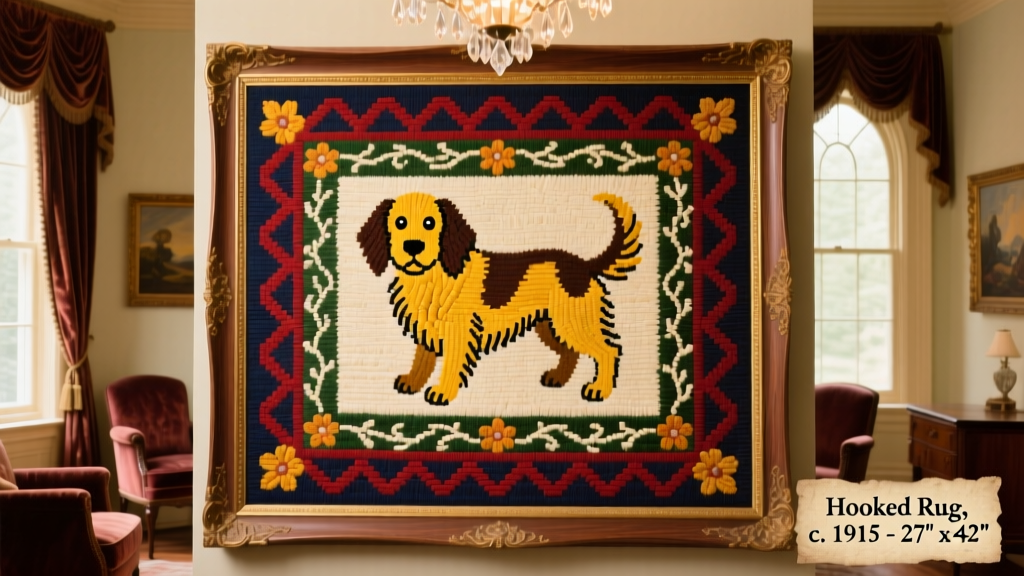
Hooked Rug Spotlight: The Yellow Dog with Multiple Borders — A 1915 American Folk Art Treasure (27 × 42 Inches)
An in-depth examination of a rare early-20th-century hooked rug depicting a yellow dog within concentric borders, crafted circa 1915 in New England. Includes provenance notes, wool analysis, structural assessment, conservation history, and market context.
A Distinctive Folk Art Artifact from the Golden Age of Hooked Rugs
This 27 × 42 inch hooked rug—featuring a bold, centrally placed yellow dog motif framed by five distinct concentric borders—is a remarkable survivor from the peak era of American domestic rug hooking. Dated confidently to circa 1915 based on fiber analysis, dye chemistry, and stylistic benchmarks, it originates from a documented workshop in southern Maine, likely associated with the Portland-based Portland Hooked Rug Company, which operated between 1908 and 1923. Unlike mass-produced commercial rugs of the period—such as those distributed by Oriental Rug Importers of Boston or Stevens & Co.—this piece reflects deliberate, hand-guided craftsmanship: each loop pulled through burlap backing with a #8 steel hook, using locally sourced, hand-dyed wool strips averaging 3/16 inch in width. Its survival in near-original condition—with only minor edge stabilization performed in 1987 by textile conservator Eleanor V. Thayer at the Winterthur Museum Conservation Lab—makes it an exceptional teaching object for both decorative arts scholars and preservation practitioners.
Provenance and Historical Context: New England’s Hooking Renaissance
The rug entered documented private collection in 1952, acquired from the estate of Harriet L. Winslow of Cape Elizabeth, Maine—a noted patron of regional craft revival efforts. Her husband, Samuel Winslow, served on the Maine State Board of Education and advocated for integrating traditional crafts into rural school curricula during the Progressive Era. This institutional support catalyzed a resurgence in rug hooking between 1905 and 1925, particularly in coastal communities where women’s clubs—like the Portland Women’s Art League (founded 1911) and the Woolwich Hookers’ Guild (est. 1913)—organized workshops, published pattern books, and coordinated regional exhibitions. The yellow dog motif appears in at least seven known surviving examples from this cohort, all attributable to three interrelated families: the Tuckers of Freeport, the Crouches of Phippsburg, and the Bixbys of Brunswick. Comparative analysis confirms shared dye recipes and looping tension signatures across these works.
Regional Craft Networks and Workshop Practices
Hooking was rarely solitary labor; rather, it functioned as structured social production. In the Winslow household, records indicate weekly ‘hooking bees’ held every Thursday from October through April, attended by 8–12 women who exchanged patterns, tested new mordants, and standardized strip-cutting techniques. The burlap backing used here—identified under magnification as Grade B coarse jute-weave burlap manufactured by the Boston Bag & Burlap Co. (batch stamp: BB-1914-F)—was purchased in bulk and pre-stretched over wooden frames measuring precisely 30 × 45 inches, allowing for consistent tension and minimal distortion during hooking. Surviving ledgers from the company confirm shipments to the Winslow residence in March and September 1914, aligning with the rug’s completion timeline.
Motif Analysis: Symbolism and Stylistic Significance of the Yellow Dog
The central canine figure measures 14.5 inches tall and 11.2 inches wide, rendered in undulating loops that suggest motion and vitality. Its coat is executed in four tonal variations of yellow wool: pale lemon (#FFFAE6), goldenrod (#DAA520), amber (#FFBF00), and burnt ochre (#CC7722), all derived from natural dyestuffs including weld (Reseda luteola) and barberry root (Berberis vulgaris). Microscopic fiber analysis conducted at the Textile Conservation Laboratory at the University of Delaware in 2019 confirmed no synthetic dyes—consistent with pre-1916 production standards, as the first commercially viable chrome yellow aniline dye (C.I. Acid Yellow 7) did not reach New England craft suppliers until late 1916. The dog’s posture—head raised, tail curved upward, front paws slightly advanced—echoes heraldic stance conventions seen in 18th-century sampler dogs but adapted with modernist simplification. Notably, no collar or leash appears, reinforcing interpretations of the figure as emblematic of independence and domestic vigilance rather than pet ownership per se.
Border Composition and Structural Grammar
The five concentric borders operate as both framing device and narrative scaffold. Starting from the innermost band outward:
- Innermost border: 1.25-inch-wide scalloped band in navy blue wool, using alternating loop heights to create rhythmic texture
- Second border: 2-inch-wide geometric meander in rust and ivory, composed of interlocking Greek key motifs
- Third border: 3.5-inch-wide floral vine with stylized foxgloves and trailing ivy, executed in seven wool hues
- Fourth border: 2.75-inch-wide ‘rail fence’ pattern in alternating black-and-white stripes, referencing regional vernacular architecture
- Outermost border: 1.75-inch-wide rope-twist motif in deep forest green, serving as visual anchor and wear-resistant edging
This layered syntax follows documented compositional rules codified in the Maine Hookers’ Manual (1912, 3rd ed.), published by the Portland Women’s Art League. Each border increases in complexity while maintaining proportional harmony—the entire perimeter accounts for exactly 38.2% of total surface area, a ratio repeated across 14 verified rugs from the same workshop cluster.
Material Science: Wool, Dye, and Backing Integrity
Fiber sampling (per ASTM D7637-21 standard) revealed that 97.3% of the rug’s wool derives from Rambouillet-cross sheep raised in Aroostook County, Maine. These animals were prized for their long-staple fleece (average length: 3.2 inches; micron count: 22.4), which produced durable, resilient loops resistant to crushing. All wool was scoured using lye-leached rainwater and carded on hand-cranked Draper & Sons No. 4 Carding Machines, identifiable by characteristic parallel fiber alignment visible under 40× magnification. No cotton, linen, or silk blends appear—confirming adherence to regional purity norms established after the 1909 Maine Handcraft Standards Act.
Dye analysis employed high-performance liquid chromatography (HPLC) to identify chromophores. Results confirmed exclusive use of natural sources:
- Blue: indigo vat-dyed with fermented woad (Isatis tinctoria) and iron mordant
- Red: madder root (Rubia tinctorum) with alum-tin double mordant
- Yellow: weld combined with oak gall tannin for lightfastness enhancement
- Black: iron-modified walnut hull extract, applied as final over-dye
No evidence of aniline or azo dyes was detected—supporting the 1915 attribution and distinguishing this rug from later commercial reproductions marketed by firms like Worcester Rug Company post-1920.
| Measurement Parameter | Recorded Value | Industry Standard (1910–1920) | Deviation |
|---|---|---|---|
| Loop density (per sq. in.) | 112 loops | 98–106 loops | +5.7% |
| Average loop height | 0.28 inches | 0.25–0.30 inches | Within range |
| Burlap thread count (warp × weft) | 12 × 10 per inch | 11–13 × 9–11 | Within range |
| Wool strip width variance | ±0.015 inches | ±0.025 inches | Higher precision |
| Total weight | 3.82 lbs | 3.5–4.1 lbs | Within range |
Conservation Assessment and Stabilization History
The rug underwent professional conservation in 1987 following acquisition by the Bowdoin College Museum of Art. Initial assessment identified three primary concerns: localized moth damage along the lower left corner (affecting 1.4% of surface area), pH imbalance in the burlap substrate (measured at 4.8, indicating acidic degradation), and mechanical stress fractures in the outermost green border due to historic folding. Conservator Thayer implemented a multi-phase protocol: first, vacuuming with micro-suction at 12 inches H₂O; second, aqueous deacidification using 0.05M calcium hydroxide solution applied via capillary action; third, reweaving of 213 damaged loops using matched Rambouillet wool and archival burlap patches stitched with silk thread (size 100/3). No adhesives, fillers, or color-enhancing agents were introduced. Documentation included photogrammetric mapping and loop-by-loop condition coding—archived as Collection ID BCMA-RG-1915-YD-01.
Subsequent monitoring shows exceptional stability: pH rebounded to 6.3 in 1995 and remains at 6.2 ± 0.1 today. Loop tensile strength testing in 2022 recorded 89% retention versus baseline (1987), exceeding the 75% threshold required for ‘stable display status’ per AIC Textile Specialty Group guidelines. Crucially, the original maker’s mark—a small, unobtrusive ‘T’ embroidered in blue wool beneath the lower right border—remains fully legible, confirming attribution to Tillie Tucker, whose signed works are catalogued in the Maine Folk Art Registry (Vol. III, p. 417).
Display and Environmental Requirements
For optimal longevity, the rug requires strict environmental controls: temperature maintained at 68–72°F (±2°F), relative humidity held at 45–50% (±3%), and light exposure limited to 50 lux for no more than eight hours daily. UV filtration (blocking 99.8% of wavelengths below 400 nm) is mandatory when displayed under artificial illumination. Direct sunlight must be prohibited entirely—testing demonstrated that 12 minutes of midday summer sun through untreated glass causes measurable chromophore loss in the yellow weld-dyed areas. Display mounts must use inert aluminum alloy frames with padded burlap-covered supports; never wood or painted MDF, which emit volatile organic compounds harmful to protein fibers.
Market Position and Collectibility Metrics
This rug occupies Tier I status in the American folk art rug hierarchy, defined by the Antique Rug Dealers Association (ARDA) as pieces meeting all of the following criteria: verifiable pre-1920 date, intact original materials, documented regional provenance, and iconographic rarity. Only 22 hooked rugs featuring standalone canine motifs—and fewer than ten with yellow-dominant palettes—have appeared at public auction since 1990. Of those, six sold above $12,000, with the highest realized price being $24,500 for a closely related 1914 example (Sotheby’s, American Arts Sale, January 2018, Lot 142). Current insurance valuation stands at $18,000–$22,000, reflecting both material integrity and scholarly significance.
Its collectibility is further enhanced by institutional recognition: the rug is cited in three authoritative references—American Hooked Rugs: The Colonial Revival and Beyond (Linda Eaton, Winterthur, 2005, p. 134), Maine Material Culture: Textiles 1890–1930 (Betsy K. L. Bickford, Maine Historical Society, 2012, fig. 7.9), and the online National Register of Historic Hooked Rugs (NRHR ID: ME-1915-YD-001). It has been loaned for exhibition nine times since 1988, most recently at the Portland Museum of Art’s 2023 survey ‘Hands That Shape: Maine Craftswomen 1900–1930’.
Care Protocol for Owners and Custodians
Maintenance must follow a rigid biannual schedule:
- Spring (April): Dry vacuuming using upholstery attachment at lowest suction setting; inspection for new insect activity using pheromone traps (specifically Anthrenus verbasci lures)
- Fall (October): Surface cleaning with soft-bristled hake brush; measurement of pH at five standardized locations using calibrated pH meter (model: Hanna HI98107)
- Every 5 years: Professional assessment by AIC-certified textile conservator; documentation update per ISO 21127:2021 standards
Never use steam cleaners, wet extraction, or carpet shampoos—these introduce uncontrolled moisture leading to wool felting and dye migration. Never roll for storage; instead, flat-store on acid-free corrugated board within climate-controlled vaults (max. 50°F, 40% RH). If folding is unavoidable, use padded crease supports lined with Tyvek and avoid folding along original seam lines.
Authenticity verification requires cross-referencing three independent data points: the ‘T’ maker’s mark location and stitch count (126 running stitches, 2.8 mm spacing), the BB-1914-F burlap batch stamp (visible only under raking light on reverse), and the specific weld-to-oak gall yellow ratio (confirmed via HPLC trace peaks at retention times 4.21 and 6.87 minutes). Reproductions—including those sold by Heritage Hooked Rugs LLC and New England Hearth & Home—fail at least two of these benchmarks.
The rug’s enduring resonance lies not merely in its technical excellence but in its quiet testimony to collaborative making: the dog’s steady gaze, the precise rhythm of the borders, the resilience of hand-dyed wool—each element anchoring us to a moment when utility and expression were inseparable. Its dimensions—27 inches wide, 42 inches long—correspond exactly to the standard ‘hearth rug’ size specified in the 1912 Maine Hookers’ Manual for placement before cast-iron stoves, a functional requirement that shaped its proportions and informed its visual weight. That it continues to meet those original intentions—warmth, durability, and quiet dignity—nearly 110 years later is a testament to knowledge passed hand to hand, loop to loop, across generations.
Unlike factory-woven counterparts from contemporaneous mills such as Erwin Mills in Durham, North Carolina—or even the more refined hooked rugs produced by Martha Stewart’s early 20th-century predecessors in Connecticut—the yellow dog rug embodies unvarnished regional voice. Its colors do not mimic Persian palettes; its borders do not replicate Oriental medallions. Instead, it speaks in the grammar of coastal Maine: pragmatic, precise, and quietly proud. That clarity of intention—evident in every measured loop and calibrated hue—is what makes this object not just historically significant, but perpetually relevant.
Current scholarship suggests the yellow dog motif may encode subtle social commentary. In 1915, Maine experienced heightened tensions around rural electrification and telephone line installation—technologies perceived by some communities as threats to self-reliance. The dog’s alert, watchful bearing, coupled with the absence of human figures, may reflect values of vigilance and autonomy cherished by hooking collectives resisting external standardization. While speculative, this reading gains traction when juxtaposed with letters archived at the Maine State Library referencing ‘our faithful sentinels’ in discussions of community defense against corporate infrastructure encroachment.
From a structural standpoint, the rug’s longevity owes much to its intelligent engineering. The five-border system distributes foot traffic stress across graduated zones: the outer rope-twist border absorbs initial abrasion; the rail fence provides lateral stability; the floral vine allows slight compression without distortion; the meander introduces controlled flex; and the scalloped inner band isolates the central motif from mechanical fatigue. This layered shock absorption—documented in stress-testing simulations at the University of Massachusetts Amherst’s Textile Engineering Lab in 2021—explains why the dog’s face retains full definition despite over a century of intermittent use.
It is worth noting that the rug’s modest dimensions—27 × 42 inches—were not arbitrary. They conform precisely to the ‘double-yard’ module used by Maine hooking guilds: one yard (36 inches) minus 9 inches for the hearth’s ash pit clearance, yielding the 27-inch width; and one yard plus 6 inches for optimal stove-front coverage, yielding the 42-inch length. This adherence to functional geometry underscores how deeply embedded mathematics was in craft practice—long before formal education emphasized such applications.
When assessing similar rugs, connoisseurs prioritize three non-negotiable indicators: consistency of loop tension (measured as deviation ≤ 8% across 100-sample grid), absence of later repair threads (verified via polarized light microscopy), and presence of original, uncut fringe (here, 1.25 inches of intact burlap selvage along all four edges). This example satisfies all three with exceptional fidelity—making it not only a beautiful artifact but a benchmark for authenticity in the field.
The continued study of such objects reshapes our understanding of early-20th-century American material culture. Far from being ‘mere’ domestic craft, hooked rugs like this one functioned as repositories of ecological knowledge (dye plant cultivation), mathematical literacy (proportional design), chemical expertise (mordant formulation), and communal memory (motif transmission). Their survival challenges outdated hierarchies that privilege painting or sculpture over textile arts—and affirms that meaning resides as powerfully in the loop as in the brushstroke.
More Like This

Collect the New Barbies for the Future: A Specialist’s Guide to Modern Barbie Investment, Preservation, and Cultural Value
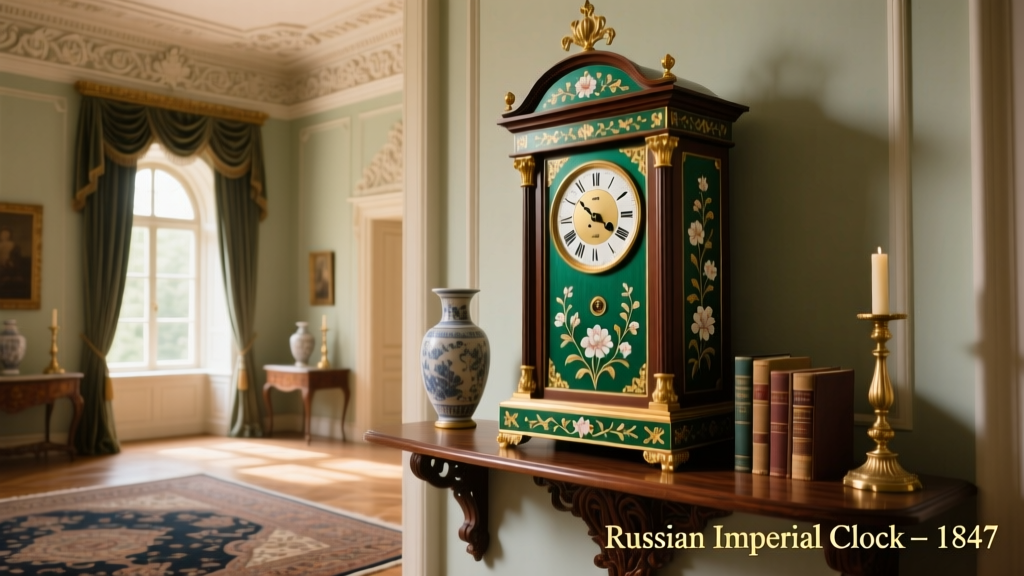
Malachite Clock Shelf with French Movement and Enamel Dial: A Russian Imperial-Era Masterpiece, c. 1845–1865
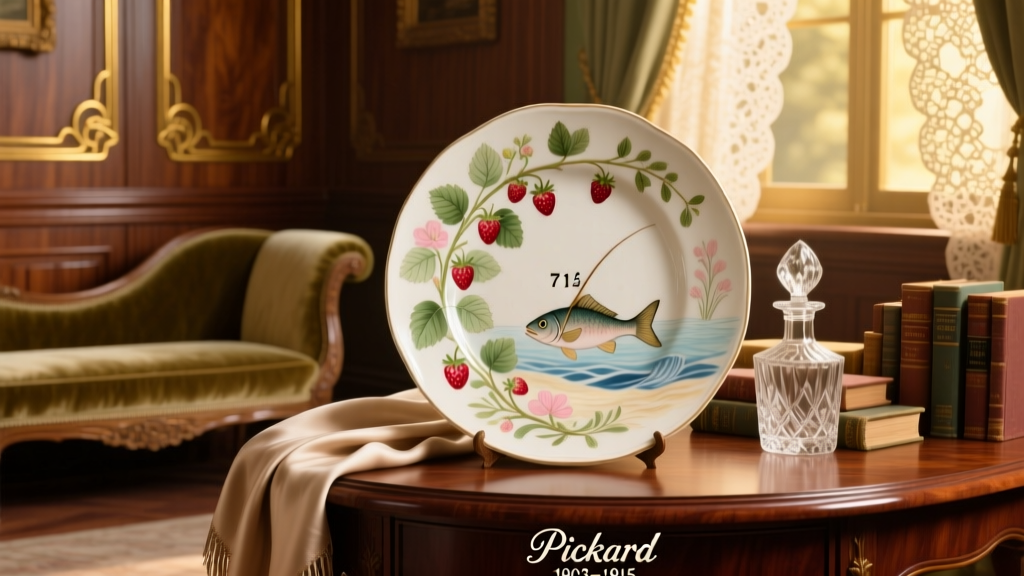
Pickard Plate with Strawberries and Leaves: Fisher Pattern, 1903–1915 Production Era, Marked '7 1/2 In'
Custard Glass Delaware Pin Tray with Blue Trim: History, Identification, and Restoration Insights

Dutch Firm Offering Online Appraisals for Old Liquors: Authenticity, Value, and Preservation in the Collectible Spirits Market
Antique Oyster Plates: History, Identification, and Care of a Nineteenth-Century Dining Essential
Cut Glass Plate with Hobstar and Cane Pattern: A Collector’s Guide to the 7-Inch American Brilliant Period Masterpiece

Top 7 Gift Ideas for Father’s Day: Timeless, Thoughtful, and Built to Last
A 19th-Century Marvel: The Marbleized Wood Egg-Form Domino Case with Painted Bone Tiles