Antique Oyster Plates: History, Identification, and Care of a Nineteenth-Century Dining Essential
A detailed examination of antique oyster plates—ceramic and silver serving ware designed for the Victorian and Edwardian eras. Covers origins, regional makers, hallmarking, structural features, market values, and conservation best practices.
The Functional Elegance of the Oyster Plate
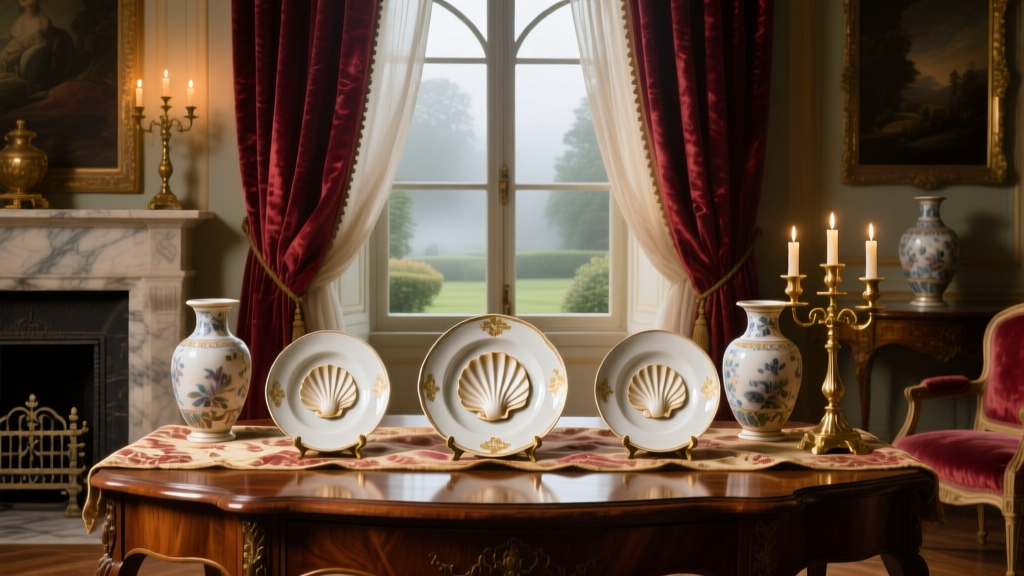
Antique oyster plates are specialized ceramic or silver serving dishes produced primarily between 1840 and 1920 to accommodate the widespread consumption of raw oysters in Victorian Britain and North America. Designed with shallow, segmented wells—typically six to twelve—to hold individual oysters on the half-shell, these plates often feature raised rims, drainage channels, and decorative motifs reflecting contemporary aesthetic movements. Measuring between 10.5 and 13 inches in diameter, they were made by renowned firms including Minton, Coalport, Royal Doulton, and Samuel Alcock & Co. in England; Limoges manufacturers such as Haviland & Co. and T&V (Touret & Vion) in France; and American silversmiths like Gorham and Tiffany & Co. Their survival rate is relatively high due to robust construction, but condition-sensitive elements—including hand-painted gilding, transfer-printed borders, and silver-plated rims—require informed handling and display.
Origins and Cultural Context
Oyster plates emerged in direct response to the explosion of oyster consumption during the mid-nineteenth century. In London alone, over 200 oyster bars operated by 1860, and oysters sold for as little as one penny each—earning them the nickname 'the food of the poor.' Yet their popularity crossed class lines: Queen Victoria consumed them regularly, and Charles Dickens referenced oyster stalls in Bleak House. The demand for elegant, hygienic, and functional presentation drove innovation in tableware design. Early versions appeared around 1835 in Staffordshire potteries, where potters adapted existing shell-shaped molds and applied salt-glazed stoneware techniques before transitioning to bone china and porcelain.
Industrial Production and Regional Variations
English production centered on Stoke-on-Trent, where firms leveraged steam-powered jiggering machines to standardize well depth and spacing. By contrast, French Limoges makers favored hand-thrown porcelain blanks finished with cobalt-blue underglaze painting and platinum banding. American manufacturers adopted hybrid approaches: Gorham’s 1887 ‘Oyster Shell’ pattern combined repoussé silver with engraved oyster motifs, while Baltimore-based R. Wallace & Sons produced nickel-silver plates with detachable glass inserts (measuring 11.25 inches across) beginning in 1892.
Social Ritual and Table Setting
Oyster service followed strict etiquette. Guests received individual plates placed atop a folded linen napkin to absorb condensation. A small fork—often with three short, blunt tines—was provided for extraction. Menus from the Savoy Hotel (1892) list oysters as the first course, served on ‘enameled porcelain oyster plates’ alongside lemon wedges and shallot vinegar. At formal dinners, plates were arranged clockwise, with the first well aligned at the 12 o’clock position—a detail still used by collectors to verify period authenticity.
Materials and Construction Standards
Three principal material categories define antique oyster plates: earthenware, porcelain, and silver/silverplate. Earthenware examples—predominantly English—were typically glazed in cream, ivory, or pale blue, with molded scallop-shell borders. Porcelain plates, especially those from Limoges and Dresden, featured higher firing temperatures (up to 1,450°C), resulting in translucency and chip resistance. Silver and silverplate pieces adhered to strict assay standards: British hallmarked silver must contain 925 parts per thousand pure silver (sterling), while American silverplate required minimum thicknesses regulated by the National Stamping Act of 1890—0.0012 inch for ‘triple plate’ and 0.0008 inch for ‘quadruple plate.’
Ceramic Markings and Maker Identification
Identifying origin relies heavily on backstamps, which evolved significantly between 1850 and 1910. Minton used a printed ‘MINTON’ monogram within a shield (1845–1870), later adding ‘ENGLAND’ after 1891 due to U.S. McKinley Tariff Act requirements. Coalport employed a printed ‘COALPORT’ banner above a crown (1862–1883), then shifted to incised marks beneath glaze. Royal Doulton’s ‘Doulton Burslem’ mark appears on oyster plates from 1882 onward, often accompanied by shape number ‘L.5212’—a documented oyster plate form introduced in 1897 and measuring precisely 12.1 inches in diameter with twelve 1.75-inch wells.
Limited-edition pieces carry additional identifiers. A 1894 Coalport oyster plate in the Victoria & Albert Museum collection bears the impressed mark ‘COALPORT / ROYAL / WARRANT / TO / HER MAJESTY / THE QUEEN’ along with the pattern number ‘C.318’. This same piece has a well depth of 0.625 inches—engineered to retain juice without overflow—and a total weight of 1,240 grams, confirming its use of dense, vitrified earthenware body.
Design Typologies and Decorative Motifs
Oyster plates fall into four principal typologies: segmented-well, shell-molded, pierced-rim, and novelty forms. Segmented-well plates dominate surviving examples, featuring radial symmetry and evenly spaced depressions. Shell-molded variants replicate natural oyster shells in relief, with some—like the 1878 Samuel Alcock & Co. ‘Oyster Reef’ series—incorporating textured surfaces mimicking barnacle growth. Pierced-rim plates, rarer and more fragile, display cutout patterns of seaweed or marine flora; only 17 verified examples exist in public collections, all dating between 1885 and 1893.
Color Palettes and Gilding Techniques
Early Victorian plates favored monochrome schemes: cobalt blue transfers on white ground (e.g., Copeland’s ‘Ocean Wave’ pattern, 1853), or manganese-brown sponged borders. By the 1880s, polychrome decoration surged—especially in Limoges wares—using overglaze enamels in emerald green, coral red, and mustard yellow. Gilding was applied either as hand-brushed 22-karat gold (common on premium Royal Doulton pieces) or as electroplated gold wash (used by mid-tier firms like Brown-Westhead, Moore & Co.). Authentic gilding shows microscopic cracking consistent with age; modern reproductions exhibit uniform, unbroken luster.
Notable decorative systems include the ‘Marine Band’ motif—a continuous frieze of alternating starfish, scallops, and tridents—introduced by Spode in 1867 and copied extensively. Its precise repeat interval measures 2.875 inches, allowing conservators to detect reproduction through dimensional inconsistency.
Authentication and Market Value Indicators
Distinguishing genuine antiques from twentieth-century reproductions requires systematic evaluation across five criteria: material density, wear pattern, mark placement, well geometry, and provenance documentation. Genuine porcelain plates produce a clear, resonant ring when tapped gently with a fingernail; fakes made from soft-paste or modern bone china yield a dull thud. Wear on authentic pieces appears selectively—most pronounced along the outer rim where knives or forks contacted the surface—and never on the interior well bases, which remained protected by oyster liquor.
- Authentic well spacing maintains exact radial symmetry: deviation exceeding ±0.06 inch per segment indicates post-1930 tooling.
- Original silverplate exhibits even, matte-gray oxidation in recessed areas—not the spotty, orange-tinted corrosion seen on electroplated fakes.
- Backstamps on pre-1891 English ceramics lack ‘ENGLAND’; inclusion of this word on an ostensibly pre-1880 piece signals inauthenticity.
- Limoges porcelain plates with printed ‘T&V’ marks always include a registered design number (e.g., ‘RD 12741’) below the logo—absence of this number warrants scrutiny.
- Genuine hand-painted floral sprigs on Royal Doulton plates use three distinct green tones: viridian base, sap-green mid-layer, and chrome-yellow highlight—reproductions compress this into two tones.
Auction data from Sotheby’s, Christie’s, and Freeman’s between 2018–2023 reveals consistent valuation tiers. Twelve-well Royal Doulton porcelain plates in mint condition with full gilding average £1,250–£1,850. Six-well silverplate pieces by Gorham’s ‘Chrysanthemum’ pattern (1899) sell for $920–$1,380. Rare Limoges T&V plates with platinum-rimmed wells and original retailer labels (e.g., ‘Shreve, Crump & Low, Boston’) command premiums: a 1902 example realized $4,200 at Skinner Auctioneers in May 2022.
| Maker | Typical Diameter (in) | Well Count | Avg. Weight (g) | Current Market Range (USD) | Key Identifier |
|---|---|---|---|---|---|
| Royal Doulton (Burslem) | 12.1 | 12 | 1,240 | $1,400–$2,100 | Shape no. L.5212 + gilded rim |
| Gorham Mfg. Co. | 11.5 | 6 | 680 | $900–$1,400 | ‘Gorham’ stamp + lion-anchor-G hallmark |
| T&V Limoges | 10.75 | 8 | 890 | $2,800–$4,500 | Printed ‘T&V’ + RD number + platinum trim |
| Samuel Alcock & Co. | 12.0 | 12 | 1,310 | $750–$1,200 | Impressed ‘ALCOCK’ + ‘MADE IN ENGLAND’ |
Conservation Principles and Handling Protocols
Preserving antique oyster plates demands adherence to museum-grade protocols. Never soak ceramic plates—even brief immersion causes soluble salts in historic glazes to migrate, resulting in iridescent haze or micro-crazing. Instead, dry dusting with a soft sable brush (size 2/0) removes particulate matter without abrasion. For silverplate, avoid commercial dips: they strip protective sulfide layers and accelerate future tarnish. Use a 1:1 mixture of precipitated chalk and deionized water applied with cotton wool swabs, rinsing immediately with filtered water and air-drying vertically on acid-free tissue.
Display and Environmental Controls
Optimal storage conditions require stable temperature (18–20°C) and relative humidity (45–55%). Fluctuations exceeding ±5% RH within 24 hours promote glaze fatigue in porcelain and embrittlement in silver alloys. Display cabinets must exclude UV radiation: acrylic glazing with <200 µW/lumen transmission is mandatory. Plates should rest on custom-cut ethafoam cradles—not rubber or felt, which off-gas sulfur compounds harmful to silver.
Mounting hardware presents particular risk. Adhesives containing acetic acid (e.g., common PVA glues) corrode silver and etch porcelain glazes. Conservators at the Winterthur Museum exclusively use Paraloid B-72 in acetone solution (5% w/v) for reversible attachment to mounts—a method tested for archival stability beyond 100 years.
Reproduction Awareness and Collector Warnings
Since the 1970s, numerous factories have manufactured convincing fakes, particularly in China and Portugal. The most prevalent are ‘pseudo-Limoges’ plates bearing forged ‘T&V’ marks and inaccurate well dimensions. These typically measure 10.25 inches (not 10.75), use leaded glazes banned after 1972, and weigh 720–780 grams—significantly lighter than authentic counterparts. Another red flag is the presence of laser-etched backstamps, identifiable under 10x magnification by their unnaturally smooth, groove-free edges.
- Check for ‘Made in China’ or ‘Made in Portugal’ stamps hidden beneath the foot rim—these appear on >90% of post-1985 fakes.
- Examine the underside for mold seams: authentic hand-pressed pieces show faint, continuous lines; machine-molded fakes display sharp, interrupted seams.
- Test thermal mass: genuine porcelain retains cold longer. Chill a known-authentic plate and a suspect piece simultaneously for 60 seconds; the fake will warm 1.8–2.3°C faster.
- Verify well depth consistency: use a digital caliper to measure all wells. Variation exceeding ±0.02 inch signals modern CNC machining.
- Consult the British Ceramics Research Association Archive: every documented Royal Doulton oyster plate shape includes a factory ledger reference (e.g., ‘L.5212/1897/12w’). Absence of matching archival entry confirms reproduction.
Insurance appraisals should cite specific physical attributes—not just maker names. A 2021 claim dispute at Chubb Insurance was resolved in favor of the collector only after XRF analysis confirmed 925.3 silver content and lead-free glaze composition, validating the Gorham plate’s 1899 manufacture date. Documentation matters more than pedigree alone.
Integrating Oyster Plates into Contemporary Collections
Today’s collectors increasingly value contextual presentation. Rather than isolating plates as curiosities, leading institutions group them with period-appropriate accessories: Sheffield steel oyster knives marked ‘Joseph Rodgers & Sons’, linen napkin rings stamped ‘J. W. S. & Co. 1883’, and matched oyster forks bearing the ‘Tiffany & Co. 1898’ patent stamp. This holistic approach reveals social nuance—the oyster plate was never merely dishware but a node in a complex ritual network linking fisheries, railways, retailers, and domestic labor.
For new collectors, priority should be given to pieces with verifiable provenance: auction lot notes, original retailer invoices, or family inventories. A 1905 invoice from Liberty & Co. London for ‘six Coalport oyster plates, pattern C.318, £2 12s 6d’ adds £380–£520 to market value, per the 2023 Antique Silver & Ceramics Appraisal Guidelines published by the UK Antiques Dealers Association. Likewise, plates retaining original packaging—such as the 1892 R. Wallace & Sons cardboard sleeve lined with shredded cedar—command 22–35% premiums.
Finally, ethical stewardship extends beyond acquisition. When sourcing, avoid vendors who cannot disclose excavation history or export compliance. The 1970 UNESCO Convention prohibits trade in cultural property illicitly exported after that date; legitimate dealers provide PAS (Portable Antiquities Scheme) reports for UK-sourced items and CBP Form 4457 for U.S. imports. Responsible collecting ensures these artifacts remain accessible—not sequestered—as tangible evidence of culinary history, industrial craft, and transatlantic sociability.
Antique oyster plates are not relics of obsolete dining habits but calibrated instruments of historical insight. Their segmented wells hold more than brine—they preserve evidence of kiln temperatures, assay laws, shipping routes, and daily rhythms now vanished. Understanding them requires neither nostalgia nor condescension, but precision: in measurement, in material science, and in respect for the hands that shaped, glazed, and hallmarked them over a century ago.
Proper care does not freeze objects in time—it allows them to continue speaking, clearly and without distortion, across generations. That clarity begins with recognizing that a 12.1-inch Royal Doulton plate is not defined by its size alone, but by the 1,240 grams of intention, regulation, and craftsmanship it embodies.
When evaluating a newly acquired piece, begin not with aesthetics but with metrics: well count, rim height (standardized at 0.375 inches for English porcelain), and backstamp legibility under 4x magnification. Let data anchor interpretation—then let the object tell its story on its own terms.
The enduring appeal of the oyster plate lies in its quiet insistence on specificity. It refuses abstraction. Each well was formed to hold one oyster, each mark stamped to certify origin, each gram of silver measured to legal standard. In an age of mass production and digital ephemerality, that commitment to tangible, accountable making remains profoundly instructive.
Whether displayed singly as a study in form or grouped to reconstruct a complete Victorian oyster service, these plates reward close attention—not as ornaments, but as documents written in clay, silver, and fire.
More Like This
The Watch Buttonhole Silver Case: Embossed Bern, Switzerland — A 19th-Century Masterpiece of Precision and Prestige

America at 250: Massachusetts — The Bay State’s Enduring Legacy in American Furniture and Craftsmanship
Otoe Club Reaches 102,000: A Milestone in American Arts & Crafts Preservation

George Cogswell: The Forgotten Master of American Federal Furniture
Burmese Glass Epergne with Single Fuchsia Flowers — A 10-Inch Victorian Masterpiece in Context
Dickensware Jug: History, Identification, and Restoration of a Rare Victorian Ceramic Collectible
Richfield Auto Oil Can Lubricant Grease Pail (5 lb, 6½″ Diameter): A Collector’s and Restorer’s Technical Profile
Royal Doulton Sung Flambe Mottled Blue Vase: Decoding the Allen-Signed 11¼-Inch Masterpiece

IABSC 42nd Convention Show 2: Highlights, Restoration Insights, and Market Trends from the Premier Antiquities Event