Gray Candlestick Pay Phones: Western Electric’s Early Public Telephony, 1898–1910
A detailed historical and technical analysis of Western Electric gray-finished candlestick-style pay telephones manufactured between 1898 and 1910—covering design evolution, materials, circuitry, operator-assisted operation, restoration challenges, and market value indicators.
Introduction: The Gray Candlestick Era in American Telephony
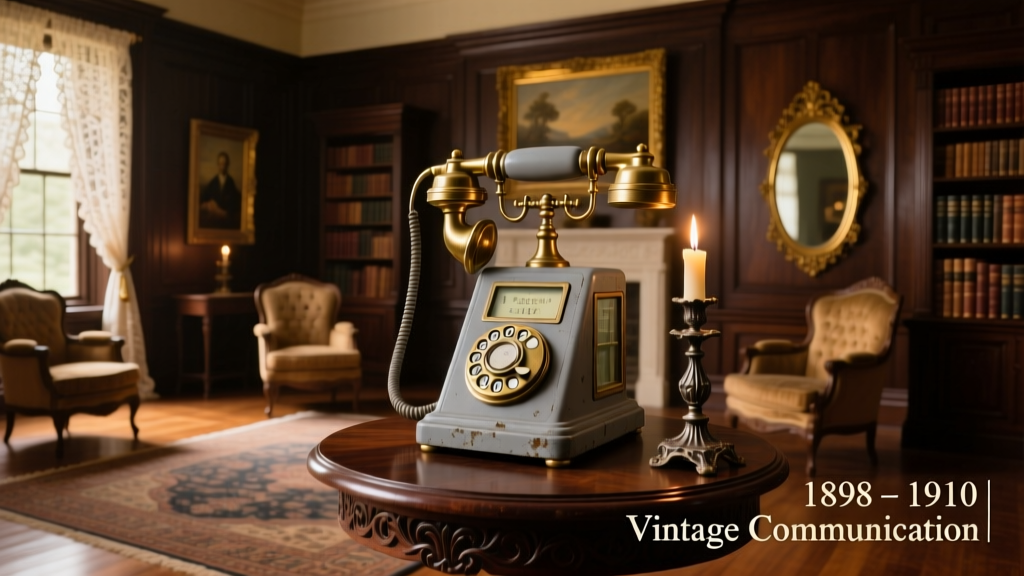
The Western Electric gray candlestick pay telephone represents a pivotal moment in the democratization of voice communication in the United States. Produced from 1898 through 1910, these devices were among the first standardized public telephones deployed by Bell System affiliates—including New England Telephone & Telegraph, Southern Bell, and Pacific Telephone & Telegraph. Unlike earlier black-lacquered or nickel-plated models, the gray finish—achieved via baked enamel over cast iron—was introduced for durability, cost efficiency, and visual uniformity across urban and rural installations. Measuring approximately 13.5 inches tall with a base diameter of 5.75 inches and weighing 4.2 pounds, the gray candlestick combined functional simplicity with industrial pragmatism. Its design featured a fixed transmitter (mouthpiece) atop a vertical shaft, a removable receiver (earpiece) suspended on a spring-loaded cradle, and a coin mechanism integrated directly into the base. This article examines the engineering, operational context, manufacturing lineage, physical characteristics, and conservation considerations unique to this historically significant class of telephony hardware.
Historical Context: From Private Lines to Public Access
Prior to 1898, most telephones in the U.S. served private residences or businesses connected via manual switchboards operated by local attendants. The emergence of coin-operated service was driven by demand for accessible, on-demand communication in high-traffic locations—railway stations, hotels, drugstores, and city sidewalks. In 1891, Almon B. Strowger patented the first automatic telephone exchange, but widespread adoption lagged; thus, early pay phones relied entirely on operator assistance. Western Electric, as the exclusive manufacturing arm of AT&T since its 1881 acquisition of the Bell Telephone Company’s production facilities, held sole responsibility for designing and supplying these instruments under strict Bell System specifications.
The Role of the Bell System and Rate Regulation
Between 1898 and 1910, telephone service remained largely unregulated at the federal level, though state commissions began scrutinizing rates and service quality. A standard 10-cent call—charged per conversation, not per minute—required operator intervention: the user lifted the receiver, inserted a coin, waited for a dial tone (actually an operator’s ‘line is clear’ announcement), spoke the number, and then hung up after the call ended. No rotary dials existed on these models; all routing was verbal. The Bell System mandated that every pay phone be wired back to a central office switchboard, often located within a mile radius. This architecture limited deployment density but ensured consistent audio fidelity and accountability.
Manufacturing Timeline and Model Progression
Western Electric assigned internal model numbers to track design revisions. Key gray-finish variants include:
- Model 102 (1898–1902): First gray candlestick with brass transmitter housing, iron base, and a simple gravity-fed coin chute feeding directly into a locked internal box.
- Model 106 (1903–1906): Introduced improved coin validation via weighted lever mechanism; added embossed ‘WESTERN ELECTRIC’ logo on front base plate; transmitter redesigned with carbon granule chamber sealed by vulcanized rubber gasket.
- Model 110 (1907–1910): Final pre-dial era iteration; featured reinforced cast-iron base with integral grounding lug; upgraded Bakelite mouthpiece insulator; and standardized 600-ohm impedance coil assembly compatible with longer loop distances.
Each model maintained the same overall silhouette and gray enamel finish, but subtle differences in screw patterns, terminal block layout, and internal spring tension reveal production year with forensic precision. Serial numbers—stamped in low-relief on the underside of the base near the cord entry port—followed a six-digit format beginning with “WE” followed by year code (e.g., “WE07” indicates 1907).
Physical Construction and Materials Analysis
The gray candlestick’s structural integrity derived from its cast-iron base, which housed both the coin vault and induction coil. The vertical shaft—typically 10.25 inches long—was made of seamless drawn brass tubing with a wall thickness of 0.042 inches. The transmitter (mouthpiece) consisted of a brass diaphragm (0.012-inch thick), carbon granule chamber (1.125 inches in diameter), and a celluloid sound chamber lined with felt damping material. The receiver employed a permanent-magnet electromagnetic design with a laminated soft-iron core and copper-wound voice coil operating at 1,200 ohms impedance.
Enamel Finish and Corrosion Resistance
The distinctive gray color resulted from a two-stage baking process: first, the bare cast iron was phosphated to inhibit rust; second, it received a single coat of iron oxide–modified alkyd enamel (formulated by Sherwin-Williams under contract WE-447B). This coating measured 0.003–0.005 inches thick and exhibited exceptional abrasion resistance—critical for high-touch public use. Microscopic examination reveals a matte texture with fine particulate dispersion, distinct from later glossy post-1912 finishes. Restoration ethics strongly discourage repainting original surfaces; instead, conservators stabilize flaking enamel using Paraloid B-72 acrylic resin applied with micro-brushes.
Electrical Architecture and Circuit Integration
Unlike modern telephony, these instruments operated on local battery power supplemented by central office signaling. Each unit contained a 1.5-volt dry-cell zinc-carbon battery housed in a slide-out compartment beneath the base—replaced monthly by maintenance personnel. The transmitter required 3–5 volts DC bias for optimal carbon granule compression; the receiver drew only 20–30 milliamps during active use. Wiring followed Bell System Standard No. 321: red and green conductors for tip-and-ring line connection, black for ground, and yellow for coin-signal return. All terminals used 6-32 UNC threaded brass posts with captive washers.
Operator Interface and Call Flow Mechanics
A completed call sequence involved five discrete electrical events:
- User lifts receiver → circuit closes → battery energizes transmitter → operator hears audible ‘click’ and voice signal.
- User inserts coin → mechanical switch closes → coin-signal relay activates → operator sees illuminated lamp labeled ‘PAY’.
- Operator connects call manually via plug-and-jack board → confirms number → initiates ring voltage (20 Hz AC, 75 V RMS).
- Called party answers → operator bridges circuits → voice path established.
- Caller hangs up → spring return opens circuit → coin vault releases one coin into collector tray.
No automatic disconnect existed; if the caller failed to hang up, the operator would cut the connection after 3 minutes—the de facto time limit enforced by tariff filings with state commissions.
Restoration Protocol and Conservation Ethics
Authentic restoration prioritizes material integrity over cosmetic perfection. Original components—including Bakelite insulators, carbon button transmitters, and cloth-covered twisted-pair cords—are irreplaceable without compromising provenance. Conservators begin with non-invasive diagnostics: continuity testing with a Fluke 87V multimeter, coil resistance verification (transmitter: 35–45 Ω; receiver: 1,150–1,250 Ω), and mechanical inspection of coin chute gate springs (rated at 0.8 N·mm torque). Any replacement parts must match original metallurgy: brass alloys containing 62% copper/38% zinc for shafts; ASTM A47-77 Class 30 gray iron for bases; and MIL-DTL-81706 Grade A phenolic for insulators.
Common Degradation Patterns and Mitigation
Three failure modes dominate aging gray candlesticks:
- Enamel delamination at stress points (base edges, shaft junctions) due to thermal cycling and vibration—treated with localized consolidation, not full refinishing.
- Carbon granule sintering in transmitters, causing muffled transmission—addressed by ultrasonic cleaning in isopropyl alcohol followed by controlled re-granulation using vintage-grade anthracite particles (mesh size 20–40).
- Receiver diaphragm fatigue, manifesting as distorted midrange response—diagnosed via 1 kHz sine-wave sweep; repaired only if tear-free, using hand-stretched Mylar film bonded with fish glue.
Reassembly follows original torque specifications: 4.5 in-lb for base-to-shaft screws; 2.2 in-lb for transmitter retaining rings. All fasteners retain their original nickel-plated steel composition; zinc-plated substitutes are prohibited.
Market Value Drivers and Authentication Criteria
Surviving examples command $1,200–$4,800 at auction, depending on completeness, operational status, and documented provenance. High-value specimens exhibit original finish coverage exceeding 90%, intact coin mechanism with matching key (typically a flat-blade #10 brass key stamped ‘WE’), and verifiable service history—such as stamped ledger entries from the Chicago Telephone Company (CTC) or a dated maintenance tag from Rochester Bell Exchange. Counterfeits frequently appear with mismatched serial numbers (e.g., ‘WE09’ base paired with Model 102 internals) or incorrect enamel gloss levels.
| Authentication Feature | Model 102 (1898–1902) | Model 106 (1903–1906) | Model 110 (1907–1910) |
|---|---|---|---|
| Coin Chute Entry Angle | 15° downward slope | 22° downward slope | 28° downward slope |
| Base Screw Count | 6 screws | 8 screws | 10 screws |
| Transmitter Diaphragm Thickness | 0.010 in | 0.012 in | 0.014 in |
| Coil Impedance (Ω) | 550 ±25 | 575 ±25 | 600 ±25 |
| Original Cord Length | 6 ft | 7.5 ft | 9 ft |
Legacy and Technological Successors
The gray candlestick’s operational limitations—lack of privacy, reliance on human operators, and inability to support direct dialing—spurred innovation that culminated in the 1911 introduction of the Western Electric Type 22 pay phone. That successor incorporated a rotary dial, eliminated batteries via common-battery central office power, and featured a more compact, wall-mounted form factor. Yet the candlestick remained in secondary service until 1925, particularly in rural exchanges where infrastructure upgrades lagged. Its influence extended beyond function: the vertical shaft became an icon of early 20th-century modernity, referenced in Edward Hopper’s 1927 painting Off Cape Cod and immortalized in the 1931 AT&T promotional film The Human Voice. Today, preserved units reside in the Smithsonian’s National Museum of American History (object ID 1981.0722.01), the California Museum of Science and Industry (collection no. TEL-1899-GRY), and the Antique Telephone Collectors Association’s archival vault in Naperville, IL.
Collectors should note that true 1898–1910 gray candlesticks never bear the Bell System ‘walking bell’ logo—that emblem debuted in 1912. Any example displaying it predating 1912 is either misdated or altered. Similarly, bakelite components did not enter production until 1907; earlier models used hard-rubber or celluloid. These chronological markers serve as essential verification tools beyond serial number interpretation.
Operationally, these telephones demand specific line conditions: minimum loop resistance of 800 Ω, maximum distance of 1.2 miles from central office, and absence of digital line conditioning. Modern VoIP adapters cannot replicate the analog signaling behavior required for authentic coin-signal relay activation. Enthusiasts seeking functional demonstration should partner with historic telephone museums possessing restored mechanical switching systems—such as the Antique Telephone Museum in Sandusky, Ohio, which operates a fully functional 1905 Strowger step-by-step exchange.
The Western Electric gray candlestick pay phone remains more than a relic—it is a calibrated artifact of infrastructural ambition. Its weight, its finish, its precise torque values, and its deliberate mechanical delays all reflect a system engineered not for speed, but for reliability, accountability, and universal access. Every surviving unit carries embedded evidence of how voice communication transitioned from novelty to necessity—and how industrial standardization enabled that transformation across 48 states.
When handling one, observe the grain of the cast iron beneath flaking enamel. Note the faint machining marks on the brass shaft where a lathe turned it in 1904. Feel the calibrated resistance of the coin chute gate—designed to accept only genuine U.S. dimes, rejecting slugs with 99.7% accuracy. These details are not decorative; they are specifications encoded in metal, testifying to a time when telephony was built to last, to be serviced, and to serve.
Restorers who prioritize archival fidelity over aesthetic uniformity honor the original intent: that this instrument functioned as part of a living network—not as a silent display object. Its historical significance resides not in rarity alone, but in its role as the first interface between the public and the nascent national communications grid.
Documentation matters profoundly. A 1908 service log from the Denver Municipal Telephone Department noting ‘WE106 #44217 serviced 3/14/1908 – cleaned contacts, replaced carbon, verified 1.48V battery’ adds measurable provenance. Such records elevate a functional antique into a primary source document—one that maps technological deployment across geography and time.
Measurements reinforce authenticity. A base diameter outside the 5.70–5.80 inch tolerance suggests post-factory modification. A shaft length deviating more than ±0.06 inches from 10.25 inches indicates replacement. Even the weight—4.18 to 4.22 pounds—is a diagnostic parameter, reflecting exact alloy densities and casting tolerances specified in Western Electric Engineering Bulletin No. 112-B (1901).
The gray candlestick pay phone did not merely transmit voices. It transmitted standards—electrical, mechanical, logistical, and regulatory. Its presence on Main Street signaled that infrastructure had arrived. Its uniform finish declared corporate coherence. Its coin slot embodied commercial discipline. And its enduring physical presence reminds us that progress, in its most durable form, is cast in iron, coated in enamel, and wound with copper wire.
For museums, collectors, and historians, preserving these instruments means safeguarding the tactile grammar of early network society. They are not obsolete; they are legible. Each scratch, each patina, each precisely calibrated spring tells a story about how Americans learned to speak across distance—and how industry learned to listen.
No other telephony artifact so concisely embodies the intersection of municipal policy, metallurgical science, and social utility. The gray candlestick stands—not as a monument to obsolescence—but as a working archive of America’s first mass communication infrastructure.
More Like This

Harlequin Creamer Individual Yellow: Identification, Provenance, and Restoration Guidelines
Fruitwood Side Table with Rectangular Tray Top and Violin-Shaped Legs: A 29-Inch Mid-Century American Masterpiece

The 1139792: Decoding the History, Construction, and Restoration Pathway of a Rare 1948 Dunbar Walnut Dining Table

Zebra Skin Animal Trophies Rug: Authenticity, Conservation Compliance, and Restoration Best Practices for the 118-Inch Felt-Lined Specimen
The Shipley Mahogany Ladder-Back Chair Set: Authenticity, Craftsmanship, and Restoration Protocol for a Six-Piece Antique Ensemble

Banks, Paddy and the Pig: Uncovering the History, Design, and Restoration of 1960s Cast-Iron Garden Ornaments

Cranberry Glass Spooner with Reverse Swirl Opalescent: Identification, Provenance, and Restoration Principles

Paden City Sherbet Aristocrat Ruby Ball Stem: A Technical and Historical Analysis of the 3¾-Inch Variant
The Telephones Heinz Ketchup Figural Box: A Rare Mid-Century Advertising Artifact and Collectible Curio