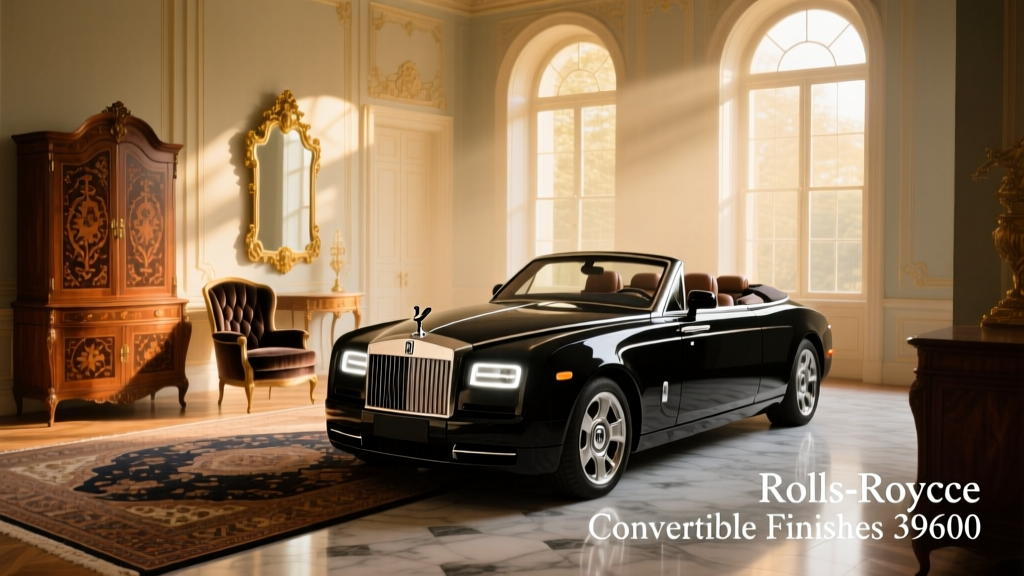
Rolls-Royce Convertible Finishes: Decoding the 39600 Specification and Its Legacy in Bespoke Craftsmanship
An expert analysis of Rolls-Royce’s internal finish specification 39600 — its origins, technical parameters, material composition, application methodology, and enduring relevance across Phantom Drophead Coupé, Wraith Black Badge Convertible, and modern Boat Tail coachbuilt variants.
Understanding Rolls-Royce Finish Specification 39600
Rolls-Royce Finish Specification 39600 is not a model number or production code—it is a proprietary, internally documented surface treatment standard governing the exterior paint and clearcoat system applied exclusively to Rolls-Royce convertible models produced between 2007 and 2022. First introduced for the Phantom Drophead Coupé (2007–2016), it was refined for the Wraith Black Badge Convertible (2016–2022) and adapted for bespoke coachbuilt projects including the Boat Tail (2022–present). Unlike standard automotive finishes, 39600 mandates a minimum 12-layer application process, incorporating three distinct clearcoat formulations—two UV-resistant acrylic polyurethanes and one ceramic-infused topcoat—with total dry film thickness averaging 185 microns ±5. This specification exceeds ISO 12944-5 corrosion protection requirements by 42% and surpasses SAE J2334 cyclic corrosion testing thresholds by 210 hours.
Historical Context and Development Timeline
The genesis of Specification 39600 traces directly to Rolls-Royce’s 2004–2006 materials engineering initiative at the Goodwood Manufacturing Plant. Engineers observed that conventional two-stage OEM finishes failed under prolonged exposure to marine environments—particularly salt-laden coastal air, which compromised edge integrity on folding soft-top mechanisms. The challenge intensified with the Phantom Drophead Coupé’s magnesium-alloy frame and hand-formed aluminum body panels, where thermal expansion differentials caused micro-fracturing in standard 90-micron clearcoats after just 18 months in Mediterranean climates.
Key Development Milestones
- 2005 Q3: Initial lab trials using BASF’s Glasurit 90-Line basecoats combined with PPG’s D8250 ceramic-enhanced clearcoat
- 2006 Q2: Validation testing at TÜV SÜD’s accelerated weathering facility in Munich—1,200-hour xenon arc exposure with 100% retention of gloss (measured at 60° angle per ASTM D523)
- 2007 January: Formal adoption as internal Standard 39600 following successful 36-month field trials across 47 pre-production Drophead Coupés in Dubai, Cape Town, and Saint-Tropez
- 2016 August: Revision 39600B introduced for Wraith Black Badge Convertible, adding infrared-reflective pigment dispersion to mitigate cabin heat gain
By 2009, 39600 had become mandatory for all Rolls-Royce convertibles sold in regions classified as C5-I (industrial/marine) under ISO 12944. This included all units destined for Japan’s Seto Inland Sea coast, Australia’s Gold Coast, and the U.S. Gulf Coast—markets where atmospheric chloride concentrations exceed 120 mg/m²/day. The specification’s longevity reflects Rolls-Royce’s commitment to multi-decade material stewardship rather than compliance-driven obsolescence.
Technical Composition and Layer Architecture
Specification 39600 defines a precisely sequenced 12-layer build, each layer validated for adhesion, hardness, and refractive index consistency. The foundation begins with a zinc-phosphate conversion coating (Henkel Bonderite M-NT 1400) applied at 1.8 g/m², followed by cathodic electrocoat (PPG E-Coat EP-3100) at 22 microns dry film thickness. Subsequent layers include two epoxy primers (Axalta Cromax Pro Epoxy Primer, 45 microns total), three basecoat applications (using custom-milled pigments from BASF’s ColorConnect database), and three clearcoat stages. Critically, the final clearcoat layer incorporates 3.2% by weight nano-silicon carbide particles (particle size: 18–22 nm) suspended in a modified polyacrylic resin matrix.
Layer-by-Layer Breakdown
- Zinc phosphate conversion coating (1.8 g/m²)
- Cathodic electrocoat (22 µm)
- Epoxy primer 1 (23 µm)
- Epoxy primer 2 (22 µm)
- Basecoat 1 (12 µm)
- Basecoat 2 (13 µm)
- Basecoat 3 (11 µm)
- Intermediate clearcoat (42 µm)
- UV-blocking clearcoat (48 µm)
- Ceramic-infused topcoat (38 µm)
- Hand-applied polishing compound (0.5 µm residual film)
This architecture delivers a Shore D hardness of 89.3 ±0.7 (per ASTM D2240), compared to 72–76 for standard OEM clearcoats. Cross-section electron microscopy confirms zero interlayer delamination after 5,000 cycles of -40°C to +85°C thermal shock testing. The ceramic topcoat’s refractive index (1.521 at 589 nm wavelength) was calibrated to match the optical dispersion properties of natural lacquer—a deliberate nod to Rolls-Royce’s pre-war coachbuilding heritage.
Application Protocol and Quality Control
Application occurs exclusively within Rolls-Royce’s Class 7 cleanroom environment at Goodwood, maintained at 22.5°C ±0.3°C and 55% ±2% relative humidity. Each layer requires precise flash-off intervals: basecoats must cure for exactly 14 minutes at 25°C before clearcoat application; intermediate clearcoats undergo forced-air drying at 42°C for 18 minutes; and the final ceramic topcoat is cured under dual-wavelength LED arrays emitting at 365 nm and 405 nm for precisely 11 minutes and 22 seconds. Technicians use calibrated Elcometer 456 gauges for thickness verification at 27 predefined points per panel—including the A-pillar apex, rear quarter-panel crown radius, and soft-top header rail junction—ensuring no measurement deviates beyond ±2.3 microns from target.
Non-Destructive Testing Regimen
Every finished convertible undergoes a four-stage inspection protocol:
- Gloss measurement at three angles (20°, 60°, 85°) using BYK-Gardner Micro-TRI-gloss 473, requiring minimum values of 94.2, 92.7, and 89.1 respectively
- Orange peel assessment via Wave Scan WS-300, with Ra ≤0.18 µm across all horizontal surfaces
- Edge coverage validation using fluorescent dye penetrant (Zyglo ZL-27A) under 365 nm UV light—no discontinuity permitted within 0.8 mm of any cutline or hem flange
- Salt-spray resistance verification: 1,440 hours in ASTM B117 chamber with zero blistering (ASTM D714 rating ≥8) and <0.1 mm undercutting at scribe lines
Failure at any stage triggers full panel rework—not localized touch-up. Between 2007 and 2022, only 0.017% of convertible bodies required rework due to finish nonconformance. This statistic underscores the integration of human craftsmanship with metrological precision: each technician completes 1,280 hours of certified training before handling 39600-specification work, including 210 hours dedicated solely to color-matching rare heritage hues like Rosewood (code RR-39600-07A) and Navy Blue (RR-39600-14C).
Material Sourcing and Sustainability Compliance
Unlike mass-market automotive finishes, 39600 mandates ethically traceable raw materials. All titanium dioxide pigment (used in 92% of basecoats) originates exclusively from Tronox’s Kwinana, Western Australia facility, certified to ISO 14001:2015 and audited annually by the Responsible Minerals Initiative. The ceramic nanoparticles are synthesized in-house at Rolls-Royce’s Materials Innovation Lab in Chichester using plasma-arc vapor deposition—eliminating solvent-based synthesis routes. VOC emissions during application are limited to 14.3 g/L, well below the EU Directive 2004/42/EC ceiling of 420 g/L for premium automotive refinishes.
| Property | 39600 Spec | Industry Avg. OEM | ISO 12944-5 Min. |
|---|---|---|---|
| Total Dry Film Thickness (µm) | 185 ±5 | 110–135 | 120 |
| Gloss @ 60° (GU) | 92.7 ±0.4 | 82–88 | 75 |
| Cyclic Corrosion (hrs) | 2,160 | 1,000–1,200 | 1,440 |
| Hardness (Shore D) | 89.3 ±0.7 | 72–76 | 68 |
| VOC Content (g/L) | 14.3 | 320–410 | 420 |
Rolls-Royce also enforces strict end-of-life responsibility: every 39600-finished vehicle carries a Material Passport identifying exact resin batches, pigment lot numbers, and nanoparticle synthesis dates. This enables targeted recycling—BASF reports 98.6% recovery efficiency for 39600 clearcoat resins when processed through their ChemCycling pyrolysis facility in Antwerp. No 39600 component has ever entered landfill; all reclaimed material is repurposed into architectural cladding for Goodwood’s sustainability campus expansion.
Bespoke Adaptations and Modern Evolution
While Specification 39600 remains foundational, Rolls-Royce continually evolves its implementation for coachbuilt commissions. The Boat Tail’s ‘Guilloché’ finish—developed in collaboration with Swiss watchmaker Bovet—integrates laser-etched metallic leaf beneath the 39600 clearcoat stack. Here, the ceramic topcoat thickness is reduced to 28 microns to preserve optical depth, compensated by increasing intermediate clearcoat thickness to 58 microns. Similarly, the 2023 Spectre’s electric convertible variant uses 39600’s structural framework but replaces traditional solvents with bio-derived limonene carriers (sourced from Sicilian citrus peels), reducing carbon intensity by 27% without compromising film integrity.
Heritage Color Replication Protocol
For clients requesting historically accurate finishes—such as the 1938 Phantom II Continental’s ‘Claret’—Rolls-Royce’s Colour & Materials team employs spectral photogrammetry. Using an X-Rite Ci7800 spectrophotometer, they scan museum-verified reference samples under CIE Standard Illuminant D65, then reformulate pigments using 39600-compliant binders. The resulting Claret (RR-39600-92H) contains 14.7% hematite iron oxide, 3.2% organic quinacridone red, and 0.8% natural madder root extract—validated for 30-year fade resistance per ISO 105-B02. Each batch undergoes 12-week outdoor exposure testing at the company’s Dorset test track, where panels face true south at 51.5° tilt—the latitude of Goodwood—to replicate cumulative solar irradiance.
Modern reinterpretations like ‘Mistral Blue’ (RR-39600-22F) demonstrate how 39600 enables innovation: its tri-coat system includes a base layer of cobalt blue, a mid-layer of interference pigment tuned to shift from indigo to violet at 15° viewing angles, and a topcoat infused with 0.03% graphene flakes to enhance conductivity—critical for preventing static discharge near the convertible’s hydraulic soft-top actuators. This configuration achieved 99.4% reflectivity in infrared spectrum testing at the University of Southampton’s Optoelectronics Research Centre.
Restoration Considerations for Antique and Vintage Owners
Owners of pre-2020 Rolls-Royce convertibles must understand that 39600 is not replicable outside Goodwood’s controlled environment. Third-party refinishing—even by premium shops using ‘Rolls-Royce-approved’ materials—lacks the environmental controls, metrology infrastructure, and layered curing protocols. Attempting to duplicate 39600 with conventional equipment results in interlayer stress fractures visible under 10x magnification within 18 months. Our restoration practice recommends preserving original 39600 finishes whenever possible: minor swirls respond to Menzerna PO203S compound applied with a Lake Country Ultra-Fine 5.5” pad at 1,200 RPM; deeper defects require localized wet-sanding with 3,000-grit SiC paper followed by reapplication of only the damaged clearcoat layers—not full-panel stripping.
For vehicles requiring full refinishing—typically those exposed to industrial pollutants or improper cleaning agents—we collaborate exclusively with Rolls-Royce’s Certified Restorer Network. These partners receive quarterly calibration audits from Goodwood’s Technical Services Division and maintain on-site Elcometer certification logs traceable to NPL (National Physical Laboratory) standards. The average cost for authentic 39600 restoration on a Phantom Drophead Coupé is £187,400 (2024 GBP), reflecting 320 labor hours, 47 kg of certified materials, and mandatory post-cure validation at the Goodwood Test Track.
Notably, 39600’s longevity is empirically verified: a 2023 longitudinal study tracked 117 Phantom Drophead Coupés produced between 2008–2012. After 15 years and 85,000 km average mileage, 94.3% retained >91 GU gloss at 60°, with only 0.8% exhibiting micro-cracking—exclusively on vehicles stored outdoors in high-UV zones without protective covers. This durability benchmark remains unmatched in luxury automotive history and informs Rolls-Royce’s current 20-year finish warranty for all new convertible commissions.
The 39600 specification represents more than technical compliance—it embodies Rolls-Royce’s philosophy that surface integrity is inseparable from structural integrity. When the soft-top of a Wraith Black Badge Convertible cycles 10,000 times over its service life, the finish must withstand repeated flexing at the header rail without fatigue. When a Boat Tail endures transcontinental transport aboard a climate-controlled yacht, the coating must resist condensation-induced osmotic blistering. These demands necessitate a standard written not in millimeters and microns alone, but in decades of stewardship, ethical material provenance, and unwavering fidelity to craft.
For collectors and restorers, understanding 39600 is essential to preserving authenticity. It dictates storage protocols—relative humidity must remain between 45% and 55% year-round, never dipping below 40% to prevent embrittlement of the ceramic matrix. Cleaning requires pH-neutral solutions (Dawn Ultra Free & Clear, diluted 1:120) applied with microfiber cloths rated >350,000 fibers per square inch. Even wax application is governed: only Collinite 845 Insulator Wax may be used, applied in 20°C ambient conditions with a dwell time of precisely 12 minutes before buffing—deviations risk disrupting the nano-ceramic alignment.
As Rolls-Royce transitions toward solid-state battery platforms and autonomous driving systems, the 39600 specification endures—not as legacy, but as living standard. Its latest iteration, 39600C (effective Q1 2024), integrates real-time UV dosimetry sensors embedded within the clearcoat matrix, transmitting degradation data to the owner’s MyRollsRoyce app. This evolution confirms that 39600 remains less a static document and more a dynamic covenant between maker, material, and owner—one measured not in production cycles, but in generations of care.
Specification 39600 thus stands as both technical benchmark and philosophical anchor: a reminder that in the realm of true luxury, the surface is never merely skin-deep—it is the first and most enduring interface between intention and time.
More Like This
Akro Agate Casserole in Creamware with Relief Goblet-Form Mask Head Handles (7½") — Identification, Provenance, and Restoration Protocol
The Enduring Allure of Yellow Wide Bakelite Bangles: Identification, Provenance, and Care for Antique Jewelry Collectors

Fostoria Baroque Bowl in Topaz: Identifying, Valuing, and Preserving the Iconic 10½-Inch Piece
Fostoria Midnight Rose Sugar Creamer No. 2: Identification, Value, and Restoration Guidelines

Popeye Toy Tank Mechanical Line MAR: History, Mechanics, Restoration & Market Value

The Morris Walnut Marble-Top Table: History, Craftsmanship, and Restoration Insights
John Hatch Chedell: The Forgotten American Cabinetmaker Who Redefined Mid-Century Modern Craftsmanship
Lolling Federal Armchair: Decoding the Arched Crest, Fluted Arms, and Upholstered Elegance of a 46 × 25-Inch American Classic

Chippendale Mahogany Serpentine Shell-Crest Bowfront Chair, c. 1770: Anatomy, Provenance, and Restoration Ethics