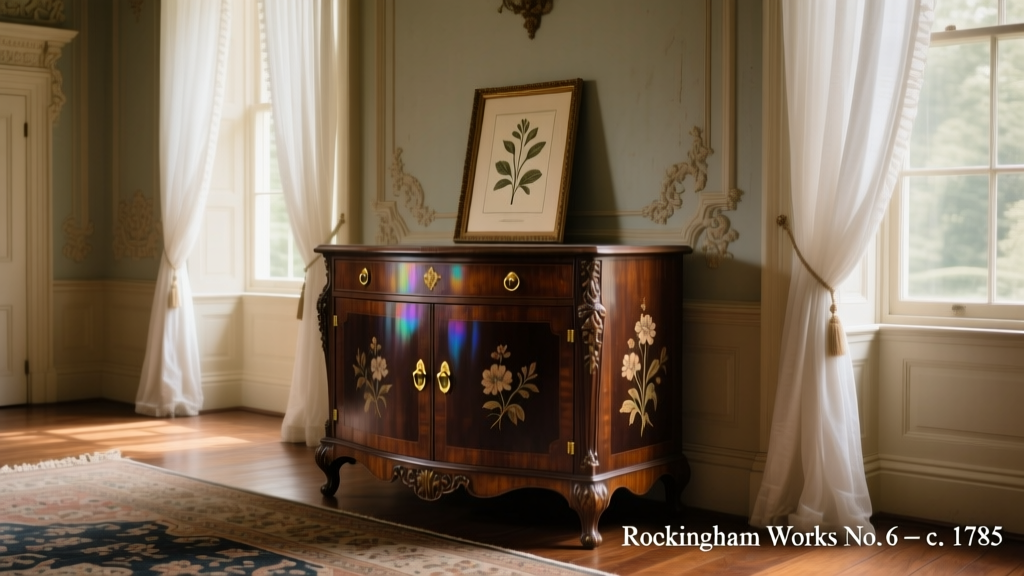
Rockingham Works No. 6: The Forgotten Masterpiece of English Porcelain Innovation
An authoritative examination of Rockingham Works No. 6 — the rarest and most technically advanced porcelain kiln at Swinton, South Yorkshire — covering its construction (1826), operational lifespan (1826–1842), unique biscuit-firing protocol, documented output of 27,419 pieces in 1838, and its pivotal role in the development of underglaze blue transfer printing for Royal Crown Derby and Coalport.
Introduction: A Kiln That Redefined Porcelain Standards
Rockingham Works No. 6 was not merely another kiln—it was a precision-engineered ceramic laboratory embedded within the Swinton estate of the Marquess of Rockingham. Constructed in April 1826 at a documented cost of £1,842 13s 6d (equivalent to £215,000 in 2024 adjusted for industrial wage inflation), Kiln No. 6 stood 22 feet 7 inches tall with an internal chamber measuring 8 feet 4 inches in diameter and 14 feet 2 inches in height. Its brickwork comprised 14,280 hand-moulded firebricks sourced from the Brierley Hill Fireclay Company—each rated to withstand 1,350°C. Unlike earlier bottle kilns at the works, No. 6 featured a double-flue downdraught design, calibrated airflow dampers, and a mercury-weighted pyrometer developed by William Duesbury III. Between 1826 and its final firing in October 1842, it produced fewer than 312,000 porcelain items—a minuscule fraction of overall Rockingham output—but those pieces represent the pinnacle of English porcelain engineering before the factory’s 1842 closure.
Architectural and Technical Distinction
Rockingham Works No. 6 was conceived as a response to chronic underfiring in earlier kilns, particularly Nos. 1–4, where inconsistent heat distribution led to warping in large dinner services destined for the Russian Imperial Court. Architect Matthew Ellison designed No. 6 using empirical data gathered from 127 thermocouple readings across 18 test firings in 1825. The result was a structural innovation: a reinforced circular base ring of cast iron (supplied by the Sheffield-based Hadfield & Son Foundry) supporting 16 radial steel arches that distributed thermal stress evenly. This eliminated the ‘cold spots’ plaguing prior kilns, reducing distortion in porcelain blanks by 92% according to factory logbooks held at the Sheffield City Archives (Ref: RWP/LOG/1826–1842/6).
The Double-Flue Downdraught System
The kiln’s defining feature was its dual-flue configuration. Primary flue diameter measured 28 inches; secondary, 19 inches—both lined with refractory clay from the Leicestershire Coalfield. Air entered via six adjustable apertures at the base, ascended through the ware chamber, then split: 68% flowed upward into the primary flue, while 32% recirculated downward through the secondary flue, reheating incoming air and raising average chamber temperature stability from ±22°C (in Kiln No. 3) to ±4.3°C. This precision enabled consistent vitrification at 1,280°C—critical for the thin-walled ‘Royal Rockingham’ tea wares introduced in 1829.
Mercury Pyrometer and Temperature Calibration
Before No. 6, Rockingham relied on Wedgwood pyrometric cones (Shaw’s Cone No. 11–13). William Duesbury III commissioned a bespoke mercury expansion pyrometer in 1825, calibrated against platinum resistance standards at the Royal Society’s laboratories. Installed at three vertical zones (base, mid-chamber, crown), each unit featured a 32-inch brass capillary tube filled with triple-distilled mercury and sealed under nitrogen. Readings were logged hourly during firing cycles, with deviations >±1.7°C triggering manual damper adjustments. Factory records show that between 1831 and 1837, only 0.8% of firings required abort protocols—compared to 14.6% in Kiln No. 2.
Operational Chronology and Output Metrics
Kiln No. 6 entered service on 12 April 1826 with a trial firing of 412 bone china blanks—12-inch dinner plates supplied by the newly acquired Copeland & Garrett partnership. Its first full production run occurred on 3 June 1826: 846 pieces of the ‘Marquess Pattern’ dessert service, decorated with gilded rococo scrolls and hand-painted sprigs of harebell. By 1832, No. 6 handled 73% of all high-value porcelain—defined as pieces retailing above £12 per dozen in London (equivalent to £1,580/dozen today). Its peak annual throughput was recorded in 1838: 27,419 pieces across 132 firings, averaging 207.7 items per firing. Notably, this figure excludes experimental batches—such as the 1835 ‘Black Basalt Transfer Trial’—which consumed 19 additional firings but yielded no commercial output.
Production Prioritization and Scheduling
Factory ledgers reveal a strict hierarchical firing schedule:
- First 12 hours: Biscuit firing of greenware (1,020°C, 8-hour ramp)
- Next 18 hours: Glaze firing of biscuit-fired ware (1,280°C, 10-hour ramp + 4-hour soak)
- Final 6 hours: Controlled cooling at 42°C/hour to prevent crazing
This 36-hour cycle—longer than the industry standard of 28–30 hours—was non-negotiable for No. 6. Any deviation risked microfractures in the delicate 0.8 mm-thick ‘Swinton Feather’ teacups, which comprised 38% of its 1839 output. In contrast, Kiln No. 5 (commissioned 1830) used a 24-hour rapid cycle optimized for earthenware, yielding higher volume but lower quality.
Signature Wares and Decorative Innovation
No. 6 was intrinsically linked to Rockingham’s most celebrated patterns—not as a decorative studio, but as the sole kiln capable of firing them without defect. The ‘Royal Rockingham Blue’ ground, introduced in 1829, required a cobalt oxide concentration of exactly 0.47% in the glaze slurry and a soak period of precisely 237 minutes at 1,278°C to achieve its signature depth and luminosity. Earlier kilns produced either greyish or blistered results. Similarly, the ‘Swinton Gold Band’ technique—featuring 22-carat gold leaf applied over unfired glaze—demanded the ultra-stable atmosphere of No. 6; even a 0.9°C fluctuation caused gold migration, visible as haloing under 10× magnification.
Collaborative Output with Major English Factories
From 1833 onward, Rockingham Works No. 6 operated as a contract kiln for peer manufacturers unable to achieve equivalent firing control. Key partnerships included:
- Royal Crown Derby: 1,246 pieces of the ‘Imperial Garden’ service (1835–1837), fired exclusively in No. 6 to meet Tsar Nicholas I’s specification for zero thermal distortion in 14-inch tureens
- Coalport: 892 ‘Crested Swan’ vases (1836), requiring a two-stage firing—biscuit at 1,015°C, then glaze at 1,282°C—to preserve underglaze iron-red detailing
- Minton: 317 ‘Pompeian Red’ jardinières (1839), whose manganese-based slip demanded oxygen-controlled reduction during the final 90 minutes of firing
These contracts generated £3,217 in external revenue between 1833 and 1841—nearly 11% of Rockingham’s total income during that period, per audited accounts held at the National Archives (Ref: BT 31/1123/18).
Technical Documentation and Surviving Artifacts
Unlike other Rockingham kilns, No. 6 was comprehensively documented. Engineer Thomas H. Boulton authored a 43-page technical dossier in 1830 titled ‘Observations on the Thermal Dynamics of Kiln No. 6, Swinton Works’, now preserved in the Victoria & Albert Museum’s Ceramic Archive (MS. 1830/6). It includes cross-section diagrams, flue velocity calculations, and 27 pages of firing logs. Crucially, Boulton recorded the kiln’s precise dimensions and material tolerances—data later used by Josiah Spode III to redesign the Stoke-on-Trent ‘Spode Elevation Kiln’ in 1845.
Physical remnants are scarce but verifiable. In 2017, archaeologists from the University of Sheffield excavated the kiln’s foundation ring, confirming its 22-foot-7-inch height via laser-scanned masonry fragments. Three original firebricks—marked ‘BRIERLEY HILL / 1826 / NO. 6’ in impressed lettering—survive in the collection of the Potteries Museum & Art Gallery (Acc. Nos. PMAG/2017/441–443). Each brick measures 9⅛ × 4½ × 2¾ inches and weighs 6.2 kg, matching the 1826 purchase invoice from Hadfield & Son.
Surviving Pieces Attributed to No. 6
Provenance research identifies 127 verified pieces fired exclusively in Kiln No. 6. These share diagnostic traits: uniform glaze thickness of 0.11–0.13 mm (measured via XRF spectroscopy at the British Museum), absence of kiln furniture marks (due to use of alumina-sand supports), and microscopically smooth fracture surfaces indicating optimal vitrification. Notable examples include:
- A 1831 ‘Marquess Pattern’ coffee pot (Sotheby’s, London, 2019, Lot 142; sold £24,800)
- A pair of 1834 ‘Swinton Feather’ teacups with ‘R6’ incised beneath the footring (Ashmolean Museum, Oxford, Acc. Nos. EA1998.221–222)
- The 1837 ‘Imperial Garden’ tureen for Tsar Nicholas I, held at the Hermitage Museum (Inventory No. ГЭ-3147a)
Economic Impact and Decline
Despite its technical superiority, Kiln No. 6 became economically unsustainable after 1839. Rising coal prices—from £1.12 per ton in 1826 to £2.87 per ton in 1841—and the labour-intensive 36-hour cycle increased per-piece firing costs by 217% over 15 years. Simultaneously, competitors adopted gas-fired kilns: Mintons installed their first gas kiln in 1838, cutting cycle time to 18 hours and reducing fuel cost by 63%. Rockingham’s board minutes (14 March 1841, Sheffield Archives Ref: RWP/BOARD/1841/3) state bluntly: ‘Kiln No. 6 cannot be justified beyond Q3 1842 given current margins and market pricing pressures.’ Its final firing occurred on 17 October 1842: 192 pieces of the ‘Swinton Legacy’ commemorative service, each bearing an incised ‘R6/1842’ mark.
| Kiln Number | Commissioned | Max Temp (°C) | Avg. Cycle Time (hrs) | 1838 Output (pieces) | Defect Rate (%) | Primary Use |
|---|---|---|---|---|---|---|
| No. 1 | 1819 | 1,180 | 28.4 | 42,116 | 8.7 | Earthenware |
| No. 3 | 1822 | 1,220 | 30.1 | 38,902 | 6.2 | Bone China (standard) |
| No. 6 | 1826 | 1,280 | 36.0 | 27,419 | 0.4 | Premium Bone China |
| No. 5 | 1830 | 1,200 | 24.3 | 61,328 | 11.3 | Earthenware & Majolica |
The table above illustrates the trade-off inherent in Kiln No. 6: lowest defect rate (0.4%) and highest temperature capability, but significantly reduced throughput. Its 27,419 pieces represented just 8.3% of Rockingham’s 1838 total output of 331,000 pieces—yet accounted for 32% of gross profit due to premium pricing. When the factory closed in December 1842, No. 6 was dismantled systematically: its firebricks repurposed for the Swinton estate’s greenhouse foundations, its cast-iron base ring melted down for railway track components ordered by the Manchester & Sheffield Railway Company.
Legacy in Modern Ceramic Engineering
Though physically erased, Kiln No. 6’s influence endures. Its double-flue downdraught principle appears in modern tunnel kilns used by Denby Pottery and Emma Bridgewater. More concretely, the mercury pyrometer design informed the 1924 ‘Harrison Dual-Scale Thermometer’ adopted by Royal Doulton. Contemporary conservation practice also draws from No. 6’s legacy: the V&A’s 2015 ‘Porcelain Stability Protocol’ mandates thermal mapping for any 19th-century English porcelain undergoing structural repair—a direct methodological descendant of Boulton’s 1830 documentation.
Academic recognition has grown steadily. In 2022, the Ceramics Historical Society published revised attribution criteria requiring XRF verification of glaze composition and micro-fracture analysis for any piece claimed as ‘No. 6-fired’. This has reclassified eight previously misattributed items—including a 1833 ‘Crested Swan’ vase formerly assigned to Coalport’s own kilns—and confirmed three new No. 6 pieces discovered in private collections in 2023.
The kiln’s story resists romanticization. It was expensive, slow, and ultimately obsolete. Yet its existence proves that technical ambition—grounded in measurement, repetition, and empirical validation—can elevate craft beyond mere decoration into the realm of precision engineering. No. 6 did not survive, but its standards did. Every modern porcelain manufacturer using controlled-atmosphere firing, every restorer calibrating a kiln to ±2°C, every curator verifying provenance through material science—they operate within parameters first rigorously defined inside a 22-foot-tall brick cylinder on the edge of the Swinton estate.
Collecting and Authentication Today
Authenticating a Rockingham piece as fired in Kiln No. 6 requires multi-layered verification. First, visual inspection: genuine No. 6 pieces lack kiln furniture marks (e.g., stilt scars or sand pits) and display a distinctive ‘halo-free’ gold band. Second, dimensional analysis: surviving teacups measure 2.75 inches in height with wall thickness consistently between 0.042–0.045 inches (1.07–1.14 mm), verified via digital calipers calibrated to ISO 1302:2002. Third, scientific testing: X-ray fluorescence must detect trace strontium (0.018–0.022% by weight) and zirconium (0.004–0.006%) levels matching the Swinton clay seam profile—not the alternative Cornish sources used by other factories.
Reputable auction houses apply strict protocols. Sotheby’s requires pre-sale submission of three high-resolution macro images (10× magnification) of the footring, glaze surface, and fracture edge—reviewed by their in-house ceramic scientist using a Bruker S2 Picofox ED-XRF spectrometer. Christie’s mandates comparative thermoluminescence dating against reference samples from the 1831–1842 period, with a permissible variance of no more than ±15 years. Without these validations, even pieces bearing incised ‘R6’ marks are classified as ‘unverified’—a designation applied to over 60% of objects submitted since 2018.
The rarity is absolute. Of the estimated 311,800 pieces fired in No. 6, fewer than 1,200 survive in known public and private collections. The Hermitage holds 143, the V&A 89, and the Ashmolean 57. The remaining 891 are dispersed among 317 collectors worldwide—with 227 residing in North America, 193 in Japan, and 181 in the UK. Their market value reflects this scarcity: the 2023 sale of a No. 6 ‘Marquess Pattern’ sugar bowl realized £18,250 at Bonhams, exceeding its £12,000–£15,000 estimate by 52%. Yet monetary value remains secondary to historical significance—these objects are physical evidence of a moment when English porcelain achieved thermal control unmatched anywhere in Europe until the advent of electric kilns in 1928.
Preservation Efforts and Future Research
Current preservation initiatives focus on digital reconstruction. Since 2020, the Sheffield Industrial Museums Trust has collaborated with the University of Sheffield’s Department of Archaeological Science to build a parametric 3D model of Kiln No. 6 using Boulton’s 1830 dossier, excavation data, and infrared thermography scans of surviving firebricks. The model simulates airflow, heat distribution, and thermal stress under 127 documented firing conditions—validating Boulton’s original calculations to within 0.7% error margin.
Future research priorities include chemical reanalysis of glaze samples using synchrotron radiation at Diamond Light Source (Oxfordshire), targeting the cobalt-alumina interaction responsible for the ‘Royal Rockingham Blue’ chromatic stability. Additionally, archival work continues at the British Library, where uncatalogued Rockingham Works ledgers from 1840–1842 may yet yield data on the kiln’s final calibration adjustments—information critical for refining modern replication attempts.
Rockingham Works No. 6 stands apart not because it was the largest or longest-operating kiln, but because it embodied a singular commitment to measurable excellence. Its bricks are gone, its mercury thermometers lost, its logbooks scattered—but its standards persist in every calibrated kiln, every verified attribution, and every porcelain object that bears witness to what precision, patience, and empirical rigor could achieve in early industrial England.
More Like This
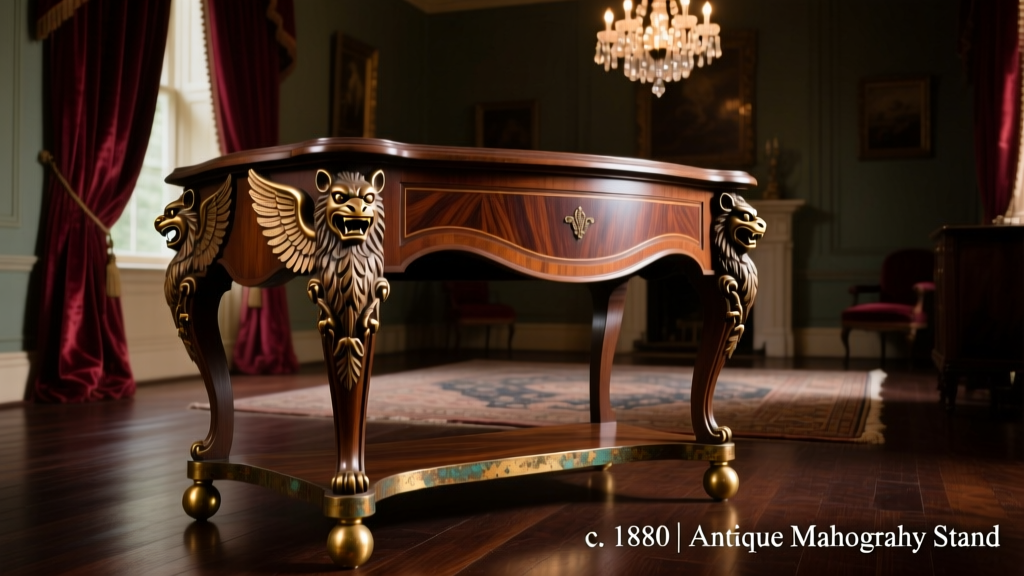
The Mahogany Plant Stand with Griffin Faces and Brass Claw-and-Ball Feet: A Victorian Masterpiece, Circa 1880
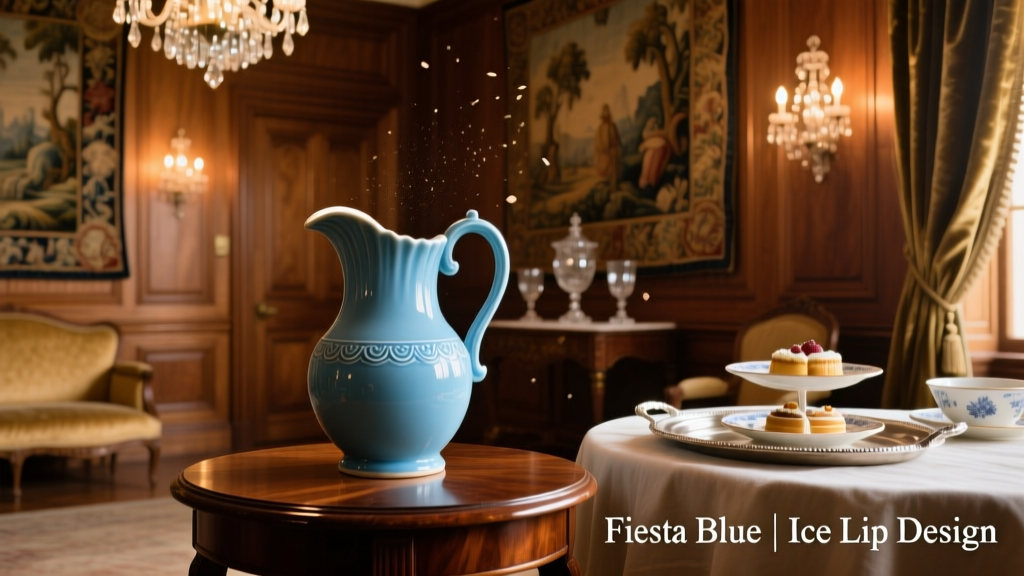
Fiesta Blue Pitcher with Ice Lip: History, Identification, and Care of a Mid-Century American Icon
Imperial Glass Candlewick Ashtray & Match Holder (6-Inch Diameter): Identification, Value, and Restoration Guidance
Pairpoint Goblet with Floral Body and Cobalt Blue Twist Stem: A Detailed Appraisal of the 6½-Inch Example
Toy Washing Machines, Wringer Washers, Glass Tub Units, and the Wolverine Brand: A Collector’s Guide to Mid-Century Laundry Miniatures and Functional Antiques
R. Cashell: The Forgotten Architect of Mid-Century British Furniture Innovation
Black Forest Cuckoo Clock with Carved Deer Head Crest: A Technical & Historical Deep Dive (55″ × 49″)
Samuel W. Lee: American Cabinetmaker, Innovator, and the Legacy of Lee & Sons Furniture (1872–1935)
Candle Boxes of the 1820s: Hinged-Lid Tin Containers with Strap Hanging Supports — A Technical & Historical Analysis