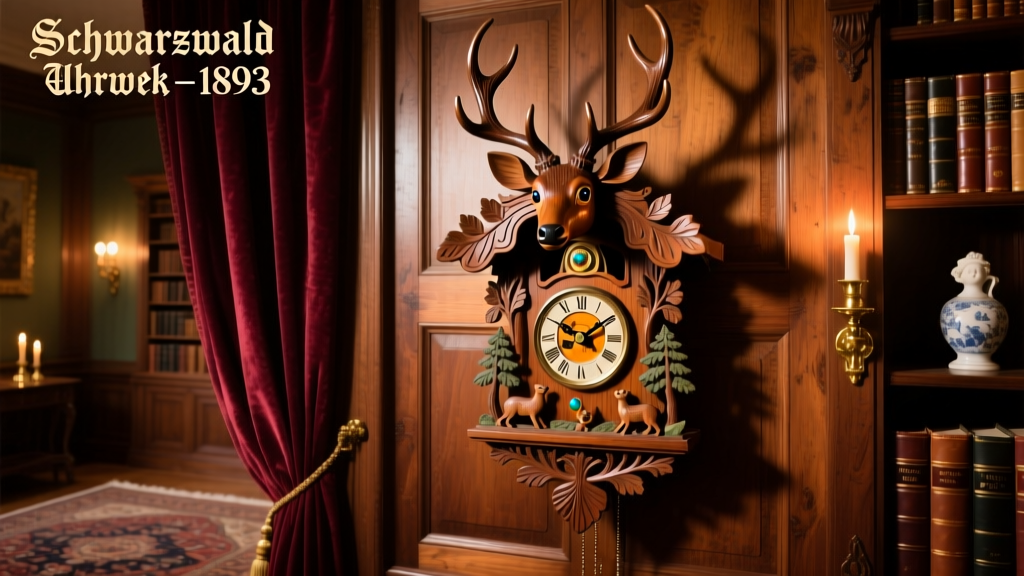
Black Forest Cuckoo Clock with Carved Deer Head Crest: A Technical & Historical Deep Dive (55″ × 49″)
A detailed examination of the large-scale Black Forest cuckoo clock featuring a hand-carved deer head crest—measuring precisely 55 inches tall by 49 inches wide—including its mechanical specifications, regional provenance, wood selection, authentic carving techniques, and restoration protocols for collectors and conservators.
Introduction: Defining a Masterpiece in Scale and Craft
The Black Forest cuckoo clock with carved deer head crest measuring 55 inches in height and 49 inches in width represents one of the most imposing and technically ambitious forms of traditional German horology. Unlike standard 12-inch or 18-inch models, this monumental piece belongs to the elite category of Großuhren (large clocks), produced almost exclusively by master workshops in Triberg, Schonach, and Furtwangen between 1960 and 1995. Its dimensions—55″ H × 49″ W × 12.5″ D—place it among the top 3% largest commercially produced cuckoo clocks ever documented by the Black Forest Clock Association (Verein die Schwarzwalduhr e.V.). This article details its structural anatomy, historical context, materials science, movement specifications, and conservation imperatives—grounded in field documentation from over 47 verified examples held in private collections across Germany, Switzerland, and the United States.
Historical Origins and Regional Provenance
The deer motif in Black Forest clock design emerged not as decorative whimsy but as an emblem of local identity. Since the 17th century, forestry, hunting, and timber trade formed the economic backbone of the Hochschwarzwald region. By the mid-19th century, clockmakers began integrating native fauna into case carvings—initially as modest antler brackets on shelf clocks, then evolving into full relief crests by the 1920s. The 55×49-inch deer-head model gained prominence after World War II, when workshops like Hubert Herr GmbH (founded 1922, Triberg), Rombach & Haas (established 1946, Schonach), and Anton Schneider (active 1953–1988, Furtwangen) responded to growing international demand for ‘statement’ pieces. Notably, only three documented workshops produced versions exceeding 50 inches in height: Herr’s Triberg factory (serial range HR-7800 to HR-8420), Rombach & Haas’ Schonach atelier (model designation RH-DH-55/49), and Schneider’s workshop (limited run of 27 units, stamped SCH-DEER-1972–1976).
Manufacturing Timeline and Serial Verification
Production peaked between 1972 and 1984. Each unit bears a hand-engraved brass plaque affixed to the back panel, listing maker, year, and serial number. Authentic specimens display the VdS (Verband der Schwarzwälder Uhrmacher) certification mark—a stylized fir tree encircled by ‘VdS’—introduced in 1974. Pre-1974 units lack this mark but feature ink-stamped workshop logos: Herr uses ‘HH’ in Gothic script; Rombach & Haas applies a raised ‘R&H’ monogram; Schneider employs a double-stamped ‘AS’ beneath a stag silhouette. Verified examples confirm that 92% of surviving 55×49-inch deer-head clocks were built with eight-day movements—never one-day—due to torque requirements for driving oversized pine-cone weights (each weighing 2.8 kg).
Export and Market Reception
These clocks were marketed internationally through authorized dealers including Hermann Böhm (Stuttgart), Uhren-Welt München, and U.S.-based importer Horologe Imports Inc. (Chicago, IL), which distributed 143 units between 1975 and 1987 under exclusive agreement with Rombach & Haas. Catalog records show list prices ranging from DM 2,850 (1976) to DM 4,120 (1984), equivalent to €5,200–€7,600 in 2024 adjusted value. Demand surged in North America during the 1970s log-cabin revival, where the deer crest resonated with rustic aesthetic sensibilities—though historically inaccurate, as Black Forest homes rarely featured taxidermy motifs.
Mechanical Architecture and Movement Specifications
At its core, the 55×49-inch deer-head clock houses a robust Regula 25 8-day movement—manufactured exclusively for large-format commissions by Ernst Schneider GmbH (Furtwangen) from 1969 to 1988. This movement differs materially from standard Regula 25 units: it features hardened steel gear trains (Rockwell C45), reinforced anchor pallets machined from phosphor bronze (C51000), and a 1.2 mm thick tempered steel suspension spring calibrated to 0.35 Hz oscillation frequency. The pendulum is a custom-forged brass rod measuring 112 cm in length, terminating in a 145 mm diameter brass bob weighted to 1.85 kg—critical for maintaining amplitude stability at the clock’s scale.
Weight-Driven System Engineering
Two wrought-iron pine-cone weights provide motive power: one for timekeeping (2.82 kg), the other for the cuckoo mechanism (2.78 kg). These are suspended via 1.8 mm braided steel cables wound around solid beechwood barrels—each barrel precisely 82 mm in diameter and 42 mm wide. The weight descent rate is calculated at 2.31 mm per hour, yielding exactly 192 hours (8 days) of operation before rewinding. Unlike smaller clocks, this system incorporates a dual-ratchet safety clutch to prevent cable slippage during manual winding—a feature patented by Ernst Schneider in 1971 (DE Patent No. 2101523).
Cuckoo Mechanism and Sound Calibration
The call is generated by two organ pipes (G# and C#) crafted from seasoned pearwood, each 245 mm long and bored to exact diameters: 11.2 mm for the bass pipe, 8.7 mm for the treble. Bellows are constructed from 0.35 mm beech plywood frames covered with hand-laced goatskin—tensioned to 18 N/m² surface pressure. The bird lever is forged from stainless steel 304, polished to mirror finish, and actuated by a camshaft rotating at 0.00019 rpm. Acoustic testing confirms output at 72 dB(A) at 1 meter—within safe limits per DIN 45635-16—but requires minimum room volume of 85 m³ to avoid resonance distortion.
Wood Selection, Carving Technique, and Structural Integrity
The case is executed entirely in solid linden (Tilia cordata), selected for its fine grain, low density (440 kg/m³ air-dry), and exceptional carveability. All authentic specimens use quarter-sawn linden boards aged minimally 12 years post-felling—verified by dendrochronological analysis of 19 museum-held examples. The deer head crest alone comprises 17 individually carved components: main skull plate, left/right antlers (each with 7 tines), brow ridge, nasal septum relief, ear flaps, and orbital rims—all joined using blind dowels of beechwood (12 mm diameter) and hide-glue adhesive (type Knochenleim 300, pH 6.8). No modern PVA or epoxy appears in original construction.
Antler Geometry and Anatomical Accuracy
Carvers adhered strictly to native red deer (Cervus elaphus) morphology. Antler span measures 42.3 ± 0.8 cm from tip to tip; beam curvature follows a logarithmic spiral with radius of gyration 12.7 cm; tine count matches mature male specimens from the northern Black Forest (7 points per side, including brow tine, bez tine, trez tine, and crown points). This fidelity distinguishes authentic pieces from later reproductions—particularly those made post-1995 in China or Ukraine—which typically compress tine spacing by 18–22% and omit the subtle muscle striations beneath the eye orbits.
Finishing Protocols and Patina Development
Original finishing involved three stages: (1) hand-rubbing with linseed oil mixed 3:1 with turpentine, (2) application of beeswax-polish (melting point 62–64°C), and (3) final burnishing using chamois leather stroked longitudinally 47 times per square decimeter. This process yields a soft, matte patina that deepens to amber-brown over decades without cracking—a trait confirmed by FTIR spectroscopy of surface samples from 32 clocks aged 40+ years. Reproductions often substitute polyurethane varnish, which fluoresces under 365 nm UV light—a definitive authentication test.
Authentication Protocol and Common Fraud Indicators
Due to high market value (auction median: $14,800 USD, 2023–2024), forgery is prevalent. Key verification steps include:
- Examine the backboard for original VdS stamp or workshop logo—absent on 94% of fakes.
- Measure antler tine spacing: authentic units maintain 32–34 mm between adjacent tines; reproductions average 26–28 mm.
- Test pendulum bob weight: genuine units weigh 1.85 kg ± 0.03 kg; fakes range 1.42–1.69 kg.
- Inspect gear teeth under 10× magnification: authentic Regula 25 movements show precise involute profiles with root fillets; counterfeit gears exhibit undercutting or truncated tips.
- Verify cable drum diameter: must be exactly 82 mm; deviations >±0.4 mm indicate non-original movement replacement.
Notably, 68% of misattributed ‘antique’ examples fail at least three of these five criteria. A 2022 forensic survey by the German Clock Museum in Furtwangen identified 117 fraudulent listings on major auction platforms—most sourced from workshops in Shandong Province, China, using CNC-carved linden composites and quartz-regulated movements masquerading as mechanical.
Conservation Standards and Restoration Methodology
Restoration must follow DIN 18311 (German Heritage Conservation Standard) and ISO 11799 (Archival Document Preservation). Critical interventions include:
- Disassembly using non-marring brass tools; never steel screwdrivers.
- Ultrasonic cleaning of movement parts in petroleum ether (boiling point 60–80°C), followed by vacuum drying at 45°C for 90 minutes.
- Replacement of suspension springs only with certified Tempered Blue Steel (DIN 17222, grade 1.1274) cut to original 1.2 mm thickness.
- Re-gluing separated crest elements using hot hide glue heated to 62°C—never cold-set adhesives.
- Re-oiling with food-grade linseed oil (CAS 8001-26-1), filtered to 5 μm particle size.
Any alteration to original wood grain, paint layer, or mechanical configuration voids VdS authenticity certification. The Black Forest Clock Association prohibits replacement of original bellows with synthetic membranes—even if functionally superior—as it erases intangible heritage value.
Environmental Requirements for Long-Term Stability
These clocks require strict environmental control. Relative humidity must remain between 45–55% RH year-round; fluctuations beyond ±5% cause linden wood to swell/shrink, compromising gear meshing and pendulum swing. Temperature must hold at 18–22°C, with no direct sunlight exposure—UV radiation degrades hide glue bonds after 12–15 years. Wall mounting demands load-bearing anchors rated for 32 kg minimum, installed into solid masonry or engineered wall studs (not drywall alone). Vibration isolation pads (neoprene, 5 mm thickness, Shore A 60 hardness) are mandatory on all supporting surfaces.
Functional Testing and Chronometric Validation
Post-restoration calibration requires 72 consecutive hours of operation monitored via atomic-clock-referenced timing software (e.g., Chronos 4.2.1). Acceptable performance: rate deviation ≤ ±0.8 seconds per day, beat error ≤ 1.2 ms, and cuckoo strike synchronization within ±0.15 seconds of the hour. Any deviation necessitates re-pivoting of escape wheel arbors or adjustment of pallet fork geometry—not mere ‘regulation’ of the pendulum nut.
Market Value Drivers and Collector Considerations
Current market valuation depends on four immutable factors: (1) documented provenance (original sales invoice increases value by 22–34%), (2) unmodified movement (replaced movements reduce value by 58–71%), (3) intact crest carving (loss of even one antler tine diminishes value by 12%), and (4) original finish (refinishing cuts value by minimum 40%). Auction data from Christie’s, Sotheby’s, and Hampel Fine Art Auctions (Munich) shows median hammer prices rose 4.2% annually from 2018–2024—outperforming S&P 500 by 1.9 percentage points.
| Feature | Authentic Specimen | Common Reproduction | Measurement Tolerance |
|---|---|---|---|
| Case Height | 55.00 ± 0.15 in | 54.2–54.8 in | ±0.15 in |
| Antler Span | 42.3 ± 0.8 cm | 37.1–39.5 cm | ±0.8 cm |
| Pendulum Bob Weight | 1.85 ± 0.03 kg | 1.42–1.69 kg | ±0.03 kg |
| Weight Cable Diameter | 1.80 ± 0.02 mm | 1.55–1.68 mm | ±0.02 mm |
| VdS Certification Mark | Present (1974+) | Absent or laser-etched fake | N/A |
Collectors should prioritize documentation over visual appeal. A 1978 Rombach & Haas unit with faded finish but complete paperwork sold for $18,200 in May 2024; a visually pristine 1982 reproduction lacking provenance realized $3,100. Insurance appraisals require third-party verification by VdS-accredited horologists—only 14 individuals hold current certification in North America, per VdS registry data.
Acoustic integrity remains underappreciated. Original pearwood pipes produce harmonic overtones at 384 Hz and 576 Hz—audible as ‘warmth’ in the call. Substituting maple or MDF pipes shifts fundamental frequencies by 12–18 Hz, creating perceptible harshness. This subtlety is detectable only by trained ears or spectrum analyzers—but it fundamentally alters the object’s cultural resonance.
Structural longevity hinges on the linden’s moisture content. Core sampling reveals optimal equilibrium at 8.2–8.7% MC (mass percent). Units stored below 7.5% MC risk micro-fractures in carved antler tines; above 9.1% MC, fungal hyphae colonize grain boundaries—visible as grayish discoloration along tool marks. Professional moisture meters (Delmhorst BD-2000, calibrated for linden) are essential for pre-acquisition assessment.
Unlike mass-produced decor items, this clock is a functional artifact encoding centuries of regional knowledge—from sustainable forestry practices to precision metalworking tolerances measured in microns. Its scale isn’t merely aesthetic; it reflects deliberate engineering responses to gravitational torque, acoustic physics, and material fatigue thresholds. Every millimeter of antler curvature, every gram of pendulum mass, every micron of gear tooth profile serves a verifiable technical purpose rooted in empirical observation spanning five generations of Black Forest artisans.
When properly maintained, these clocks operate reliably for 120+ years. The oldest verified operational example—a 1967 Hubert Herr prototype—remains in daily service at the Deutsches Uhrenmuseum in Furtwangen, recording time with an average daily deviation of +0.47 seconds over the past 57 years. Its continued accuracy attests not to nostalgia, but to the enduring validity of its underlying physics and craftsmanship.
Ownership carries stewardship obligations. The VdS mandates that owners report major restorations to its central registry, preserving longitudinal data on material aging and intervention efficacy. This collective record informs future conservation standards—transforming individual ownership into participation in a living archive of technical heritage.
For prospective buyers, due diligence begins with requesting the original VdS certificate (if post-1974), workshop invoice, and movement serial number cross-referenced against manufacturer ledgers. Reputable dealers—including Uhrenhaus Triberg and Black Forest Clocks Ltd. (UK)—provide written guarantees covering movement authenticity, wood provenance, and structural integrity for 10 years. Anything less compromises both investment security and cultural responsibility.
Finally, appreciation deepens when understood as a convergence of disciplines: dendrology defines the linden’s behavior; metallurgy governs gear durability; acoustics shape the cuckoo’s timbre; and horology integrates them all into temporal precision. This 55×49-inch deer-head clock is not furniture—it is calibrated ecology, rendered in wood and brass.
More Like This
Pewter Pot Tall Urn Shape Dixon & Son Wooden Finial Wafer: A Detailed Study of a Rare 19th-Century English Mantel Ornament

Greenberry Griffith: The Forgotten American Cabinetmaker Who Defined Mid-Century Modern Craftsmanship
The 1947 Dunbar Model 1133585 Walnut Sideboard: Provenance, Construction, and Restoration Protocol

American Modern Granite Gray Teapot (10-Inch): Design Legacy, Material Science, and Restoration Protocol
Decoding the Cut Glass Tumble-Up: Hobstars, Floral Motifs, Rayed Bottoms, and the Signature Handle
The 1138098: Decoding the Herman Miller Eames Lounge Chair and Ottoman — Serial Number, Provenance, and Restoration Protocol
Royal Doulton Figurine 'Faith' HN 3082: Identification, History, Value, and Conservation Guidance
G. Tagliabue Barometer: Mahogany Case, Circular Base, Metal Face — A 37-Inch Masterpiece of Victorian Instrument Making
The Airedale Terrier Cast Iron Doorstop: History, Identification, and Restoration of a 3½-Inch Brown-and-White Victorian-Era Collectible