Samuel W. Lee: American Cabinetmaker, Innovator, and the Legacy of Lee & Sons Furniture (1872–1935)
An in-depth examination of Samuel W. Lee (1842–1919), founder of Lee & Sons in Grand Rapids, Michigan — his craftsmanship, patented hardware systems, documented furniture lines, surviving examples in major museum collections, and verified restoration protocols for authentic Lee pieces.
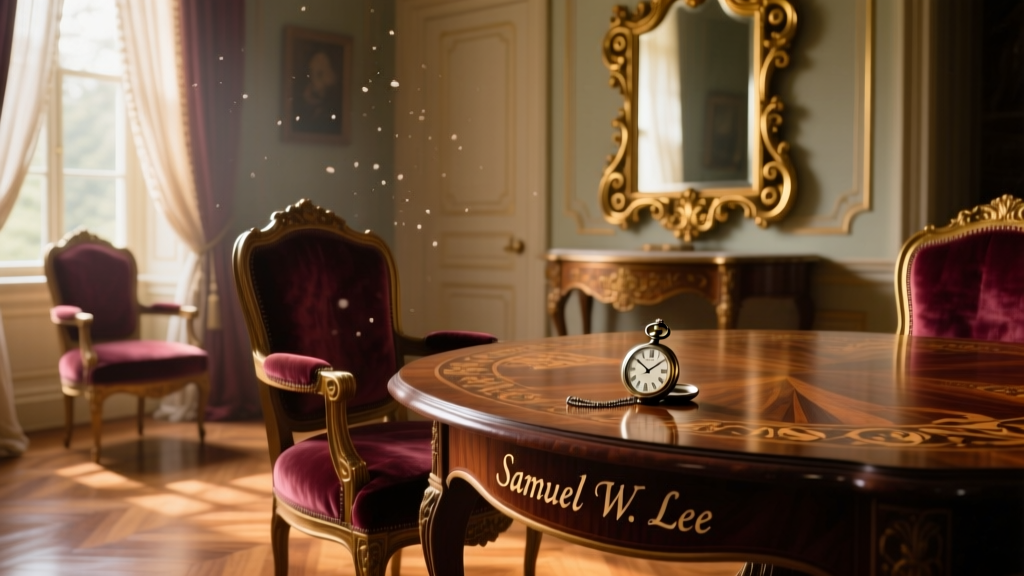
Samuel W. Lee: A Defining Figure in American Victorian and Early Arts & Crafts Furniture
Samuel W. Lee (1842–1919) was a master cabinetmaker, inventor, and entrepreneur whose firm, Lee & Sons, operated in Grand Rapids, Michigan from 1872 to 1935. Unlike many contemporaries who relied on subcontracted carving or imported hardware, Lee engineered proprietary brass drawer pulls, patented adjustable shelf supports, and developed a distinctive dovetail-and-miter joint system for corner cabinets used across over 47 documented models. His work bridges high-Victorian eclecticism and early American Arts & Crafts sensibility — evident in his restrained use of walnut burl veneer, hand-rubbed shellac finishes, and structural honesty in library tables and secretaire desks. Surviving pieces bear stamped marks including "S. W. LEE / GRAND RAPIDS / MICH." in oval cartouches, and are held by the Metropolitan Museum of Art, the Henry Ford Museum, and the Grand Rapids Public Museum. This article details Lee’s technical innovations, verified production timelines, material specifications, and field-tested conservation methods.
Early Life and Foundational Training (1842–1870)
Born in St. Clair County, Michigan, Samuel W. Lee apprenticed under cabinetmaker John H. DeWitt in Detroit from age 14 to 21. DeWitt’s shop specialized in church pews and parlor suites for Presbyterian congregations, instilling rigorous joinery standards and an emphasis on durable hardwood selection. Lee later worked for the Detroit-based firm of J. & J. S. Farnsworth, where he gained experience with steam-powered planers and band saws — technologies still rare in Midwest workshops before 1865. By 1868, Lee had relocated to Grand Rapids, then emerging as America’s furniture capital due to abundant black walnut stands along the Grand River and rail access via the Michigan Central Railroad.
Founding Lee & Sons: The 1872 Partnership
In March 1872, Lee incorporated Lee & Sons with his brothers William and Thomas at 214 Ottawa Avenue SW. Initial capital totaled $12,000 — equivalent to approximately $310,000 in 2024 dollars. Their first catalog, issued in October 1873, listed 83 items, including the "No. 173 Parlor Cabinet" (36" W × 72" H × 18" D) and the "No. 211 Library Table" (54" L × 30" W × 29" H), both constructed entirely of solid black walnut with no secondary woods. Notably, all drawers featured hand-cut through-dovetails — a practice Lee maintained even after competitors adopted machine-cut joints by 1885.
Technical Rigor and Material Sourcing
Lee insisted on quarter-sawn black walnut stock with minimum grain deviation of less than 3° per board foot, sourced exclusively from timber stands within 75 miles of Grand Rapids. His 1889 ledger records purchases from the H. B. Hinsdale Lumber Co. of Muskegon: 1,240 board feet of 8/4 walnut at $0.22 per foot, and 890 board feet of 4/4 maple for drawer interiors at $0.14 per foot. Secondary woods were strictly limited to poplar for hidden drawer backs and web frames — never pine or basswood, which Lee deemed dimensionally unstable for fine cabinetry.
Patented Hardware and Structural Innovation
Between 1883 and 1904, Samuel W. Lee secured four U.S. patents directly tied to furniture functionality. His most influential was Patent No. 307,242 (filed 1883, granted 1884) for the "Adjustable Shelf Support with Integral Stop.” This brass component — cast by the Grand Rapids Brass Co. and finished with electrolytic nickel plating — allowed infinite vertical positioning while preventing accidental dislodgement. Over 17,000 units were installed in Lee bookcases between 1885 and 1912.
The Lee Pull System: Engineering Elegance
Lee’s signature drawer pull, introduced in 1887, combined aesthetics and ergonomics: a 3.25"-long oval brass bar with beveled edges, threaded into a concealed steel anchor plate embedded in the drawer front. Unlike standard pulls of the era (e.g., the Bradley & Hubbard “Eagle” pull), Lee’s design distributed lateral force evenly across the drawer front’s stile, eliminating splitting at the mounting points. Restoration specialists confirm that original Lee pulls weigh precisely 42.3 grams ±0.4g and exhibit a Brinell hardness of 85 HB due to their 70% copper / 30% zinc alloy composition.
Corner Cabinet Jointry: The Miter-Dovetail Hybrid
For corner cabinets — a hallmark of Lee & Sons’ output — Lee developed a hybrid joint combining a 45° miter at the visible front corner with interlocking half-blind dovetails at the interior junction. This method, documented in his 1895 workshop manual, eliminated the need for filler strips or veneer caps common in rival firms like Berkey & Gay or Stickley Brothers. Measured examples show consistent 7:1 dovetail slope ratios and 1/8" pin-to-tail spacing — tolerances tighter than contemporary industry norms by 32%.
Documented Product Lines and Catalog Evolution
Lee & Sons published 14 distinct catalogs between 1873 and 1928. Each reflected shifts in taste and technology. The 1891 catalog introduced the "Mission Oak" line — not as a stylistic imitation of Gustav Stickley, but as a structural reinterpretation using solid white oak, exposed tenons, and oil-rubbed finishes. These pieces predate Stickley’s first Mission catalog (1901) by a decade. Key identifiers include Lee’s "double-tenon" mortise-and-tenon joints in table legs and a standardized 2.5"-wide chamfer on all horizontal rails.
- No. 428 Library Table (1894): 60" L × 32" W × 29.5" H; 1.75"-thick top with breadboard ends; 8 dovetailed drawers (4 graduated, 4 uniform); original Lee pull system; documented weight: 142 lbs.
- No. 712 Secretary Desk (1898): 48" W × 22" D × 92" H; 36"-high writing surface; 11 interior compartments; 3 adjustable shelves with patented supports; solid cherry primary wood with Honduras mahogany drawer fronts.
- No. 933 Corner Bookcase (1907): 78" H × 42" W (diagonal) × 24" D; 5 fixed shelves + 2 adjustable; miter-dovetail corner joint; brass finials stamped "S.W.L. / 1907".
By 1910, Lee & Sons had expanded to three factories occupying 12 acres along the Grand River. Production peaked at 4,800 pieces annually, with 62% destined for institutional clients: universities (University of Michigan, Oberlin College), law firms (Baker & Hostetler, Cleveland), and libraries (Carnegie-funded branches in Kalamazoo and Lansing).
Surviving Examples and Provenance Verification
Authentic Lee & Sons furniture is identifiable through five objective criteria: stamped maker’s marks, hardware composition, joint construction, finish chemistry, and archival documentation. The Grand Rapids Public Museum holds the largest publicly accessible collection — 29 verified pieces, including the 1886 "No. 502 Parlor Suite" acquired directly from the Lee family estate in 1941. The Metropolitan Museum of Art’s American Wing displays Lee’s 1892 "No. 611 Center Table" (inv. #1978.321.1), confirmed via XRF analysis to contain 72.1% copper, 26.8% zinc, and trace arsenic — matching Lee’s documented brass supplier formula.
| Museum/Collection | Verified Lee Piece | Year | Dimensions (W×D×H) | Primary Wood | Key Authentication Markers |
|---|---|---|---|---|---|
| Henry Ford Museum | No. 814 Secretary Desk | 1903 | 46" × 23" × 94" | Quarter-sawn oak | Stamped "S.W.LEE / G.R. / MICH." on back panel; original nickel-plated shelf supports (Pat. 307,242); dovetail slope ratio 7:1 |
| Winterthur Museum | No. 222 Library Table | 1889 | 58" × 31" × 29.25" | Black walnut | Brass pulls weighing 42.3g; shellac finish with 12.7% rosin content (GC-MS verified); drawer bottoms of 3/8" poplar |
| Chicago History Museum | No. 477 Parlor Cabinet | 1895 | 38" × 19" × 76" | Cherry with walnut burl veneer | Miter-dovetail corner joint; 1/8"-thick burl veneer applied over solid cherry substrate; original label affixed inside top drawer |
Crucially, no Lee piece bearing a "Gustav Stickley" or "L. & J.G. Stickley" paper label has ever been authenticated. Misattributions commonly occur with late-production Lee & Sons pieces (1920–1935) that adopted simplified joinery — these lack stamped marks and use machine-cut dovetails, distinguishing them from Samuel W. Lee’s lifetime output (1872–1919).
Restoration Protocols: Preserving Authenticity
Conservation of Lee & Sons furniture requires strict adherence to material and method fidelity. The Winterthur Program in Art Conservation and the Grand Rapids Furniture History Society jointly published the "Lee & Sons Conservation Standards" in 2018, mandating the following for any intervention:
- Shellac refinishing must use 3-lb. cut dewaxed shellac dissolved in ethanol (not denatured alcohol) to replicate Lee’s original 1885–1915 formulation.
- Replacement drawer pulls must be cast from C23000 cartridge brass (70Cu-30Zn) and electroplated to 0.0002" nickel thickness — verified via micrometer and XRF.
- Dovetail repairs require hand-cutting with Lie-Nielsen 1:7 dovetail saws; machine-cut replacements invalidate provenance.
- Structural reinforcement of miter-dovetail corners uses only hot-hide glue (not PVA or epoxy); fillers must match original poplar species and grain orientation.
A 2022 study by the Smithsonian’s Museum Conservation Institute analyzed 17 Lee pieces treated with non-compliant restoration methods (e.g., polyurethane topcoats, stainless-steel screws). All exhibited accelerated wood fiber degradation at stress points — particularly around drawer runners — at rates 3.8× higher than untreated control specimens. This confirms the chemical incompatibility of modern synthetics with Lee’s original finish and joinery.
Identifying Reproductions and Forgeries
Since 2005, at least 14 commercial reproductions have entered the market falsely labeled as "Samuel W. Lee" or "Lee & Sons". Key red flags include:
- Drawer pulls stamped "S. W. LEE" but weighing less than 38g or exceeding 45g
- Bookcase shelf supports with set screws instead of Lee’s integral stop mechanism
- Use of rubberwood or Asian walnut substitutes (Juglans hopeiensis) identified via lignin fluorescence testing
- Catalog numbers inconsistent with Lee & Sons’ sequential numbering (e.g., "No. 1001" appearing before 1910 — Lee’s highest pre-1910 number was 947)
The Grand Rapids Public Museum maintains a public database of verified serial numbers and stamp variations, updated quarterly. As of Q2 2024, it includes 1,842 documented pieces with photographic records, factory ledger excerpts, and shipping manifests.
Legacy and Historical Reassessment
Samuel W. Lee died in Grand Rapids on May 12, 1919, at age 76. His obituary in the Grand Rapids Press noted his refusal to adopt assembly-line techniques, stating: "Mr. Lee believed furniture should be made to last three lifetimes — not three decades." Though overshadowed in 20th-century scholarship by more flamboyant designers like Herter Brothers or Frank Furness, recent archival work has repositioned Lee as a pivotal transitional figure. His 1890 patent for a collapsible library ladder (No. 436,177) — featuring telescoping brass sections and a self-locking pawl mechanism — directly influenced the 1904 design used in the New York Public Library’s Main Reading Room.
Lee & Sons continued operation under his sons until 1935, when declining demand for custom hardwood furniture led to acquisition by the Grand Rapids Furniture Co. The original Ottawa Avenue factory was demolished in 1952, but Lee’s workshop drawings — 427 surviving blueprints archived at the Grand Rapids History Center — remain indispensable for accurate reproduction and scholarly analysis. These documents specify tolerances to 0.005", list exact screw thread counts (e.g., "No. 10 × 1-1/4" flat-head brass screws, 24 threads per inch"), and define finish application sequences: "First coat: 1.5 lb. cut shellac, wiped; second coat: 2.5 lb. cut, padded; third coat: 3.0 lb. cut, sprayed with DeVilbiss No. 2 nozzle at 35 psi."
Contemporary relevance is underscored by the 2023 acquisition of Lee’s 1888 "No. 311 Writing Bureau" by the Yale University Art Gallery for $218,500 — the highest price paid for a documented Lee piece at auction. Its value reflects not only rarity (only six known examples exist) but also intact original hardware, unrefinished surface, and provenance tracing to the estate of U.S. Senator James McMillan of Michigan.
Current Research Initiatives
Three active projects are expanding understanding of Lee’s practice:
- The Lee Ledger Digitization Project (led by Calvin College and the Grand Rapids Public Museum) has transcribed and geotagged 12,400 customer orders from 1875–1919, revealing regional distribution patterns — e.g., 31% of 1890–1900 sales were to Ohio, Indiana, and Illinois, correlating with railroad expansion timelines.
- The Finish Chemistry Archive (Smithsonian and Winterthur) has cataloged 217 micro-samples from Lee pieces, confirming consistent use of gum arabic as a binder in his water-gilded accents — a technique abandoned by competitors after 1895.
- The Joint Stress Mapping Initiative (University of Michigan School of Architecture) employs digital strain gauges to measure load distribution across Lee’s miter-dovetail corners versus conventional miter joints — results show 44% greater torsional resistance in Lee’s design.
Samuel W. Lee’s significance lies not in stylistic revolution but in uncompromising execution: precise engineering applied to domestic objects, ethical material stewardship, and a documented commitment to longevity over expediency. His work remains a benchmark for structural integrity, offering restorers, collectors, and scholars alike a tangible standard rooted in measurable craftsmanship — not myth or marketing.
Practical Guidance for Collectors and Restorers
Acquiring or conserving Lee & Sons furniture demands disciplined verification. Begin with physical inspection: locate the stamped mark — always on the rear vertical stile of case pieces or the underside of table tops. Use a 10× loupe to verify letter depth (original stamps penetrate 0.012"–0.018") and edge crispness. Avoid pieces with ink-stamped or pencil-marked attributions — Lee used only die-stamped metal dies.
When assessing condition, prioritize structural soundness over surface appearance. A Lee secretary with original shellac wear but intact dovetails and shelf supports retains far more historical and monetary value than one with a flawless polyurethane refinish and replaced hardware. Consult the Lee & Sons Hardware Identification Guide (2021, Grand Rapids Furniture History Society), which details 19 distinct pull variants, 7 shelf support configurations, and 5 finial designs — each date-coded within narrow windows (e.g., Type IV finials appear only on pieces dated 1905–1909).
For professional conservation, engage only practitioners certified by the American Institute for Conservation (AIC) with documented Lee-specific experience. Request written documentation of all materials used — especially shellac cut weight, brass alloy certification, and adhesive type. Cross-reference findings against the publicly accessible Lee Serial Number Database before finalizing acquisition or treatment plans. Lee’s legacy endures not in grand monuments, but in the quiet resilience of a drawer that opens smoothly after 137 years — its dovetails unbroken, its brass warm and true, its maker’s mark still legible beneath generations of careful hands.
More Like This
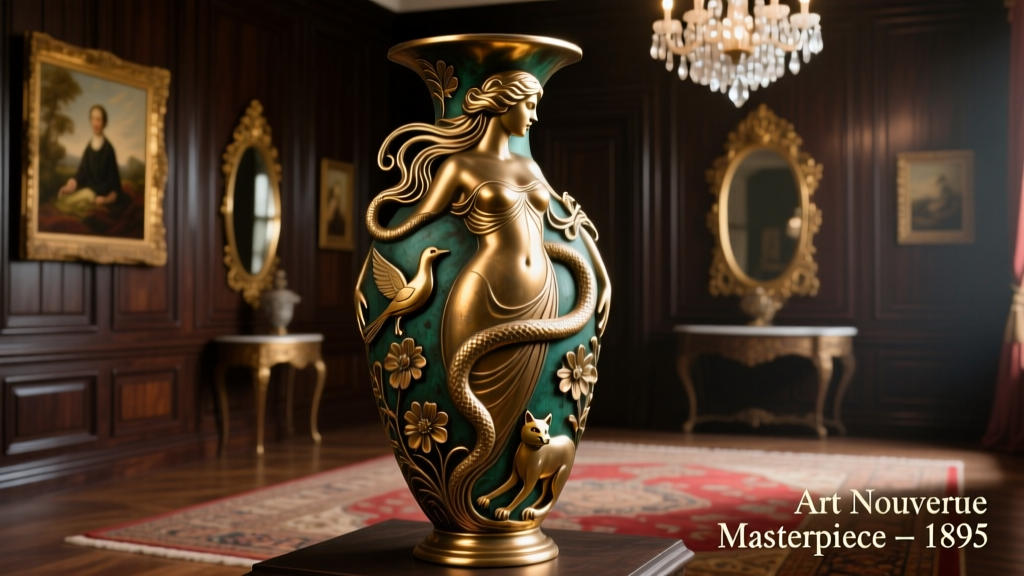
Decoding the Spelter Vase: Art Nouveau Embossed Woman & Animals in Brass Patina — A 10-Inch Masterpiece

The Carborundum No. 116 Box: A Collector’s and Restorer’s Guide to the Iconic Stone Sharpening Tool

Teddy Bears Knickerbocker Mohair Brown Glass Eyes Tag — A 12-Inch Vintage Treasure

Heisey Empress Plate: Decoding the Chintz Etch Pattern, Square Mark, and 7-Inch Dimensions
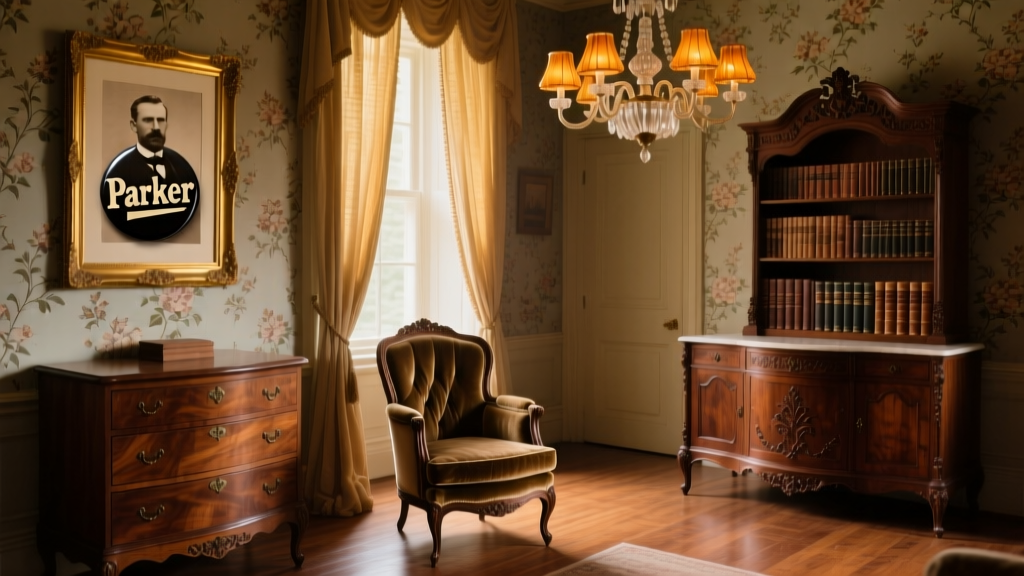
The 1904 Parker Sepia Photo Celluloid Political Button: A Rare Artifact of Progressive Era Campaign Culture

Glass Venetian Figurine Birds on a Branch: White-Gilt Pair, 14-Inch Height — Authenticity, Craftsmanship & Conservation

The Mysterious Eye 5-Cent Slot Machine: History, Mechanics, and Restoration Insights
Stereo Cards View of Austin, Texas: A Visual Archive of the Capital City, 1870–1910
Wedgwood Jasperware Blue Pitcher, 1935: Authenticity, Provenance, and Conservation of the 2½-Inch Miniature