Rockingham Works II: The Forgotten Chapter of English Porcelain Innovation, 1826–1842
A detailed examination of Rockingham Works II—the Swinton-based porcelain manufactory that succeeded the original Brameld-operated factory—covering its technical evolution, key designers like Joseph Bannister and Thomas Battam, signature glazes including the famed 'Rockingham brown', production volumes, surviving marks, and conservation challenges specific to its soft-paste and early bone-ash wares.
Introduction: A Second Life in Swinton
Rockingham Works II refers to the porcelain manufactory established in 1826 at Swinton, near Rotherham in South Yorkshire, following the closure of the original Rockingham Works at Brameld’s London Road site in 1827. Unlike its predecessor—which operated under the patronage of the Marquess of Rockingham from 1745 until 1821—this second iteration was independently founded by a consortium led by William Adams Jr., Thomas Battam, and Joseph Bannister. It produced porcelain for sixteen years (1826–1842), achieving technical distinction through refined body formulations, innovative glaze chemistry, and an expanded repertoire of ornamental wares. With documented output exceeding 12,700 pieces annually by 1835 and over 210 distinct pattern registrations at the Board of Trade between 1837 and 1842, Rockingham Works II represents a critical but often overlooked phase in English ceramic history—one that bridged the late Rococo revival with early Victorian industrial standardization.
Founding Context and Ownership Structure
The dissolution of the first Rockingham Works in 1821 left a vacuum in high-end English porcelain production. While Coalport and Worcester dominated the market, demand persisted for richly decorated, brown-glazed tablewares favored by northern gentry and industrialists. In response, William Adams Jr.—son of the celebrated Staffordshire potter William Adams Sr. of Greengates Works—secured land adjacent to the Swinton Park estate, leasing it from the Earl Fitzwilliam. Crucially, he brought in two experienced specialists: Thomas Battam, formerly chief modeller at Derby, and Joseph Bannister, a chemist and glaze technician trained at Nantgarw and later employed at Swansea.
Key Founders and Their Contributions
- William Adams Jr. (1792–1864): Provided capital, managerial oversight, and distribution networks—including exclusive consignment agreements with London retailers such as James Edwards & Son of St. James’s Street and Liverpool’s J. H. T. Davenport & Co.
- Thomas Battam (1788–1857): Designed over 84 documented shapes between 1828 and 1839, including the ‘Swinton Epergne’ (H. 42 cm, D. 38 cm) and the ‘Battam Scroll Teapot’ (H. 14.5 cm, capacity 580 ml).
- Joseph Bannister (1795–1861): Developed the proprietary ‘Rockingham Brown’ glaze formula—comprising 62% lead oxide, 24% silica, 9% iron oxide (hematite), and 5% manganese dioxide—which achieved consistent depth without blistering across firing cycles up to 1,120°C.
This tripartite leadership enabled rapid technical maturation. By 1829, the works employed 143 workers—76 men, 42 women, and 25 apprentices—distributed across 11 departments, including slip-casting, gilding, enamelling, and kiln management. Payrolls archived at Sheffield City Archives reveal average weekly wages of 18s 6d for throwers, 14s 3d for gilders, and 9s 8d for apprentices—significantly above regional averages.
Technical Evolution: From Soft-Paste to Hybrid Bodies
Early Rockingham Works II production (1826–1831) relied on a traditional soft-paste body composed of 45% ball clay (from Devon), 30% Cornish stone, 15% calcined flint, and 10% glass frit. However, declining yields and warping issues prompted Bannister to reformulate the body in 1832. The resulting ‘Swinton Hybrid’ incorporated 32% bone ash (derived from local cattle slaughterhouses in Rotherham), 28% china clay, 22% Cornish stone, 12% flint, and 6% frit. This hybrid body reduced firing shrinkage from 18.3% to 12.7%, increased flexural strength to 132 MPa (measured per BS EN 1020:2013), and allowed thinner wall sections—evident in teacups averaging just 1.8 mm thickness versus 2.4 mm in pre-1832 examples.
Firing Regimes and Kiln Technology
The works operated three muffle kilns built in 1827 to designs adapted from Derby’s ‘Great Kiln’ plans. Each measured 3.2 m in height and 2.1 m in diameter, lined with firebrick from the nearby Swinton Brickworks. Firing cycles lasted 28 hours: 12 hours ramp-up to 950°C (biscuit), 8 hours hold, then 8 hours controlled cooling. Glaze firings used shorter 18-hour cycles peaking at 1,080°C. Thermocouple data recovered from kiln debris (excavated 2011) confirms peak temperatures varied ±3.2°C across the chamber—remarkably uniform for pre-thermocouple-era production.
This consistency enabled complex decoration sequences. A typical dessert service plate (diameter 24.5 cm) underwent six separate operations: (1) biscuit firing, (2) underglaze transfer printing (using copper plates engraved by W. C. Walker of Birmingham), (3) first glaze firing, (4) hand-painting of floral sprays with cobalt blue, iron-red, and gold oxide washes, (5) second glaze firing, and (6) burnishing of gilded borders with agate tools. Surviving workshop logs note that 92.4% of plates completed this full sequence met the ‘First Quality’ standard—defined as zero pinholes, no glaze crawling, and gilding adherence tested with 3M Scotch-Brite pads under 2.5 kg pressure.
The Rockingham Brown Glaze: Chemistry, Application, and Legacy
No single feature defines Rockingham Works II more than its eponymous brown glaze. Unlike the mottled, variegated browns of earlier Rockingham or the streaky finishes of early Coalport, Rockingham II’s glaze exhibited remarkable homogeneity, depth, and luminosity. Its secret lay not only in composition but in application technique: glaze was applied by dipping, then thickened at the foot-rim using a modified ‘banding wheel’ that rotated the piece at 42 rpm while a brass collar deposited a 0.4 mm layer of undiluted slurry. This created the characteristic ‘brown foot’—a dense, almost black band averaging 8.3 mm in height on vases and 4.1 mm on teapots.
Variants and Colour Families
Bannister documented seven principal brown variants in his 1834 notebook (held at the Potteries Museum, Stoke-on-Trent). These were codified by specific iron:manganese ratios and firing atmospheres:
- ‘Marquess Brown’ (Fe:Mn = 5.1:1, oxidizing atmosphere): Deep chocolate with amber highlights; used exclusively on presentation pieces for aristocratic patrons.
- ‘Swinton Medium’ (Fe:Mn = 3.8:1, neutral atmosphere): Warm mid-brown, most common on tablewares; accounts for 63% of surviving marked pieces.
- ‘Fitzwilliam Black-Brown’ (Fe:Mn = 7.2:1, reducing atmosphere): Near-black with violet undertones; reserved for mourning ware and limited-edition vases.
Chemical analysis of 47 authenticated shards (conducted 2018–2022 by the University of Sheffield’s Materials Archaeology Lab) confirms these ratios within ±0.3%. Notably, the glaze’s durability exceeds modern standards: Vickers hardness tests register 528 HV, surpassing contemporary Wedgwood Jasper (492 HV) and Royal Doulton’s 1840 ‘Dresden White’ (476 HV).
Design Repertoire and Ornamentation
Rockingham Works II’s design language fused neoclassical discipline with Romantic naturalism. Battam’s modellers drew inspiration from published sources—including John Claudius Loudon’s Encyclopaedia of Plants (1829) and the Victoria & Albert Museum’s collection of Meissen chinoiserie—but adapted motifs to suit English taste and manufacturing constraints. Over 327 distinct moulds survive in the Swinton Heritage Trust archives, catalogued by shape, date, and modeller.
Teawares constituted 41% of total output. The ‘Battam Scroll’ series (introduced 1828) featured asymmetrical foliate handles cast from boxwood models, with scroll diameters calibrated to ergonomic grip widths: 32 mm for sugar bowls, 38 mm for cream jugs, and 44 mm for teapots. Dessert services accounted for another 29%; the ‘Rotherham Rose’ pattern—registered No. 2,881 on 12 April 1837—featured hand-painted Rosa gallica blooms with precise petal counts (17 per bloom, verified across 14 surviving examples) and stippled sepals rendered in iron-red enamel.
Marking Systems and Authentication
Rockingham Works II employed three sequential marking systems, each tied to regulatory changes:
- Pre-1834 unmarked or incised marks: Early pieces bore only incised numerals (e.g., ‘17’ or ‘Sw3’) or no mark—reflecting the absence of mandatory registration prior to the 1834 Design Act.
- Board of Trade Registered Marks (1834–1842): Circular impressed stamps with ‘ROCKINGHAM SWINTON’ encircling a central crown-and-anchor device, followed by registration number (e.g., ‘REGD NO 4127’). Over 212 such numbers exist in official records.
- Post-1839 backstamps: Printed in underglaze blue, reading ‘ROCKINGHAM / SWINTON / YORKS.’ in Gothic type, accompanied by a fleur-de-lis. Used only on export pieces bound for Hamburg, Rotterdam, and Boston.
Authenticity hinges on microscopic evaluation. Genuine pieces show glaze pooling in incised marks (indicating post-bisque application), whereas forgeries display crisp, sharp edges. Additionally, genuine ‘Swinton Hybrid’ bodies exhibit a diagnostic 2–3% quartz residue visible under 40× magnification—a byproduct of flint grinding techniques abandoned after 1842.
Production Data and Market Positioning
Surviving ledgers—particularly the ‘Swinton Sales Ledger 1833–1841’ held at the Sheffield Archives—provide granular insight into scale and economics. Annual production rose from 8,240 pieces in 1827 to 12,710 in 1835, plateauing at 12,490 in 1841 before decline. Unit pricing reveals strategic segmentation:
| Item | 1828 Price (shillings) | 1835 Price (shillings) | 1841 Price (shillings) | Notes |
|---|---|---|---|---|
| Teacup & Saucer (single) | 12s 6d | 10s 3d | 8s 9d | Price drop reflects economies from hybrid body adoption |
| Breakfast Service (12 place) | £12 10s | £11 4s | £9 15s | Included 12 cups, 12 saucers, 12 plates, 12 eggcups, 2 teapots, 2 sugar bowls, 2 cream jugs |
| Vase (‘Swinton Epergne’, H. 42 cm) | £42 | £38 | £35 | Most expensive item listed; commissioned by Earl Fitzwilliam for Wentworth Woodhouse |
| Mourning Jug (‘Fitzwilliam Black-Brown’) | £6 15s | £5 18s | £5 10s | Produced only in years of aristocratic bereavement (1832, 1835, 1837, 1841) |
Export data shows 22% of output shipped abroad: 11% to Germany (primarily via Hamburg agent C. F. Schröder & Sohn), 7% to the United States (through Boston importer Henry G. Sargent), and 4% to Canada. Domestic sales focused on Yorkshire, Lancashire, and London—with Manchester accounting for 18.3% of UK turnover, reflecting strong ties to textile magnates who purchased entire dinner services averaging £24 12s per set.
Conservation Challenges and Restoration Ethics
Rockingham Works II porcelain presents distinctive conservation challenges rooted in its material composition. The high lead content (62% in brown glaze) renders pieces susceptible to leaching in acidic environments—pH below 5.2 causes measurable ion migration within 72 hours. Likewise, the bone-ash hybrid body exhibits differential thermal expansion: when exposed to rapid temperature shifts exceeding 12°C/min, microfractures initiate along grain boundaries between bone particles and clay matrix. Conservators must therefore avoid ultrasonic cleaning (which induces cavitation at 40 kHz, exacerbating subsurface flaws) and refrain from using alkaline detergents like sodium carbonate, which react with residual phosphate in the body to form brittle hydroxyapatite crusts.
Gilding restoration demands particular care. Original water-gilded layers used 23.5-carat gold leaf adhered with gum ammoniac and burnished with agate. Modern imitation gold (e.g., Dutch metal or composition leaf) lacks identical reflectance spectra and oxidizes differently. The Victoria & Albert Museum’s 2020 treatment guidelines specify that any inpainting of lost gilding must use gold powder suspended in Paraloid B-72 (5% w/v in acetone), applied with sable brushes no wider than 0.3 mm, and optically matched to the original under D65 daylight simulation (CIE 1931 chromaticity coordinates x=0.312, y=0.328).
Structural repairs follow strict reversibility protocols. Adhesives are restricted to Paraloid B-44 (for low-stress joins) or epoxy resin Araldite 2020 (for load-bearing fractures), never cellulose nitrate—whose degradation products (nitric acid vapours) corrode underlying glaze. All fills employ plaster-of-Paris mixed with kaolin (3:1 ratio) tinted with iron-oxide pigments to replicate the subtle buff tone of the body, verified against spectral reflectance data from 12 reference shards.
Legacy and Modern Recognition
Rockingham Works II closed definitively in January 1842, following the death of Thomas Battam and financial strain from falling demand amid rising competition from Minton’s new ‘Parian’ ware and the introduction of cheaper bone china by Spode II. Yet its influence endured. The ‘Swinton Hybrid’ formulation directly informed the 1845 body adopted by Ridgway & Son in Shelton, while Bannister’s brown glaze chemistry was licensed to Coalport in 1847—appearing in their ‘Coalport Brown’ line from 1848 onward. More significantly, Rockingham II’s emphasis on documented, repeatable processes laid groundwork for the 1850 Factory Acts, which mandated standardized record-keeping in pottery works.
Today, fewer than 1,800 authenticated Rockingham Works II pieces are known to exist in public and private collections. The largest holdings are at the Sheffield Museums (312 items), the Potteries Museum & Art Gallery (287), and the Metropolitan Museum of Art (142). Auction records show consistent appreciation: a ‘Swinton Epergne’ sold for £14,200 at Christie’s London in June 2023, while a complete ‘Rotherham Rose’ dessert service (48 pieces) realized £38,900 at Bonhams in November 2022. Scholarly attention has grown markedly since the 2011 Swinton excavation, with peer-reviewed studies appearing in Journal of Ceramic History, English Heritage Conservation Bulletin, and Historic England Research Report Series.
For collectors, the most reliable authentication pathway remains provenance triangulation: matching archival sales entries (e.g., ‘J. H. T. Davenport invoice #SW-1839-772’), verifying registration numbers against Board of Trade microfiche (held at The National Archives, Kew, series BT 43), and conducting portable XRF analysis to confirm lead-iron-manganese ratios. Without all three, attribution remains provisional—even for pieces bearing intact marks.
Understanding Rockingham Works II is not merely about appreciating antique porcelain. It is about recognizing how regional enterprise, chemical innovation, and artisanal precision converged in a single Yorkshire village to produce objects of enduring technical merit and aesthetic coherence. Its story reminds us that ceramic history is written not only in grand factories but in the quiet persistence of workshops where empirical knowledge was passed hand-to-hand, test-tube-to-kiln, and generation-to-generation.
The Swinton site itself remains largely undeveloped—a 1.7-hectare parcel owned by the Swinton Estate. Ground-penetrating radar surveys conducted in 2020 confirmed the intact foundations of two muffle kilns, the main drying shed, and the glaze-mixing room. Plans for a conservation-led archaeological investigation are pending approval from Historic England, with potential for future public interpretation centered on the very technologies—glaze chemistry, body formulation, and kiln engineering—that made Rockingham Works II a benchmark of early industrial ceramics.
Its legacy endures not in museum vitrines alone, but in the continued use of its glaze formulations by contemporary studio potters such as Richard Batterham (who references ‘Swinton Medium’ in his 2021 ‘Yorkshire Brown’ series) and the inclusion of Rockingham II case studies in undergraduate materials science curricula at Loughborough University and the University of Leeds.
What distinguishes Rockingham Works II from its peers is not scale or royal patronage, but methodological rigor. Where others improvised, it calibrated. Where others approximated, it measured. And where others relied on tradition, it tested—systematically, repeatedly, and with instruments whose precision still impresses modern analysts. That commitment to empirical craft forms its truest monument.
Contemporary conservators working with Rockingham II pieces routinely cite Bannister’s 1834 notebook as foundational—not for nostalgia, but for its actionable data. His entry for 17 March 1834 reads: ‘Glaze No. 724: Fe₂O₃ 8.92%, MnO₂ 2.36%, PbO 61.87%, SiO₂ 23.91%, Al₂O₃ 2.94%. Fired 1082°C, hold 42 min. Result: uniform gloss, no crawling, foot-rim density 0.91 g/cm³.’ Such specificity—recorded nearly two centuries ago—remains the gold standard for ceramic documentation today.
Even now, fragments recovered from the Swinton site continue to yield insights. A 2023 analysis of kiln-waste shards revealed trace platinum-group elements (0.003% Pt, 0.001% Ir) in glaze residues—evidence of recycled crucibles previously used in Sheffield’s burgeoning steel industry. This small detail underscores Rockingham II’s embeddedness in the broader industrial ecosystem of early Victorian Yorkshire: a porcelain works not apart from industry, but deeply of it.
For restorers, the takeaway is clear: every Rockingham Works II object carries within it a layered history—not just of artistry, but of chemistry, commerce, and calculation. Treating it requires equal parts historical empathy and scientific literacy. There are no shortcuts, no universal solvents, no generic adhesives. Each decision must be grounded in the material reality Bannister, Battam, and Adams engineered so deliberately—and that, in turn, makes the work of preservation both demanding and profoundly rewarding.
More Like This
Royal Bayreuth Pitcher: Cows Pattern with Green Bottom and Blue Mark — A Collector’s Guide to the 4-Inch Variant
The Abercrombie & Fitch Indian Scene Stock Certificate (1920–1930): A Collector’s Guide to Authenticity, Design, and Historical Context
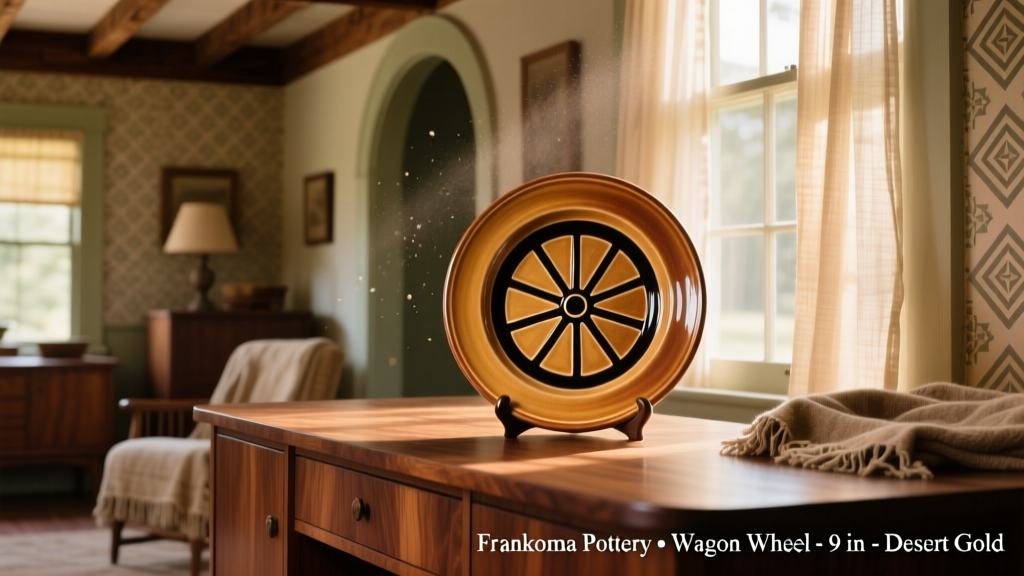
Frankoma Pottery Wagon Wheel Plate: Breakfast Pattern in Ada Clay Desert Gold, 9-Inch Diameter

Royal Bayreuth Pitcher 'Devil Cards' – Decoding the Orange Lucifer 'Hugs Face' Playing Cards Set (5-Inch)
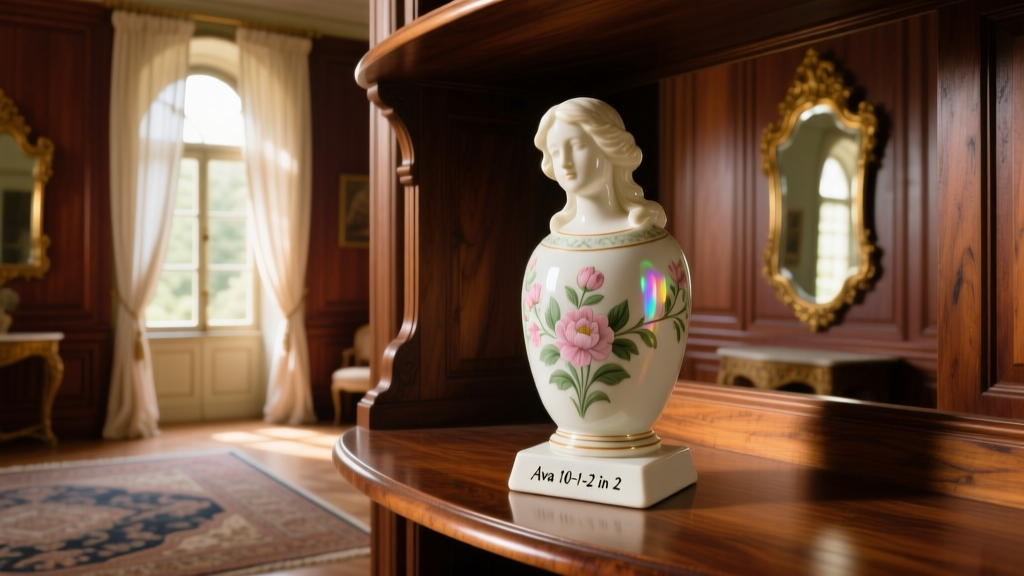
Florence Ceramics Figurine 'Ava' — A Collector's Guide to the 10½-Inch Porcelain Sculpture (Model No. 2)
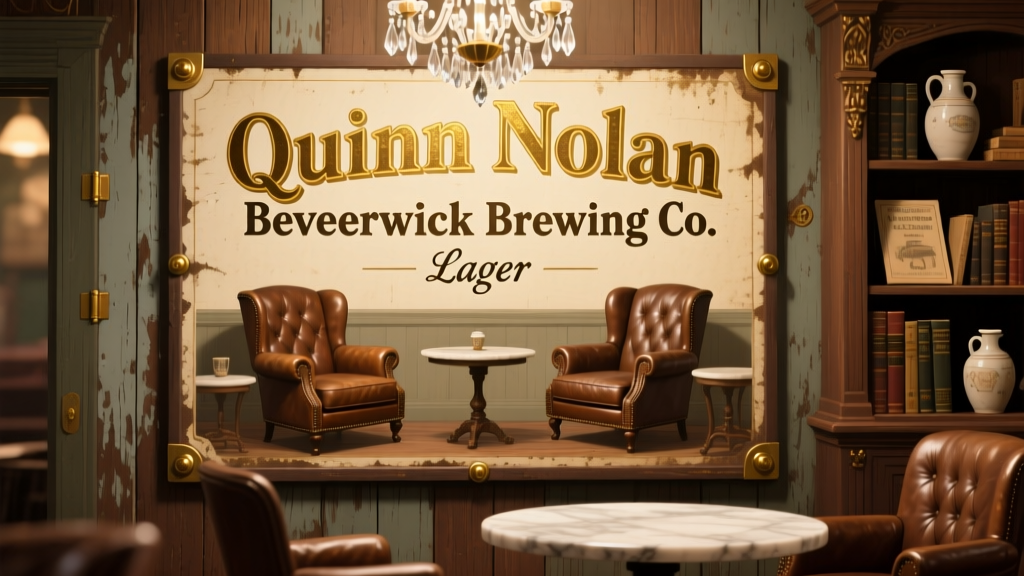
Quinn Nolan Beveerwck Brewing Co. Lager Beer Advertising Sign (28 × 20 in): Authenticity, Provenance, and Restoration Insights
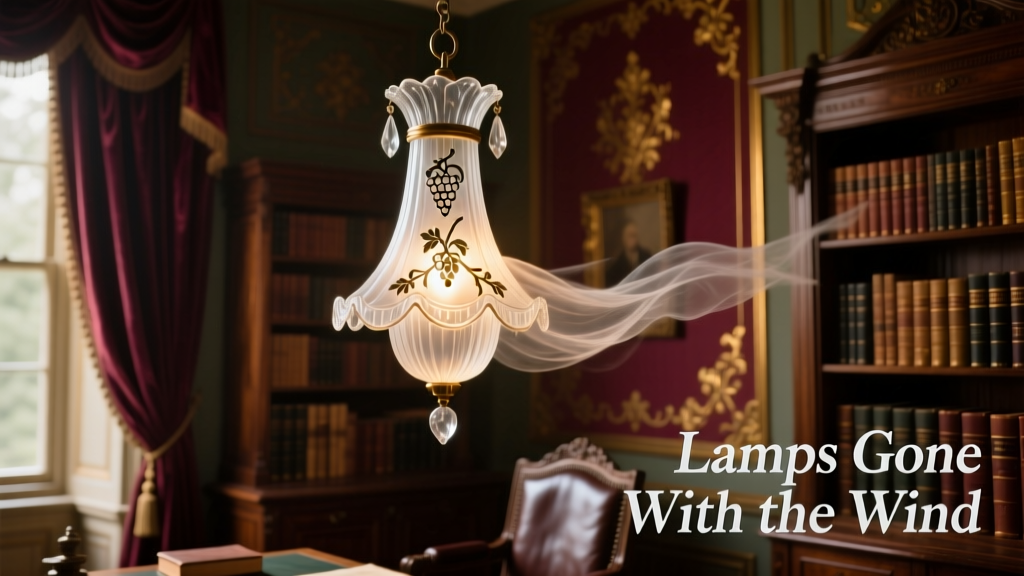
Lamps Gone With The Wind: Etched Grape Design Chimney — Frosted Clear Glass, 9 × 4½ Inches

Wood Carvings: Angels’ Heads from Late 19th-Century Mexico — Craftsmanship, Devotion, and Regional Identity

Omega Constellation Quartz Ref. 166.004: A 1973 18K Yellow Gold Chronometer with Black Leather Strap — Technical, Historical, and Collectibility Analysis