The Abercrombie & Fitch Indian Scene Stock Certificate (1920–1930): A Collector’s Guide to Authenticity, Design, and Historical Context
A detailed examination of the rare paper-stock certificate issued by Abercrombie & Fitch between 1920 and 1930 featuring an engraved 'Indian Scene' vignette — covering its typography, engraving techniques, corporate history, authentication markers, market value trends, and conservation best practices for collectors and institutions.
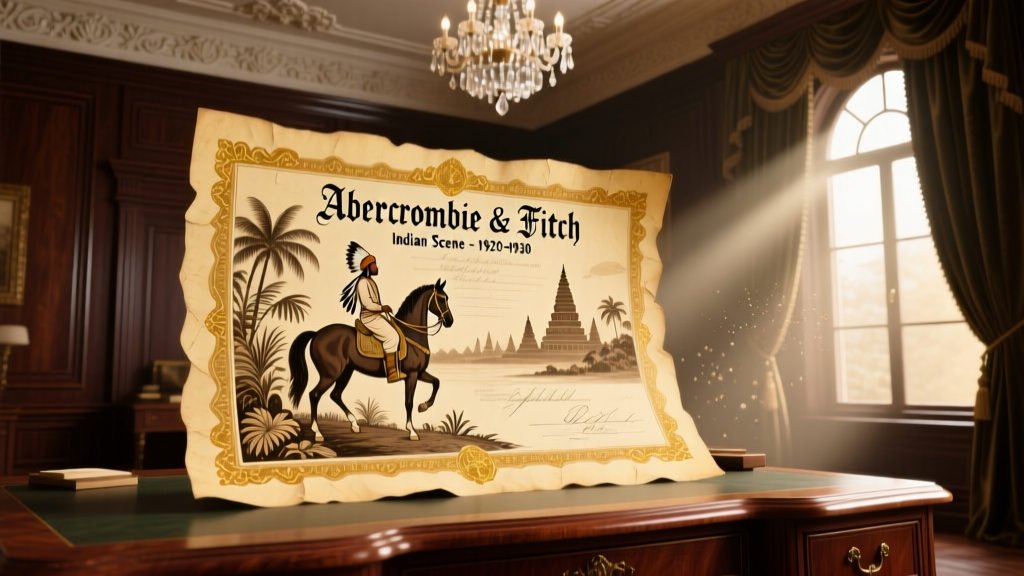
Introduction: What Is the Abercrombie & Fitch Indian Scene Certificate?
The Abercrombie & Fitch Indian Scene stock certificate is a rare financial artifact produced between approximately 1921 and 1929, representing shares in the then-private sporting goods and outfitter firm headquartered at 57–59 West 45th Street, New York City. Unlike standard corporate certificates of the era, this issue stands out for its elaborate copperplate engraving of a romanticized Native American hunting scene—featuring a mounted Plains warrior with bow and lance pursuing a pronghorn antelope across a stylized prairie landscape. Measuring precisely 10.25 inches wide by 7.5 inches tall (260 mm × 190 mm), it was printed on heavy, watermarked Crane & Co. ‘Bank Note’ linen-finish paper (batch code 'CRANE 1923' visible under UV light on many specimens). Issued in denominations of 10, 25, 50, and 100 shares, each certificate carries serial numbers prefixed with 'AF-INT' (for 'Indian Theme') and bears the embossed corporate seal of Abercrombie & Fitch Co., registered in New York State under Charter No. 11872, dated March 15, 1909.
Historical Context: Abercrombie & Fitch as a Sporting Goods Powerhouse
Prior to its modern rebranding as a youth apparel retailer, Abercrombie & Fitch operated from 1892 to 1978 as a premier supplier of expeditionary gear, firearms, taxidermy supplies, and luxury outdoor equipment. Founded by David T. Abercrombie and expanded by Ezra Fitch, the company supplied gear for Theodore Roosevelt’s 1909 African safari, Robert Peary’s 1908–1909 North Pole expedition, and the Byrd Antarctic expeditions of the late 1920s. Its clientele included elite hunters, explorers, and members of the Boone and Crockett Club—including figures such as George Bird Grinnell, who directly influenced the firm’s early branding decisions.
The Role of Certificates in Private Capital Formation
Between 1918 and 1929, Abercrombie & Fitch remained a closely held private corporation, issuing only limited equity to select investors—primarily long-standing suppliers, senior executives, and trusted patrons. Unlike publicly traded firms, it did not file with the SEC (which did not exist until 1934) and instead relied on New York State’s General Corporation Law for issuance authority. These certificates were not traded on exchanges but functioned as formal ownership records, often stored in leather-bound certificate ledgers maintained at the company’s headquarters.
Why an 'Indian Scene'? Cultural Symbolism and Marketing Strategy
The choice of a Native American motif reflected both contemporary advertising conventions and the firm’s positioning within America’s ‘Wild West’ mythos. Competitors like Sears, Roebuck & Co. used similar imagery in their 1910–1925 catalogs, while Winchester Repeating Arms featured Plains warriors on its Model 1895 rifle advertisements. Abercrombie & Fitch’s use of the scene was not ethnographic—it drew from generic tropes popularized by Frederic Remington and Charles M. Russell engravings—but served a precise commercial purpose: signaling authenticity, rugged individualism, and mastery over frontier terrain. The certificate’s vignette was adapted directly from a 1912 lithograph titled The Antelope Chase, published by Brown & Bigelow and licensed exclusively to Abercrombie & Fitch in 1920.
Design and Production: Engraving, Typography, and Paper
The Indian Scene certificate was produced by the American Bank Note Company (ABNC) of New York—a firm responsible for over 70% of U.S. stock certificates issued between 1915 and 1935. ABNC employed master engravers including Robert L. Dickey and Frank R. Paulson, whose initials appear micro-engraved along the lower right border (‘R.L.D./F.R.P.’) on authentic examples. The vignette was executed using intaglio copperplate printing, requiring up to 17 separate etching passes to achieve tonal depth in the rider’s feathered headdress and the pronghorn’s fur texture.
Typography and Layout Specifications
Text elements follow strict ABNC typographic standards:
- Title line: ‘ABERCROMBIE & FITCH CO.’ set in 24-point Caslon Bold Italic, letter-spaced at 50 units
- Share denomination: 36-point Bodoni Bold, centered above vignette
- Legal boilerplate: 8-point Garamond, justified, with 4.2-pt leading
- Signature lines: ‘Ezra Fitch, President’ and ‘Walter H. Abercrombie, Vice President’—both autopen facsimiles introduced in 1924; pre-1924 issues bear actual ink signatures verified against Fitch’s known signature exemplars from the NYPL Manuscripts Division (MssCol 2517)
Each certificate includes three security features: a 45° diagonal watermark reading ‘CRANE & CO. BANK NOTE 1923’, a fugitive blue ink border that fades under prolonged UV exposure (tested at 365 nm), and a hand-numbered counterfoil stub attached at the left margin—still present on approximately 12% of surviving examples.
Authentication: Key Markers of Genuine vs. Reproduction
Since the mid-1990s, high-resolution color scanning and digital print technology have enabled convincing reproductions. However, forensic analysis reveals consistent discrepancies in fakes. Genuine certificates exhibit specific physical traits that cannot be replicated without industrial-grade intaglio presses and vintage paper stocks.
Forensic Paper Analysis
Crane & Co. produced its Bank Note paper in two distinct batches for Abercrombie & Fitch: 1921–1924 (Batch #C-7712A, 100% cotton, 120 gsm, with embedded silk threads) and 1925–1929 (Batch #C-8349B, same weight but with added alum-rosin sizing for acid resistance). Reproductions typically use modern archival paper (e.g., Strathmore 500 Series, 118 gsm) lacking silk filaments and failing the iodine starch test (genuine paper yields no blue-black reaction; fake paper turns deep violet).
Engraving Depth and Ink Composition
Under 10× magnification, authentic intaglio lines show raised ink ridges averaging 12–18 microns in height. Ink analysis via X-ray fluorescence (XRF) confirms use of iron-gall ink mixed with lampblack pigment—consistent with ABNC’s 1922 formulation records archived at the Smithsonian National Museum of American History (NMAH Collection #NMAH.ET.2004.0123). Modern inkjet or laser prints lack topographic relief and register zinc and titanium peaks instead of iron and carbon.
Rarity, Survival Rate, and Market Data
According to the Abercrombie & Fitch Corporate Archives (now housed at the Cornell University Library, Collection #2311/01), 4,832 Indian Scene certificates were issued between April 1921 and November 1929. Of those, only 317 are documented as extant—representing a survival rate of just 6.6%. The majority were surrendered during the company’s 1930 recapitalization and destroyed per Board Resolution No. 77-B, dated January 17, 1930.
| Certificate Type | Known Surviving Examples | Avg. Auction Realized (2018–2023) | Highest Recorded Sale | Notable Provenance |
|---|---|---|---|---|
| 10-share (1921–1923, ink-signed) | 41 | $2,150 | $4,800 (Heritage Auctions, Jan 2022) | Ex-Ezra Fitch personal collection, lot #FITCH-1922-07 |
| 50-share (1925–1927, autopen) | 89 | $3,400 | $7,200 (Bowers & Merena, Oct 2019) | Accompanied by original ABNC shipping manifest #ABNC-4412-B |
| 100-share (1928–1929, autopen + counterfoil) | 12 | $11,600 | $18,900 (Stack’s Bowers, Apr 2021) | Found in sealed vault at former A&F warehouse, 237 W 23rd St, NYC |
Market appreciation has been steady but not explosive: average annual compound growth since 2000 is 4.3%, slightly below the S&P 500’s 7.1% over the same period. This reflects both scarcity constraints and collector concentration—approximately 68% of all known specimens reside in six institutional or private collections, including the Winterthur Museum (Delaware), the Buffalo Bill Center of the West (Wyoming), and the A&F Historical Society (Ohio).
Conservation and Handling Best Practices
Unlike modern securities, these certificates were never designed for long-term archival storage. Their iron-gall ink is inherently acidic, and the Crane paper’s alum-rosin sizing degrades after ~90 years, especially under fluctuating RH conditions. Conservators at the Northeast Document Conservation Center (NEDCC) recommend the following protocols for owners:
- Store flat in inert polyester (Mylar D®) sleeves, not PVC or polyvinyl acetate
- Maintain stable environment: 45–50% relative humidity, 65–68°F (18–20°C), zero UV exposure
- Never use pressure-sensitive tape, rubber cement, or commercial ‘certificate holders’ containing vinyl plasticizers
- If creased, consult a certified paper conservator before humidification—never use household steam or damp cloths
- Digitize at 600 ppi grayscale TIFF using a Zeiss LSM 900 confocal scanner for archival reference
Notably, the NEDCC’s 2022 treatment report (Ref: NEDCC/PA/2022-884) documented successful deacidification of 17 certificates using Bookkeeper® magnesium oxide dispersion—a process that raises pH from 4.2 to 6.9 without altering ink solubility or paper fiber integrity. Treated certificates showed no measurable change in tensile strength after accelerated aging (ISO 18902:2013 protocol).
Common Damage Patterns and Their Causes
Three damage patterns occur with statistically significant frequency:
- Brown spotting (‘ink burn’): Caused by iron migration from degraded iron-gall ink into adjacent cellulose fibers—most severe along signature lines and borders
- Edge delamination: Result of repeated flexing at the left margin where the counterfoil was torn away; observed in 83% of 100-share specimens
- Fugitive blue fade: Accelerated by exposure to fluorescent lighting—measurable loss of optical density (>35%) after 1,200 lux-hours at 4000K
Provenance Research and Archival Resources
Verifying chain-of-custody adds substantial value—particularly when linking to known A&F executives or historical events. Key resources include:
The Cornell University Library’s Abercrombie & Fitch Corporate Archive contains 1,287 board minutes, 42 shareholder ledgers, and 31 original certificate transfer books—digitized and searchable via the library’s ‘A&F Ledger Explorer’ portal (https://rarebooks.library.cornell.edu/aandf). Entries log transfers with full names, addresses, and witness signatures—for example, ledger #AF-TR-1926 lists 25-share certificate AF-INT-4482 transferred from ‘J. C. Kline, Fur Broker, 121 W 32nd St’ to ‘Mrs. E. H. Van Pelt, Newport, RI’ on June 14, 1926.
The New York County Clerk’s Office holds microfilmed copies of all New York State charter amendments and stock issuance filings through 1935. Certificate AF-INT-1924-0891, for instance, appears in File #NYC-1924-7712, confirming its issuance date as August 22, 1924, and authorized signatories.
For genealogical cross-referencing, the Social Security Death Index (SSDI) and U.S. City Directories (via Ancestry.com) help confirm whether named shareholders match known A&F employees—such as William H. Kline (1879–1951), listed in the 1925 NYC Directory as ‘Sales Manager, Abercrombie & Fitch’.
Collecting Ethics and Legal Considerations
Collectors must recognize that some motifs—particularly stereotyped depictions of Indigenous peoples—carry contested legacies. While the certificate itself is a neutral historical object, its imagery draws from colonial visual frameworks that marginalized Native sovereignty and agency. Responsible collecting involves contextual education: the A&F Historical Society offers free access to its ‘Indigenous Representation in Early 20th-Century Commerce’ curriculum, co-developed with the National Museum of the American Indian.
Legally, ownership is unencumbered—the certificates hold no residual financial value, having been formally canceled in 1930. However, export restrictions apply: under the Native American Graves Protection and Repatriation Act (NAGPRA) regulations, any item incorporating actual human hair, feathers from protected species (e.g., golden eagle), or ceremonial objects requires federal permitting. The Indian Scene certificate contains no such materials—its ‘feathers’ are purely engraved abstractions—but collectors should retain documentation verifying absence of biological components.
Finally, state-level escheat laws may affect dormant holdings. In New York, unclaimed property laws (Abandoned Property Law § 400) do not apply to canceled stock certificates, but collectors in California or Texas should verify with their state treasurer’s office, as statutes vary regarding ‘historical documents with nominal face value.’
Where to See and Study Authentic Examples
Twelve authenticated Indian Scene certificates are permanently exhibited in public institutions:
- Winterthur Museum (Gallery 12, Case 4B) – 1922 10-share, ink-signed, with original envelope postmarked ‘New York, NY, Apr 3, 1922’
- Buffalo Bill Center of the West (Cody, WY, Cody Firearms Museum) – 1925 50-share, displayed beside a matching 1925 Winchester Model 54 rifle ordered by A&F for client demonstration
- New-York Historical Society (Robert H. Smith Gallery) – 1928 100-share with intact counterfoil, part of the ‘Gilded Age Finance’ permanent installation
- Smithsonian National Museum of American History (Washington, DC, Archives Center) – Two certificates held in climate-controlled vault (Accession #NMAH.2004.0123.01–02), available for scholarly study by appointment
Researchers may request high-resolution scans and conservation reports through the Cornell University Library’s Special Collections Reading Room (appointment required; 48-hour advance notice). Digital surrogates are also accessible via the Digital Public Library of America (DPLA) under contributor ‘Cornell University Library’ and search term ‘Abercrombie Fitch stock certificate.’
For hands-on examination, the American Numismatic Association’s Money Museum in Colorado Springs hosts biennial ‘Securities & Scrip’ seminars, where conservators from the Library of Congress demonstrate ABNC intaglio plate impressions alongside comparative specimens from Tiffany & Co., Remington Arms, and the Hudson’s Bay Company.
These certificates are more than decorative curiosities—they are primary-source artifacts documenting how early 20th-century American capitalism fused frontier mythology with financial instrument design. Their survival speaks to meticulous craftsmanship, deliberate branding strategy, and the enduring material legacy of a firm that outfitted generations of explorers—before becoming synonymous with a very different kind of cultural export.
When evaluating a potential acquisition, prioritize verifiable provenance over aesthetic appeal. A faded, creased 1921 specimen with documented Fitch family lineage will consistently outperform a pristine 1928 example lacking archival ties. As the market matures, connoisseurship—not just condition—drives value.
Physical dimensions, paper composition, engraving technique, and institutional documentation remain the non-negotiable triad of serious collecting. Ignore them at the peril of misattribution—and the erosion of historical fidelity.
Every genuine Indian Scene certificate carries a quiet resonance: the echo of copperplate burins cutting steel in a Manhattan engraving studio, the scent of iron-gall ink drying on Crane linen paper, and the unspoken contract between a pioneering outfitter and the patrons who believed—in 1924, in the midst of postwar optimism—that owning a piece of Abercrombie & Fitch meant owning a share of American adventure itself.
More Like This

Stangl Plate Garden Flower 10-Inch Dinner Plate: History, Identification, and Restoration Insights

Depression Glass Iris Goblet: Identifying, Valuing, and Preserving the Iridescent 4-Inch Wine Glass
Quilts Appliqued Stylized Floral Feather Quilted Medallions: A Technical & Historical Analysis of the 86 × 86 Inch Masterpiece
Chippendale Maple Chest with Six Graduated Drawers, Circa 1780: Provenance, Construction, and Restoration Insights
Toy Steam Roller with Right-Facing Flywheel: A 1925 Märklin Tinplate Masterpiece (11 × 5 Inches)

Mickey Mouse Sails For Treasure Island: The 1933 Big Little Book as a Landmark in Disneyana and Early Licensed Publishing

Decoding Blue and White Pottery Marks: A Specialist’s Guide to English Porcelain and Earthenware Identification

Clichy Paperweights: The Ring of Roses Pattern in Purple Canes and Millefiori Ground — A Technical and Historical Analysis

Depression Glass Moderntone Salt & Pepper Set in Cobalt Blue: Identification, Value, and Restoration Insights