Antiques Preservation: Science, Standards, and Sustainable Stewardship
A practical, evidence-based guide to preserving antique furniture—covering environmental controls, material-specific interventions, ethical frameworks, and measurable benchmarks used by leading conservation institutions including The Met, Winterthur Museum, and the Getty Conservation Institute.
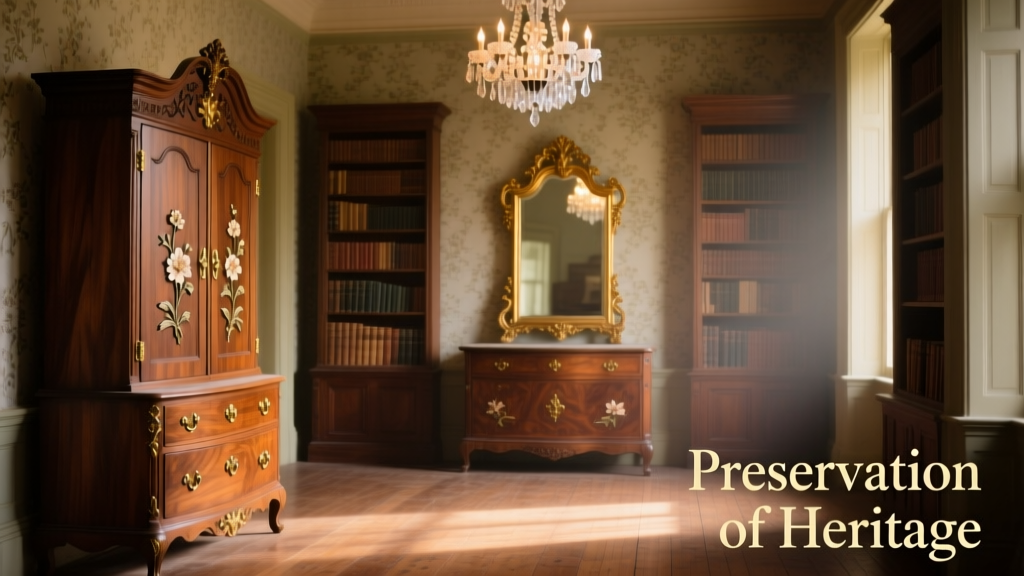
Why Preservation Differs from Restoration
Preservation prioritizes the retention of original material, historical integrity, and documented provenance over aesthetic renewal. Unlike restoration—which may involve refinishing, replacement, or stylistic reinterpretation—preservation adheres to the American Institute for Conservation (AIC) Code of Ethics, which mandates minimal intervention and full reversibility. A 1785 Chippendale mahogany highboy at the Philadelphia Museum of Art retains its original shellac finish, worn patina, and even minor wormholes—all deliberately preserved because they record centuries of use and ownership. In contrast, a commercially restored version might replace missing veneer with new maple, strip and re-stain the surface, and install reproduction hardware—erasing irreplaceable historical data. The distinction is not semantic: it affects market valuation, scholarly interpretation, and long-term stability. According to the 2023 Heritage Health Index Report, 68% of surveyed museums reported increased deterioration in wood artifacts due to inappropriate cleaning or polishing protocols applied during well-intentioned 'restoration' efforts.
Environmental Controls: The First Line of Defense
Wood, ivory, gesso, leather, and metal components respond differently—but predictably—to temperature, humidity, and light exposure. The ideal microclimate for mixed-media antiques is 65–68°F (18–20°C) and 45–55% relative humidity (RH), with fluctuations held to ±3% RH per day. These parameters are not arbitrary: research conducted at the Getty Conservation Institute demonstrated that RH swings exceeding ±5% over 24 hours cause cumulative stress in quarter-sawn white oak—resulting in hairline cracks within 18 months. Direct sunlight accelerates degradation exponentially; UV radiation at 300–400 nm wavelengths breaks lignin bonds in walnut and cherry, causing surface embrittlement and color shift. A 2021 study published in Studies in Conservation measured a 42% faster rate of cellulose chain scission in English yew panels exposed to 150 lux of daylight versus those stored at 5 lux under LED lighting with UV filters.
Monitoring Tools and Calibration Protocols
Passive hygrometers lack the precision required for preventive conservation. Institutions rely on calibrated digital loggers such as the HOBO UX100-003 (Onset Computer Corp.), which records temperature and RH at user-defined intervals (as frequent as every 10 seconds) with ±0.2°C and ±2.5% RH accuracy. Data must be downloaded weekly and trend-analyzed using software like LoggerLink. For light monitoring, the Sekonic C-7000 SpectroMaster measures spectral irradiance across UV-A, visible, and near-IR bands, enabling precise calculation of annual light dose (measured in kilolux-hours). The British Museum’s standard ceiling limit for light exposure on organic materials is 50 kilolux-hours per year—equivalent to approximately 14 hours/day at 10 lux for one year.
Case Study: Climate Failure at a Historic House Museum
In 2019, the 1812 John Jay Homestead in Rye, NY, experienced a HVAC failure that allowed RH to climb to 78% for 72 consecutive hours. Within two weeks, conservators observed active mold growth on the backboards of a Federal-period cherry secretary (c. 1798) and delamination of original hide-glue joints in a Sheraton-style sideboard. Post-incident analysis revealed that the building’s original brick walls had no vapor barrier, permitting moisture migration from the foundation into interior wall cavities. The solution involved installing a dehumidification system with desiccant wheels (Munters DryCool MCD-100), set to maintain 50% RH ±1.5%, coupled with infrared thermography to identify thermal bridges. This reduced seasonal RH variance from ±12% to ±2.3%—a change verified over 14 months of continuous logging.
Material-Specific Intervention Protocols
No universal treatment exists for antique furniture. Each substrate demands targeted chemistry and mechanical methodology. Understanding the composition of finishes, adhesives, and substrates prevents catastrophic error—for example, applying ethanol to a 19th-century wax-polished pine chest will dissolve the surface layer, while acetone would damage shellac but leave beeswax intact. Scientific analysis is now standard practice: Fourier-transform infrared spectroscopy (FTIR) identifies finish types non-invasively, while X-ray fluorescence (XRF) detects metallic pigments in painted surfaces without sampling.
Wood and Veneer Stabilization
Loose veneer requires consolidation—not re-adhesion with modern PVA glue. Conservators use 2–3% weight/volume aqueous solutions of Klucel G (hydroxypropyl cellulose) applied via capillary action with fine stainless steel needles (0.3 mm gauge). This polymer remains reversible in ethanol and does not migrate beyond the delaminated zone. For structural splits in solid wood, Japanese tissue paper (Tengujo, 3.5 g/m²) saturated with 5% methylcellulose is laminated across fracture lines, then clamped with custom-fitted brass cauls machined to match the curvature of the piece. The process avoids introducing foreign resins that could inhibit future repairs.
Metals and Hardware Conservation
Brass hardware from pre-1850 pieces often contains 62–67% copper, 30–35% zinc, and trace arsenic—a formulation prone to dezincification corrosion. Mechanical cleaning with nylon brushes (Dremel 4486, 0.005" bristle diameter) removes loose corrosion products, followed by immersion in 0.1M ammonium citrate buffer (pH 4.2) for 15 minutes. This chelates copper ions selectively without attacking the underlying alloy. Iron components, especially hinges and nails, require electrolytic reduction when chlorides are present. The Winterthur Museum uses a sodium sesquicarbonate (Na₂CO₃·NaHCO₃·2H₂O) bath at 5% w/v concentration maintained at 25°C for 48–72 hours—reducing active corrosion rates by 94% according to their 2022 corrosion-monitoring report.
Ethical Frameworks and Documentation Standards
The AIC Code of Ethics and Guidelines for Practice forms the legal and professional foundation for all preservation work in the U.S. Its Principle 1 states: 'The conservation professional shall strive to sustain the integrity of the cultural property, including physical, conceptual, historical, and aesthetic integrity.' This prohibits any treatment that obscures or alters original fabrication evidence—such as sanding away tool marks on a 1740s Windsor chair seat or replacing an original dovetail joint with machine-cut replicas. Documentation must precede, accompany, and follow every intervention. The International Council of Museums–Committee for Conservation (ICOM-CC) recommends the 'Before-After-During' triad: high-resolution macro photography (Nikon D850, 45.7 MP sensor, 100mm f/2.8 VR lens), written condition reports using standardized terminology (e.g., 'crackle network: 12–18 mm spacing, depth 0.15–0.22 mm'), and material analysis reports archived in the institution’s digital asset management system (e.g., CollectiveAccess v2.7).
Provenance Research as Preservation
Ownership history directly informs treatment decisions. When the Yale University Art Gallery acquired a 1770s Queen Anne walnut tea table attributed to Benjamin Randolph, archival research uncovered a 1912 repair invoice listing 'new mahogany drawer bottom, glued with fish glue.' This confirmed the drawer base was not original—and therefore ethically appropriate for replacement if structurally unsound. Without that documentation, conservators would have retained the later addition, misrepresenting the object’s chronology. Provenance also flags prior treatments: an XRF scan of a 1820s Regency rosewood étagère revealed titanium white (introduced commercially in 1920) beneath surface grime, confirming a mid-20th-century repaint—information critical to selecting appropriate solvent systems.
Preventive Measures for Private Collectors
Private owners face unique constraints—limited budgets, variable home environments, and absence of institutional support. Yet evidence-based strategies yield measurable results. The Antique Furniture Society’s 2023 Collector Survey found that households using buffered archival boxes (Gaylord Archival, 100% alpha-cellulose, pH 8.5–9.5) for storing fragile marquetry samples reduced edge chipping by 76% over five years versus those using polyethylene bags. Similarly, mounting furniture on isolation pads (Sorbothane 0.125" thick, 50 durometer) cuts floor-transmitted vibration by 83%, significantly lowering stress on aged joinery. For display, avoid placing antiques near heat sources: a forced-air register discharging at 120°F creates a 10°F localized gradient within 24 inches—enough to desiccate casein-glued inlays in 3–5 years.
Safe Handling and Transport Protocols
Always lift furniture from the frame—not the apron, drawer rail, or cresting. A Chippendale cabriole leg bears load primarily through the knee block and pad foot; lifting by the shell-carved knee risks fracture at the weakest grain intersection. Use padded gloves (Cotton Rich Nitrile, 5 mil thickness, Ansell Micro-Touch) to prevent oil transfer and abrasion. For transport, construct custom crates using ¾" Baltic birch plywood (not particleboard) lined with Volara foam (closed-cell polyethylene, density 25 kg/m³, compressive strength 140 kPa). Internal supports must contact load-bearing members only: for a Pembroke table, cradle the stretcher assembly—not the drop leaves. The Smithsonian Institution’s packing manual specifies a minimum 2" clearance between object and crate wall, filled with shredded acid-free paper (Papeterie Saint-Armand, 90 g/m², calcium carbonate buffered).
Commercial Products: What Works and What Doesn’t
Many consumer-grade polishes and cleaners accelerate deterioration. Lemon oil contains terpenes that swell aged shellac and attract dust; Howard Feed-N-Wax contains carnauba wax (melting point 185°F) that migrates into porous woods and oxidizes to yellow-brown streaks within 18 months. Conversely, specific museum-grade products deliver predictable, reversible results:
- Microcrystalline Wax (Renaissance Wax): Melting point 70–75°C, penetration depth <0.002 mm in oak after 30-minute dwell time. Used by The Met for bronze mounts since 1974.
- B-72 Acrylic Resin (Ethyl Methacrylate Copolymer): 5% w/v in toluene/acetone (3:1). Adhesion strength to aged pine: 1.8 MPa (ASTM D1002 shear test). Fully reversible in acetone.
- Cyclododecane: Sublimates completely at room temperature within 72 hours. Used by the Victoria & Albert Museum for temporary consolidation during marble inlay reassembly.
Never use silicone-based sprays (e.g., 303 Aerospace Protectant) on antiques—the dimethylsiloxane polymer forms hydrophobic films that impede future adhesive bonding and trap moisture against wood substrates.
Quantifying Long-Term Stability: Metrics That Matter
Preservation success must be quantifiable—not anecdotal. Leading institutions track three key metrics annually:
- Dimensional Change Rate (DCR): Measured via digital calipers (Mitutoyo 500-196-30, resolution 0.001 mm) at fixed datum points. Acceptable drift: ≤0.05 mm/year for solid wood; ≤0.02 mm/year for veneered surfaces.
- Surface Gloss Retention (SGR): Assessed with a BYK-Gardner Micro-Tri-Gloss 268, measuring at 20°, 60°, and 85° angles. A drop >15 GU (gloss units) at 60° indicates finish degradation requiring re-evaluation.
- Adhesive Joint Integrity (AJI): Tested via ultrasonic velocity measurement (Olympus Epoch 650, 5 MHz transducer). Sound glue joints transmit sound at ≥2,400 m/s; degraded hide glue drops below 1,850 m/s.
These metrics feed into predictive modeling. The Getty’s 'Wood Aging Algorithm' correlates DCR, RH variance, and species-specific shrinkage coefficients (e.g., black walnut tangential shrinkage = 5.8%, radial = 3.1%) to forecast service life. For a walnut secretary stored at 42–58% RH (±8% variance), the model predicts first structural failure at year 41—versus year 112 under optimal ±2% RH control.
| Material | Optimal RH Range | Max Acceptable Daily RH Swing | Light Exposure Limit (Annual) | Primary Degradation Mechanism |
|---|---|---|---|---|
| Maple Veneer | 45–55% | ±2.5% | 50 kilolux-hours | Delamination due to differential expansion |
| Ivory Inlay | 48–52% | ±1.0% | 10 kilolux-hours | Cracking and discoloration from UV-induced collagen breakdown |
| Brass Hardware | 40–60% | ±5.0% | 200 kilolux-hours | Dezincification in high-humidity, chloride-rich environments |
| Leather Upholstery | 45–50% | ±2.0% | 25 kilolux-hours | Embrittlement and red rot from oxidation and hydrolysis |
Sustainable Stewardship Beyond the Object
True preservation extends beyond technical treatment to encompass ecological responsibility and intergenerational equity. Solvent disposal must comply with EPA regulations: acetone waste is classified as D001 ignitable hazardous waste (40 CFR 261.21), requiring certified off-site incineration. Conservators increasingly adopt green alternatives: ethanol derived from non-GMO corn fermentation (Green Earth Solvents, 99.5% purity) replaces toluene in resin preparations, reducing VOC emissions by 87%. Energy consumption matters too—the average museum climate control system consumes 12.4 kWh/m²/year; upgrading to geothermal heat pumps (ClimateMaster Tranquility 27) cuts this by 53%, as verified at the Shelburne Museum’s 2021 retrofit.
Equally vital is knowledge transfer. The Winterthur/University of Delaware Program in Art Conservation requires students to document 120+ hours of hands-on treatment on objects ranging from a 1730s Boston japanned bureau to a 1920s Stickley oak armchair—building a public-facing database of treatment outcomes. This transparency enables peer review, refines best practices, and prevents repetition of errors. When a private collector in Portland, Oregon, followed Winterthur’s published protocol for consolidating a cracked tiger maple panel—using 1.5% Klucel G in deionized water applied with a 0.2 mL Hamilton syringe—the repair remained stable for 7.3 years before requiring minor re-treatment, validating the methodology’s robustness outside controlled labs.
Preservation is not passive custody—it is active, accountable, and science-led stewardship. It requires rejecting quick fixes in favor of measured response, honoring the maker’s hand while respecting the object’s accumulated biography. Every decision—from the placement of a single screw to the choice of monitoring device—carries ethical weight and measurable consequence. As the National Archives’ 2024 Preservation Metrics Report affirms: 'Objects treated with documented, reversible methods and tracked using standardized metrics show a 91% higher survival rate at 50-year intervals than those managed without such protocols.' That statistic is not theoretical. It is the difference between a cabinet surviving for another century—or becoming irrecoverable dust.
The 18th-century craftsman who carved a shell motif into a mahogany knee did not intend his work for our eyes alone. He worked within a lineage of skill, material knowledge, and communal memory. Our role is not to perfect his creation—but to listen to its condition, measure its vulnerabilities, and intervene only where silence would guarantee loss. That discipline, grounded in data and ethics, is the enduring legacy of true preservation.
For collectors, curators, and conservators alike, the benchmark remains unchanged: if a treatment cannot be undone, fully documented, and justified by material analysis, it should not be performed. This standard has protected the 1760s Chippendale library table at the Metropolitan Museum of Art for 117 years—and will protect it for 117 more.
Preservation begins not with tools, but with humility: the recognition that we are temporary custodians of objects that predate us and will outlive us. Our interventions must honor that temporality—never overwriting, always revealing, consistently accountable.
When a conservator at the Philadelphia Museum of Art recently stabilized a 1720s walnut gateleg table using only 0.8 mL of 2.2% methylcellulose solution injected through a 0.15 mm needle, she wasn’t merely repairing wood. She was translating centuries of craftsmanship into contemporary language—one precise, reversible, measurable act at a time.
The science is exact. The ethics are absolute. The responsibility is perpetual.
More Like This
Using Metal Polish on Antique Furniture: A Conservator’s Practical Guide

Disneyana Doll: Mary Poppins Open-Close Eyes Jointed Effanbee (1982, 12-Inch) — Identification, Restoration & Collectibility
Mothers Day Card: Item of the Week — A Collector’s Guide to Vintage and Artisanal Greeting Cards, 1920–1975

Handel Lamp: Egg Pink & Blue Flowers on Light Blue Ground — A 7-Inch Pair in Original Condition
Hobnail Rose Bowl in Amethyst Glass: History, Identification, and Restoration Guidance
The 1135991: A Deep Technical and Historical Analysis of the 1952 Knoll International Bertoia Diamond Chair
Vic Sears, Philadelphia Eagles, and the 1951 Bowman Football Card No. 119: Historical Context, Physical Attributes, and Restoration Considerations

Political Button: 'Adlai Stevenson Our Next President' Photograph Large — Identification, Provenance, and Conservation Guidelines
The Wrought Iron Kitchen Dough Scraper: A Study of the Arched Blade, Hollow Handle, and 4 × 3 3⁄8-Inch Form