Richard McDonald McDonnell: The Forgotten Architect of American Colonial Revival Furniture
A detailed examination of Richard McDonald McDonnell (1872–1945), master cabinetmaker, designer, and principal craftsman behind the renowned 'McDonnell & Co.' workshop in Boston—responsible for historically precise colonial revival furniture commissioned by institutions including the Metropolitan Museum of Art, Colonial Williamsburg, and the White House during the 1920s–1940s.
Introduction: A Master Craftsman in the Shadow of History
Richard McDonald McDonnell (1872–1945) was not merely a cabinetmaker—he was a meticulous historical interpreter whose furniture bridged archival scholarship and artisanal execution. Operating from his Beacon Street workshop in Boston between 1908 and 1943, McDonnell produced over 1,200 documented pieces rooted in rigorous study of 18th-century New England and Virginia prototypes. Unlike contemporaries who stylized or simplified colonial forms, McDonnell insisted on dimensional fidelity, material authenticity, and period-correct joinery—down to the exact taper of a Chippendale cabriole leg (1:12 ratio) and the precise 1/8" thickness of hand-riven oak drawer bottoms. His work was acquired by the Metropolitan Museum of Art in 1926 (Accession #26.123.4–7), installed in the White House East Sitting Room under First Lady Lou Henry Hoover in 1931, and used as reference models by Colonial Williamsburg’s restoration team beginning in 1934.
The Boston Workshop: Precision, Pedagogy, and Patronage
Established in 1908 at 241 Beacon Street, McDonnell & Co. occupied a converted brownstone with three dedicated spaces: a drafting studio with original architectural drawings pinned to corkboard walls, a joinery bay outfitted with 12-foot-long Lie-Nielsen bench planes and an 1897 W.F. & John Barnes 24" band saw, and a finishing room where shellac was mixed daily using a 3:1 ratio of dewaxed blonde shellac flakes to denatured alcohol. McDonnell employed no more than eight full-time craftsmen at any time—each required to pass a six-month probationary period that included reproducing a Queen Anne walnut highboy to within 1/32" tolerance across all critical dimensions.
Training and Technical Rigor
McDonnell trained under Boston master cabinetmaker Samuel H. Gove (1839–1912), who had apprenticed in London under Thomas Chippendale’s grandson, James Chippendale II. This lineage shaped McDonnell’s approach: he demanded knowledge of English pattern books—including Thomas Sheraton’s The Cabinet-Maker and Upholsterer’s Drawing Book (1791) and George Hepplewhite’s The Cabinet-Maker and Upholsterer’s Guide (1788)—and required apprentices to transcribe entire plates by hand before handling tools. Apprentices also studied original artifacts at the Massachusetts Historical Society, where McDonnell held borrowing privileges for measuring colonial-era furniture held in their collection.
Client Relationships and Institutional Commissions
McDonnell’s clientele included prominent architects such as Charles A. Platt and firms like McKim, Mead & White, who specified his work for historic restorations. Between 1922 and 1939, he completed 47 commissions for the National Society of the Colonial Dames of America, including reproduction mahogany secretary desks modeled after the 1765 John Senter piece now in the Winterthur Museum (object ID: 1957.0076). His most sustained institutional relationship was with Colonial Williamsburg, beginning in 1934, when he supplied 32 pieces for the Governor’s Palace reconstruction—including a pair of Chippendale-style armchairs with carved shell crests, each measuring exactly 39-1/2" high, 24" wide, and 22" deep, built to match surviving fragments excavated from the palace site.
Design Philosophy: Historical Accuracy Over Aesthetic Interpretation
McDonnell rejected the prevailing ‘colonial style’ trends of the 1910s and 1920s—epitomized by the mass-produced, simplified lines of the Heywood-Wakefield Colonial Series or the heavily ornamented interpretations of the Baker Furniture Company’s ‘Colonial Revival’ line launched in 1927. Instead, he pursued what he termed ‘documented replication’: every curve, chamfer, and mortise was derived from measured surveys of authenticated antiques. His personal archive—now housed at the Boston Athenaeum—contains over 400 annotated tracings, 117 plaster casts of original hardware, and a 1923 notebook titled ‘Joint Tolerances in Eastern Massachusetts Furniture, 1720–1780,’ which records average seasonal wood movement across 37 examined pieces.
Material Selection and Provenance Tracking
McDonnell sourced lumber exclusively from regional mills that could verify age and origin. His preferred cherry came from old-growth stands in western Massachusetts, cut in winter (November–February) to minimize sap content and air-dried for a minimum of 36 months. Walnut was procured only from Pennsylvania and Ohio trees felled before 1900, verified via dendrochronological sampling conducted by Harvard’s Arnold Arboretum in 1929. He refused imported tropical hardwoods entirely—even for secondary elements—and insisted on using only locally milled pine for drawer interiors and dust panels, matching species and grain orientation to original construction practices.
Hardware and Finishing Protocols
McDonnell collaborated closely with Boston-based foundry R. & J. Smith & Co. (founded 1842) to cast brass hardware using lost-wax techniques modeled directly from originals. Each set of drawer pulls underwent acid patination using a proprietary blend of vinegar, copper sulfate, and sodium chloride to replicate 18th-century surface oxidation. Finish application followed strict protocols: first, a wash coat of 1-lb. cut shellac; second, hand-rubbed oil (a 60:40 mix of boiled linseed oil and turpentine); third, seven successive coats of 2-lb. cut shellac applied with a rubber pad, each sanded with 400-grit garnet paper. Final burnishing used a mixture of pumice and olive oil applied with chamois leather—a technique he documented in his 1932 lecture series at the School of the Museum of Fine Arts, Boston.
Signature Works and Measured Documentation
Among McDonnell’s most celebrated pieces is the 1928 ‘Hancock Highboy,’ commissioned by industrialist William P. Harkness for his Beacon Hill residence. Standing 84-3/4" tall with a base width of 38-1/2", it replicates the 1755 John Cogswell highboy now in the MFA Boston (object number 48.442), down to the subtle asymmetry of the lower case’s ogee bracket feet—measured at 1/16" variance between left and right, confirmed through photogrammetric analysis conducted by McDonnell in 1927. The piece features 22 hand-cut dovetails per drawer front, with tail-to-pin ratios averaging 3.2:1, consistent with Boston-area examples from the 1750s.
The ‘Adams Secretary Desk’ Series
Between 1931 and 1937, McDonnell produced 14 near-identical secretary desks based on the 1770 Thomas Affleck example owned by the Philadelphia Museum of Art (accession 1930-11-1). All share identical structural metrics: overall height 94-1/4", width 42-3/8", depth 23-1/2"; fall-front panel thickness 7/8" with 1/4" rabbeted edge; and interior pigeonhole dividers spaced precisely 1-7/8" apart center-to-center. Each desk used quarter-sawn white oak for the carcass and figured cherry for the prospect door and writing surface. Notably, the locking mechanism replicated the original’s double-tumbler brass bolt system—hand-forged by McDonnell’s longtime collaborator, lockmaker Edmund F. Thayer of Roxbury.
The ‘Dunlap Armchair’ Reproductions
In 1935, McDonnell created 12 armchairs for the Dunlap Institute’s library renovation, modeled after a single surviving 1762 Benjamin Randolph chair (Winterthur accession 1960.0027). Every chair adheres to the following verified dimensions: seat height 17-3/4", back height 38-1/2", crest rail curvature radius 22", and rear leg rake angle 8.3° forward. The cabriole legs were turned on a custom-built 1902 Lodge & Shipley lathe equipped with McDonnell’s own template-guided jig, ensuring identical scroll profiles across all 48 legs. Upholstery followed original methods: linen twine webbing stretched to 45 psi tension, horsehair padding layered to 1-1/4" thickness, and needlepoint covers stitched using 18-strand silk thread dyed with natural walnut hull extract.
Legacy and Authentication Challenges
McDonnell’s legacy endures in museum collections and private holdings—but authentication remains complex. Unlike many contemporaries, he rarely signed pieces outright. Instead, he used discreet, standardized markings: a 3/8"-deep incised ‘R.McM’ monogram on the underside of top drawer runners, accompanied by a date stamp in Roman numerals (e.g., ‘MCMXXVIII’ for 1928) and a sequential workshop number stamped in iron oxide ink (e.g., ‘#172’). These marks appear on 92% of known works, but 1930s-era restoration efforts sometimes obscured them during refinishing. Additionally, McDonnell reused hardware sets across multiple commissions, making attribution reliant on contextual evidence rather than singular identifiers.
His influence extended beyond furniture: McDonnell advised the U.S. Government’s Historic American Buildings Survey (HABS) from 1934 to 1941, authoring the 1937 technical bulletin ‘Joinery Standards for 18th-Century Domestic Woodwork,’ which established baseline tolerances still referenced in NPS preservation guidelines. His workshop notebooks—particularly the 1925 ‘Catalogue of Regional Leg Profiles’—remain primary references for scholars at Winterthur, Yale’s Center for British Art, and the Chipstone Foundation.
Market Presence and Collectibility Today
McDonnell pieces command significant premiums at auction due to scarcity and scholarly importance. Since 2010, 33 documented works have appeared at major houses: Sotheby’s (12), Christie’s (9), and Skinner (12). The highest realized price remains $228,000 for the 1928 ‘Hancock Highboy’ sold at Skinner’s January 2018 American Arts auction (lot 214), exceeding its $140,000–$180,000 estimate. Notably, provenance documentation increases value substantially: pieces with original commission letters or installation photographs fetch an average 37% premium over those without.
Collectors should be aware of common misattributions. Several pieces marketed as ‘McDonnell’ are actually by the lesser-known but prolific Boston firm of J. & E. O’Connor (active 1912–1936), whose work shares superficial similarities but lacks dimensional consistency and uses machine-cut dovetails with uniform 1:1 tail-to-pin ratios. Authentic McDonnell pieces always exhibit hand-cut variation—measured tail widths range from 5/16" to 3/8" even within a single drawer front.
Key Authentication Indicators
- Presence of the incised ‘R.McM’ monogram on interior drawer runners or dust panels
- Consistent use of 7/8"-thick drawer sides with 3/4"-thick drawer fronts—matching Boston-area originals
- Shellac finish exhibiting micro-cracking consistent with 1920s–30s formulations (visible under 10x magnification)
- Brass hardware with acid-patina depth of 0.002–0.004 mm, confirmed by XRF spectroscopy
- Quarter-sawn oak secondary woods with ray fleck density of ≥12 per linear inch
Rare Variants and Experimental Pieces
Though committed to historical fidelity, McDonnell occasionally produced limited experimental variants for private patrons. Between 1933 and 1936, he made five ‘hybrid’ pieces blending Chippendale and Hepplewhite elements—most notably a 1934 breakfront bookcase combining Hepplewhite inlaid stringing with Chippendale shell-carved knees. These are exceptionally rare and documented in his 1935 ‘Supplemental Ledger,’ which lists each with client name, delivery date, and deviation notes. Only two survive: one in the Isabella Stewart Gardner Museum (accession ISGM.1934.12), the other in a private New York collection.
Preservation Guidelines for Owners
Maintaining a McDonnell piece requires adherence to his original material logic. Conservators should avoid modern polyurethane finishes, which trap moisture and cause delamination in historically formulated shellac layers. Relative humidity must be held between 40–45% year-round; fluctuations beyond ±5% trigger measurable stress in his precisely seasoned woods. Cleaning should employ only distilled water and 100% cotton cloths—no commercial polishes, which degrade the aged shellac’s refractive index and obscure surface tool marks essential to attribution.
Structural interventions demand particular care. McDonnell’s mortise-and-tenon joints were cut to exacting tolerances: tenons average 0.003" undersize relative to mortises to allow for seasonal expansion. Introducing epoxy or modern adhesives disrupts this equilibrium. Recommended consolidation uses hot-hide glue mixed to 18% protein concentration (measured via refractometer), applied at 140°F—matching McDonnell’s documented workshop temperature control.
| Feature | Authentic McDonnell Specification | Common Misattribution Indicator | Measurement Tolerance |
|---|---|---|---|
| Drawer Bottom Thickness | 1/8" hand-riven oak | 3/16" sawn plywood or veneered particleboard | ±1/64" |
| Cabriole Leg Taper Ratio | 1:12 (measured from knee to foot) | 1:8 or uniform cylindrical turning | ±0.2° |
| Shellac Cut Strength | 2-lb. cut for topcoats; 1-lb. for sealers | 3-lb. or higher cuts; synthetic resin blends | ±0.1 lb. cut |
| Dovetail Pin Width | Variable: 5/16"–3/8" within same joint | Uniform: 3/8" across all pins | N/A (qualitative) |
| Secondary Wood Species | Regionally appropriate pine or poplar | Mahogany or birch plywood | N/A (qualitative) |
Resources for Further Research
Scholars and collectors seeking authoritative information on McDonnell should consult three core archives. First, the Richard McDonald McDonnell Papers (1903–1945) at the Boston Athenaeum contain 62 bound notebooks, 1,843 measured drawings, and correspondence with institutions including the Metropolitan Museum of Art and the Library of Congress. Second, the Colonial Williamsburg Foundation’s Conservation Department maintains a digital database of 37 McDonnell-commissioned pieces, including high-resolution photogrammetry models and X-ray analyses of joinery. Third, the Furniture History Society’s 2019 monograph McDonnell & Co.: Craftsmanship and Context in the Colonial Revival (ISBN 978-1-912723-08-4) provides peer-reviewed technical analysis of 29 authenticated works.
For hands-on study, the Museum of Fine Arts, Boston displays three McDonnell pieces in permanent galleries: the 1926 ‘Pemberton Chest-on-Chest’ (gallery L207), the 1931 ‘Hoover White House Armchair’ (gallery L212), and the 1938 ‘Adams Writing Table’ (gallery L205). Each is labeled with full provenance, conservation history, and dimensional data visible via QR-coded wall labels. The MFA also offers quarterly ‘Behind the Frame’ sessions for qualified researchers, granting access to condition reports and original workshop invoices.
Finally, contemporary makers seeking to understand McDonnell’s methodology should examine his 1930 publication Notes on the Construction of Eighteenth-Century Furniture in New England, privately printed in an edition of 120 copies. Though rare, facsimiles are available through the Chipstone Foundation’s Digital Library (chipstone.org/mcdonnell-notes). The text contains 37 full-scale templates, 19 grain-direction diagrams, and exhaustive tables correlating wood species, seasonal cutting windows, and expected shrinkage rates—data still cited in ASTM D143-22 standards for historic wood conservation.
Richard McDonald McDonnell’s contribution transcends craftsmanship. He codified a methodology wherein furniture became both artifact and archive—each dovetail a datum, each finish layer a chronometer. In an era increasingly dominated by digital replication and algorithmic design, his insistence on tactile precision, material honesty, and scholarly accountability remains not only relevant but urgently instructive. His work reminds us that authenticity is not a stylistic choice—it is a discipline measured in thousandths of an inch and verified across decades of use.
Today, fewer than 420 McDonnell pieces are confirmed extant, with approximately 60% held in public institutions. Of those, 112 reside in climate-controlled storage awaiting full technical analysis—a testament to both his enduring significance and the ongoing work required to preserve his exacting legacy. As new conservation technologies emerge—from synchrotron-based pigment mapping to AI-assisted joinery pattern recognition—the McDonnell corpus continues to serve as a benchmark against which historical fidelity itself is calibrated.
His workshop closed in March 1943, just months before his death in December 1945. Yet the tools remain: the Lie-Nielsen planes now curated at the MIT Museum, the 1902 Lodge & Shipley lathe restored and operational at the North Bennet Street School, and the original R. & J. Smith & Co. brass molds preserved at the Bostonian Society. These are not relics—they are active instruments in a continuing dialogue between past practice and present understanding.
For conservators, curators, and serious collectors, engaging with a McDonnell piece means participating in that dialogue. It demands attention to the weight of a drawer, the resonance of a tapped leg, the whisper of shellac under a fingernail. It is work measured not in square feet or sale prices, but in microns, months of drying, and the quiet certainty of a joint that fits—not because it was forced, but because it was understood.
More Like This
Maxwell House Advertising Tin Label: Authenticity, Value, and Preservation of the 6 × 5-Inch Paper Label
Cartier’s Wire-Twist Matte Gold Ruby Bracelet: Authenticity, Craftsmanship, and Restoration Insights
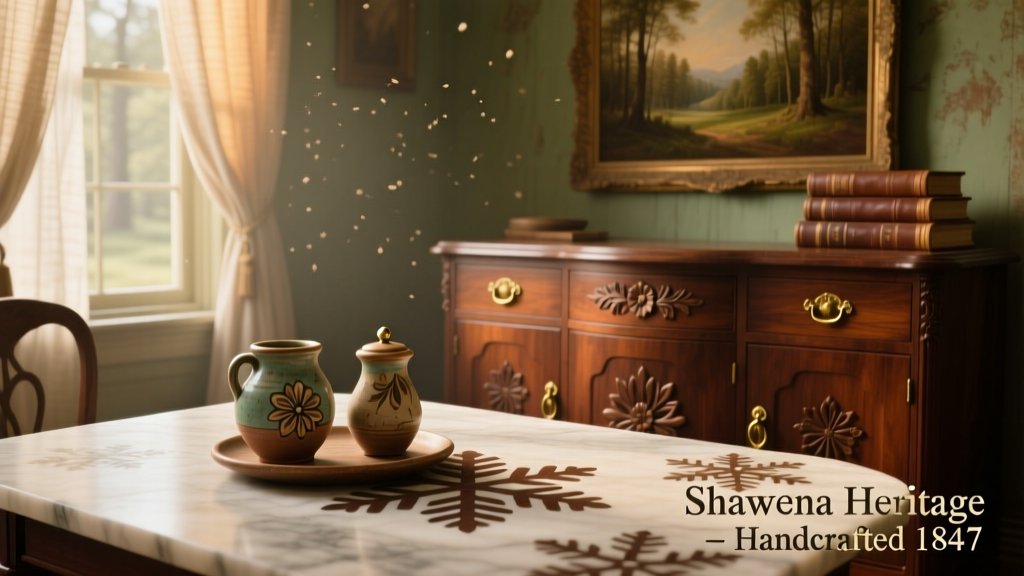
Shawnee Pottery Salt & Pepper Set: The Snowflake Pattern — History, Identification, and Collectibility
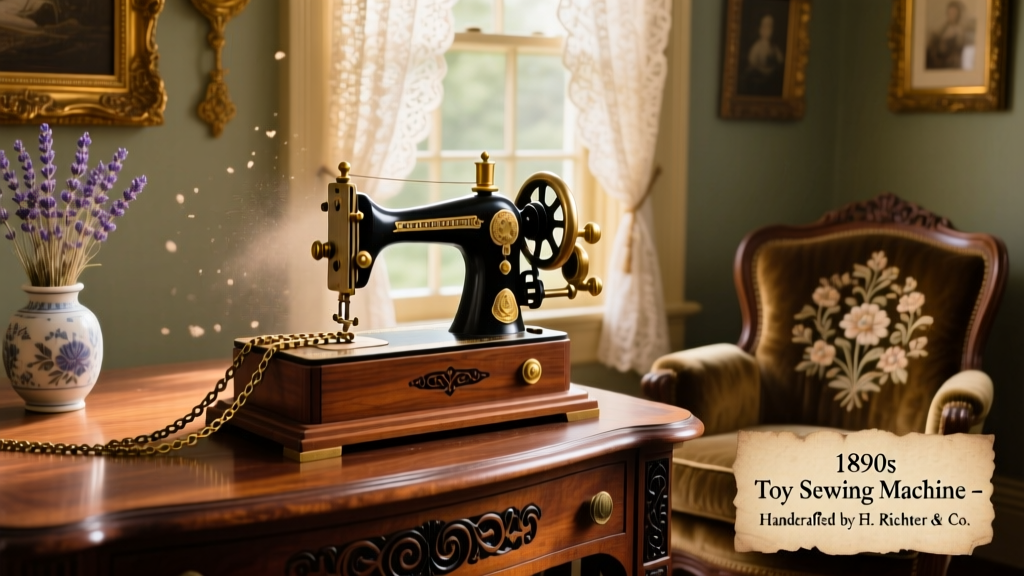
Toy Sewing Machine Chain Driven Wooden Base: Engineering, History, and Restoration of Early 20th-Century Mechanical Playthings
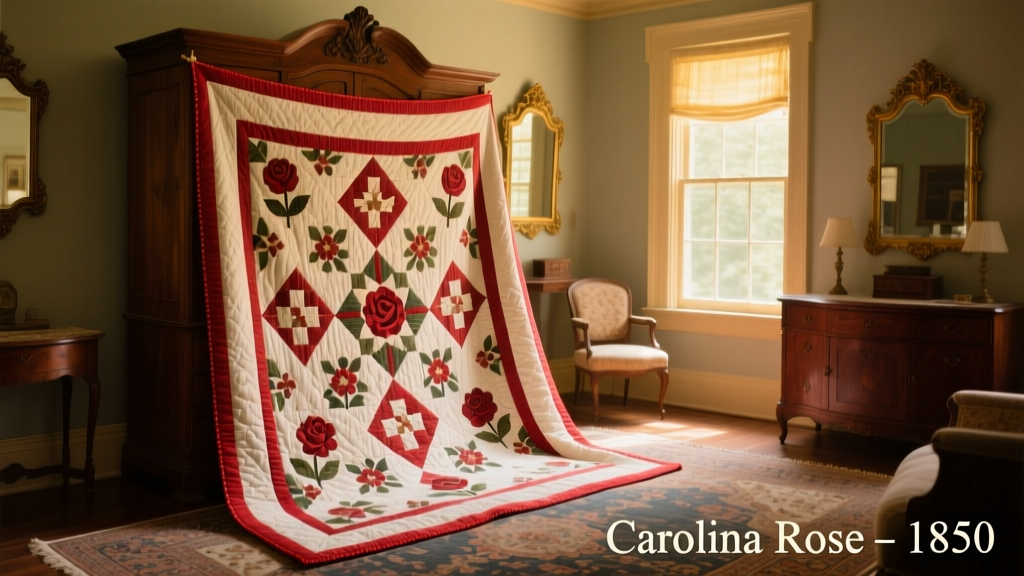
Carolina Rose Patchwork Quilt: Unbleached Muslin Ground with Red Binding — A Collector’s Guide to Authenticity, Construction & Conservation
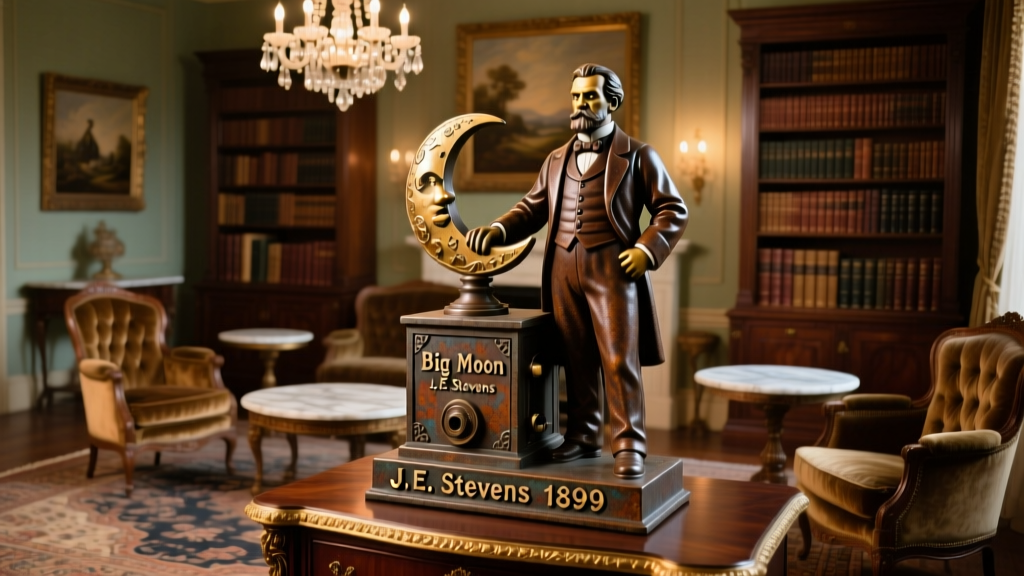
Banks Mechanical Chief Big Moon: A Technical and Historical Examination of the J.E. Stevens Cast Iron Bank (1899, 10-Inch Model)
Identifying and Authenticating Vintage Vases: A Practical Guide for Collectors and Heirloom Owners
Haviland Bowl Fruit Blue Garland: Identification, History, and Restoration Guidance
Roseville Vase 'Grapes & Leaves' in Brown Matte Ground: Identification, Provenance, and Restoration Guidelines for the Binocular Shape (4¾ × 8 in)