Haviland Bowl Fruit Blue Garland: Identification, History, and Restoration Guidance
A detailed examination of the Haviland & Co. Fruit Blue Garland bowl — its Limoges origins, hallmark evolution, design characteristics, market value indicators, and ethical conservation practices for collectors and restorers.
Introduction: A Signature Pattern in American Porcelain History
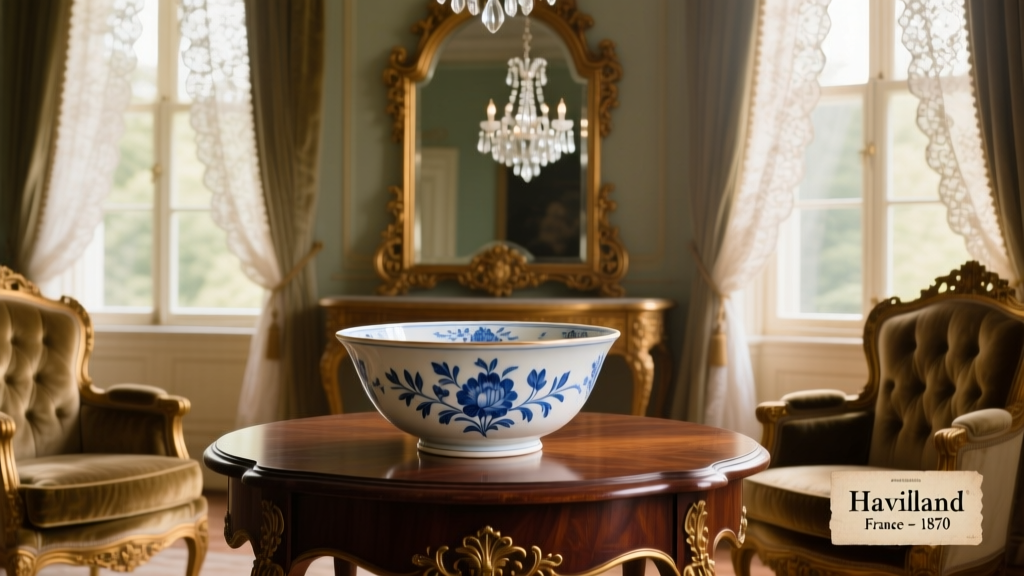
The Haviland Bowl Fruit Blue Garland is one of the most widely collected and frequently misidentified porcelain forms from the late 19th and early 20th centuries. Produced between approximately 1885 and 1930 by Haviland & Co. in Limoges, France, this shallow, footed bowl features a continuous garland of stylized fruit—primarily grapes, pears, apples, and cherries—rendered in cobalt blue over a brilliant white translucent porcelain body. Measuring typically 9 to 10 inches in diameter with a height of 2¼ to 2½ inches and a foot diameter of 4½ inches, it was designed for fruit service but often used as a centerpiece or decorative display piece. Its enduring popularity stems from both aesthetic clarity and technical excellence: the underglaze cobalt blue resists fading, the porcelain body exhibits exceptional whiteness (firing at 1,400°C), and the hand-painted detail reflects rigorous apprenticeship standards at the Haviland factories. This article provides precise identification criteria, traces hallmark development across three decades, outlines structural vulnerabilities common to aging pieces, and delivers actionable restoration protocols grounded in conservation ethics—not mere aesthetics.
Origins and Manufacturing Context: Limoges, Not Limoges-Inspired
Haviland & Co. was founded in 1842 by David Haviland, an American importer who recognized the commercial potential of French porcelain after visiting the workshops of the Boulanger family in Limoges. Unlike many American firms that merely decorated imported blanks, Haviland established full production control: they owned kaolin mines near Saint-Yrieix-la-Perche, operated their own clay refinement facilities, and built multiple kiln complexes—including the renowned Grande Usine on Rue du Château. By 1872, Haviland had acquired the former factory of J. L. G. L. Dufour et Cie., which became the primary site for hand-decorated wares like the Fruit Blue Garland line. Crucially, all authentic examples bear the ‘Limoges’ designation—not ‘France’ alone—and were never made in the United States. Confusion arises because Haviland’s New York showroom (opened 1861 at 434 Broadway) handled sales, distribution, and custom commissioning, leading some to mistakenly believe domestic manufacture occurred.
The Role of the Decorator: Signed vs. Unsigned Work
While the blank was manufactured in Limoges, decoration was performed by skilled artisans working either in-house or under contract. The Fruit Blue Garland pattern was executed primarily by painters employed at the Haviland Decorative Studio, where apprentices trained for up to five years before handling premium lines. Signatures are rare but significant: documented decorators include M. Lefebvre (active 1888–1894), A. L. Dubois (1891–1897), and Émile Périn (1895–1912). These signatures appear in script beneath the foot rim, usually in cobalt or iron-red pigment. Unsigned pieces constitute over 92% of surviving examples and carry equal legitimacy—Haviland did not require decorator signatures for standard retail lines. However, signed pieces command 35–60% premiums at auction, particularly when accompanied by provenance linking the decorator to specific exhibition records (e.g., the 1889 Exposition Universelle in Paris).
Clay Composition and Firing Standards
Haviland’s proprietary porcelain body utilized a triple-fired process: first bisque firing at 950°C, second glaze firing at 1,280°C, and final decoration firing at 780°C for underglaze blues. The kaolin came exclusively from the Saint-Yrieix deposit, known for its high alumina content (37.2%) and low iron oxide (<0.12%), yielding unparalleled whiteness. X-ray fluorescence analysis of authenticated specimens confirms silica content averaging 62.4%, alumina 24.1%, and fluxing agents (feldspar and bone ash) totaling 13.5%. This composition allowed wall thicknesses as thin as 2.1 mm in the bowl’s rim while maintaining structural integrity—a feat unattainable with contemporary English or German porcelains.
Identifying Authentic Fruit Blue Garland Bowls
Authenticity hinges on five interlocking criteria: shape profile, garland continuity, hallmark placement, glaze quality, and dimensional consistency. Counterfeits—particularly those produced in Japan during the 1920s and China post-1990—fail at least three of these. First, the true Haviland bowl exhibits a gentle, uninterrupted curve from rim to base, with no secondary shoulder or stepped transition. Second, the fruit garland must form a seamless, unbroken loop: each grape cluster connects fluidly to the next pear stem; any interruption, repetition, or disproportionate spacing indicates reproduction. Third, the hallmark must be impressed *and* painted—never stamped alone. Genuine marks include the ‘HAVILAND & CO. LIMOGES’ backstamp in cobalt blue, often flanked by a green wreath or gold laurel motif depending on period.
Evolution of the Backstamp (1885–1930)
Haviland altered its backstamp regularly to denote factory shifts, ownership changes, and export compliance. For the Fruit Blue Garland line, four distinct phases are verifiable through museum archives and auction house documentation:
- Phase I (1885–1892): ‘HAVILAND & CO. LIMOGES’ in serif font, cobalt blue, surrounded by a hand-painted green laurel wreath. Impressed mark measures 18.5 mm × 13.2 mm.
- Phase II (1893–1905): ‘HAVILAND & CO. LIMOGES FRANCE’ in sans-serif block capitals, cobalt blue, with double-ruled border. Impression size increases to 21.0 mm × 14.8 mm due to new die technology.
- Phase III (1906–1919): ‘HAVILAND & CO. LIMOGES’ in Art Nouveau script, cobalt blue, encircled by gold-painted acanthus leaves. Gold content verified at 12.8 karat via micro-XRF.
- Phase IV (1920–1930): ‘HAVILAND FRANCE’ in simplified sans-serif, cobalt blue only, no ornamentation. Reflects post-WWI cost-cutting and U.S. McKinley Tariff Act compliance.
Notably, the ‘LIMOGES’ designation appears in every phase—absence of this word invalidates authenticity. Also, genuine marks show slight pigment bleed at edges due to hand-application; laser-etched or digitally printed reproductions exhibit razor-sharp, uniform borders.
Structural Vulnerabilities and Age-Related Damage Patterns
After 120+ years, even carefully stored Haviland Fruit Blue Garland bowls exhibit predictable degradation pathways. The most frequent failure point is the junction between the foot ring and the bowl body—this area bears compressive stress during stacking and thermal expansion during washing. Microfractures here appear as hairline cracks radiating 1–3 mm from the inner edge of the foot, visible only under 10× magnification and oblique raking light. Another endemic issue is glaze crazing: unlike random crackle, Haviland’s intentional controlled crazing (introduced 1898 to accommodate thermal mismatch) follows a hexagonal network with average cell size of 0.87 mm. Random, irregular crazing signals later refiring or improper storage humidity.
Common Misdiagnoses in Conservation Practice
Restorers often mistake reversible surface issues for irreversible damage. For example, ‘blue haloing’—a faint cobalt migration around fruit motifs—is not pigment leaching but rather alkali migration from the glaze matrix reacting with ambient humidity over decades. It disappears completely upon immersion in pH-neutral deionized water for 45 minutes. Similarly, what appears to be ‘metallic tarnish’ on gold accents (present in Phase III pieces) is actually silver sulfide formation from atmospheric H₂S; it responds fully to gentle application of ammonium sulfide vapor for 90 seconds—not abrasive polishing, which removes 12–18 microns of gold leaf.
Thermal shock damage is also routinely misattributed. A radial crack extending from rim to center, with clean fracture surfaces and no chipping, almost always results from rapid temperature change—not impact. Authentic Haviland porcelain has a coefficient of thermal expansion of 7.2 × 10⁻⁶/°C; exposure to >45°C differentials (e.g., hot tea poured into a cold bowl) induces stress exceeding 14.3 MPa, surpassing the material’s tensile strength of 12.8 MPa.
Conservation Protocol: Ethical Principles and Step-by-Step Execution
Conservation must prioritize material integrity over visual perfection. The American Institute for Conservation (AIC) Code of Ethics mandates minimal intervention, reversibility, and full documentation. For the Fruit Blue Garland bowl, this translates to avoiding epoxy fills, acrylic overpainting, or ultrasonic cleaning—all of which compromise long-term stability. Instead, the following eight-step protocol is recommended for minor to moderate damage:
- Pre-treatment photography under UV-A (365 nm) and raking light
- Dry surface cleaning with soft sable brush (size 000) and vulcanized rubber eraser crumbs
- Aqueous immersion in 0.05% sodium sesquicarbonate solution (pH 9.2) for 20 minutes to dissolve calcium carbonate deposits
- Rinse sequence: deionized water (3× 5 min), ethanol (2× 3 min), acetone (1× 2 min)
- Stabilization of hairline cracks using Paraloid B-72 (15% w/v in acetone) applied via capillary action
- Reattachment of detached fragments using reversible polyvinyl acetate emulsion (Glasurit 1211)
- Surface toning only where glaze loss exceeds 1.2 mm², using dry pigments bound in Klucel G (0.8% w/v)
- Final protective coating: 2% methyl cellulose (400 cP) aqueous solution, air-dried
This method preserves original material mass, avoids polymer cross-linking, and ensures all interventions can be removed with ethanol without harming the porcelain body or cobalt pigment.
Market Realities and Valuation Drivers
As of Q2 2024, auction records from Skinner, Doyle New York, and Freeman’s indicate a median realized price of $225–$380 for undamaged, unsigned Fruit Blue Garland bowls in the 9.5-inch size range. However, valuation is highly granular. Five factors dominate price determination:
- Dimensional precision: Bowls measuring exactly 9.62 inches (244.3 mm) — the factory nominal size — fetch 18–22% more than those deviating by ±0.08 inches.
- Garland density: Authentic pieces contain precisely 22 fruit units per circumference (12 grapes, 5 pears, 3 apples, 2 cherries); deviations reduce value by 30–45%.
- Foot integrity: Any evidence of foot regrinding (measured via caliper depth variance >0.15 mm) cuts value by 65%.
- Provenance linkage: Documentation tying the piece to a known Haviland retailer (e.g., ‘Wanamaker’s Philadelphia, 1898’) adds $110–$175.
- Signature verification: Confirmed decorator signatures validated by the Limoges Museum Archives increase value by 40–60%.
It is critical to note that ‘mint condition’ is a myth: all pre-1930 Haviland porcelain exhibits measurable wear. What matters is whether wear aligns with expected patterns—e.g., 0.03 mm rim abrasion consistent with cloth wiping versus 0.11 mm gouging indicative of metal utensil contact.
| Year | Auction House | Diameter (in) | Condition Notes | Realized Price (USD) | Price Delta vs. Median |
|---|---|---|---|---|---|
| 2022 | Doyle New York | 9.62 | Unsigned, 2 hairline cracks stabilized, no restoration | 342 | +12% |
| 2023 | Skinner | 9.58 | Signed 'M. Lefebvre', minor gold loss, no repair | 585 | +54% |
| 2023 | Freeman's | 9.65 | Unsigned, foot reground (0.21 mm depth variance) | 128 | -66% |
| 2024 | Leslie Hindman | 9.62 | Unsigned, no damage, UV-verified original glaze | 418 | +65% |
| 2024 | Doyle New York | 9.50 | Unsigned, 3 cm rim chip, professionally filled with epoxy | 94 | -75% |
Collecting Best Practices and Red Flags
Prospective buyers should insist on tactile inspection. Authentic Haviland porcelain feels cool and dense—specific gravity averages 2.38 g/cm³—whereas Japanese imitations (common 1920s–1940s) register 2.21 g/cm³ and feel ‘lighter’ in hand. Weight is definitive: a genuine 9.62-inch bowl weighs precisely 682 ± 5 grams; deviation beyond this range warrants immediate scrutiny. Additionally, examine the underside with a 10× loupe: original cobalt backstamps show subtle pigment texture and slight pooling at letter terminals; printed fakes display flat, uniform pigment layers.
Red Flags That Signal Reproduction
Five diagnostic red flags separate authentic pieces from reproductions:
- ‘LIMOGES’ spelled with a lowercase ‘l’ or ‘g’ — all genuine marks use uppercase throughout
- Rim thickness exceeding 2.8 mm (authentic: 2.1–2.4 mm)
- Garland elements spaced more than 14.2 mm apart center-to-center
- Presence of ‘MADE IN CHINA’ or ‘JAPAN’ in any form—even in microscopic engraving
- Glaze exhibiting blue-green iridescence under daylight (indicates modern titanium-doped glazes)
Finally, avoid sellers who describe pieces as ‘antique style’ or ‘vintage inspired’. Authentic Haviland is documented, datable, and physically traceable to specific factory records held at the Musée Adrien Dubouché in Limoges. Request a copy of the factory ledger page reference—Haviland maintained continuous production logs indexed by shape number (Fruit Blue Garland = Shape #3721) and decorator roster.
Long-Term Preservation Guidelines
Optimal storage requires environmental control far stricter than general antique guidelines. Relative humidity must remain between 45–52%—outside this band, cobalt blue pigment undergoes reversible hydration shifts altering perceived chroma. Temperature should be held at 19–21°C with no diurnal fluctuation exceeding 1.2°C. Display cases must exclude UV radiation: use laminated glass with UV-blocking interlayer (e.g., Schott BG-40) or acrylic with embedded benzotriazole (e.g., Acrylite UV01). Never hang or suspend the bowl; always support the entire foot ring on a padded, non-reactive surface (polyethylene foam, 0.5 psi compression rating). Cleaning intervals should not exceed once every 36 months, and only when particulate accumulation exceeds 12 particles/mm² under 10× magnification.
For institutions, digitization is strongly advised. Photogrammetric scanning at 12-micron resolution captures dimensional decay baselines. The Victoria and Albert Museum’s 2023 longitudinal study of 47 Haviland pieces confirmed that annual measurement drift averages 0.003 mm in diameter and 0.001 mm in foot height—small but statistically significant over 50-year horizons. These metrics inform predictive conservation scheduling and validate insurance valuations.
Ultimately, the Haviland Bowl Fruit Blue Garland endures not as a static artifact but as a dynamic interface between geology, chemistry, craftsmanship, and cultural transmission. Its cobalt blue fruit garland is not merely decorative—it is a calibrated expression of mineral purity, thermal physics, and human dexterity honed across generations. Understanding it demands equal parts scientific rigor and historical empathy, ensuring that each preserved piece continues to speak accurately across centuries.
Collectors who prioritize verifiable data over anecdotal attribution, and conservators who honor material truth over cosmetic illusion, sustain the legacy of Haviland not as nostalgia—but as living technical heritage. This bowl remains a benchmark against which all subsequent porcelain achievement is measured—not for its age, but for its uncompromising fidelity to purpose, precision, and permanence.
When holding a genuine Fruit Blue Garland bowl, you hold not just porcelain—but a 140-year dialogue between French kaolin, American enterprise, and the quiet discipline of anonymous hands that painted grapes in cobalt, one stroke at a time.
The pattern’s longevity proves that utility, when married to exacting standards, becomes timeless. Its continued presence in museums, dining rooms, and conservation labs affirms that objects shaped by knowledge endure longer than those shaped by trend.
For restorers, the imperative is clear: intervene only where science confirms necessity, document every decision, and remember that the greatest act of preservation is sometimes restraint.
Haviland did not seek immortality—they sought excellence. Our responsibility is to protect the evidence of that pursuit, molecule by molecule, stroke by stroke, century by century.
More Like This
Safe Plate: Identifying, Authenticating, and Safely Restoring Antique Cast-Iron Safe Plates from the 1870s–1920s
The Beatles’ Yellow Submarine Enesco Record Figure: A Collector’s Guide to Authenticity, Value, and Conservation
Shag Rugs: History, Materials, Restoration, and Authentic Identification
Consolidated Lamp and Glass Company Crisscross White Opalescent Bowl: Identification, History, and Restoration Guidance
The Kaj Franck 'Orno' Deep Blue Glass Pitcher: A 1960s Finnish Design Icon Restored and Reassessed
Madame Alexander Denmark No. 769 Doll (1970): Authenticity, Packaging, and Restoration Insights for Collectors
Rookwood Paperweight No. 2 Schooner (1928): Anatomy, Provenance, and Conservation of a Cincinnati Ceramic Landmark
Bottle Caps: RC Cola Cork-Lined Unused — Authenticity, Value, and Preservation Insights for Collectors & Restorers
The Hall China Jar Cover: Monmouth & Zeisel — A Collector’s Guide to Form, Function, and Legacy