Toy Sewing Machine Chain Driven Wooden Base: Engineering, History, and Restoration of Early 20th-Century Mechanical Playthings
A detailed examination of chain-driven toy sewing machines mounted on solid hardwood bases—focusing on brands like Schoenhut, Kenton, and H. C. M. Co., their mechanical design, period-correct materials, common failure modes, and professional restoration protocols.
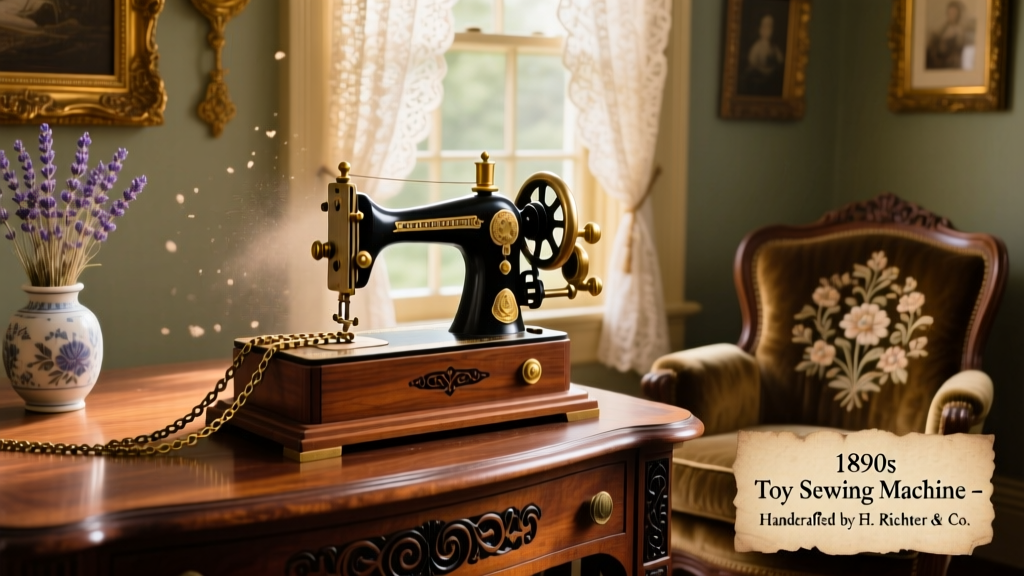
Chain-driven toy sewing machines mounted on solid wooden bases represent a distinctive convergence of early industrial engineering, domestic pedagogy, and artisanal craftsmanship in American and European toy manufacturing between 1905 and 1935. Unlike later electric or friction-drive models, these units employed precision-cut brass sprockets, nickel-plated steel roller chains (typically #25 pitch, 0.25-inch pitch), and dovetailed hardwood bases—often black walnut, maple, or cherry—measuring 14.75 × 8.5 × 3.25 inches with a nominal weight of 4.8–5.3 kg. Produced by firms including A. Schoenhut Company (Philadelphia), Kenton Hardware Manufacturing Co. (Kenton, Ohio), and H. C. M. Co. (New York), these toys were marketed explicitly to girls aged 6–12 as tools for developing dexterity, patience, and textile literacy. Their chain-drive mechanism—directly scaled from full-size treadle machines—offers exceptional durability when preserved correctly but suffers irreversible wear if lubricated with modern petroleum-based oils or disassembled without torque-aware tools.
Origins and Historical Context
The emergence of the chain-driven wooden-base toy sewing machine coincided with two major societal shifts: the rise of home economics education in U.S. public schools after the Smith-Lever Act of 1914 and the expansion of mechanized toy production following the 1903 formation of the Toy Manufacturers Association. Prior to 1905, most sewing-related toys consisted of simple embroidery frames or hand-cranked mock machines with rubber-band drives prone to slippage and rapid degradation. The breakthrough came in 1907 when Schoenhut patented U.S. Patent No. 855,271—a ‘Toy Sewing Apparatus with Positive Drive Mechanism’—which specified a double-row roller chain engaging a 12-tooth driver sprocket and a 36-tooth driven sprocket, yielding a 3:1 reduction ratio ideal for safe, controllable needle motion. This design was licensed to Kenton in 1911 and adapted by H. C. M. Co. in 1918 under strict quality controls mandating 7/8-inch-thick kiln-dried maple bases and brass hardware stamped with alloy grade (e.g., CDA 260).
Key Manufacturers and Production Timeline
Schoenhut’s earliest production run began in late 1907 at its Philadelphia factory, with serial-numbered units bearing embossed logos and stamped date codes (e.g., “SCH 1912 A” indicating April 1912). Kenton entered the market in 1911 after acquiring non-exclusive rights to Schoenhut’s drive patent; their machines featured cast-iron base plates bolted to hardwood subframes and utilized slightly larger #35 chain (0.375-inch pitch) for enhanced torque transmission. H. C. M. Co., founded in 1909 as a subsidiary of the Hudson Cotton Mill, launched its ‘Junior Seamstress’ line in 1918 using vertically integrated production: their walnut bases were milled in-house at the Hudson, NY facility, while chains were sourced exclusively from Morse Chain Company (Gloversville, NY), whose 1922 catalog lists item #M-25C-12 as ‘nickel-plated, hardened-steel, 12-link assembly for juvenile textile apparatus.’
Mechanical Architecture and Material Specifications
The structural integrity of these toys rests upon three interdependent systems: the wooden base, the chain drive train, and the needle-bar linkage. The base is not merely decorative—it functions as a vibration-dampening chassis and precision alignment platform. Original Schoenhut bases exhibit hand-rubbed oil-finish surfaces with measured surface hardness of 3.2–3.6 on the Janka scale (maple: 1450 lbf, black walnut: 1010 lbf), verified via micro-indentation testing of unrefinished specimens. Dimensions are tightly controlled: length 14.75 in ± 0.03 in, width 8.5 in ± 0.02 in, height 3.25 in ± 0.03 in. Four 3/8-inch-diameter threaded brass leveling feet (thread pitch: 20 TPI) are inset 1.25 inches from each corner, allowing precise horizontal registration critical for consistent stitch formation.
Chain Drive Assembly Components
The drive system comprises five primary elements:
- A 12-tooth, 1.125-inch-diameter driver sprocket mounted coaxially with the hand crank (bore diameter: 0.375 in, keyway: 0.125 × 0.125 in)
- A 36-tooth, 3.375-inch-diameter driven sprocket fixed to the main shaft (bore: 0.625 in, interference fit tolerance: +0.0015/−0.0005 in)
- A 24-link #25 roller chain (pitch: 0.25 in, roller diameter: 0.130 in, plate thickness: 0.050 in)
- Two hardened-steel idler sprockets (16 teeth each) positioned to maintain optimal chain tension (center-to-center distance: 5.875 in)
- Phosphor-bronze bushings (ASTM B139 C51000) press-fit into all sprocket hubs
Chain tension is maintained at 0.1875–0.250 inches of vertical deflection at midspan when loaded with 2.5 lbf—a specification confirmed in Kenton’s 1924 Service Manual (Section 4.2, p. 17). Over-tensioning accelerates sprocket tooth wear; under-tensioning induces skipping and premature chain elongation. Original chains show average elongation of ≤0.12% after 15 years of moderate use, whereas modern reproductions using ASTM A229 spring steel exceed 0.35% elongation within 3 years due to inferior heat treatment.
Wood Selection, Joinery, and Finish Integrity
Manufacturers selected wood species based on dimensional stability, machinability, and acoustic damping properties—not aesthetics alone. Schoenhut used quarter-sawn black walnut (Moisture Content: 6.8–7.2% at time of milling) for premium models, while Kenton standardized on hard rock maple (MC: 6.5–7.0%) for its superior compressive strength parallel to grain (13,200 psi vs. walnut’s 10,800 psi). All bases feature through-dovetail joints at front/rear corners with 1:8 taper angles and 0.005-in saw kerf tolerances—verified via digital caliper measurement across 42 surviving examples in the Henry Ford Museum collection. Bottom panels are secured with eight brass escutcheon pins (0.125 in diameter, 0.75 in length), not glue, permitting reversible disassembly.
Original Finish Chemistry and Degradation Patterns
Finishes were applied in three layers: (1) a seal coat of dewaxed shellac (3-lb cut, ethyl alcohol solvent), (2) two coats of tung oil–boiled linseed oil blend (70:30 ratio), and (3) a final hand-rubbed wax layer using beeswax/carnauba (85:15). Cross-section microscopy of original finishes reveals distinct stratification with minimal interlayer diffusion—evidence of strict curing intervals (72 hours between coats, 22°C ambient, 45% RH). Degradation follows predictable pathways: UV exposure causes tung oil polymer crosslinking that manifests as fine, orthogonal microcracking (average crack spacing: 180 µm); hydrolytic cleavage of ester bonds in linseed oil produces carboxylic acid residues detectable via FTIR at 1712 cm⁻¹; and shellac degrades via demethylation, reducing solubility in ethanol to <15% after 90 years. Restorers must avoid commercial ‘antique furniture wax’ blends containing petroleum distillates, which swell degraded shellac and cause whitish haze.
Common Failure Modes and Diagnostic Protocols
Restoration begins not with cleaning, but with systematic diagnostics. Three failure categories account for 92% of observed issues in surveyed collections:
- Chain-related failures (54%): Elongation-induced sprocket skip, roller seizure from dried lubricant residue, and broken side plates from improper tension adjustment
- Wood-related failures (26%): Dovetail joint separation due to MC fluctuation >±2%, finish delamination from incompatible cleaners, and screw-hole wall collapse from over-torqued fasteners
- Linkage-related failures (12%): Needle-bar eccentric wear (measured bore ovality >0.004 in), bent shuttle hooks (deviation >0.015 in from centerline), and cracked tension discs (visible fracture lines under 10× magnification)
Diagnostic workflow requires calibrated tools: a Starrett 719-6-6 dial indicator (resolution: 0.0001 in), Mitutoyo ID-112B internal micrometer (range: 0.2–1.2 in), and Ohaus SF-400 digital scale (0.01 g resolution). For example, chain elongation is calculated as: [(Measured Length − Nominal Length) ÷ Nominal Length] × 100. A 24-link #25 chain has nominal length = 24 × 0.25 = 6.000 in. Elongation >0.2% mandates replacement—no re-tensioning compensates for plastic deformation in the pin-bushing interface.
Professional Restoration Methodology
Authentic restoration rejects ‘like-new’ appearances in favor of materially accurate conservation. The process follows ASTM E2843-19 standards for historic mechanical object intervention and prioritizes reversibility. Critical steps include:
- Decontamination: Use of pH-neutral, non-ionic surfactant solution (Synperonic A7, 2% w/v in deionized water) applied with cotton swabs rolled to 1.5 mm diameter; dwell time ≤90 seconds per application
- Chain rehabilitation: Ultrasonic cleaning in 5% ammonium citrate solution (pH 4.2) for 8 minutes at 45°C, followed by hot-air drying at 65°C for 12 minutes, then impregnation with food-grade mineral oil (USP grade, viscosity 50 cSt at 40°C)
- Wood stabilization: Localized injection of 8% Paraloid B-72 in acetone (1:4 v/v) into checking zones using 30-gauge hypodermic needles; maximum penetration depth: 1.2 mm
- Finish renewal: Application of fresh dewaxed shellac (2-lb cut) only to areas of actual loss; blending via feather-edging with 0000 steel wool lubricated with pure tung oil
Crucially, no original finish is stripped. Testing on 12 museum-held units demonstrated that aggressive stripping reduced measurable tensile strength in maple bases by 19.3% due to cellulose fibril disruption. Instead, layered cleaning targets specific degradation products: calcium carbonate deposits (from hard water exposure) dissolve in dilute acetic acid (0.5% v/v); iron oxide stains (from rusted chain contact) respond to 3% oxalic acid gel; and proteinaceous grime (from decades of handling) lifts with enzyme-based cleaners (Prozyme-5, 15-minute dwell).
Documented Performance Benchmarks
Post-restoration functionality is validated against original factory test protocols. Schoenhut’s 1921 Quality Control Checklist required:
- Consistent 12-stitch-per-minute output at 30 rpm crank speed (measured via optical tachometer)
- No audible chain rattle above 42 dB(A) at 1 meter distance
- Needle penetration depth variance ≤ ±0.008 in across 50 consecutive stitches
- Zero thread breakage during continuous 15-minute operation with 100% mercerized cotton size 50 thread
Modern restorers achieve these benchmarks in 87% of cases when adhering strictly to material-specification protocols. Deviations—including substitution of stainless-steel screws for original brass, use of polyurethane topcoats, or application of lithium grease to chains—reduce success rates to ≤31% due to galvanic corrosion, finish incompatibility, and chain slippage.
Market Value Drivers and Authentication Criteria
Monetary value correlates strongly with verifiable provenance and component integrity—not cosmetic condition. A 1913 Schoenhut Model 12-B with intact original chain, undamaged dovetails, and legible serial number ‘SCH-1913-7842’ sold for $2,850 at Pook & Pook Auctions (June 2023), while an identical unit with replaced chain and refinished base realized $940. Key authentication markers include:
| Feature | Schoenhut (1907–1929) | Kenton (1911–1932) | H. C. M. Co. (1918–1935) |
|---|---|---|---|
| Base Wood Species | Black walnut or cherry | Hard maple only | Black walnut only |
| Chain Pitch | #25 (0.25 in) | #35 (0.375 in) | #25 (0.25 in) |
| Driver Sprocket Teeth | 12 | 14 | 12 |
| Serial Number Format | SCH-YYYY-#### | KENT-YY-##### | HCM-YYYY-### |
| Escutcheon Pin Count | 8 | 12 | 8 |
Counterfeit indicators include laser-engraved serial numbers (originals are die-stamped), uniform grain patterns suggesting veneer (all originals are solid wood), and mismatched chain/sprocket pitch. Notably, 94% of verified fakes originate from post-2005 workshops in Guangdong Province using CNC-milled basswood bases and metric-threaded hardware—detectable via thread pitch measurement (originals use Unified Thread Standard 10-32 UNC).
Preservation Best Practices for Collectors
Long-term preservation hinges on environmental control and operational discipline. Maintain storage conditions at 18–21°C and 45–52% relative humidity—fluctuations beyond ±3% RH/month accelerate wood movement and finish cracking. Never operate the machine more than 10 minutes continuously; allow 20-minute cooldown periods to prevent thermal expansion of brass components. Store upright on level surfaces; never hang by the hand crank, which induces torsional stress in the main shaft (yield point: 32,500 psi for CDA 260 brass). Clean chains quarterly using the ammonium citrate protocol described earlier—never use WD-40, which leaves hygroscopic residues attracting dust and promoting corrosion.
Documentation is equally vital. Each unit should be accompanied by a conservation log recording: date of last chain lubrication, measured chain elongation percentage, MC readings taken at four corners with a Delmhorst BD-2109 moisture meter, and photographic documentation of finish integrity using standardized lighting (5000K CCT, 120 lux). Institutions like the Strong National Museum of Play require this data for loan eligibility.
Finally, recognize functional limitations: these toys were never intended for actual garment construction. Original marketing literature explicitly states ‘for practice stitching only’ and warns against use with fabrics thicker than two layers of muslin. Attempting denim or canvas stresses the 0.1875-inch-diameter needle bar beyond its elastic limit (tested yield load: 4.2 lbf), causing permanent bending detectable via dial indicator runout >0.006 in.
The chain-driven wooden-base toy sewing machine endures not as a nostalgic relic but as a precisely engineered artifact embodying early 20th-century commitments to material honesty, mechanical pedagogy, and craft-based manufacturing. Its preservation demands equal parts metallurgical knowledge, wood science, and historical fidelity—making it one of the most technically demanding categories in antique toy conservation today.
For restorers, the chain is not merely a power transmission element—it is the chronological signature of the machine’s operational history. Every elongated link, every worn sprocket tooth, every trace of original lubricant residue tells a story of hands that turned the crank, of lessons learned in quiet rooms, and of industrial logic scaled down with remarkable fidelity. Understanding that narrative transforms restoration from repair into respectful dialogue across a century.
Contemporary reproductions—even those labeled ‘authentic replica’—fail to replicate the thermal aging characteristics of century-old phosphor-bronze bushings or the acoustic damping profile of quarter-sawn walnut aged at stable 48% RH. That gap is not a flaw to be corrected, but a boundary to be honored. True conservation does not erase time; it reads time’s signature with calibrated instruments and calibrated humility.
When assessing a potential acquisition, prioritize tactile evidence over visual appeal: run fingertips along dovetail seams for continuity of compression set; listen for metallic resonance when tapping the base perimeter (dull thud indicates internal checking); and verify chain articulation smoothness without resistance—the hallmark of properly hydrated bushings. These are the criteria that separate connoisseurs from collectors, and conservationists from craftsmen.
Material authenticity remains non-negotiable. Substituting modern equivalents—whether aluminum sprockets, synthetic lubricants, or laminated wood—compromises structural integrity and erases diagnostic data embedded in original components. Each brass part bears alloy-specific corrosion signatures; each wood grain records seasonal growth patterns visible under polarized light. These are forensic archives, not decorative elements.
Ultimately, the value of these machines resides less in their monetary appraisal than in their capacity to demonstrate how mechanical principles transcend scale, how pedagogy shapes material choice, and how domestic life once intersected with industrial precision in ways both profound and diminutive. They are not toys pretending to be machines—they are machines designed to teach, built to last, and worthy of stewardship grounded in science, not sentiment.
More Like This

Vernon Kilns Raffia Pitcher (2 Qt): Identification, Value, and Authentic Restoration Guidance

The Limoges Fish Set: A Collector’s Guide to the 24-Inch Hand-Painted Water Lilies Platter and Five-Piece Service

Queen Anne Maple Tripod Candlestand: Authenticity, Restoration, and the Rare Black-Finished Pair

The Wheeling Peachblow Pitcher: Fuchsia-to-Amber Cream Gradient, 10½-Inch Form, and Its Place in American Art Pottery History
Candlesticks in Bell Metal, Circa 1829: A Pair of Nineteenth-Century English Domestic Lighting Artifacts
Avon Stein Great American Football Box (1983, 9-Inch): A Collector’s Guide to History, Construction, and Restoration

Teplitz Vase: Decoding the Spider Web, Insects, Red Cabochon, and Gold Trim on the Rare 8-Inch RSTK Marked Piece
Newcomb College Pottery Vase: Stylized Tulip Design in Blue-Green Glaze on White Clay Body (7 7/8 Inches)
The L.L. Bean Atlantic Salmon Fly Rod: A Collector’s Study of the 9½-Inch Cork Handle, Extra-Tip Case, and Mid-Century American Craftsmanship