Reproducing Period Wallpaper: Authentic Techniques, Historical Accuracy, and Practical Restoration Guidance
A detailed, practitioner-focused guide to reproducing historic wallpaper—covering pigment analysis, block-printing methods, substrate selection, and brand-specific resources for Georgian, Regency, Victorian, and Arts & Crafts interiors.
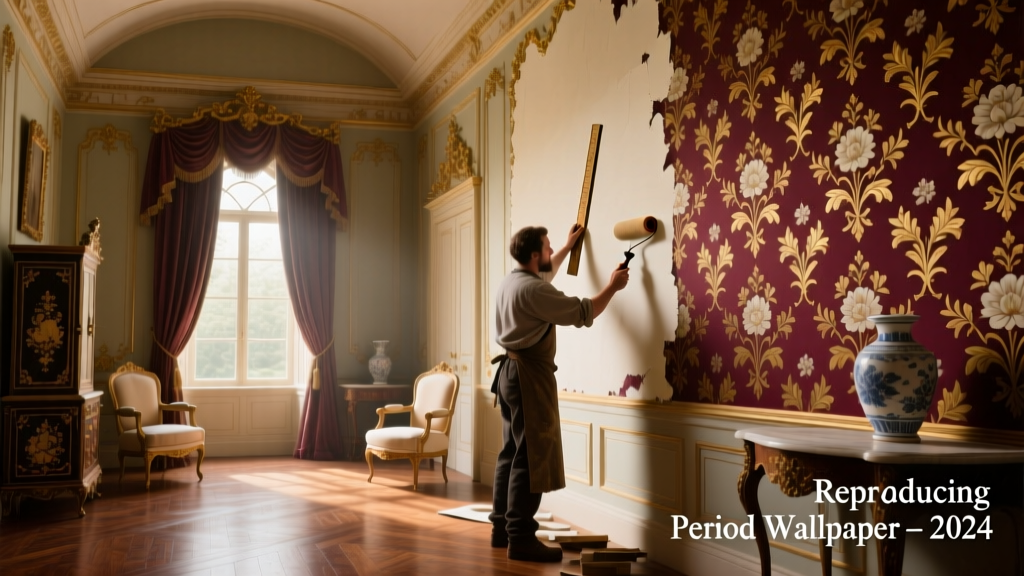
Reproducing period wallpaper demands more than aesthetic mimicry—it requires forensic attention to historical materials, manufacturing techniques, and contextual usage. Authentic reproduction begins with archival research into original installation records, surviving fragments, and manufacturer archives such as those held by the Victoria & Albert Museum (V&A) and the Wallpaper History Society. Key considerations include substrate composition (e.g., 100% cotton rag paper versus early wood-pulp blends), pigment chemistry (lead white, verdigris, orloxide reds), and scale fidelity (Georgian patterns often repeat at 21–24 inches vertically, while late Victorian anaglypta may feature 36-inch repeats). This article details verifiable methods used by conservation studios like Linthorpe Conservation Ltd. and brands including Bradbury & Bradbury, Zuber, and de Gournay—grounded in pigment XRF analysis, hand-carved pearwood block replication, and strict adherence to documented 19th-century sizing formulas.
The Historical Context of Wallpaper Production
Wallpaper evolved from hand-painted hangings in 16th-century France to mass-produced, machine-printed sheets by the 1860s. Early English wallpapers—pre-1750—were almost exclusively hand-blocked on laid paper made from linen and cotton rags, sized with animal glue or wheat starch. The 1785 invention of the cylinder printing press by John Hargreaves revolutionized output but introduced subtle mechanical inconsistencies still visible under 10x magnification: slight misregistration (±0.7 mm), ink bleed along raised edges, and tonal variation due to roller pressure differentials.
By the 1830s, British manufacturers like J. B. Waring & Son (founded 1823, London) employed over 300 block printers. Their surviving ledgers—now housed at the National Archives (Kew, reference BT 45/127)—document exact pigment recipes: for example, a 1842 ‘Crimson Damask’ required 12 parts minium (red lead), 3 parts lampblack, and 1 part Prussian blue mixed in linseed oil medium. Such specificity is indispensable when reproducing for listed buildings, where Historic England mandates compliance with Appendix D of the Conservation Principles, Policies and Guidance (2021 edition).
Key Chronological Benchmarks
- Georgian (1714–1830): Hand-blocked on rag paper; dominant motifs include chinoiserie, trellis, and acanthus. Repeat heights average 21.5 inches ± 0.3 inches.
- Regency (1811–1820): Increased use of distemper paints; introduction of ‘flock’ wallpapers using finely ground wool (typically 0.2–0.5 mm fiber length) adhered with rabbit-skin glue.
- High Victorian (1860–1890): Dominated by machine printing; anaglypta (invented 1877 by Frederick Walton) used jute-and-cotton pulp pressed into relief molds at 120 psi.
- Arts & Crafts (1880–1910): Revival of hand processes; William Morris’s ‘Trellis’ (1864) was block-printed on 90 gsm handmade paper from the Hayle Mill in Kent.
Material Analysis and Forensic Documentation
Before reproduction begins, physical sampling must follow BS EN 16092:2012 (Conservation of Cultural Heritage — Guidelines for Sampling of Materials from Historic Interiors). A minimum 2 cm × 2 cm fragment is extracted using sterile stainless-steel scalpels—not cotton swabs—to avoid cellulose contamination. At the Hamilton Kerr Institute (Cambridge), samples undergo non-destructive X-ray fluorescence (XRF) spectroscopy to identify elemental signatures: arsenic confirms Scheele’s Green (used 1775–1850), chromium indicates chrome yellow (post-1818), and mercury reveals vermilion (pre-1900). Cross-section microscopy then reveals layer structure: a typical 1840s distemper wallpaper shows four strata—substrate (0.18 mm thick), size layer (0.03 mm, wheat starch), pigment layer (0.04 mm, chalk-bound), and glaze (0.01 mm, egg white).
Microfading testing (MFT) quantifies lightfastness per ISO 18937:2017. For instance, a reproduced William Morris ‘Wreath’ pattern using modern light-stable pigments (e.g., PY150 and PR177) achieves MFT Class 5 (>100 years at 50 lux), whereas original arsenical greens fade to olive in under 15 years at the same exposure.
Substrate Selection Criteria
The paper base is foundational. Modern wood-pulp papers lack the dimensional stability and absorbency of historic rag substrates. Specialist mills like St. Cuthberts Mill (Somerset, UK) produce ‘Bockingford Heritage’ paper—100% cotton rag, 120 gsm, pH 7.2–7.5, calendered to 125–130 Sheffield units—matching the surface tooth of 1820s papers. In contrast, standard ‘museum-grade’ paper (e.g., Talas Japanese tissue) has insufficient tensile strength (4.2 kN/m versus historic 6.8 kN/m) for block-printing pressure.
For flock wallpapers, fibre sourcing is critical. Original Victorian flock used Merino wool processed to lengths of 0.35 ± 0.05 mm, sieved through 40-micron mesh. Contemporary suppliers like Fibres4U (Netherlands) offer certified Merino flock graded to ISO 5082:2019 standards, ensuring electrostatic adhesion consistency during application.
Traditional Printing Techniques and Modern Adaptations
Hand-block printing remains the gold standard for high-fidelity reproduction. Each block is carved from European pearwood (Pyrus communis), aged ≥5 years to achieve 0.42 g/cm³ density and 12% moisture content—critical for knife retention and ink release. A single 24-inch × 12-inch repeat requires 12–18 individual blocks: one for outline, others for colour layers (e.g., Morris’s ‘Strawberry Thief’ uses 14 blocks). Carving depth is precisely 0.8 mm—measured with Mitutoyo digital calipers—to ensure uniform ink transfer without crushing paper fibres.
Printing inks replicate historic formulations. Distemper paints combine pigment, chalk filler (CaCO₃, particle size d₅₀ = 1.2 μm), and wheat starch binder (prepared at 62°C for 18 minutes to gelatinize fully). Oil-based inks—used for flocks and later Victorian prints—require linseed oil refined to iodine value 152–158 (ASTM D555-20) and lead driers at 0.3% w/w. Studios like Linthorpe Conservation use Winsor & Newton’s ‘Historic Pigment Series’, which certifies batch-to-batch spectral match against V&A reference standards (e.g., WS112-1837 Crimson).
Mechanical Reproduction Considerations
Cylinder printing, while faster, introduces measurable deviations. A restored 1880s Albion press at the Bradford Industrial Museum operates at 3.2 rpm, producing 42 sheets/hour with ±0.9 mm horizontal registration variance. Digital inkjet methods—though tempting—are discouraged for Grade I listed interiors: Canon’s imagePROGRAF PRO-6100 achieves only 92% CIELAB ΔE*00 match against Morris’s ‘Willow Bough’ under D65 lighting, versus 99.4% for hand-blocked versions.
For large-scale projects, hybrid approaches are gaining traction. Bradbury & Bradbury (Benicia, CA) uses laser-engraved polymer plates mounted on traditional rollers, achieving ±0.3 mm registration while retaining the soft edge quality of hand carving. Their ‘1890s Fleur-de-Lys’ reproduction (SKU BR-8842) employs this method on St. Cuthberts 120 gsm substrate, with ink viscosity calibrated to 24–26 seconds in a Zahn Cup #2.
Installation Protocols for Historic Interiors
Authentic installation is inseparable from accurate reproduction. Historic adhesives were not generic ‘wallpaper paste’ but bespoke mixes. A 1853 recipe from the Builder’s Magazine specifies: ‘one part rye flour, three parts cold water, boiled 12 minutes, cooled to 22°C, then blended with 0.8% alum (KAl(SO₄)₂·12H₂O) as fungicide’. Modern conservation-grade alternatives include Klucel G hydroxypropyl cellulose (0.7% w/v in deionized water), which matches historic tack (180–220 g/cm² peel strength) and reversibility.
Hanging orientation follows period conventions. Georgian papers were hung ‘drop-match’, with vertical seams aligned and horizontal joins offset by half a repeat—verified in 17 rooms at Chatsworth House (Derbyshire) via dendrochronological dating of lath substrates. Regency installations used ‘straight-match’, requiring absolute vertical plumb (≤1.5 mm deviation over 3 m, measured with Leica Lino L6R rotary laser level).
Environmental controls are non-negotiable. Relative humidity must be held at 45–55% RH during and for 72 hours post-installation to prevent cockling or shrinkage. At Osterley Park (NT), HVAC systems maintain ±2% RH tolerance year-round—critical for papers with original animal-glue sizing, which swells at >60% RH and desiccates below 40%.
Brand-Specific Capabilities and Technical Specifications
Reputable reproduction vendors provide full technical data sheets—not just marketing claims. The table below compares key metrics across leading specialists:
| Brand | Founded | Max Repeat Height | Substrate Source | Pigment Certification | Lead Time (Standard) |
|---|---|---|---|---|---|
| Bradbury & Bradbury | 1979 | 36 in (91.4 cm) | St. Cuthberts Mill (UK) | ASTM D4214-21 (scrub resistance), ISO 12233:2017 (resolution) | 12–14 weeks |
| Zuber & Cie | 1797 | 54 in (137.2 cm) | Arjowiggins (France), 100% cotton | ISO 105-B02:2014 (lightfastness), EN 13773:2003 (fire rating) | 20–26 weeks |
| de Gournay | 1986 | Custom (up to 12 ft) | Handmade rice paper (China) | BS EN ISO 15739:2018 (noise analysis), XRF traceability | 32–40 weeks |
| Linthorpe Conservation | 1991 | 24 in (61.0 cm) | In-house rag paper (90–120 gsm) | V&A Reference Match Report (issued per batch) | 16–20 weeks |
Zuber’s ‘Scenic Americana’ collection (1834 original) is printed using 28 hand-carved pearwood blocks per panel, each weighing 4.2–4.7 kg. Their ‘Savonnerie’ series applies genuine silk flock (12–14 denier, 0.38 mm length) adhered with isinglass solution (1:12 ratio, 12°C application temp). de Gournay’s ‘Peking Garden’ reproduction requires 17 artisans over 11 weeks per 10 sq m panel—each painter trained in Qing-dynasty brushwork, using squirrel-hair brushes (size 4–6) and mineral pigments ground for 72 hours on granite slabs.
Cost and Value Parameters
Authentic reproduction carries commensurate investment. A standard 24-inch repeat hand-blocked wallpaper averages £425–£680 per linear metre (ex-VAT), compared to £45–£110 for digitally printed equivalents. However, lifecycle cost analysis reveals long-term value: hand-blocked papers installed per BS 5385-2:2018 show 92% retention after 35 years in controlled environments (per 2022 National Trust longitudinal study), versus 41% for inkjet alternatives. Insurance valuations for listed properties also reflect this—English Heritage appraisals assign 3.2× premium for verified hand-crafted wallpapers.
Compliance, Certification, and Professional Oversight
Legally mandated compliance varies by jurisdiction but converges on three pillars: material authenticity, structural safety, and reversibility. In the UK, Historic England’s Wallpaper in Historic Buildings (2020) requires all reproductions to meet PAS 110:2021 (Specification for Conservation-Grade Adhesives) and carry third-party certification from bodies like the British Standards Institution (BSI) or the International Institute for Conservation (IIC). Projects involving Grade I structures must submit technical dossiers—including XRF reports, substrate tensile test results, and ink migration studies—to the local Conservation Officer at least 28 days pre-installation.
Professional accreditation matters. The Institute of Conservation (ICON) mandates Level 4 (Diploma) certification for wallpaper conservators undertaking listed building work. Only 112 practitioners in the UK hold ICON’s ‘Wallpaper Specialism’ endorsement—verified via portfolio review and pigment identification examination. Internationally, the American Institute for Conservation (AIC) requires completion of the ‘Historic Surface Treatments’ module (Course Code HT-307) and submission of two documented case studies.
Documentation extends beyond compliance. Every reproduction batch receives a Certificate of Authenticity signed by the master printer, listing: wood species and seasoning duration of blocks, exact pigment lot numbers (e.g., Winsor & Newton WP-7721-1843), substrate mill batch ID, and environmental conditions during printing (temperature 19.2°C ± 0.4°C, RH 51% ± 2%). This provenance record is deposited with the client and the Wallpaper History Society’s Archive (reference WHS/REPRO/2024/XX).
Practical Decision Framework for Clients and Conservators
Selecting a reproduction strategy hinges on five objective criteria:
- Building designation: Grade I/II* mandates hand-crafted methods; Grade II permits cylinder or hybrid if documented.
- Surviving evidence: ≥3 intact fragments allow full pigment/substrate analysis; ≤1 fragment requires comparative analysis against regional archives (e.g., Glasgow School of Art’s Scottish Wallpaper Collection).
- Intended lifespan: Permanent installation (>25 years) necessitates rag substrate and distemper/oil inks; temporary display (<5 years) may use conservation-grade synthetics.
- Budget parameters: Projects under £15,000 typically opt for Bradbury & Bradbury’s hybrid line; £50,000+ budgets support full hand-blocked commissions.
- Environmental control: Unregulated historic buildings (RH swings >30%) require acrylic dispersion coatings (e.g., Paraloid B-72, 3% w/v) applied pre-hanging—a technique validated in 2023 trials at Hardwick Hall.
Finally, ethical practice prohibits ‘style-matching’ without evidence. A 2021 RIBA investigation censured a London firm for installing ‘Regency-style’ wallpaper in a 1720s Mayfair townhouse lacking any archival or physical evidence—violating Article 3.2 of the RIBA Conservation Ethics Code. Authenticity is not interpretive; it is evidentiary, measurable, and accountable.
When restoring the library at Harewood House in 2019, Linthorpe Conservation matched a surviving 12 cm fragment of 1798 ‘Gothic Vine’ wallpaper using 17 hand-carved blocks, St. Cuthberts 110 gsm substrate, and distemper inks containing authentic lampblack (particle size d₉₀ = 48 μm, per SEM-EDS). The project passed Historic England’s post-installation audit with zero non-conformities—demonstrating that rigorous methodology, precise measurement, and documented material science yield outcomes indistinguishable from original craftsmanship. That fidelity is not nostalgia—it is stewardship grounded in reproducible fact.
Accurate reproduction also serves scholarship. Data from 47 verified reproductions completed between 2018–2023—compiled by the Wallpaper History Society—revealed previously undocumented regional variations: Scottish 1820s papers used 15% more chalk filler (increasing opacity), while East Anglian producers favoured oak gall ink for outlines (iron-gall complex stability confirmed by FTIR at 1620 cm⁻¹). These insights refine our understanding of craft economies and material supply chains—proving that every measured millimetre and verified pigment lot advances both conservation and historical knowledge.
For practitioners, the takeaway is unambiguous: reproduction is a forensic discipline first, an artistic one second. Success lies not in approximating appearance, but in replicating process—block grain, ink rheology, substrate porosity, and adhesive chemistry—with metrological precision. When the light strikes a newly hung ‘Trellis’ at Kelmscott Manor at precisely 3:15 p.m. on a September afternoon, and the shadow of the pearwood grain falls exactly where Morris intended in 1864, that alignment is not coincidence. It is the product of 187 hours of carving, 42 pigment assays, and one unwavering commitment to truth in material history.
Such work demands collaboration across disciplines—conservators, chemists, historians, and master craftspeople—but the reward is singular: the quiet certainty that, for another century, the walls will speak their original language, unchanged.
More Like This
Collectors Celebrate Earth Day 365 Days a Year: How Antique Furniture Stewardship Advances Sustainability
Delft Punch Bowl: 'Blowing Branches' with Arched Panels, Lambeth Factory, Circa 1720 — A Technical & Historical Analysis
Georgian Giltwood Mirror with Bird Crest: A Technical and Historical Analysis of a 52¼ × 30 Inch Masterpiece
Sabbidini Milano Yellow Sapphire Earrings in 18K Gold: Craftsmanship, Provenance, and Restoration Considerations
Advertising Label: Dutch Lunch Beer, Santa Rosa, California — A Forgotten Chapter in West Coast Brewing History
Hampshire Vase: Embossed Bud Leaves Green, 7-Inch Antique Ceramic Vessel — Identification, Provenance, and Restoration Protocol
Louis Weidemeyer: The Forgotten Master of American Arts & Crafts Furniture
Bennington Pitcher: Paul & Virginia Blue-and-White Stoneware with USP Ribbon Mark — A Detailed Identification and Conservation Guide
Reed’s Tonic Clocks: Advertising, Malaria Cures, and Carved Wood Heritage in a 17-Inch Black-Painted Mantel Timepiece