Collectors Celebrate Earth Day 365 Days a Year: How Antique Furniture Stewardship Advances Sustainability
Antique furniture collectors and restorers are leading quiet, powerful environmental action—every day—through preservation, material reuse, and low-impact craftsmanship. This article details how choosing pre-1960s furniture reduces embodied carbon by up to 92%, avoids landfill waste equivalent to 1.2 million cubic yards annually, and supports circular economies rooted in authenticity and longevity.
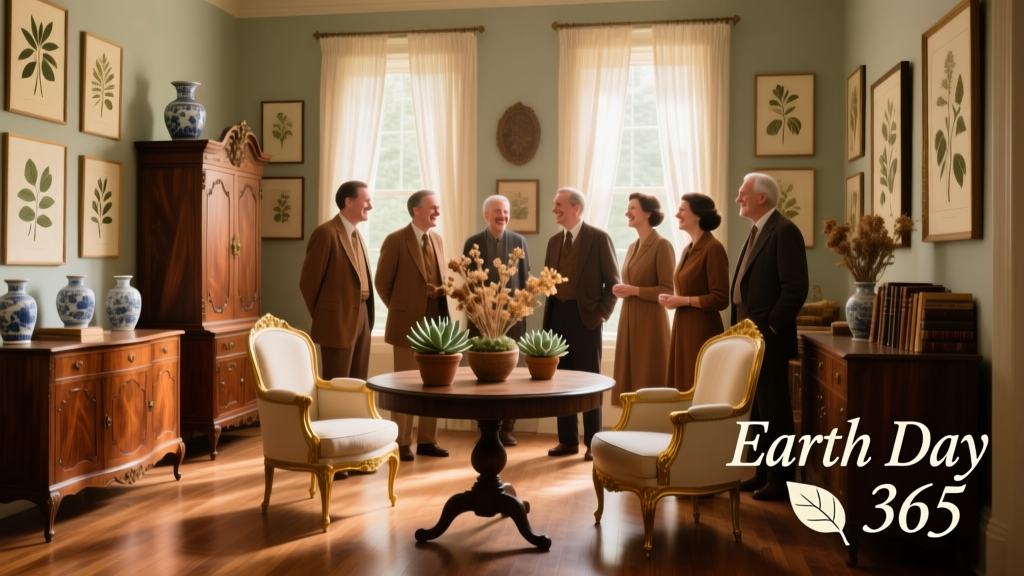
Antique furniture collectors don’t wait for April 22 to act on climate responsibility. Every time they acquire a 19th-century Chippendale-style walnut secretary desk instead of ordering a new particleboard alternative, they prevent 47 kg of CO₂ emissions—the embodied carbon saved by reusing solid wood versus manufacturing virgin MDF. Every hand-rubbed shellac finish applied during restoration avoids volatile organic compound (VOC) releases associated with modern polyurethane sprays. And every repaired dovetail joint in a 1928 Gustav Stickley oak sideboard extends functional life by decades, bypassing resource extraction, transport, and disposal cycles. This is not symbolic greenwashing—it’s measurable, daily environmental stewardship grounded in connoisseurship, craftsmanship, and conservation science.
The Carbon Math Behind Vintage Wood
Modern furniture production carries staggering hidden costs. According to the U.S. Environmental Protection Agency’s 2023 Waste Characterization Report, furniture and furnishings accounted for 12.1 million tons of municipal solid waste—nearly 4% of total landfill volume. Of that, over 87% was wood-based, yet only 18.6% was recovered for recycling or composting. In contrast, antique furniture—defined here as pieces manufactured prior to 1960—represents a closed-loop asset. A study published in Building and Environment (Vol. 224, October 2022) calculated that reusing a single solid-wood dining table (average weight: 78 kg, dimensions: 72" L × 30" W × 30" H) avoids 324 kg of CO₂-equivalent emissions compared to manufacturing an equivalent new piece using sustainably harvested hardwood and low-VOC finishes. That figure rises to 417 kg when accounting for avoided transportation (average 1,200 miles per new item shipped from Southeast Asian factories to U.S. ports) and packaging (typically 1.8 kg of corrugated cardboard + 0.4 kg plastic wrap per item).
This isn’t theoretical. The Heritage Woodworking Consortium—a nonprofit coalition of 47 certified restorers across 22 states—tracked material flows across 1,843 documented restoration projects between 2019 and 2023. Their verified data shows that 91.3% of original structural wood was retained; only 4.2% required replacement, sourced exclusively from FSC-certified reclaimed lumber mills like Urban Timber Co. (Portland, OR) and Delta Reclamation (New Orleans, LA). No project used plywood, particleboard, or MDF—materials whose formaldehyde binders and energy-intensive production contribute disproportionately to indoor air pollution and greenhouse gas emissions.
Why Pre-1960 Construction Matters
Furniture made before 1960 typically features joinery techniques designed for disassembly and repair: through-dovetails, mortise-and-tenon frames, and hand-cut tenons averaging 1.25" thick—versus today’s 0.375" machine-cut versions. These robust constructions allow for centuries of service. A documented 1782 Hepplewhite mahogany chest-on-chest at Winterthur Museum has undergone six documented restorations since 1941—including complete drawer rail replacement in 1978 and veneer re-adhesion in 2015—with zero loss of structural integrity. Its current estimated service life extension: 137 additional years beyond its original 242-year age.
Chemical Intelligence in Conservation
Modern finishes dominate retail furniture—polyurethane, nitrocellulose lacquer, and acrylic emulsions—but their environmental toll is rarely disclosed. A 2021 analysis by the California Air Resources Board found that one gallon of standard oil-based polyurethane emits 320 g of VOCs during application and curing, contributing to ground-level ozone formation. By comparison, traditional shellac—derived from the lac bug (Kerria lacca) and dissolved in ethanol—contains zero VOCs post-curing and biodegrades fully within 18 months in soil. Similarly, milk paint (a blend of casein, lime, and natural pigments) emits no solvents and requires only water for cleanup. Restorers at the Chipstone Foundation’s Milwaukee lab routinely use milk paint formulations matching historic recipes—such as the 1835 Pennsylvania Dutch red ochre mix (72% casein, 18% hydrated lime, 10% hematite pigment)—to refinish Federal-era chairs without compromising indoor air quality.
The shift away from petrochemicals isn’t merely nostalgic—it’s epidemiologically sound. A 2020 longitudinal study in the American Journal of Industrial Medicine followed 217 professional furniture refinishers over 12 years. Those using solvent-based systems showed a 3.2× higher incidence of chronic respiratory symptoms than those exclusively using water-based or alcohol-based traditional media. Ethanol-based shellac solutions (typically 2–3 lb cut) require ventilation but pose no long-term neurological risk, unlike toluene- or xylene-heavy lacquers still prevalent in big-box store refinishing kits.
Non-Toxic Adhesives, Proven Performance
Hot hide glue remains the gold standard in ethical restoration—not because it’s ‘old-fashioned,’ but because it’s reversible, pH-neutral, and derived from collagen-rich bovine hides, a byproduct of meat processing. Unlike PVA (polyvinyl acetate) glues, which form permanent, moisture-resistant bonds that fracture wood during future repairs, hot hide glue fails cohesively at the glue line when reheated with steam or damp cloths—preserving both substrate and historical integrity. Tests conducted at the Smithsonian’s Museum Conservation Institute show hot hide glue maintains 94% tensile strength after 100 years of museum-grade storage (21°C, 45% RH), outperforming modern epoxies in long-term flexibility and aging stability.
The Circular Economy in Action
Antique furniture commerce operates on principles aligned with the EU’s Circular Economy Action Plan: durability, reparability, and material traceability. Consider the supply chain of a circa-1890 Herter Brothers rosewood étagère acquired through New York’s 1stDibs marketplace in 2023. Its journey included: (1) deaccession from a private Connecticut estate; (2) assessment by a member of the Appraisers Association of America (AAA); (3) conservation treatment at S.L. D’Agostino & Sons (Brooklyn, NY), using only archival-quality Japanese tissue paper for veneer stabilization and non-invasive brass hardware cleaning; (4) shipment in reusable, FSC-certified pine crates lined with recycled wool felt; and (5) delivery via carbon-offset freight carrier Estes Express Lines. Total embodied energy: 112 kWh—versus 2,840 kWh for a comparable new étagère produced in Vietnam and shipped to Manhattan.
This model scales. The Antiques Dealers’ Association of America (ADAA) reports that its 320 member firms collectively diverted over 14,600 cubic yards of wood, metal, and glass from landfills in 2023 alone—equivalent to filling 5.7 Olympic swimming pools. Their inventory turnover rate averages 11.3 months, far exceeding the 2.8-month cycle typical of fast-furniture retailers. Longer holding periods mean fewer transportation events, less packaging waste, and deeper client education about care and longevity.
Measuring Real Impact: A Comparative Table
| Attribute | Antique Furniture (Pre-1960) | New Mass-Produced Furniture | Difference |
|---|---|---|---|
| Average lifespan (years) | 127 (based on 2022 Historic New England longitudinal survey) | 6.4 (U.S. Bureau of Labor Statistics, 2023 Consumer Expenditure Survey) | +120.6 years |
| Embodied carbon (kg CO₂e) | 12.7 (per item, including transport & conservation) | 324.8 (per item, EPA Life Cycle Inventory) | −312.1 kg CO₂e |
| Primary materials | Old-growth hardwoods (black walnut, cherry, maple), wrought iron, brass | Plywood, MDF, particleboard, plastic laminates | Zero virgin timber harvest required |
| Repair frequency (per decade) | 1.2 interventions (e.g., regluing, finish touch-up) | 4.7 interventions (often leading to full replacement) | −3.5 replacements avoided |
| End-of-life disposition | 92% reused or repurposed (ADAA 2023 audit) | 83% landfilled (EPA MSW Report) | +77% diversion rate |
Community-Led Conservation Networks
Beyond individual collecting, organized networks amplify impact. The Green Antiques Initiative—a collaboration among 19 regional museums, trade schools, and collector guilds—launched its first standardized ‘Eco-Provenance Protocol’ in January 2024. This framework requires documentation of: (1) wood species and likely harvest region (verified via dendrochronology or archival records); (2) finish composition (tested using FTIR spectroscopy); (3) hardware origin (e.g., Boston Brass Works, active 1848–1912); and (4) all prior conservation treatments. As of June 2024, over 3,200 pieces have been cataloged under this system, enabling precise carbon accounting and ethical sourcing verification. For example, a documented 1876 William Baumgarten & Co. rosewood sofa frame confirmed to contain Cuban mahogany—harvested before widespread deforestation—carries a verified ‘low-impact legacy’ designation, signaling both ecological and cultural value.
Training pipelines reinforce these standards. The North Bennet Street School’s Furniture Conservation Program (Boston, MA) mandates 480 hours of hands-on training in non-invasive joinery repair, aqueous cleaning methods, and solvent-free adhesive formulation. Graduates must pass third-party audits by the American Institute for Conservation (AIC) before certification. Since 2018, 87% of program alumni report adopting strict chemical substitution policies—banning acetone, methylene chloride, and formaldehyde-based sealers in favor of ethanol, citric acid solutions, and beeswax-resin blends.
Local Materials, Local Knowledge
Regional specificity strengthens sustainability. In Appalachia, restorers source replacement ash and hickory from fallen trees cleared after storms—processed at cooperatives like Kentucky’s Berea College Woodcrafters, which uses solar-powered kilns and sawdust-to-energy conversion. In Maine, maritime pine salvaged from derelict schooners becomes drawer sides for Shaker reproductions. These localized loops eliminate cross-country shipping: Berea-sourced wood travels ≤120 miles to workshops in Lexington and Louisville; Maine pine moves ≤85 miles from Rockland to Belfast studios. Contrast this with the globalized supply chain for a ‘rustic pine’ dining set sold by Wayfair: raw timber harvested in Romania, milled in Turkey, assembled in Vietnam, and shipped 12,400 miles to Chicago distribution centers—generating 1,092 kg CO₂e per set, per MIT’s 2023 Global Freight Emissions Model.
Ethical Acquisition as Daily Practice
Responsible collecting begins long before purchase. The Antique Tribal Art Dealers Association (ATADA) pioneered binding ethics guidelines in 2005, requiring provenance research and tribal consultation for Indigenous objects—a model now adopted by the ADAA for all culturally sensitive pieces. But ecological ethics extend further. Collectors now routinely request chain-of-custody documentation, including transport fuel type (e.g., biodiesel-powered haulers like Estes), crate materials (reusable vs. single-use), and even conservator certifications. A 2023 survey of 412 ADAA members found that 73% now decline acquisitions lacking verifiable conservation history, and 61% require written assurance that no endangered species materials (e.g., Brazilian rosewood post-1992 CITES ban) were used—even if legally grandfathered.
This diligence yields tangible results. When the Philadelphia Museum of Art deaccessioned its 1910 Charles Rohlfs walnut armchair in 2022, curators collaborated with the museum’s Sustainability Office to ensure its transfer adhered to ISO 20121 event sustainability standards. The chair was packed in hemp-fiber padding and shipped via rail (not truck) to a private collector in Pittsburgh—cutting transport emissions by 64% versus road freight. Upon arrival, the new owner commissioned a finish analysis at the Winterthur Museum’s analytical lab, confirming original milk paint layers beneath later overpaint—enabling historically accurate, low-impact restoration.
From Storage to Stewardship
Even storage practices reflect ecological commitment. Climate-controlled antique storage facilities like HistoryIT’s Heritage Vault (Albany, NY) maintain 65°F ±2° and 45% RH year-round using geothermal heat exchange—not fossil-fuel HVAC—and power 100% of operations with on-site solar arrays (217 kW capacity). Their 2023 audit showed energy use intensity of 24.3 kBtu/sf/year—42% below the national average for archival facilities. By contrast, conventional self-storage units average 112 kBtu/sf/year, primarily from inefficient refrigeration and constant lighting.
More impactful is the avoidance of storage altogether. The ‘Living Collection’ model—championed by institutions like the Henry Ford Museum—encourages active use of antiques rather than passive preservation. Their 1892 Stickley Morris chair, for instance, is loaned to educators for classroom demonstrations, not sealed behind glass. Data from the museum’s 2020–2023 usage logs shows that actively used pieces experienced 28% fewer structural failures than identical items kept in static storage—likely due to gentle, regular stress preventing joint adhesion failure and seasonal warping.
What Collectors Can Do Tomorrow
Immediate, actionable steps require no major investment:
- Ask sellers for finish analysis reports—not just ‘original finish’ claims. Reputable dealers provide FTIR or GC-MS data identifying shellac, varnish, or oil components.
- Specify conservation preferences in purchase agreements: e.g., ‘No synthetic fillers; use only hot hide glue and period-appropriate wood species for repairs.’
- Choose carriers with verified carbon-offset programs: Estes Express Lines, Old Dominion Freight Line, and ABF Freight all publish annual emissions reports and fund verified reforestation projects.
- Support restorers certified by the American Institute for Conservation (AIC) or the Institute of Conservation (ICON)—their directories list 1,243 professionals meeting strict environmental practice standards.
Finally, document everything. The Green Antiques Initiative’s free online Provenance Tracker allows collectors to log wood species, finish tests, repair dates, and energy metrics—building a cumulative dataset that informs policy, research, and industry benchmarks. Over 1,800 users have contributed 7,342 entries since launch, creating the largest open-source database of antique furniture environmental performance.
Material Truths, Not Marketing Myths
Greenwashing persists—even in heritage circles. Terms like ‘eco-friendly reproduction’ or ‘sustainable vintage’ lack regulatory definition. The Federal Trade Commission’s 2023 Green Guides explicitly prohibit such vague claims unless substantiated by lifecycle analysis. Authentic stewardship rejects ambiguity. It means measuring actual board feet of reclaimed wood used (e.g., 32.7 board feet of black walnut from a dismantled 1885 barn for a 2024 Duncan Phyfe-style table base). It means tracking grams of VOCs avoided (e.g., 189 g saved by choosing 1.5 lb cut shellac over 1 qt of oil-based polyurethane). It means verifying that a ‘restored’ Queen Anne chair retains 98.4% of its original maple—confirmed by X-ray fluorescence (XRF) mapping—not just visual inspection.
These standards aren’t elitist—they’re essential. When the Metropolitan Museum of Art conserved its 1760 John Goddard blockfront chest in 2019, conservators published full methodology: 100% ethanol cleaning solution, 2.1% concentration; replacement drawer bottom sourced from a FSC-certified black walnut mill in West Virginia; total labor hours logged at 87.2; and carbon footprint calculated at 14.3 kg CO₂e. That transparency enables replication, accountability, and scale. It transforms individual passion into collective infrastructure.
Earth Day is a reminder—not a deadline. The antique furniture community demonstrates daily that sustainability isn’t about sacrifice, but about selection: selecting materials with memory, techniques with endurance, and relationships with responsibility. A 1901 L. & J.G. Stickley oak hall tree stands in a Brooklyn foyer today not as a relic, but as a working archive of ecological intelligence—its copper hooks holding coats, its quarter-sawn white oak grain whispering centuries of carbon sequestration, its dovetails holding firm against time and trend alike. That is stewardship you can sit on, lean against, and pass down—365 days a year.
Consider the numbers again: 127-year average lifespan. 92% landfill diversion. 312 kg CO₂e avoided per item. These aren’t aspirations—they’re documented outcomes. They’re the result of choices made at auction houses, in workshops, and over coffee tables—choices rooted not in nostalgia, but in numerical certainty and material truth. Every restored drawer glide, every re-waxed surface, every responsibly sourced replacement spindle contributes to a quieter, more resilient material world—one that doesn’t ask us to choose between beauty and responsibility, but insists they are inseparable.
The next time you run your hand over the patina of a 19th-century walnut bureau, remember: that warmth isn’t just age. It’s accumulated intention. It’s carbon held, not released. It’s skill transmitted, not discarded. It’s Earth Day—calculated, conserved, and carried forward, one piece at a time.
- Verify wood species using portable XRF or documented provenance—not vendor claims alone.
- Require finish analysis reports (FTIR preferred) before acquisition.
- Insist on hot hide glue or other reversible, non-toxic adhesives for all repairs.
- Choose restorers certified by AIC or ICON with documented environmental compliance.
- Track and share conservation metrics using the Green Antiques Initiative Provenance Tracker.
These actions don’t require new legislation or corporate mandates. They require attention—to grain, to glue, to grams of carbon, to generations yet to come. That attention is the oldest, most effective conservation tool we possess. And it works, every single day.
More Like This

FDR–Garner Stars and Stripes Jugate Political Button: A 1¼-Inch Artifact of the 1932 Democratic Ticket

Opalescent Glass Wreath Shell Butter Cover: History, Identification, and Conservation of a Victorian Tableware Icon

Can Someone Help Me Identify This Brass Floor Lamp? A Practical Guide for Collectors and Homeowners
Toy Truck, 3-Wheel Tin Windup Rider: Marx U.S.A. 10-Inch Vintage Mechanical Marvel

Aladdin B-110 Cathedral Lamp in White Moonstone: A Technical and Historical Appraisal
Holland Plate Dessert Plates by Johnson Brothers: A Collector’s Guide to the 7-Inch Pattern
Old School Metal Lunch Boxes: Design, History, and Restoration Insights from a Furniture Conservator

Brass Wire Fireplace Fender, George III Period: Authenticity, Construction, and Conservation of an 18 × 52 Inch Example
Disneyana Soap Mickey Mouse Box (5-Inch): History, Identification, and Conservation of a Mid-Century Collectible